Within Haiti
Could Poison Really Create a Haitian Zombie?
The claim that pufferfish toxin could create living zombies offered a natural explanation, but laboratory findings and identity tests weakened it.
On this page
- Clairvius Narcisse and the resurrection claim
- Tetrodotoxin, burial and the Wade Davis theory
- Toxicology, DNA testing and alternative explanations
Page outline Jump by section
Introduction
Could poison really create a Haitian zombie? For a time, many scientists and journalists thought the answer might be yes. In the 1980s, a widely publicised theory proposed that certain Haitian “zombies” were not supernatural beings but victims of poisoning. According to this idea, a powerful toxin could place a person into a deathlike state, allowing them to be declared dead, buried and later recovered. The theory offered a dramatic natural explanation for one of Haiti’s most famous mysteries and attracted worldwide attention through books, films and magazine features. Yet the same theory also became one of the most criticised scientific claims associated with Haitian zombie stories. Subsequent toxicological studies, laboratory analyses and identity investigations raised serious doubts about whether the proposed poison could work as described. Today, the debate is remembered as a revealing case study in the tension between folklore, field research, media excitement and scientific scrutiny.[Wikipedia]WikipediaClairvius NarcisseClairvius Narcisse

Clairvius Narcisse and the Resurrection Claim
The central figure in the poisoned-zombie theory was Clairvius Narcisse, a Haitian man who reportedly died in 1962 after being treated at the Albert Schweitzer Hospital in Deschapelles. Medical staff declared him dead, and he was supposedly buried by his family. Nearly two decades later, a man appeared claiming to be Narcisse. He recognised relatives, recounted family disputes and told a remarkable story: he said he had remained conscious after being pronounced dead, had been buried, and was later removed from his grave and forced to work on a plantation with other “zombies”.[Wikipedia]WikipediaClairvius NarcisseClairvius Narcisse
The case attracted particular attention because it seemed more substantial than many earlier zombie tales. Haitian psychiatrist Lamarque Douyon investigated reports of alleged zombies and found that many could be explained by mental illness, epilepsy, alcoholism or mistaken identification. Narcisse’s case, however, appeared harder to dismiss because there were hospital records documenting his reported death.[Time]time.commedicine zombies do they existMedicine: Zombies: Do They Exist?Oct 16, 1983 — The case of Clairvius Narcisse, however, gave Douyon good evidence. Medical records s…
For researchers searching for a natural explanation, Narcisse became the most important test case. If his story could be explained scientifically, perhaps Haitian zombie traditions reflected real experiences that had later been interpreted through local beliefs about death and sorcery.
Tetrodotoxin, Burial and the Wade Davis Theory
The best-known attempt to explain zombification came from Harvard ethnobotanist Wade Davis. After travelling in Haiti and collecting samples of powders said to be used by sorcerers, Davis argued that a chemical process might account for some zombie reports. His theory centred on tetrodotoxin, a powerful neurotoxin associated with pufferfish. Tetrodotoxin can cause paralysis and dramatically slow bodily functions while leaving consciousness partially intact in some cases.[Wikipedia]WikipediaClairvius NarcisseClairvius Narcisse
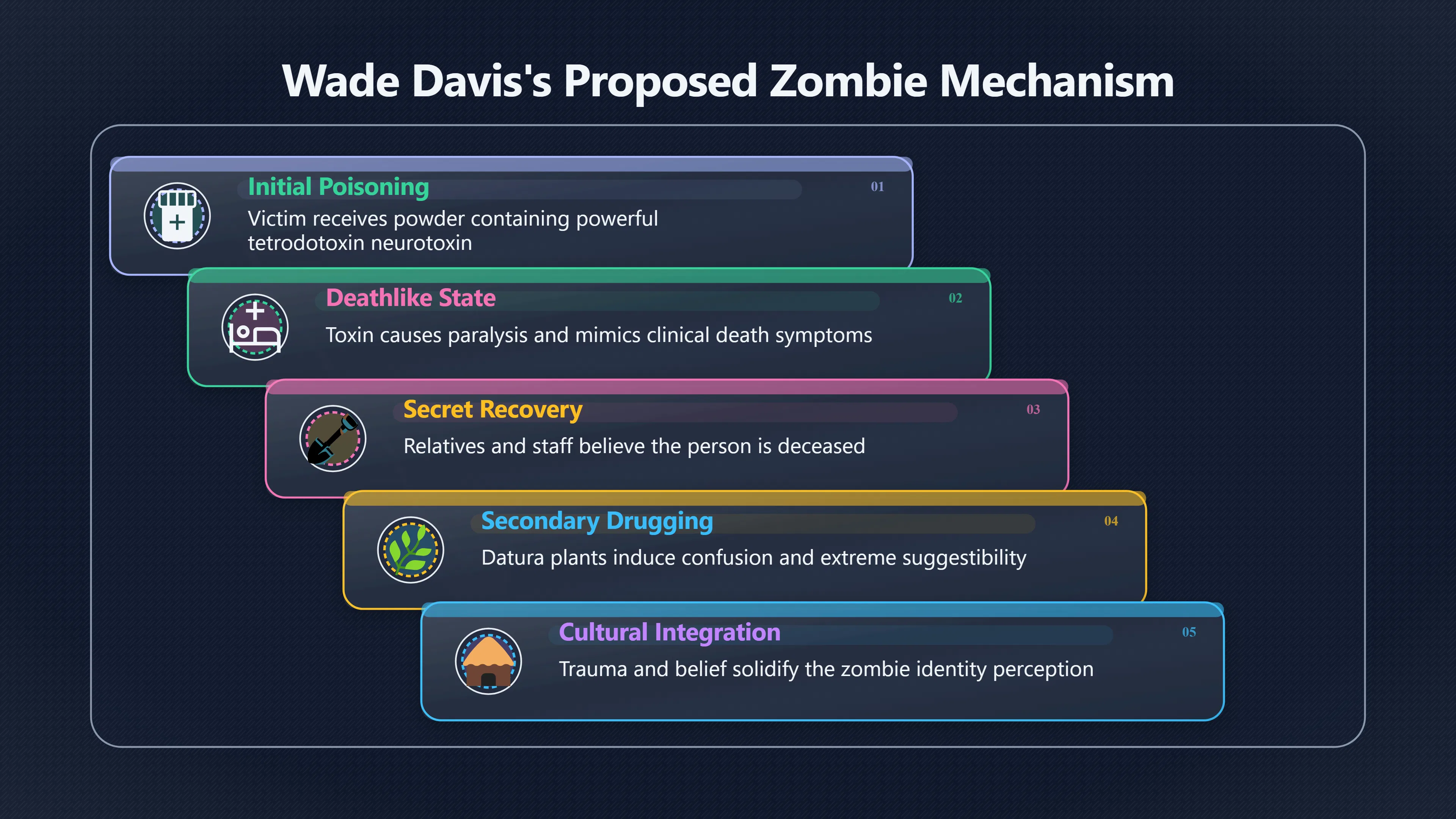
Davis proposed a two-stage process. First, a victim would receive a poison containing tetrodotoxin and other ingredients. The toxin would supposedly create a state so close to death that relatives and even medical personnel might believe the person had died. After burial, the victim would be secretly recovered. A second set of drugs, particularly substances derived from Datura plants, would then produce confusion, memory problems and suggestibility. According to Davis, the combination of poisoning, oxygen deprivation, trauma and powerful cultural beliefs about zombies could leave a person convinced that they had literally returned from the dead.[Wikipedia]WikipediaClairvius NarcisseClairvius Narcisse
The theory was attractive for several reasons:
- It appeared to bridge folklore and science rather than dismissing either.
- Tetrodotoxin was a real, medically documented poison.
- Cases such as Narcisse’s seemed to provide apparent examples.
- The explanation fit popular fascination with hidden pharmacological knowledge and exotic mysteries.[Wikipedia]WikipediaClairvius NarcisseClairvius Narcisse
The idea became internationally famous through Davis’s books The Serpent and the Rainbow and Passage of Darkness, helping transform the Haitian zombie from a folkloric figure into a subject of scientific debate.[Wikipedia]WikipediaThe Serpent and the Rainbow (bookThe Serpent and the Rainbow (book
Why Toxicologists Challenged the Theory
The strongest criticism came not from sceptics of Haitian culture but from toxicologists examining the chemistry itself.
When independent researchers analysed samples of purported zombie powders, the results did not consistently support Davis’s claims. The key issue was tetrodotoxin. If the poison theory were correct, measurable quantities of the toxin should have appeared regularly in the samples. Instead, later analyses often found little or none. Toxicologists Chen-Yuan Kao and Toshio Yasumoto concluded that the popular claim linking tetrodotoxin to zombification lacked factual support.[Wikipedia]WikipediaClairvius NarcisseClairvius Narcisse
Critics also pointed to biological difficulties. Tetrodotoxin poisoning can indeed cause paralysis, numbness and respiratory failure, but its effects do not neatly match the long-term zombie condition described in folklore. The difference between a non-lethal dose and a fatal dose is extremely small. A victim given enough toxin to mimic death would face a significant risk of actually dying. Critics argued that reliably producing apparent death and later recovery would be extraordinarily difficult.[Wikipedia]WikipediaClairvius NarcisseClairvius Narcisse
Another problem involved consistency. Davis collected different powders from different sources, and their ingredients varied considerably. Critics argued that a mechanism dependent on a precise toxin should not rely on mixtures whose contents changed from sample to sample.[Wikipedia]WikipediaClairvius NarcisseClairvius Narcisse
By the early 1990s, the tetrodotoxin explanation had largely disappeared from mainstream toxicological literature. Although debate continued in popular culture, scientific support for the specific poisoning mechanism remained weak.[Wikipedia]WikipediaClairvius NarcisseClairvius Narcisse
DNA Testing and Questions of Identity
A second line of criticism focused on identity rather than chemistry.
Even if some people were wrongly declared dead, critics asked whether all alleged zombie cases involved the same individuals returning from the grave. Investigations of certain claimed zombies found evidence of mistaken identity, mental illness or social confusion rather than resurrection. Researchers studying Haitian zombie reports discovered that some supposed zombies were living people with psychiatric disorders who had been identified as deceased relatives by communities already familiar with zombie beliefs.[Time]time.commedicine zombies do they existMedicine: Zombies: Do They Exist?Oct 16, 1983 — The case of Clairvius Narcisse, however, gave Douyon good evidence. Medical records s…
Later examinations of famous cases also introduced genetic and identity-testing questions. Although such work did not necessarily disprove every claim, it weakened assumptions that every reported zombie represented a verified return of a specific dead individual. The broader lesson was that eyewitness certainty and community recognition were not always as reliable as they initially appeared.
This mattered because the poisoned-zombie theory depended on authentic cases of apparent death and return. If some celebrated examples could be explained by misidentification or illness, the need for an elaborate poisoning mechanism became less compelling.
Alternative Explanations Beyond the Poison Theory
As confidence in the tetrodotoxin explanation declined, researchers explored other possibilities.
Some scholars suggested that the most important factor was not poison but social belief. In communities where zombification is culturally understood and feared, people may interpret unusual behaviour through that framework. A person suffering from mental illness, neurological damage, trauma or severe social marginalisation might be labelled a zombie without any poisoning taking place.[Time]time.commedicine zombies do they existMedicine: Zombies: Do They Exist?Oct 16, 1983 — The case of Clairvius Narcisse, however, gave Douyon good evidence. Medical records s…
Others proposed that different cases may have different causes. Rather than one secret formula producing all zombies, reports could emerge from a mixture of factors:
- Severe psychiatric illness.
- Neurological disorders.
- Memory impairment.
- Social punishment and ostracism.
- Misidentification of vulnerable individuals.
- Occasional poisoning episodes unrelated to a universal zombie recipe.[Time]time.commedicine zombies do they existMedicine: Zombies: Do They Exist?Oct 16, 1983 — The case of Clairvius Narcisse, however, gave Douyon good evidence. Medical records s…
Under this view, the search for a single “zombie toxin” may have oversimplified a complex social and cultural phenomenon.

What Zombie Science reveals about belief and deception
The poisoned-zombie theory survives because it occupies a fascinating middle ground between folklore and science. Unlike supernatural explanations, it offered a mechanism that sounded testable. Unlike a simple dismissal of zombie stories, it treated Haitian accounts seriously enough to investigate them. That combination made it attractive to journalists, filmmakers and readers looking for a real-world mystery.[harpers.org]harpers.orgThe Pharmacology of Zombies, by Wade DavisScientific interest in the zombie poison was rekindled recently by reported cases of zombies un…
Yet the history of the theory is also a cautionary tale. A compelling explanation can spread quickly when it appears to solve a famous mystery, even if the supporting evidence remains incomplete. The case of Clairvius Narcisse, the search for tetrodotoxin and the subsequent scientific criticisms illustrate how extraordinary claims are tested, challenged and sometimes weakened by later evidence.
For historians of Haiti’s famous contested stories, the poisoned-zombie theory remains important not because it definitively solved the zombie mystery, but because it showed how scientific investigation, media fascination and local belief became intertwined around one of the most enduring legends in the modern world.[wikipedia.org]WikipediaClairvius NarcisseClairvius Narcisse
Amazon book picks
Further Reading
Books and field guides related to Could Poison Really Create a Haitian Zombie?. Use these as the next step if you want deeper reading beyond the article.
The Serpent and the Rainbow
Introduced the toxin-based explanation to a global audience.
Passage of Darkness
Expands the scientific and ethnographic claims behind the zombie debate.
The Magic Island
Shows the earlier media environment that made zombie claims compelling.
Bad Science
Useful for understanding how sensational scientific claims are evaluated and challenged.
eBay marketplace picks
Marketplace Samples
Live-tested eBay searches with available results related to this page.
Endnotes
1.
Source: Wikipedia
Title: Clairvius Narcisse
Link:https://en.wikipedia.org/wiki/Clairvius_Narcisse
2.
Source: harpers.org
Link:https://harpers.org/archive/1984/04/the-pharmacology-of-zombies/
Source snippet
The Pharmacology of Zombies, by Wade DavisScientific interest in the zombie poison was rekindled recently by reported cases of zombies un...
3.
Source: time.com
Title: medicine zombies do they exist
Link:https://time.com/archive/6697896/medicine-zombies-do-they-exist/
Source snippet
Medicine: Zombies: Do They Exist?Oct 16, 1983 — The case of Clairvius Narcisse, however, gave Douyon good evidence. Medical records s...
4.
Source: Wikipedia
Link:https://en.wikipedia.org/wiki/Zombie
5.
Source: Wikipedia
Title: The Serpent and the Rainbow (book)
Link:https://en.wikipedia.org/wiki/The_Serpent_and_the_Rainbow_%28book%29
6.
Source: pmc.ncbi.nlm.nih.gov
Link:https://pmc.ncbi.nlm.nih.gov/articles/PMC3184504/
Source snippet
Revisiting the Ethnobiology of the Zombie Poison - PMCby UP Albuquerque · 2011 · Cited by 37 — We must look more closely at this supposed...
7.
Source: Wikipedia
Title: Dwyane Wade
Link:https://en.wikipedia.org/wiki/Dwyane_Wade
8.
Source: pubmed.ncbi.nlm.nih.gov
Link:https://pubmed.ncbi.nlm.nih.gov/39093422/
9.
Source: journals.ed.ac.uk
Link:https://journals.ed.ac.uk/script-ed/article/view/11315
Source snippet
The Zombie from Myth to Reality: Wade Davis, Academic...by D Inglis · 2010 · Cited by 13 — But the figure of the zombie was not always s...
10.
Source: skeptoid.com
Link:https://skeptoid.com/episodes/262
11.
Source: science.howstuffworks.com
Link:https://science.howstuffworks.com/science-vs-myth/strange-creatures/zombie.htm
12.
Source: fromtheparapet.wordpress.com
Title: clairvius narcisse
Link:https://fromtheparapet.wordpress.com/tag/clairvius-narcisse/
13.
Source: zombie.fandom.com
Title: Clairvius Narcisse
Link:https://zombie.fandom.com/wiki/Clairvius_Narcisse
Additional References
14.
Source: researchgate.net
Link:https://www.researchgate.net/publication/351618659_THE_ZOMBIE_TOXIN_The_Debate_Surrounding_the_Toxicology_of_Wade_Davis%27_Research
Source snippet
What we do know is that two people, Clairvius Narcisse and Francina Illeus...Read more...
15.
Source: youtube.com
Title: Zombies, Sorcery, and Secret Societies! (Haitian Zombies)
Link:https://www.youtube.com/watch?v=Mlt7TNOstb0
Source snippet
Interview with a Zombie - Voodo and black magic, the truth behind the Haitian legend...
16.
Source: youtube.com
Title: Interview with a Zombie
Link:https://www.youtube.com/watch?v=T_kHGb-zbJ0
Source snippet
Zombies! (Real, Haitian Zombies!) - Jimmy Akin's Mysterious World...
17.
Source: youtube.com
Title: Zombies! (Real, Haitian Zombies!)
Link:https://www.youtube.com/watch?v=gReI25riPsw
Source snippet
Maya Annik Bedward 'Black Zombie' & Haiti's History | SXSW 2026...
18.
Source: harvardmagazine.com
Title: are zombies real
Link:https://www.harvardmagazine.com/faculty-community/are-zombies-real
Source snippet
Harvard MagazineThe Secrets of Haiti's Living Dead31 Oct 2017 — Most Haitians believe in zombies, and Narcisse's claim is not unique...
19.
Source: youtube.com
Link:https://www.youtube.com/watch?v=tSXahgLKkoc
Source snippet
Zombies, Sorcery, and Secret Societies! (Haitian Zombies) - Jimmy Akin's Mysterious World...
20.
Source: reddit.com
Link:https://www.reddit.com/r/todayilearned/comments/11huxj/til_a_haitian_man_was_declared_dead_by_2/
21.
Source: cambridge.org
Link:https://www.cambridge.org/core/books/science-of-the-supernatural/call-is-coming-from-inside-the-house/0FDF748809B446234F81860D198A8D99/core-reader
22.
Source: medium.com
Link:https://medium.com/tftunderworld/the-strange-tale-of-clairvius-narcisse-haitis-vodou-zombie-8722ac71f30c
23.
Source: merriam-webster.com
Link:https://www.merriam-webster.com/dictionary/wade
Topic Tree