Within Fiji Hoaxes
How Did Cannibal Fiji Become a Brand?
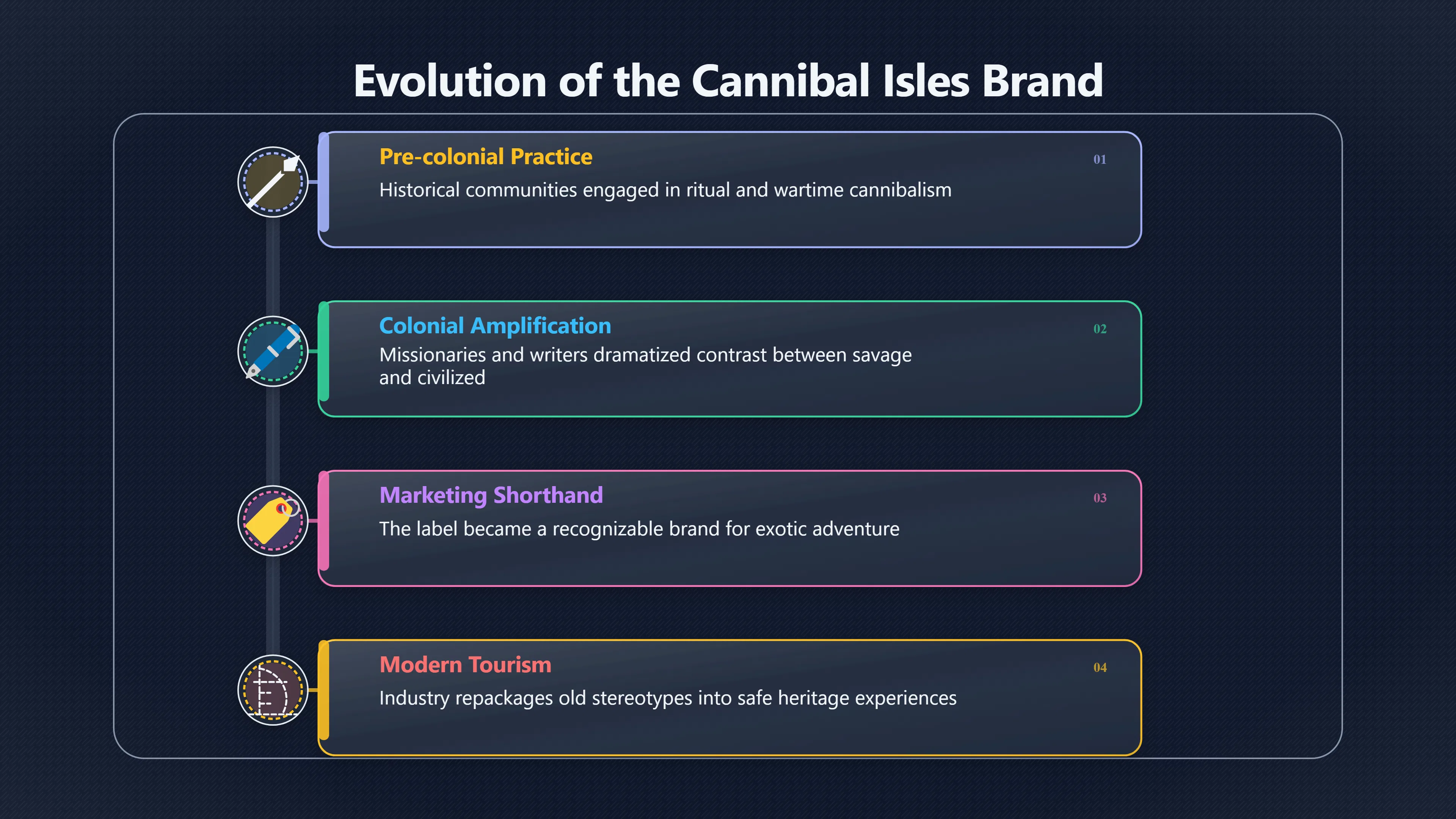
Real practices were exaggerated into a national stereotype that reshaped stories, ceremonies and souvenir objects.
On this page
- Fact, exaggeration and the Cannibal Isles image
- Thomas Baker and the simplified taboo story
- Tourism, reconciliation and repeated spectacle
Page outline Jump by section
Introduction
The image of Fiji as the “Cannibal Isles” did not begin as a tourist slogan. It grew from a real historical practice that existed in some parts of pre-colonial Fiji, but it was amplified by missionaries, colonial writers, travellers and later tourism promoters until it became one of the country’s most recognisable international brands. The result was a striking mixture of fact and exaggeration: a complex society was reduced to a single dramatic image that proved commercially useful long after cannibalism had disappeared. Rather than inventing a complete hoax, promoters repeatedly simplified history, turning selected stories, artefacts and rituals into spectacles that visitors could consume. The enduring power of the stereotype shows how a partial truth can become almost as misleading as a fabrication when it is detached from context.[ResearchGate]researchgate.netResearch Gate(PDF) Social construction of touristic imagery: Case of fijicannibalism, violence and hostility), collectively consti-. tuted imagery… of war dances and souvenir cannibal forks and war clubs; bu…

Fact, Exaggeration and the “Cannibal Isles” Image
Cannibalism in Fiji was real. Historical accounts, oral traditions and surviving artefacts leave little doubt that some communities practised forms of ritual and wartime cannibalism before the nineteenth century. Specialised objects associated with these practices, including wooden flesh forks used by high-status individuals, survive in museums in Fiji and overseas.[museum.ie]museum.ie· Where does it come from? · Who were cannibals' forks used by? · Why did people participate in cannibalism? · How did this…Read more…
The distortion emerged when outsiders transformed a regional and historical practice into a defining national characteristic. Nineteenth-century missionary reports and travel literature often highlighted cannibalism because it dramatised the contrast between “savage” and “civilised” societies that colonial audiences expected to see. Fiji became famous in European and American imagination less for its political systems, navigation traditions or artistic achievements than for lurid stories of cannibal feasts. The label “Cannibal Isles” became a marketing shorthand for danger, exoticism and adventure.[ResearchGate]researchgate.netResearch Gate(PDF) Social construction of touristic imagery: Case of fijicannibalism, violence and hostility), collectively consti-. tuted imagery… of war dances and souvenir cannibal forks and war clubs; bu…
This stereotype proved remarkably adaptable. Once established, it could be attached to almost any Fijian object or story. Ceremonial clubs, forks and carvings were routinely described through the lens of cannibalism even when their original cultural significance was broader. The attraction was obvious: dramatic stories sold books, museum displays and later tourist experiences more effectively than nuanced explanations.[ResearchGate]researchgate.netResearch Gate(PDF) Social construction of touristic imagery: Case of fijicannibalism, violence and hostility), collectively consti-. tuted imagery… of war dances and souvenir cannibal forks and war clubs; bu…
In this sense, “Cannibal Fiji” resembles many famous national legends. The underlying facts were genuine, but repeated retelling exaggerated their scale and importance until they became the dominant way outsiders imagined an entire country.
Thomas Baker and the Simplified Taboo Story
No single story did more to reinforce Fiji’s cannibal reputation than the death of the Methodist missionary Thomas Baker in 1867. Baker and several Fijian companions were killed and their bodies consumed in the highlands of Viti Levu. The event became one of the most frequently repeated episodes in Fijian colonial history.[Wikipedia]WikipediaThomas Baker (missionaryThomas Baker (missionary
The popular version often reduces the incident to a simple lesson: Baker touched a chief’s head, violated a taboo and was therefore killed and eaten. There is truth in that explanation, but historians have noted that frontier encounters between missionaries and local leaders involved wider tensions over authority, conversion, prestige and cultural change. The head-touching story survived because it was memorable and easy to repeat, not because it captured every aspect of the conflict.[Wikipedia]WikipediaThomas Baker (missionaryThomas Baker (missionary
For tourism and popular culture, the simplified version had advantages. It provided:
- A dramatic personal story.
- A clear moral lesson about cultural misunderstanding.
- A tangible destination linked to a famous event.
- Physical relics, including Baker-related objects displayed in museums.[Wikipedia]WikipediaThomas Baker (missionaryThomas Baker (missionary
Over time the story became less about nineteenth-century Fiji and more about reinforcing a broader image of the islands as a place with a dramatic cannibal past. It functioned almost like a national legend, repeated in guidebooks, travel articles and heritage tours long after the original historical context faded from public memory.[Culture Trip]theculturetrip.coma brief history of cannibalism in fijiCulture TripA Brief History Of Cannibalism In Fiji16 Jun 2025 — Fiji is open about the cannibalism that took place here; you can buy cann…
Tourism Turned a Colonial Stereotype into a Marketable Identity
The most striking transformation occurred after cannibalism had long ceased. Instead of distancing themselves completely from the stereotype, parts of the tourism industry incorporated it into visitor experiences.
Modern travellers can encounter references to cannibalism in museums, cultural attractions, souvenir shops and promotional material. Replicas of cannibal forks are widely sold, while “cannibal” imagery appears on carvings, dolls and novelty items marketed to visitors. Genuine historical artefacts remain in museums, but reproductions have become a tourist commodity in their own right.[fijitravel.org]fijitravel.orgCannibalism in Fiji: History, Sites & Dark Tourism EthicsCannibalism in Fiji: History, Sites & Dark Tourism Ethics
Researchers studying Fiji’s tourism imagery have noted that older colonial themes did not disappear; they were softened and repackaged. Earlier portrayals of violent islanders evolved into a safer form of exoticism. Tourists were invited to experience traces of a supposedly dangerous past while enjoying modern resorts and hospitality. Cannibal forks, war clubs and staged warrior imagery became symbols of heritage rather than threats.[ResearchGate]researchgate.netResearch Gate(PDF) Social construction of touristic imagery: Case of fijicannibalism, violence and hostility), collectively consti-. tuted imagery… of war dances and souvenir cannibal forks and war clubs; bu…
This commercial adaptation created an unusual paradox. A stereotype originally imposed from outside eventually became something that parts of the tourism industry used strategically because visitors already recognised it. The image survived not because it accurately represented contemporary Fiji but because it remained economically useful and instantly identifiable.
Tourism, Reconciliation and Repeated Spectacle
The continuing fascination with Thomas Baker illustrates how historical tragedy became intertwined with heritage tourism. In 2003, descendants of those involved in Baker’s killing conducted a traditional reconciliation ceremony with Baker’s descendants. The event attracted international media attention and was widely reported as an act of apology and healing.[theguardian.com]theguardian.comThe GuardianFijians apologise for eaten missionary | World news13 Nov 2003 — Fijian villagers wept yesterday as they apologised to descen…
Such ceremonies highlight an important shift. The focus moved away from celebrating sensational tales of cannibalism and towards discussing memory, responsibility and reconciliation. Yet the older stereotype still shaped public interest. International coverage often framed the event through the dramatic fact that Baker had been eaten, rather than through the cultural significance of the reconciliation ritual itself.[The Guardian]theguardian.comThe GuardianFijians apologise for eaten missionary | World news13 Nov 2003 — Fijian villagers wept yesterday as they apologised to descen…
This pattern appears repeatedly in tourism. Historical cannibalism becomes the hook that attracts attention, while more complex discussions of Fijian history, colonialism and cultural change occupy a secondary position. Visitors may arrive expecting stories about cannibals and leave with a broader understanding, but the marketing often begins with the stereotype.
The wider consequences of Cannibal Fiji
“Cannibal Fiji” endures because it combines several elements that make stories memorable: genuine historical foundations, dramatic incidents, unusual artefacts and a clear contrast between past and present. Unlike a pure hoax, it cannot simply be debunked. The challenge is understanding how a real historical practice was enlarged into a national brand.
The stereotype survives in museums, travel writing, souvenir culture and popular history because it offers a simple narrative that outsiders can immediately grasp. Yet it also obscures much of Fiji’s history by making one aspect of the past appear more representative than it really was. The story therefore belongs in the history of contested truth not because cannibalism was invented, but because a selective version of reality became more famous than the reality itself.[ResearchGate]researchgate.netResearch Gate(PDF) Social construction of touristic imagery: Case of fijicannibalism, violence and hostility), collectively consti-. tuted imagery… of war dances and souvenir cannibal forks and war clubs; bu…
Amazon book picks
Further Reading
Books and field guides related to How Did Cannibal Fiji Become a Brand?. Use these as the next step if you want deeper reading beyond the article.
The Feejee Mermaid and Other Essays in Natural and Unnatural...
Explores the history of fabricated curiosities.
Cannibalism and Colonialism: Charting Colonies and Frontiers...
Directly addresses the creation of the Cannibal Isles image.
eBay marketplace picks
Marketplace Samples
Live-tested eBay searches with available results related to this page.
Endnotes
1.
Source: researchgate.net
Title: Research Gate(PDF) Social construction of touristic imagery: Case of fiji
Link:https://www.researchgate.net/publication/259098407_Social_construction_of_touristic_imagery_Case_of_fiji
Source snippet
cannibalism, violence and hostility), collectively consti-. tuted imagery... of war dances and souvenir cannibal forks and war clubs; bu...
2.
Source: museum.ie
Link:https://www.museum.ie/en-IE/Collections-Research/Collection/Documentation-Discoveries/Artefact/Cannibal%E2%80%99s-Fork-from-Fiji/b7f4d30c-4c64-4924-a7a9-fd84504c2798
Source snippet
· Where does it come from? · Who were cannibals' forks used by? · Why did people participate in cannibalism? · How did this...Read more...
3.
Source: Wikipedia
Title: Fiji Museum
Link:https://en.wikipedia.org/wiki/Fiji_Museum
4.
Source: Wikipedia
Title: Joseph Waterhouse (minister)
Link:https://en.wikipedia.org/wiki/Joseph_Waterhouse_%28minister%29
5.
Source: Wikipedia
Title: Thomas Baker (missionary)
Link:https://en.wikipedia.org/wiki/Thomas_Baker_%28missionary%29
6.
Source: fijitravel.org
Title: Cannibalism in Fiji: History, Sites & Dark Tourism Ethics
Link:https://fijitravel.org/posts/cannibalism-history-fiji/
7.
Source: theculturetrip.com
Title: a brief history of cannibalism in fiji
Link:https://theculturetrip.com/pacific/fiji/articles/a-brief-history-of-cannibalism-in-fiji
Source snippet
Culture TripA Brief History Of Cannibalism In Fiji16 Jun 2025 — Fiji is open about the cannibalism that took place here; you can buy cann...
8.
Source: otagomuseum.nz
Title: cannibal forks
Link:https://otagomuseum.nz/blog/cannibal-forks/
Source snippet
Tūhura Otago MuseumCannibal Forks22 Apr 2020 — This beautifully carved four-pronged wooden object is called a cannibal fork, or a flesh f...
9.
Source: theguardian.com
Link:https://www.theguardian.com/world/2003/nov/14/1
Source snippet
The GuardianFijians apologise for eaten missionary | World news13 Nov 2003 — Fijian villagers wept yesterday as they apologised to descen...
Additional References
10.
Source: yourlifeisatrip.com
Title: Your Life Is ATrip.com The Killing and Eating of Reverend Baker
Link:https://www.yourlifeisatrip.com/home/the-killing-and-eating-of-reverend-baker
Source snippet
The Killing and Eating of Reverend Baker - YourLifeIsATrip.com14 Jul 2015 — When I visited in July, 2011 they were conducting a ceremony...
11.
Source: youtube.com
Title: Untold Pacific History: Episode 5
Link:https://www.youtube.com/watch?v=kBMhRUOrJ7A
Source snippet
The Legendary Origins of the Fijian People | Warriors, Chiefs, and Ancient Voyages...
12.
Source: facebook.com
Link:https://www.facebook.com/fijimuseum/posts/did-you-know1%EF%B8%8F%E2%83%A3-reverend-thomas-baker-was-a-methodist-missionary-in-fiji-during-/1077562967739804/
13.
Source: facebook.com
Link:https://www.facebook.com/sircar.j/posts/memories-of-fiji-the-farthest-end-of-the-earth-where-they-still-remember-that-th/24103630959265048/
14.
Source: youtube.com
Link:https://www.youtube.com/watch?v=kuG1YiOVzJc
Source snippet
Cannibal Fork From The Fiji Islands...
15.
Source: youtube.com
Link:https://www.youtube.com/watch?v=dJX_Ljusahg
Source snippet
Untold Pacific History: Episode 5 - Fiji / The colonial forces that shaped modern Fiji...
16.
Source: facebook.com
Title: the brutal truth about fijian cannibalism the 1867 case that shocked the pacific
Link:https://www.facebook.com/61581947741870/videos/the-brutal-truth-about-fijian-cannibalism-the-1867-case-that-shocked-the-pacific/3396732997147970/
17.
Source: thetimes.com
Title: cannibals curse lifted with gift of whales teeth rlhtjtpv957
Link:https://www.thetimes.com/travel/destinations/australasia-travel/australia/cannibals-curse-lifted-with-gift-of-whales-teeth-rlhtjtpv957
18.
Source: youtube.com
Title: Myths, Legends & Cannibals of the Fiji Islands
Link:https://www.youtube.com/watch?v=0Bilo-rnepg
Source snippet
Fiji and Samoa 1933...
19.
Source: reddit.com
Title: thomas baker a missionary cannibalized
Link:https://www.reddit.com/r/HistoryAnecdotes/comments/ccxd6n/thomas_baker_a_missionary_cannibalized/
Topic Tree