Which Ukrainian Hoaxes Fooled the World?
Ukraine’s history of hoaxes is not one story of national credulity.
Page outline Jump by section
Introduction
The most revealing question is therefore not simply whether a story was false. It is how the claim acquired authority. A prestigious museum trusted expert-looking craftsmanship. National romantics wanted an ancient written ancestry. News organisations relied on police announcements. Social media rewarded heroic simplicity during an invasion. In each case, the falsehood worked because it fitted an existing expectation—and because institutions, journalists or audiences repeated it before the evidence had been properly tested.
The golden tiara that fooled the Louvre
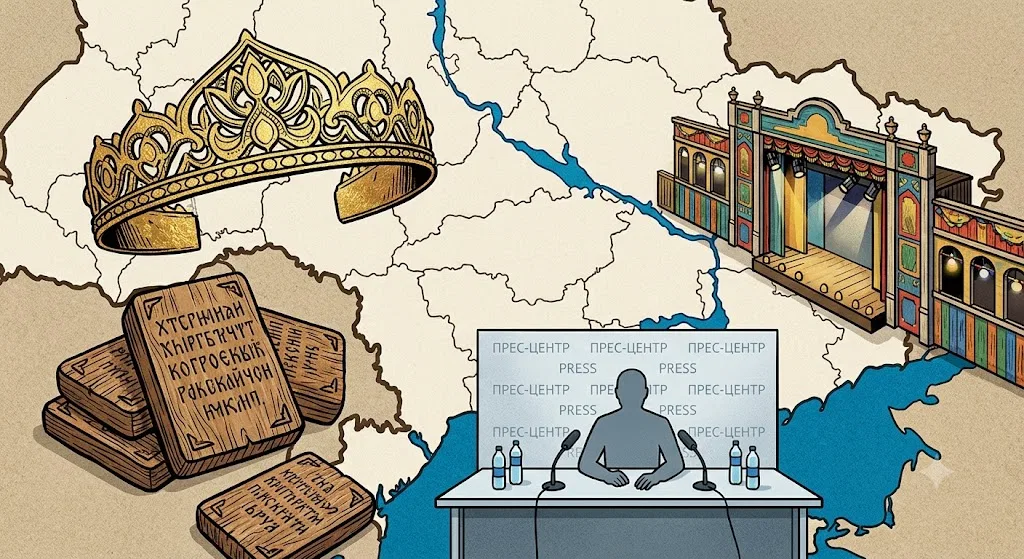
One of the most celebrated archaeological forgeries associated with Ukraine was the Tiara of Saitaphernes, an elaborate gold object acquired by the Louvre in 1896. It was presented as a third-century BC gift from the Greek colony of Olbia, near the Black Sea coast in present-day Ukraine, to a Scythian ruler named Saitaphernes. Its inscription appeared to support the story, while its decoration seemed to combine convincing scenes from Greek and Scythian antiquity.[Archaeology Magazine]archive.archaeology.orgArchaeology MagazineHoaxes, Fakes, and Strange Sites - Saitaphernes' Golden TiaraRussian art dealer Schapschelle Hochmann's tale was that…
The tiara succeeded because it offered museums exactly what they wanted: a spectacular, apparently well-documented object linking classical Greek art with the fashionable archaeology of the northern Black Sea. Its sellers supplied a plausible discovery story, and the inscription resembled ancient material already known to scholars. The Louvre’s institutional prestige then strengthened the illusion. Once a famous museum had paid heavily for the object and displayed it, doubters faced not only an artefact but the authority of the museum itself.
Questions nevertheless arose almost immediately. Specialists noticed that the ornament was suspiciously complete and that parts of its imagery appeared to derive from published archaeological illustrations. The decisive breakthrough came when the object was linked to Israel Rouchomovsky, a highly skilled goldsmith working in Odesa. Rouchomovsky explained that dealers had commissioned the tiara from him and that he had believed he was making a modern gift, not an object intended to deceive a museum. He demonstrated his technique and knowledge of the piece, ending serious doubt about its modern origin. The Louvre now catalogues it as a nineteenth-century work by Rouchomovsky, with its supposed place of discovery listed as unknown.[Louvre Collections]collections.louvre.frLouvre Collectionstiare de Saitapharnes24 Apr 2026 — tiare de Saitapharnes 1800 / 1900: 17 cm; Diamètre: 18 cm. Eberhard, Paul, Gefäls…
The episode was more than an embarrassment for one museum. It showed that archaeological fraud need not depend on crude workmanship. The tiara was persuasive because it was beautifully made and carefully tailored to contemporary scholarship. The weakest part of the deception was not the object itself but its provenance—the chain of evidence showing where it had been found and who had owned it. That remains one of the central lessons of the antiquities trade: scientific-looking style cannot substitute for a documented excavation history.
The ancient book that appeared only in modern copies
The Book of Veles is a different kind of forgery. It was promoted as a pre-Christian Slavic chronicle carved on wooden boards and supposedly discovered after the Russian Revolution. Its contents offered an expansive account of ancient Slavic history, religion and migration. For readers seeking a written national or spiritual ancestry older than the medieval conversion to Christianity, the text seemed to fill an emotionally powerful gap.
The original boards were never made available for independent examination. The work became known through transcriptions, reproductions and publications circulated by émigré enthusiasts during the twentieth century. This missing physical evidence is important: scholars could not test the wood, writing material or carving directly, while supporters were left defending copies of an allegedly lost object.
Linguistic analysis has been devastating to the claim of antiquity. The language combines features drawn from different Slavic periods and regions, includes forms inconsistent with an authentic early medieval text and appears to have been artificially made to look old. Academic treatments consequently classify the book as a forgery or “mystification”, rather than a surviving pagan chronicle. Cambridge University Press material on early Rus explicitly indexes it as a forgery, while later scholarship has examined how the fabricated text was transformed into modern religious and national myth.[Cambridge University Press & Assessment]resolve.cambridge.orgUniversity Press & Assessment Writing, Society and Culture in Early Rus, c950-1300Book of Veles (forgery), 92–3 book-dealers, 31. Cambridge Books Online © Cambridge University Press, 2009. Published online by Ca…
The Book of Veles nevertheless found readers in Ukraine and elsewhere because it offered something conventional historical sources could not: a continuous indigenous scripture, complete with ancient wisdom and heroic collective origins. Its survival illustrates an important distinction between exposure and disappearance. A forgery can lose scholarly credibility while retaining cultural power. Once incorporated into spiritual practice, identity politics or popular publishing, arguments about grammar may matter less to believers than the narrative the book permits them to tell.
It is therefore misleading to treat everyone who has used the text as a participant in a single deliberate fraud. The likely fabrication belongs to one stage of the story; later circulation often reflects sincere belief, ideological usefulness or indifference to academic standards. The false artefact became what folklorists sometimes call invented tradition: a modern creation experienced by adherents as recovered inheritance.

Did Potemkin really build fake villages?
The expression “Potemkin village” is now used worldwide for a decorative façade designed to conceal failure. Its supposed origin lies in Catherine II’s grand journey through the southern territories of the Russian Empire and Crimea in 1787. According to the familiar story, Prince Grigory Potemkin erected portable fake settlements along the route, populating them with cheerful peasants before moving the scenery downstream overnight.
The geographical setting places the legend firmly within the history of lands now in Ukraine, including the Dnipro corridor and Crimea. Yet the famous story is much less secure than the expression it created. Its most influential early promoter, the Saxon diplomat Georg von Helbig, was not present on Catherine’s journey. His account appeared later and drew upon hostile court gossip about Potemkin.[Wikipedia]WikipediaPotemkin villagePotemkin village
There is evidence that the imperial tour was carefully stage-managed. Towns were decorated, ceremonies were organised and visitors were shown a flattering image of development in recently conquered territory. Potemkin had clear political reasons to impress Catherine, foreign ambassadors and potential allies before another war with the Ottoman Empire. What is doubtful is the theatrical extreme of entire movable villages repeatedly dismantled and rebuilt along the river.
Historians who have examined correspondence and memoirs generally regard the portable-village tale as an exaggeration or hostile legend. Potemkin beautified real settlements and arranged spectacles, but the evidence for rows of hollow façades populated by transported actors is weak. The story may therefore be a hoax in reverse: not a deception by Potemkin, but a durable defamatory account of one.[Wikipedia]WikipediaPotemkin villagePotemkin village
Its endurance comes from its perfection as a political metaphor. Bureaucracies really do prepare model factories, freshly painted streets and carefully selected citizens for official visits. Because the behaviour described is plausible in general, the specific origin story feels true even when its most memorable details cannot be established.
The journalist who was murdered for one night
On 29 May 2018, police and news organisations reported that Russian journalist Arkady Babchenko had been shot and killed in Kyiv. Babchenko, an outspoken critic of the Kremlin who had left Russia after receiving threats, seemed a plausible target. Ukrainian officials publicly discussed the killing, international organisations condemned it and newsrooms around the world reported his death.
The following day, Babchenko walked into a press conference alive.
Ukraine’s Security Service said it had staged the murder as part of an operation to expose and disrupt a genuine assassination plot. The performance reportedly involved make-up, blood, prepared clothing and the circulation of an image showing Babchenko apparently dead. Investigators said the deception had helped them identify or arrest an alleged organiser and gather evidence about a wider threat.[cpj.org]cpj.orgCommittee to Protect JournalistsThe many questions about Arkady Babchenko's staged…May 31, 2018 — 30 May 2018 — The authorities releas…
This was not an ordinary self-promotional hoax. Babchenko faced credible danger, and the operation was presented as a law-enforcement sting intended to save his life. Yet it deliberately manipulated journalists, international organisations and the public. The initial death announcement was sufficiently convincing that the Organization for Security and Co-operation in Europe issued a formal condemnation of the supposed murder before learning that the victim was alive.[rfom.osce.org]rfom.osce.orgrepresentative on freedom of mediarepresentative on freedom of media
Critics argued that the operation damaged trust at precisely the moment Ukraine needed credible reporting about political violence and Russian interference. Reporters Without Borders and journalist organisations objected to the use of fake news methods by state authorities, while commentators warned that future genuine killings might initially be dismissed as another performance. Defenders replied that preserving a threatened man’s life and catching alleged conspirators outweighed the temporary deception.[theguardian.com]theguardian.comOpen source on theguardian.com.
The unresolved issue is proportionality. Undercover operations routinely involve deception, but the Babchenko case transformed the global press into an unwitting participant. The immediate operational gain therefore came with a diffuse public cost: people who had responsibly trusted police statements discovered that the authorities had designed those statements to mislead them.

The Ghost of Kyiv: false pilot, real function
During the opening days of Russia’s full-scale invasion in February 2022, social media posts celebrated an unnamed Ukrainian fighter pilot said to have destroyed several Russian aircraft over Kyiv. The “Ghost of Kyiv” rapidly became a perfect wartime hero: anonymous, highly skilled, impossible for the enemy to catch and seemingly present whenever the capital needed defending.
Some circulating footage was not evidence of an actual aerial victory. At least one widely shared clip came from a combat flight simulator rather than the skies over Ukraine. Official and semi-official accounts nevertheless amplified the story, while online users supplied artwork, photographs, supposed identities and increasing victory totals.[WIRED]wired.comHow Ukraine Is Winning the Propaganda WarHow Ukraine Is Winning the Propaganda War
The legend became confused with real pilots, including men who had died in combat. This created pressure for clarification. On 30 April 2022, Ukraine’s Air Force described the Ghost as a “superhero-legend” and a collective representation of the pilots defending Kyiv, rather than a single ace with the record attributed to him online.[The Washington Post]washingtonpost.comOpen source on washingtonpost.com.
Calling the story simply a calculated hoax misses part of what happened. It emerged through a mixture of wartime rumour, popular creativity, recycled imagery, official encouragement and genuine admiration for Ukrainian aircrews. There were real pilots fighting against a larger invading force; the false element was the concentration of their achievements into one cinematic figure.
The Ghost’s appeal was practical as well as emotional. A lone ace is easier to remember and share than an explanation of dispersed air-defence operations, ground control, maintenance crews and multiple pilots. The legend personalised resistance at a moment of extreme fear. It also revealed the risk of morale-building fiction: once authorities become associated with an invented hero, opponents can use the correction to cast doubt upon well-documented events that have nothing to do with the myth.
The fake surrender video that failed quickly
On 16 March 2022, a manipulated video appeared to show President Volodymyr Zelensky telling Ukrainian soldiers to surrender. It was distributed through a reportedly compromised news website and then circulated on social media. The head appeared poorly integrated with the body, the voice and accent were unconvincing, and viewers quickly identified visual inconsistencies. Meta removed the video under its policy against misleading manipulated media.[TechCrunch]techcrunch.comTech Crunch Meta takes down deepfake of Ukraine's President ZelenskyTech Crunch Meta takes down deepfake of Ukraine's President Zelensky
The video is commonly described as a deepfake, meaning synthetic or heavily manipulated audiovisual material designed to make a real person appear to say or do something that never occurred. Researchers subsequently used it as a case study in methods for distinguishing fabricated images of Zelensky from authentic appearances by analysing his characteristic facial movements and gestures.[arXiv]arxiv.orgarXiv Protecting President Zelenskyy against Deep FakesarXiv Protecting President Zelenskyy against Deep Fakes
Technically, the fabrication was not especially persuasive. Strategically, however, perfection may not have been necessary. A fake surrender message released during combat could create momentary uncertainty, especially if it appeared through a trusted or hacked outlet. It could also support a broader claim that authentic videos might themselves be fake—the so-called liar’s dividend, in which the existence of manipulated media gives public figures an excuse to deny genuine evidence.
The attempted deception failed because several defences operated at once. Zelensky had established a pattern of frequent authentic video addresses. Ukrainian officials responded rapidly. Viewers were already alert to the possibility of fabricated material, and major platforms removed the clip. The case demonstrated that deepfakes are most dangerous not because they are magically undetectable, but because they can exploit a short window before verification catches up.
When unusual observations become extraordinary claims
Not every disputed Ukrainian case involved conscious deception. In 2022, researchers associated with Ukraine’s Main Astronomical Observatory circulated papers describing unusual objects observed by cameras over Kyiv and nearby areas. The authors used labels such as “phantoms” and reported estimates suggesting dark objects travelling at extraordinary speeds. The papers attracted attention from UFO communities and international media.[arXiv]arxiv.orgarXiv Unidentified aerial phenomena I. Observations of eventsarXiv Unidentified aerial phenomena I. Observations of events
The criticism focused on the method used to estimate distance. Object size and speed depend heavily upon how far away an object is assumed to be. Astronomer Avi Loeb argued that the inferred objects would generate conspicuous heating and light if they were genuinely moving through the atmosphere at the stated speeds. If the objects were much closer than the researchers calculated, their measured properties became compatible with artillery shells rather than exotic craft.[arXiv]arxiv.orgOpen source on arxiv.org.
Ukrainian scientific authorities and other commentators also questioned the work, which had circulated as a preprint rather than an established discovery confirmed through peer review and independent replication.[Jerusalem Post]jpost.comJerusalem Post UAPs or Russian shells? Israel-born astronomer, UkraineJerusalem Post UAPs or Russian shells? Israel-born astronomer, Ukraine
This episode belongs on the boundary between error and sensationalism, not straightforward fraud. Cameras did record something; the dispute concerned what could legitimately be inferred from the images. War made ordinary explanations particularly important, since Ukrainian airspace contained missiles, shells, aircraft, drones, debris and optical disturbances. The case shows how an uncertain observation can become “UFO evidence” when dramatic numerical estimates are repeated without equal attention to assumptions and error margins.
Why Ukrainian hoaxes keep travelling
These cases differ sharply in intention, but the same recurring conditions helped them spread.
Authority arrived before verification. The Louvre validated the tiara by purchasing it. Police announcements validated Babchenko’s death. Military-linked accounts helped legitimise the Ghost of Kyiv. Once an institution endorses a claim, later correction must overcome the memory of the original announcement.
The stories answered emotional needs. The Book of Veles promised ancient continuity. The Ghost offered hope during invasion. The Potemkin story supplied a timeless image of corrupt government. Claims that explain identity, fear or power are rarely assessed as detached puzzles.
The false version was simpler than the truth. “Ancient royal crown” is more memorable than a complicated chain of dealers and craftsmen. “Single heroic ace” travels better than the collective work of an air brigade. “Fake villages” is more vivid than a debate over imperial ceremony, urban decoration and hostile memoirs.
Corrections did not erase symbolic value. The tiara remains a masterpiece of modern metalwork. The Ghost survives in art as a collective hero. “Potemkin village” remains useful language even when its origin is doubtful. Exposure can change what a story means without making people stop telling it.
The best defence is not automatic disbelief. It is careful classification. A forged object, a police sting, a wartime legend, a manipulated video and a mistaken scientific inference require different kinds of judgement. Asking who created the evidence, whether the original material survives, how provenance was established, what independent tests were performed and who first corrected the claim usually reveals more than arguing over the vague label “hoax”.
Ukraine’s deceptive and disputed stories are memorable precisely because they sit where trust is most vulnerable: museums, national history, journalism, warfare and science. They show that falsehood rarely succeeds through invention alone. It succeeds when an appealing story is joined to a trusted channel—and when the audience has an urgent reason to believe.
Amazon book picks
Further Reading
Books and field guides related to Which Ukrainian Hoaxes Fooled the World?. Use these as the next step if you want deeper reading beyond the article.
The Confidence Game
Examines why intelligent people believe convincing frauds and myths.
A History of Fake Things on the Internet
Explains mechanisms that help false stories spread and gain authority.
Scientific Investigation of Copies, Fakes and Forgeries
Covers forged artefacts and the detection of historical frauds.
eBay marketplace picks
Marketplace Samples
Live-tested eBay searches with available results related to this page.
Endnotes
1.
Source: archive.archaeology.org
Link:https://archive.archaeology.org/online/features/hoaxes/saitaphernes_tiara.html
Source snippet
Archaeology MagazineHoaxes, Fakes, and Strange Sites - Saitaphernes' Golden TiaraRussian art dealer Schapschelle Hochmann's tale was that...
2.
Source: collections.louvre.fr
Link:https://collections.louvre.fr/en/ark%3A/53355/cl010256592
Source snippet
Louvre Collectionstiare de Saitapharnes24 Apr 2026 — tiare de Saitapharnes 1800 / 1900: 17 cm; Diamètre: 18 cm. Eberhard, Paul, Gefäls...
3.
Source: resolve.cambridge.org
Title: University Press & Assessment Writing, Society and Culture in Early Rus, c
Link:https://resolve.cambridge.org/core/services/aop-cambridge-core/content/view/E1A43BD82B014803BDDDCC110BB53E77/9780511496509ind_p309-325_CBO.pdf/index.pdf
Source snippet
950-1300Book of Veles (forgery), 92–3 book-dealers, 31. Cambridge Books Online © Cambridge University Press, 2009. Published online by Ca...
4.
Source: cambridge.org
Link:https://www.cambridge.org/core/books/slavic-native-faith/C6AC26C0A15F84A0D7D8243B60C362F7
Source snippet
Cambridge University Press & AssessmentSlavic Native Faith31 Mar 2026 — 'The New Life of the Book of Veles: The Transformation of Mystifi...
5.
Source: Wikipedia
Title: Potemkin village
Link:https://en.wikipedia.org/wiki/Potemkin_village
6.
Source: time.com
Link:https://time.com/5476536/person-of-the-year-2018-arkady-babchenko/
7.
Source: wired.com
Link:https://www.wired.com/story/russian-journalist-arkady-babchenko-fake-murder
8.
Source: rfom.osce.org
Title: representative on freedom of media
Link:https://rfom.osce.org/representative-on-freedom-of-media/382831
9.
Source: wired.com
Title: How Ukraine Is Winning the Propaganda War
Link:https://www.wired.com/story/ukraine-propaganda-war
10.
Source: Wikipedia
Title: Ghost of Kyiv
Link:https://en.wikipedia.org/wiki/Ghost_of_Kyiv
11.
Source: techcrunch.com
Title: Tech Crunch Meta takes down deepfake of Ukraine’s President Zelensky
Link:https://techcrunch.com/2022/03/16/facebook-zelensky-deepfake/
12.
Source: arxiv.org
Title: arXiv Protecting President Zelenskyy against Deep Fakes
Link:https://arxiv.org/abs/2206.12043
13.
Source: arxiv.org
Title: arXiv Unidentified aerial phenomena I. Observations of events
Link:https://arxiv.org/abs/2208.11215
14.
Source: arxiv.org
Title: arXiv Unidentified aerial phenomena II. Evaluation of UAP properties
Link:https://arxiv.org/abs/2211.17085
15.
Source: arxiv.org
Link:https://arxiv.org/abs/2210.01972
16.
Source: dictionary.cambridge.org
Link:https://dictionary.cambridge.org/zht/%E8%A9%9E%E5%85%B8/%E8%8B%B1%E8%AA%9E-%E6%BC%A2%E8%AA%9E-%E7%B9%81%E9%AB%94/book
17.
Source: cambridge.org
Link:https://www.cambridge.org/core/elements/slavic-native-faith/C6AC26C0A15F84A0D7D8243B60C362F7
18.
Source: resolve.cambridge.org
Title: in wodens shadow anglosaxonism paganism and politics in modern england
Link:https://resolve.cambridge.org/core/services/aop-cambridge-core/content/view/684641DB8FD9FD8DC30687F36858A43C/9781800101012c8_p129-156_CBO.pdf/in_wodens_shadow_anglosaxonism_paganism_and_politics_in_modern_england.pdf
19.
Source: Wikipedia
Title: Book of Veles
Link:https://en.wikipedia.org/wiki/Book_of_Veles
20.
Source: carnegie.ru
Link:https://carnegie.ru/commentary/76493
21.
Source: jsis.washington.edu
Title: information warfare the ghost of kyiv
Link:https://jsis.washington.edu/news/information-warfare-the-ghost-of-kyiv/
22.
Source: cpj.org
Link:https://cpj.org/2018/05/the-many-questions-about-arkady-babchenkos-staged/
Source snippet
Committee to Protect JournalistsThe many questions about Arkady Babchenko's staged...May 31, 2018 — 30 May 2018 — The authorities releas...
Published: May 31, 2018
23.
Source: theguardian.com
Link:https://www.theguardian.com/commentisfree/2018/may/31/the-guardian-view-on-a-journalists-return-the-death-was-fake-the-damage-was-not
24.
Source: carnegieendowment.org
Title: truth without borders why faking a journalists death wont help ukraine
Link:https://carnegieendowment.org/posts/2018/05/truth-without-borders-why-faking-a-journalists-death-wont-help-ukraine
25.
Source: washingtonpost.com
Link:https://www.washingtonpost.com/world/2022/05/01/ghost-of-kyiv-propaganda/
26.
Source: theguardian.com
Title: The Guardian Mayor of Melitopol released after abduction
Link:https://www.theguardian.com/world/live/2022/mar/16/ukraine-russia-war-latest-zelenskiy-says-peace-talks-are-more-realistic-three-eu-leaders-vow-support-on-kyiv-visit-live
Source snippet
In the midst of the conflict, Zelenskiy praised Ukraine's unity and resistance, and emphasized that the country would rebuild after the w...
27.
Source: jpost.com
Title: Jerusalem Post UAPs or Russian shells? Israel-born astronomer, Ukraine
Link:https://www.jpost.com/science/article-719773
28.
Source: theguardian.com
Title: russian journalist arkady babchenko who was reported killed is still alive
Link:https://www.theguardian.com/world/2018/may/30/russian-journalist-arkady-babchenko-who-was-reported-killed-is-still-alive
29.
Source: facebook.com
Link:https://www.facebook.com/groups/thearchaeologynewsnetwork/posts/2409563539058510/
30.
Source: facebook.com
Link:https://www.facebook.com/NBCNewsWorld/posts/the-ukrainian-air-force-says-the-ghost-of-kyiv-never-existed-and-although-the-my/5438257026193060/
31.
Source: facebook.com
Title: when in 1787 empress catherine the great embarked on a grand tour of russias new
Link:https://www.facebook.com/thewire.in/posts/when-in-1787-empress-catherine-the-great-embarked-on-a-grand-tour-of-russias-new/979794964718532/
32.
Source: washingtonpost.com
Title: jonas bendiksen book veles
Link:https://www.washingtonpost.com/photography/2021/10/15/jonas-bendiksen-book-veles/
33.
Source: rodnovery.ru
Title: book of veles
Link:https://rodnovery.ru/en/articles/book-of-veles
34.
Source: the-slavic-forgery-universe.fandom.com
Title: The Book of Veles
Link:https://the-slavic-forgery-universe.fandom.com/wiki/The_Book_of_Veles
Additional References
35.
Source: resources.metmuseum.org
Link:https://resources.metmuseum.org/resources/metpublications/pdf/A_Fourth_Century_BC_Royal_Kurgan_in_the_Crimea_The_Metropolitan_Museum_Journal_v_26_1991.pdf
Source snippet
MetMuseum ResourcesA Fourth-Century B.C. Royal KurganBut after the scandalous exposure in 1903 of the famous specu- lation on the "Tiara...
36.
Source: researchgate.net
Link:https://www.researchgate.net/figure/A-deepfake-video-of-President-of-Ukraine-Volodymyr-Zelenskyy-and-President-of-Russia_fig4_361007477
37.
Source: europeansources.info
Link:https://www.europeansources.info/record/arkady-babchenko-stages-death-ukrainian-investigation-life-threats/
38.
Source: donsmaps.com
Link:https://www.donsmaps.com/hoax.html
39.
Source: morningstaronline.co.uk
Link:https://www.morningstaronline.co.uk/article/f-2nd-ghost-kiev-legend-revealed-be-fake-news
40.
Source: reddit.com
Link:https://www.reddit.com/r/worldnews/comments/tft9fk/facebook_removes_deepfake_of_ukrainian_president/
41.
Source: e-a-a.org
Link:https://www.e-a-a.org/EAA/EAA/News___Publications/TEA_77_content/Newsflash.aspx
42.
Source: medium.com
Link:https://medium.com/create-change/stop-building-[potemkin-villages
43.
Source: gostbooks.com
Link:https://gostbooks.com/products/the-book-of-veles
44.
Source: worldpressphoto.org
Link:https://www.worldpressphoto.org/collection/photo-contest/2022/Jonas-Bendiksen/1
Topic Tree
Follow this branch
Related pages 192
- Albanian Hoaxes
- Algerian Hoaxes
- Antigua Deceptions
- Argentina Hoaxes
- Armenian Hoaxes
- +187 more in sidebar