Within Nigeria Deceptions
Why Did 419 Scams Feel So Official?
Advance-fee scammers built convincing worlds of officials, documents and urgent payments around a fortune that never existed.
On this page
- The promise of trapped money and easy reward
- How fake officials and documents created credibility
- Why repeated fees kept victims committed
Page outline Jump by section
Introduction
Why did 419 scams feel so official? Because their success depended less on technology than on performance. The classic advance-fee fraud associated with Nigeria promised access to a fortune that supposedly existed somewhere inside a maze of government departments, banks, contracts and legal procedures. Victims were not merely told a lie; they were invited into a carefully staged drama populated by ministers, central-bank officials, lawyers, auditors and diplomats. Every letter, stamp, certificate and procedural hurdle helped transform a simple confidence trick into something that looked like bureaucracy at work.[Wikipedia]WikipediaAdvance-fee scamAdvance-fee scam

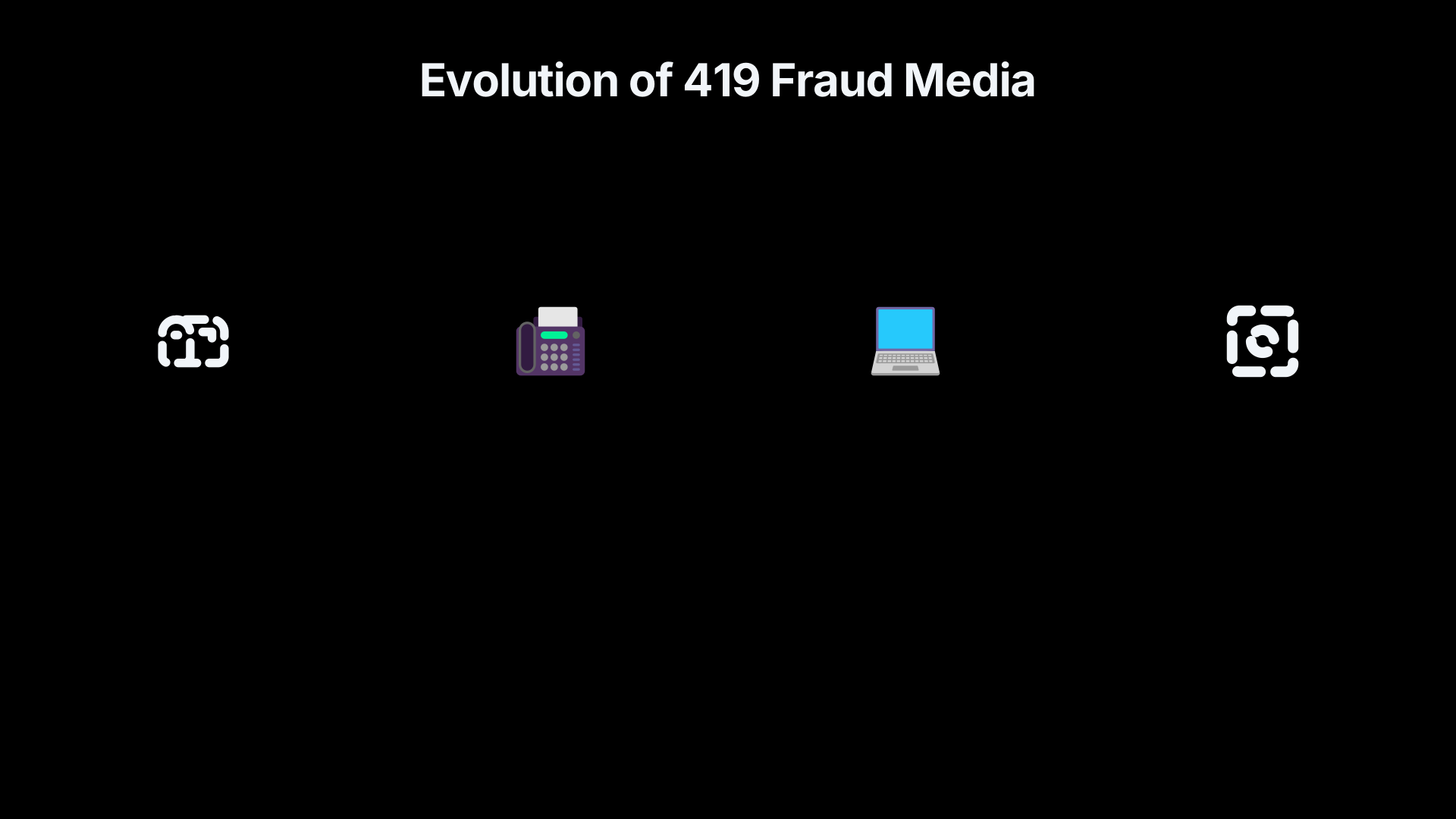
Known internationally as “419 fraud”, after the section of the Nigerian Criminal Code dealing with obtaining property by false pretences, the scheme evolved from postal letters to fax machines and then to mass email. Yet the core mechanism remained remarkably consistent: convince the target that a huge sum of money was trapped inside an official process, then demand a series of fees to release it.[wikipedia.org]WikipediaAdvance-fee scamAdvance-fee scam
The Promise of Trapped Money and Easy Reward
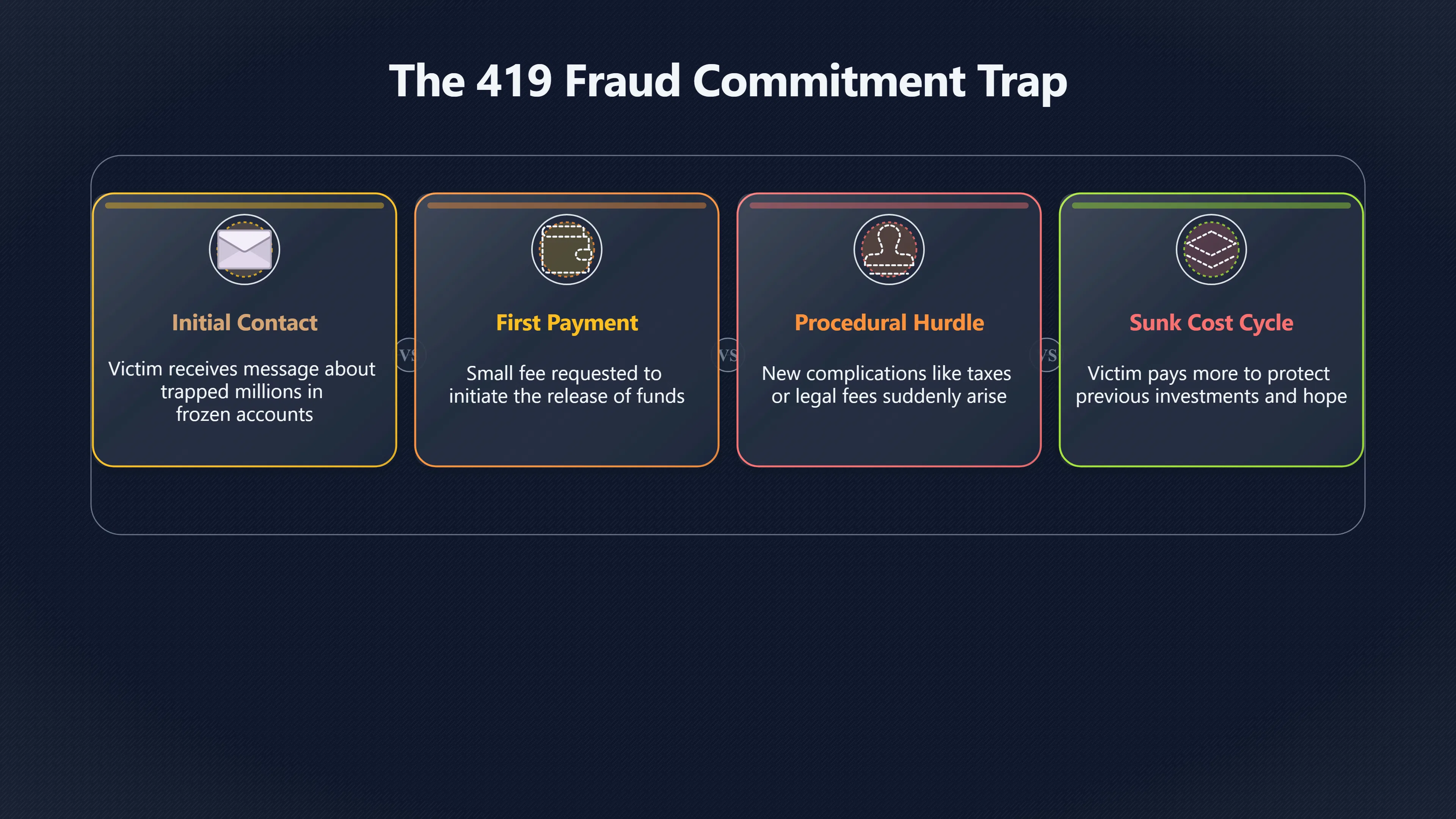
At the heart of the classic 419 approach was a story about inaccessible wealth. The victim would receive a message claiming that millions of dollars were waiting in a frozen account, tied up in an abandoned government contract, stranded after a political crisis, or left behind by a deceased official or businessman. The recipient was offered a substantial percentage of the fortune in exchange for helping move it out of the country or through a banking system.[wikipedia.org]WikipediaAdvance-fee scamAdvance-fee scam
What made these stories persuasive was not simply greed. The narratives borrowed from situations that sounded plausible in an era of military coups, privatisation programmes, international sanctions, debt negotiations and large state-controlled industries. Researchers have noted that many early scam letters specifically invoked institutions such as the Central Bank of Nigeria, the Ministry of Finance or the Nigerian National Petroleum Corporation because these organisations were familiar enough to seem real but distant enough that foreign recipients could not easily verify the claims.[issafrica.s3.amazonaws.com]issafrica.s3.amazonaws.comDemystifying the advance‐fee fraud criminal networkby OB Simon · Cited by 10 — Initially, most of the letters were purported to have orig…
The promised reward also created a psychological imbalance. A recipient was not being asked to hand over money in exchange for nothing. Instead, they were supposedly helping to unlock an enormous payment. Compared with the millions allegedly waiting, each requested fee seemed minor and temporary.[Wikipedia]WikipediaAdvance-fee scamAdvance-fee scam
How Fake Officials and Documents Created Credibility
The most distinctive feature of 419 fraud was its theatrical use of bureaucracy. Fraudsters understood that people often trust procedures, paperwork and official titles. Instead of presenting themselves as obvious criminals, they acted as administrators trapped by regulations.
A typical scheme might introduce several characters over time:
- A senior government official responsible for releasing funds.
- A lawyer handling legal clearance.
- A bank manager supervising transfers.
- A customs officer demanding certification.
- An anti-corruption investigator supposedly checking the transaction.
In reality, these figures were often fictional identities controlled by the same scammer or small group.[Wikipedia]WikipediaAdvance-fee scamAdvance-fee scam
Documents played an equally important role. Victims frequently received letters bearing seals, signatures, letterheads and stamps that appeared governmental or financial. Fraud researchers and law-enforcement agencies have repeatedly identified forged certificates, fake contracts, fabricated bank documents and counterfeit authorisation letters as central tools of the scam. The paperwork did not need to survive forensic examination; it only needed to reassure the target long enough to justify the next payment.[wikipedia.org]WikipediaAdvance-fee scamAdvance-fee scam
This was bureaucracy transformed into theatre. Every new document acted like a prop. Every invented office created another scene in the story. Victims were encouraged to believe that delays and complications proved authenticity. Real institutions generate paperwork and obstacles; therefore, the fraudsters supplied both.

Why Complexity Increased Believability
Many frauds fail because they appear too simple. The classic 419 scheme often moved in the opposite direction.
Rather than promising immediate riches, scammers introduced procedural complications: taxes, transfer charges, legal certificates, anti-money-laundering clearances, notarisation fees or diplomatic approvals. Each obstacle appeared frustrating but understandable. If millions of dollars were crossing borders, surely some paperwork would be required.[Wikipedia]WikipediaAdvance-fee scamAdvance-fee scam
Paradoxically, complexity made the fiction seem more realistic. The victim experienced the transaction not as a fantasy but as an administrative process. The very delays that prevented payment became evidence that the scheme was genuine.
Why Repeated Fees Kept Victims Committed
The advance-fee mechanism worked because the first payment was rarely the last. Once a victim sent money, a new problem appeared. A certificate had expired. A tax had unexpectedly arisen. A bank official required compensation. A transfer had been delayed by regulators.
Each payment was presented as the final step before release of the funds. Then another final step appeared.[Wikipedia]WikipediaAdvance-fee scamAdvance-fee scam
Psychologists and fraud researchers often describe this pattern as a commitment trap. After investing money, time and emotion, victims become reluctant to admit the possibility of deception. Walking away means accepting that previous payments are gone. Continuing offers the hope that losses can still be recovered once the promised fortune arrives.[cybercrimejournal.com]cybercrimejournal.comA Qualitative Analysis of Advance Fee Fraud E-mail Schemesby TJ Holt · 2007 · Cited by 142 — These messages are often referred to as “Nig…
The structure therefore rewarded persistence. A victim who had already paid several fees might view an additional charge not as a warning sign but as a necessary step to protect the larger investment already made.
Secrecy as a Control Mechanism
Many versions of the scam also encouraged secrecy. The transaction was presented as confidential, politically sensitive or legally questionable. Victims were told that disclosure could jeopardise the deal.
This served two purposes. First, it prevented outsiders from exposing obvious inconsistencies. Second, it made the victim feel like an insider with privileged access to information unavailable to the general public.[Wikipedia]WikipediaAdvance-fee scamAdvance-fee scam
The result was a strange partnership in which the victim believed they were participating in an exclusive opportunity rather than being targeted by a fraud.
From Letters and Fax Machines to Email
Although 419 fraud became famous through email, the underlying formula predated the internet. Variants circulated through postal mail and fax long before mass electronic communication became common. Email simply allowed the same theatrical script to reach millions of potential targets at almost no cost.[wikipedia.org]WikipediaAdvance-fee scamAdvance-fee scam
The transition to digital communication changed the scale rather than the core narrative. Messages still arrived from supposed officials. Documents still appeared as attachments. Bureaucratic obstacles still generated repeated fees. The technology evolved, but the performance remained recognisable.
What 419 Fraud reveals about belief and deception
The enduring image of the “Nigerian prince” email has obscured what made classic 419 fraud effective. The scam was never primarily about royalty, inheritances or hidden treasure. It was about credibility generated through imitation of institutions.
By turning administration into a dramatic narrative, fraudsters exploited a common assumption: that official-looking processes indicate legitimacy. Stamps, signatures, departments and procedural delays became tools of persuasion. The victim was not merely promised money. They were invited to navigate a fictional bureaucracy whose complexity itself became evidence that the opportunity was real.[wikipedia.org]WikipediaAdvance-fee scamAdvance-fee scam
That mechanism explains why 419 fraud remains one of the most influential confidence tricks of the modern era. Its lasting lesson is not that people believed an implausible fortune existed. It is that many people were persuaded because the fraud looked and felt like ordinary official business.[police.uk]reportfraud.police.ukim to be handling. Their aim is to take fees from you…
Amazon book picks
Further Reading
Books and field guides related to Why Did 419 Scams Feel So Official?. Use these as the next step if you want deeper reading beyond the article.
Scam Me If You Can
Covers fraud methods and warning signs relevant to advance-fee schemes.
The Confidence Game
Explains exactly how confidence tricks build trust and commitment.
eBay marketplace picks
Marketplace Samples
Live-tested eBay searches with available results related to this page.

Endnotes
1.
Source: Wikipedia
Title: Advance-fee scam
Link:https://en.wikipedia.org/wiki/Advance-fee_scam
2.
Source: issafrica.s3.amazonaws.com
Link:https://issafrica.s3.amazonaws.com/site/uploads/18N4SIMON.PDF
Source snippet
Demystifying the advance‐fee fraud criminal networkby OB Simon · Cited by 10 — Initially, most of the letters were purported to have orig...
3.
Source: sciencedirect.com
Link:https://www.sciencedirect.com/org/science/article/abs/pii/S1359079021000324
Source snippet
This study not only provides a historical perspective as to why these scams...Read more...
4.
Source: cybercrimejournal.com
Link:https://www.cybercrimejournal.com/pdf/thomasdanielleijcc.pdf
Source snippet
A Qualitative Analysis of Advance Fee Fraud E-mail Schemesby TJ Holt · 2007 · Cited by 142 — These messages are often referred to as “Nig...
5.
Source: arxiv.org
Title: arXiv Trend and Emerging Types of 419 Scams
Link:https://arxiv.org/abs/2308.12448
6.
Source: Wikipedia
Link:https://en.wikipedia.org/wiki/Nigeria
7.
Source: 1997-2001.state.gov
Link:https://1997-2001.state.gov/regions/africa/naffpub.pdf
8.
Source: reportfraud.police.uk
Link:https://www.reportfraud.police.uk/419-emails-and-letters/
Source snippet
im to be handling. Their aim is to take fees from you...
9.
Source: journals.uj.ac.za
Link:https://journals.uj.ac.za/index.php/djis/article/view/4096/2439
Additional References
10.
Source: theabi.org.uk
Link:https://www.theabi.org.uk/news/advance-fee-fraud-case-studies
Source snippet
The Association of British InvestigatorsAdvance fee fraud & case studiesAdvance fee fraud, also known as 419 fraud or Nigerian scam, is a...
11.
Source: dirco.gov.za
Title: DIRCOScam Letters
Link:https://dirco.gov.za/losangeles/scam-letters/
Source snippet
Los AngelesWhat is the 419 Scam? An advance-fee scam is a type of fraud and. The scam typically involves promising the victim a significa...
12.
Source: warwick.ac.uk
Link:https://warwick.ac.uk/fac/Soc/law/elj/jilt/2009_1/chawki/chawki.pdf
Source snippet
University of Warwick419 Scam on the Internet: A Nigerian Perspectiveby M Chawki · 2009 · Cited by 115 — Accordingly, this paper seeks to...
13.
Source: ebsco.com
Link:https://www.ebsco.com/research-starters/law/advance-fee-scams
14.
Source: placng.org
Link:https://placng.org/lawsofnigeria/print.php?sn=18
15.
Source: facebook.com
Link:https://www.facebook.com/PoliceServiceTT/posts/how-the-419-or-nigerian-scam-worksyou-receive-a-message-often-claiming-to-be-fro/1315387693960594/
16.
Source: myfloridalegal.com
Link:https://www.myfloridalegal.com/consumer-protection/how-to-protect-yourself-nigerian-419
17.
Source: facebook.com
Link:https://www.facebook.com/forum9ja/posts/this-is-the-origin-of-the-slang-4191section-419-of-the-criminal-code-act-defines/1811130398948752/
18.
Source: cybereason.com
Link:https://www.cybereason.com/blog/malicious-life-podcast-the-nigerian-prince
19.
Source: researchgate.net
Link:https://www.researchgate.net/profile/Polra-Falade/publication/375516662_Analysis_of_419_Scams_The_Trends_and_New_Variants_in_Emerging_Types/links/654cf892ce88b87031d8ac15/Analysis-of-419-Scams-The-Trends-and-New-Variants-in-Emerging-Types.pdf
Topic Tree