How Peru's Strangest Hoaxes Borrowed Real History
Peru’s most famous hoaxes tend to borrow credibility from something genuine: spectacular archaeology, naturally preserved human remains, museum authority or the continuing mystery of the Nazca Lines.
Page outline Jump by section
Introduction
The cases also overlap. A market for antiquities encourages both looting and forgery. Unprovenanced objects — pieces with no documented archaeological excavation history — can then be promoted through books, television, museums and social media before independent specialists examine them. The result is more serious than a harmless tall tale: genuine graves may be disturbed, human remains exploited, scholarship confused and cultural achievements recast as the work of lost super-civilisations or extraterrestrials.[culturalheritage.org]resources.culturalheritage.orgConservation Online Faking pre-Columbian artifactsIncan bronze figurines from. Peru. Courtesy. Peabody Museum of Natural. History, Yale. University. Types of fakes. Over the years, the…
The Ica stones: dinosaurs made for a modern market
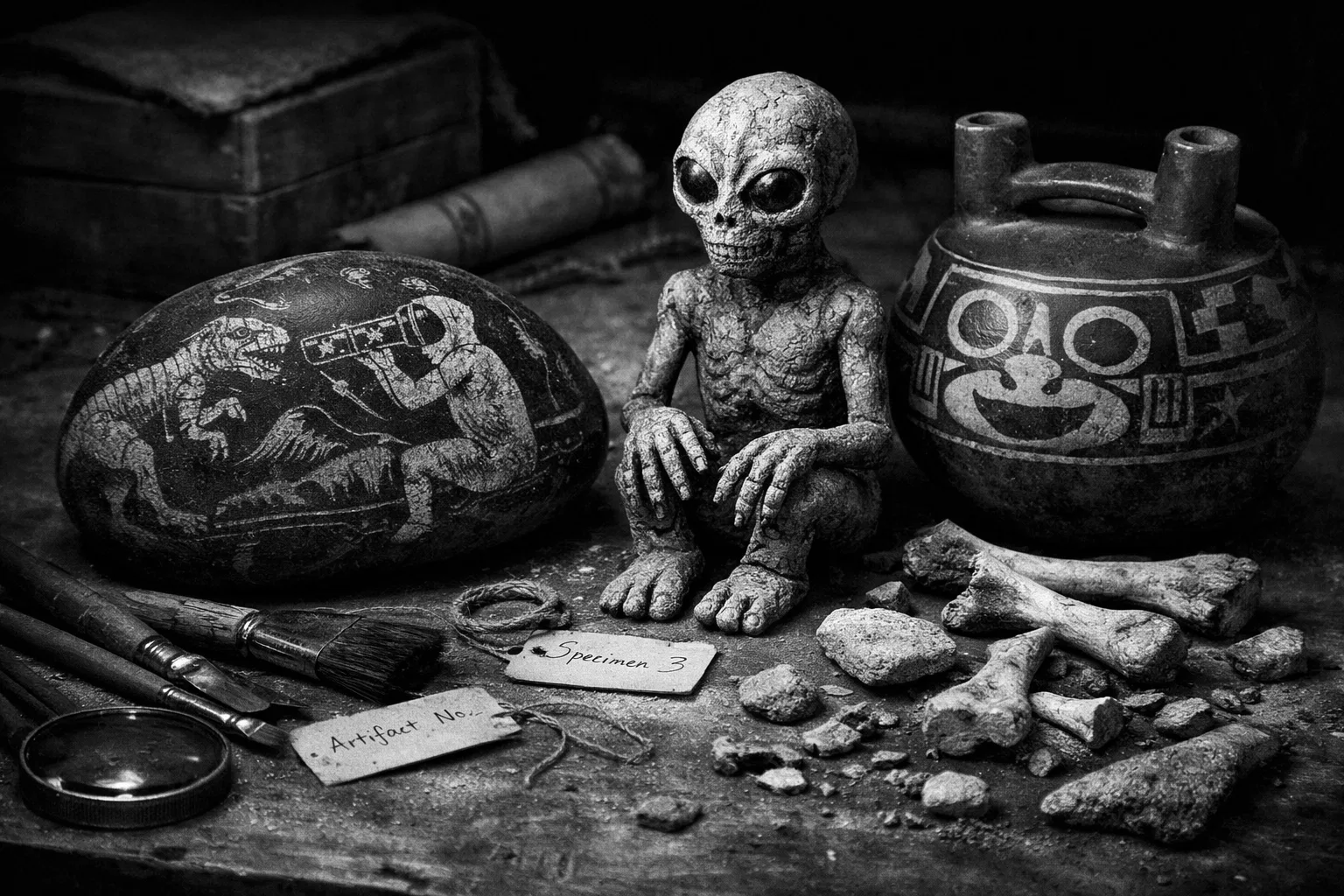
The Ica stones are dark rocks engraved with scenes that appear to show humans fighting dinosaurs, performing sophisticated operations, observing the heavens and using machines resembling aircraft. They became internationally famous through Javier Cabrera Darquea, a Peruvian doctor who assembled thousands of them and argued that they recorded an immensely ancient, technologically advanced civilisation. To readers already attracted to “lost history”, the images seemed to overturn conventional accounts of human evolution and the extinction of dinosaurs.[HISTORY]history.comWhat Are the Ica Stones—and Are They Real?What Are the Ica Stones—and Are They Real?June 18, 2026 — Historians and experts believe there's a plausible explanation for the c…
The stones were persuasive partly because their setting did not sound inherently implausible. Peru possesses abundant archaeological remains, and the dry southern coast preserves material that would decay elsewhere. Cabrera was also a doctor rather than an anonymous carnival promoter, while the growing scale of his collection gave the impression of a substantial archive rather than a single suspicious object. Authors associated with ancient-astronaut theories helped turn a local trade in engraved stones into an international pseudoarchaeological phenomenon.[Wikipedia]WikipediaIca stonesIca stones
The central evidential problem was provenance. None of the sensational stones was securely recovered in a controlled excavation, with its position and surrounding material documented by archaeologists. The rock itself could be ancient while the engraving was recent, so identifying the geological age of the stone did not establish the date of the pictures. Claims about surface patina likewise could not substitute for a recorded archaeological context.[Wikipedia]WikipediaIca stonesIca stones
Basilio Uschuya, a farmer who supplied large numbers of stones, demonstrated how such objects could be made and admitted engraving them. Accounts describe modern tools, artificial ageing and imagery borrowed from contemporary books and popular culture. His later statements were sometimes inconsistent, allowing believers to argue that his confession had been made to avoid prosecution for selling protected antiquities. That argument explains why a confession alone did not end the controversy, but it does not repair the absent excavation history, the anachronistic imagery or the demonstrated ease of manufacture.[wikipedia.org]WikipediaIca stonesIca stones
The Ica stones endure because they can be detached from the history of their production. A dramatic photograph of a dinosaur engraving circulates more easily than the less exciting facts about provenance, modern tools and tourist demand. They also serve several audiences at once: ancient-astronaut enthusiasts, young-Earth creationists, collectors of anomalous objects and visitors seeking an unusual souvenir. Each group can treat objections as evidence that orthodox scholars are unwilling to investigate, even though the decisive weakness is that the alleged discoveries did not enter the record through verifiable archaeological work.[Wikipedia]WikipediaIca stonesIca stones
The Nazca “alien mummies”: a spectacle built from real remains
A newer and more troubling episode concerns small humanoid bodies with elongated heads and three fingers, said to have been recovered near Nazca. Promoters presented specimens as unknown beings, non-human organisms or possible extraterrestrials. The claims reached a global audience in 2023 when Mexican journalist and UFO advocate Jaime Maussan displayed two purported Peruvian bodies during a hearing in Mexico’s Congress. Photographs, scans and claims about unusual DNA then spread rapidly through news sites and social media.[Reuters]reuters.comScientists assert 'alien mummies' in Peru are really dollsScientists assert 'alien mummies' in Peru are really dolls
Peruvian forensic specialists have examined seized figures associated with the phenomenon and concluded that they were manufactured objects rather than extraterrestrial corpses. In January 2024, experts from Peru’s Institute of Legal Medicine said two humanoid specimens intercepted at Lima’s airport were dolls assembled with animal bones, paper, glue and metal fasteners. The finding did not necessarily authenticate or dispose of every object promoted under the broad “Nazca mummies” label, but it demonstrated that convincingly alien-looking composites were being made and moved through the same publicity environment.[gob.pe]tvperu.gob.peTVPerú"Momias extraterrestres": nuevo peritaje en PerúTVPerú"Momias extraterrestres": nuevo peritaje en Perú
A detailed study published through Peru’s Ministry of Culture described the affair as a fraud shaped by familiar popular images of aliens. It noted that the objects matched expectations created by films, television and ancient-astronaut stories: enlarged heads, reduced facial features and three-fingered hands. This is an important feature of successful paranormal fraud. The evidence does not introduce a wholly unfamiliar creature; it resembles what the audience has already learned to recognise as an alien.[Revistas Cultura]revistas.cultura.gob.peOpen source on gob.pe.
Some of the material may have involved genuine ancient human remains that were modified, combined with animal bones or removed from archaeological contexts. Reuters reported that grave robber Leandro Rivera was convicted in 2022 after removing material from the Nazca region, and that specialists feared bodies and artefacts had entered an international black market. Cranial shaping, a documented practice among some ancient Peruvian populations, also supplies naturally elongated skulls that can be stripped of their cultural context and advertised as non-human.[Reuters]reuters.comNazca, known for its ancient geoglyphs and archaeological significance, is prone to grave robbing. Rivera was convicted in 2022 for unear…
This makes the mummy story more damaging than a fabrication made entirely from modern materials. When ancient bones are cut, rearranged or smuggled, the deception destroys information about real people: burial position, associated textiles, offerings, injuries, diet and community practices. It also turns Indigenous human remains into commercial props. A supposed alien may therefore be simultaneously a fake creature and a genuine cultural object that has been robbed, altered or desecrated.[Reuters]reuters.comNazca, known for its ancient geoglyphs and archaeological significance, is prone to grave robbing. Rivera was convicted in 2022 for unear…
The affair persists because different specimens and tests are repeatedly presented as though they belong to one stable body of evidence. A finding that a sample contains human DNA may be described as proof that the object is biological, even when human material would be expected in a composite made from archaeological remains. Conversely, an unidentified DNA sequence does not automatically indicate an unknown species: poor preservation, contamination and incomplete reference databases can all prevent a confident match. Without an independently documented excavation and an unbroken chain of custody, laboratory results cannot reconstruct what happened to an object before it reached the laboratory.
Fake antiquities and the authority of museums
The Ica stones and alien figures are unusually theatrical examples of a much wider trade. Peruvian-style ceramics, metalwork, textiles and figurines have long been forged for collectors. Conservation research identifies pottery as especially common and notes strong demand for objects attributed to cultures such as the Moche and Chavín. Makers may use appropriate local clays and skilled traditional techniques, then add scratches, mineral deposits, soot or artificial patina to simulate burial and age.[Conservation Online]resources.culturalheritage.orgConservation Online Faking pre-Columbian artifactsIncan bronze figurines from. Peru. Courtesy. Peabody Museum of Natural. History, Yale. University. Types of fakes. Over the years, the…
This market thrives on ambiguity. A modern craft object openly sold as a replica is not a fraud. It becomes deceptive when a seller invents an excavation story, conceals recent manufacture or represents it as an ancient original. At the same time, an authentic looted object may be accompanied by false paperwork intended to disguise its origin. Forgery and trafficking therefore meet at the same vulnerable point: the absence of a reliable documented history between excavation, ownership and sale.[UNESCO Digital Library]unesdoc.unesco.orgOpen source on unesco.org.
Museums do not automatically solve this problem. In 2001, Peru’s consumer-protection authorities investigated claims that a very large proportion of pre-Columbian pieces in Lima’s privately founded Gold Museum were not ancient. Later reports stated that thousands of objects had been declared false, although published accounts differed over the precise percentage and scope of the disputed material. The responsible conclusion is therefore not that every object in the institution was fake, but that museum display and prestigious ownership had given contested pieces a powerful appearance of authenticity.[jckonline.com]jckonline.comJCKPeruvian gold museum may hold fakesJCKPeruvian gold museum may hold fakes
The episode illustrates a circular authentication problem. Collectors may trust dealers, museums may acquire collectors’ holdings, scholars may cite museum objects and visitors may assume that anything in a glass case has passed exhaustive testing. Once an object has appeared in a respected collection or publication, that history itself raises its market value. Later doubts can be resisted because acknowledging them threatens reputations, catalogues, exhibitions and financial interests.
Scientific analysis can help, but it is not a magic authenticity machine. Researchers may examine tool marks, pigments, metal composition, manufacturing technique, surface deposits and thermoluminescence, a method used to estimate when some fired ceramics were last heated. Yet a result must answer the right question. Ancient material can be reworked in modern times, while skilled forgers can imitate known chemical and stylistic features. Secure excavation records and a transparent ownership history remain more valuable than a dramatic test conducted after an object has passed through unknown hands.[Conservation Online]resources.culturalheritage.orgConservation Online Faking pre-Columbian artifactsIncan bronze figurines from. Peru. Courtesy. Peabody Museum of Natural. History, Yale. University. Types of fakes. Over the years, the…

How the Nazca Lines became a platform for false claims
The Nazca Lines themselves are not a hoax. They are authentic geoglyphs made by ancient communities between roughly 500 BC and AD 500 by removing the darker surface stones and exposing lighter ground beneath. UNESCO describes hundreds of geometric forms and images of animals, plants and other beings spread across the arid coastal plain. Their exact functions remain debated, but uncertainty about purpose is not evidence that their makers lacked the ability to create them.[UNESCO World Heritage Centre]whc.unesco.orgOpen source on unesco.org.
The falsehood enters when a real archaeological puzzle is converted into a claim that only aircraft, extraterrestrials or a vanished advanced civilisation could explain the designs. The geoglyphs do not require aerial technology to construct. Lines can be laid out with stakes, cords, measured sightlines and organised labour, and portions are visible from surrounding high ground. Their archaeological setting also connects them to the societies that occupied the region rather than to a technologically advanced outsider.[Wikipedia]WikipediaNazca linesNazca lines
Ancient-astronaut interpretations became commercially influential through popular books, especially Erich von Däniken’s Chariots of the Gods? The appeal was visual and intuitive: figures are most impressive from the air, so it feels natural to assume that they were intended for airborne observers. That argument confuses the best modern viewing position with the only possible ancient purpose. Monumental works can be designed for ritual movement, communal labour, distant deities, landscape marking or social display without their makers ever seeing the complete figure from an aircraft.
These claims matter to Peru’s hoax history because they created the cultural setting in which the Ica stones and alien mummies could flourish. Nazca had already been branded internationally as a place where orthodox archaeology supposedly failed and extraterrestrial explanations remained open. Later promoters did not need to build an audience from nothing: they placed new objects inside an existing story about enigmatic lines, desert burials and visitors from the sky. Reuters found that alien imagery had even become part of local roadside commerce and tourism around the region.[Reuters]reuters.comNazca, known for its ancient geoglyphs and archaeological significance, is prone to grave robbing. Rivera was convicted in 2022 for unear…
Why the fakes survive exposure
Peru’s celebrated hoaxes share a recognisable mechanism. First comes a real source of wonder: ancient cities, technically accomplished ceramics, preserved mummies or enormous desert drawings. A promoter then introduces an object with poor provenance but immediate visual impact. Publicity arrives before specialist examination, and every objection becomes part of a conflict between daring outsiders and supposedly closed-minded institutions.
Several forces keep the stories alive:
- The objects are easy to understand visually. A person beside a dinosaur or a three-fingered body communicates its claim without technical explanation.
- Authentic material may be mixed with fabrication. An old stone, ancient bone or traditional ceramic technique can produce a genuine laboratory result that is then misrepresented as proof of the entire story.
- Conflicting statements create permanent doubt. When a maker confesses and later retracts, believers can select whichever version supports authenticity.
- Media repetition replaces provenance. Numerous reports may all trace back to the same promoter, specimen or undocumented discovery story.
- There is money in continued uncertainty. Souvenirs, private collections, documentaries, speaking appearances, tourism and online attention reward the claim long after decisive evidence has weakened it.
- Exposure is less memorable than revelation. “Alien body discovered” is a self-contained story; explaining composite anatomy, chain of custody and archaeological context takes longer.
Digital media has intensified these effects. Photographs and scans can travel globally while the physical object remains inaccessible. New specimens can be introduced whenever an earlier one is discredited, and promoters can describe ordinary scientific caution as suppression. Online marketplaces also blur the distinction between replicas, looted antiquities and deliberate forgeries. UNESCO and Peruvian authorities continue to treat illicit trafficking as a major heritage problem, while Peru regularly recovers objects that have left the country through private collections and international trade.[UNESCO Digital Library]unesdoc.unesco.orgOpen source on unesco.org.
What these episodes reveal about Peru
The central lesson is not that Peru is a land of inexplicable artefacts. It is that the country’s genuine past possesses exceptional commercial and imaginative power. Forgers imitate Moche ceramics because authentic Moche art is technically brilliant and internationally desirable. Fake mummies are assigned to Nazca because its dry landscape genuinely preserves ancient bodies. The Ica stones use dinosaurs and surgery because they promise to make Peru the site of a discovery capable of rewriting world history.
The harm lies in replacing human achievement with a more marketable fantasy. Ancient Peruvians engineered landscapes, organised large workforces, developed distinctive artistic traditions and created monumental sites without assistance from aliens or a forgotten industrial civilisation. Claims that such accomplishments require outsiders may appear admiring, but they diminish the people who actually produced them.
These cases also show why “fake” is sometimes too simple a category. The Ica stones are modern engravings presented as ancient records. Some alleged alien bodies are manufactured composites, while others may incorporate looted human remains. A forged pot may be a highly skilled modern artwork until someone invents a pre-Columbian origin for it. The Nazca Lines are real, but extravagant explanations attached to them are unsupported. Separating deliberate fraud from commercial craft, sincere belief, archaeological crime and pseudoscientific interpretation is essential to understanding how each story worked.
The most reliable question is therefore not whether an object looks astonishing, or whether one laboratory result sounds unusual. It is whether the object has a documented origin, whether independent experts can examine it, whether the tests address the actual authenticity claim and whether simpler explanations have been ruled out. Peru’s hoax history repeatedly demonstrates that, without those safeguards, an impressive object can acquire a legend far faster than evidence can establish a past.
Amazon book picks
Further Reading
Books and field guides related to How Peru's Strangest Hoaxes Borrowed Real History. Use these as the next step if you want deeper reading beyond the article.
Frauds, Myths, and Mysteries: Science and Pseudoscience in Ar...
Directly explains how fake discoveries gain credibility.
Fingerprints of the Gods
Represents the type of lost-civilization claims that overlap with Peru-related controversies.
eBay marketplace picks
Marketplace Samples
Live-tested eBay searches with available results related to this page.

Endnotes
1.
Source: reuters.com
Link:https://www.reuters.com/world/americas/alien-fever-dreams-fuel-peruvian-grave-robbings-2024-04-06/
Source snippet
Nazca, known for its ancient geoglyphs and archaeological significance, is prone to grave robbing. Rivera was convicted in 2022 for unear...
2.
Source: history.com
Title: What Are the Ica Stones—and Are They Real?
Link:https://www.history.com/articles/ica-stones-hoax
Source snippet
What Are the Ica Stones—and Are They Real?June 18, 2026 — Historians and experts believe there's a plausible explanation for the c...
Published: June 18, 2026
3.
Source: Wikipedia
Title: Ica stones
Link:https://en.wikipedia.org/wiki/Ica_stones
4.
Source: discourse.biologos.org
Title: where do dinosaurs fit into evolutionary creationism
Link:https://discourse.biologos.org/t/where-do-dinosaurs-fit-into-evolutionary-creationism/36364/195
Source snippet
The BioLogos ForumWhere Do Dinosaurs Fit Into Evolutionary Creationism?2 Aug 2017 — In 1977, during the BBC documentary Pathway to the Go...
5.
Source: reuters.com
Title: Scientists assert ‘alien mummies’ in Peru are really dolls
Link:https://www.reuters.com/world/americas/scientists-assert-alien-mummies-peru-are-really-dolls-made-earthly-bones-2024-01-13/
6.
Source: unesdoc.unesco.org
Link:https://unesdoc.unesco.org/ark%3A/48223/pf0000266098
7.
Source: unesdoc.unesco.org
Link:https://unesdoc.unesco.org/ark%3A/48223/pf0000374570_eng
8.
Source: jckonline.com
Title: JCKPeruvian gold museum may hold fakes
Link:https://www.jckonline.com/editorial-article/peruvian-gold-museum-may-hold-fakes/
9.
Source: forbes.com
Link:https://www.forbes.com/2002/01/09/0109connguide.html
10.
Source: whc.unesco.org
Link:https://whc.unesco.org/en/list/700/
11.
Source: Wikipedia
Title: Nazca lines
Link:https://en.wikipedia.org/wiki/Nazca_lines
12.
Source: unesdoc.unesco.org
Title: pf0000389778 eng
Link:https://unesdoc.unesco.org/ark%3A/48223/pf0000389778_eng
13.
Source: reuters.com
Title: peru reclaims ancient pre hispanic objects dating back 2000 years 2024 01 16
Link:https://www.reuters.com/world/americas/peru-reclaims-ancient-pre-hispanic-objects-dating-back-2000-years-2024-01-16/
14.
Source: Wikipedia
Title: Archaeological forgery
Link:https://en.wikipedia.org/wiki/Archaeological_forgery
15.
Source: Wikipedia
Title: Gold Museum of Peru and Arms of the World
Link:https://en.wikipedia.org/wiki/Gold_Museum_of_Peru_and_Arms_of_the_World
16.
Source: reuters.com
Title: gold peru swiss
Link:https://www.reuters.com/investigates/special-report/gold-peru-swiss/
17.
Source: reuters.com
Link:https://www.reuters.com/video/watch/idRW445322042026RP1/
18.
Source: unesco.org
Link:https://www.unesco.org/en/fight-illicit-trafficking/partners
19.
Source: unesdoc.unesco.org
Link:https://unesdoc.unesco.org/ark%3A/48223/pf0000379805
20.
Source: unesdoc.unesco.org
Link:https://unesdoc.unesco.org/ark%3A/48223/pf0000393485
21.
Source: unesdoc.unesco.org
Link:https://unesdoc.unesco.org/ark%3A/48223/pf0000263350
22.
Source: unesdoc.unesco.org
Link:https://unesdoc.unesco.org/ark%3A/48223/pf0000121239
23.
Source: unesdoc.unesco.org
Link:https://unesdoc.unesco.org/ark%3A/48223/pf0000388845
24.
Source: unesdoc.unesco.org
Link:https://unesdoc.unesco.org/ark%3A/48223/pf0000133487
25.
Source: archive.archaeology.org
Link:https://archive.archaeology.org/online/news/perumuseum.html
26.
Source: resources.culturalheritage.org
Title: Conservation Online Faking pre-Columbian artifacts
Link:https://resources.culturalheritage.org/wp-content/uploads/sites/8/2015/02/osg014-09.pdf
Source snippet
Incan bronze figurines from. Peru. Courtesy. Peabody Museum of Natural. History, Yale. University. Types of fakes. Over the years, the...
27.
Source: revistas.cultura.gob.pe
Link:https://revistas.cultura.gob.pe/index.php/arqueologicas/article/download/448/528/1859
Source snippet
Revistas Culturaanatomía de un fraude: el caso de las presuntas momiasEn el Perú recientes noticias difundidas por medios locales e inter...
28.
Source: tvperu.gob.pe
Title: TVPerú”Momias extraterrestres”: nuevo peritaje en Perú
Link:https://www.tvperu.gob.pe/noticias/cultural/momias-extraterrestres-nuevo-peritaje-en-peru-desmiente-que-sean-reales
29.
Source: revistas.cultura.gob.pe
Link:https://revistas.cultura.gob.pe/index.php/arqueologicas/article/view/448/528
30.
Source: revistas.cultura.gob.pe
Link:https://revistas.cultura.gob.pe/index.php/arqueologicas/article/view/448
31.
Source: www2.congreso.gob.pe
Link:https://www2.congreso.gob.pe/Sicr/ParCiudadana/Foro_pvp.nsf/RepOpiweb04?Col=zzzzz&Db=8B8FF09850D3DB38052582C800052BC3&OpenForm=&View=yyyy
32.
Source: resources.culturalheritage.org
Title: osg014 09
Link:https://resources.culturalheritage.org/osg-postprints/wp-content/uploads/sites/8/2015/02/osg014-09.pdf
33.
Source: themaritimeexplorer.ca
Title: Nazca Lines
Link:https://themaritimeexplorer.ca/2026/03/04/nazca-lines/
34.
Source: legendsandchronicles.com
Title: The Ica Stones
Link:https://www.legendsandchronicles.com/ancient-artifacts/the-ica-stones/
Additional References
35.
Source: popularmechanics.com
Link:https://www.popularmechanics.com/science/archaeology/a70909278/alien-hoax-grave-robbing-ring/
Source snippet
The real story lies in the origins of these fake aliens. They were composed of genuine ancient remains illicitly taken from a cave near C...
36.
Source: youtube.com
Title: Ancient Aliens: Dinosaur Secrets Revealed in Ica Stones (Season 4) | History
Link:https://www.youtube.com/watch?v=87UEd0zYu2E
Source snippet
"Ica stones" hoax Peru dinosaur OR Nazca "alien mummies" इंसानो को किसने बनाया? | This Ancient Artifact Completely Changes Everything We...
37.
Source: creation.com
Title: ica stones authenticated
Link:https://creation.com/en/articles/ica-stones-authenticated
Source snippet
Metallurgical analysis would not be influenced by any 'artificial aging' patina applied to fake stones either.Read more...
38.
Source: youtube.com
Title: The Ica Stones Of Peru
Link:https://www.youtube.com/watch?v=5trdcq5thfE
Source snippet
Ancient Aliens: Dinosaur Secrets Revealed in Ica Stones (Season 4) | History...
39.
Source: youtube.com
Title: Aliens Cutaway | Nazca Humanoid Mummies: The Big Fraud. Episode-2
Link:https://www.youtube.com/watch?v=-DmDHF6jN9A
Source snippet
The Ica Stones Of Peru - Pre Columbian Art or Fraud? You Decide...
40.
Source: youtube.com
Title: Alien Mummy Hoax Revealed
Link:https://www.youtube.com/watch?v=KXAdaF5y-eI
Source snippet
Aliens Cutaway | Nazca Humanoid Mummies: The Big Fraud. Episode-2...
41.
Source: researchgate.net
Link:https://www.researchgate.net/publication/373769434_Beyond_Forgery_Collecting_Authentication_and_Protection_of_Cultural_Heritage
42.
Source: academia.edu
Link:https://www.academia.edu/126048450/Fakes_in_the_history_of_archaeology
43.
Source: facebook.com
Link:https://www.facebook.com/NewsNationNow/posts/reality-check-with-ross-coulthart-a-mummy-mystery-takes-you-to-peru-is-this-anci/948672750873076/
44.
Source: reddit.com
Link:https://www.reddit.com/r/AlienBodies/comments/1fdrpb5/the_biggest_hoax_of_the_21st_century_alien/
Topic Tree
Follow this branch
Related pages 192
- Albanian Hoaxes
- Algerian Hoaxes
- Antigua Deceptions
- Argentina Hoaxes
- Armenian Hoaxes
- +187 more in sidebar