Within Nauru
Who Could Verify the Truth on Nauru?
Restricted access turned Nauru's detention system into a struggle between official denials, leaked accounts and claims that were hard to verify.
On this page
- Why Restricted Access Made Independent Checking Difficult
- Official Statements, Leaks and Rival Propaganda Claims
- How to Separate Proven Falsehoods from Contested Evidence
Page outline Jump by section
Introduction
Australia’s offshore detention system on Nauru became one of the most difficult modern controversies to verify independently. Unlike a classic hoax that can be decisively exposed, the dispute revolved around competing claims made in an environment where access was tightly controlled. Governments, contractors, detainees, journalists, advocacy groups and whistle-blowers often described the same events in sharply different ways. The central question was not simply whether allegations were true or false, but who could reliably check them.

Restricted media access, limits on independent observation and the island’s remoteness created a situation in which official denials, leaked documents and personal testimony all competed for public trust. As a result, Nauru became a case study in how secrecy can blur the line between proven facts, disputed allegations and political propaganda.[lowyinstitute.org]lowyinstitute.orgmedia access nauru australia s concernThe Lowy InstituteMedia access to Nauru is Australia's concern20 July 2016 — 'The presence on Nauru of media who have no respect for our…
Why Restricted Access Made Independent Checking Difficult
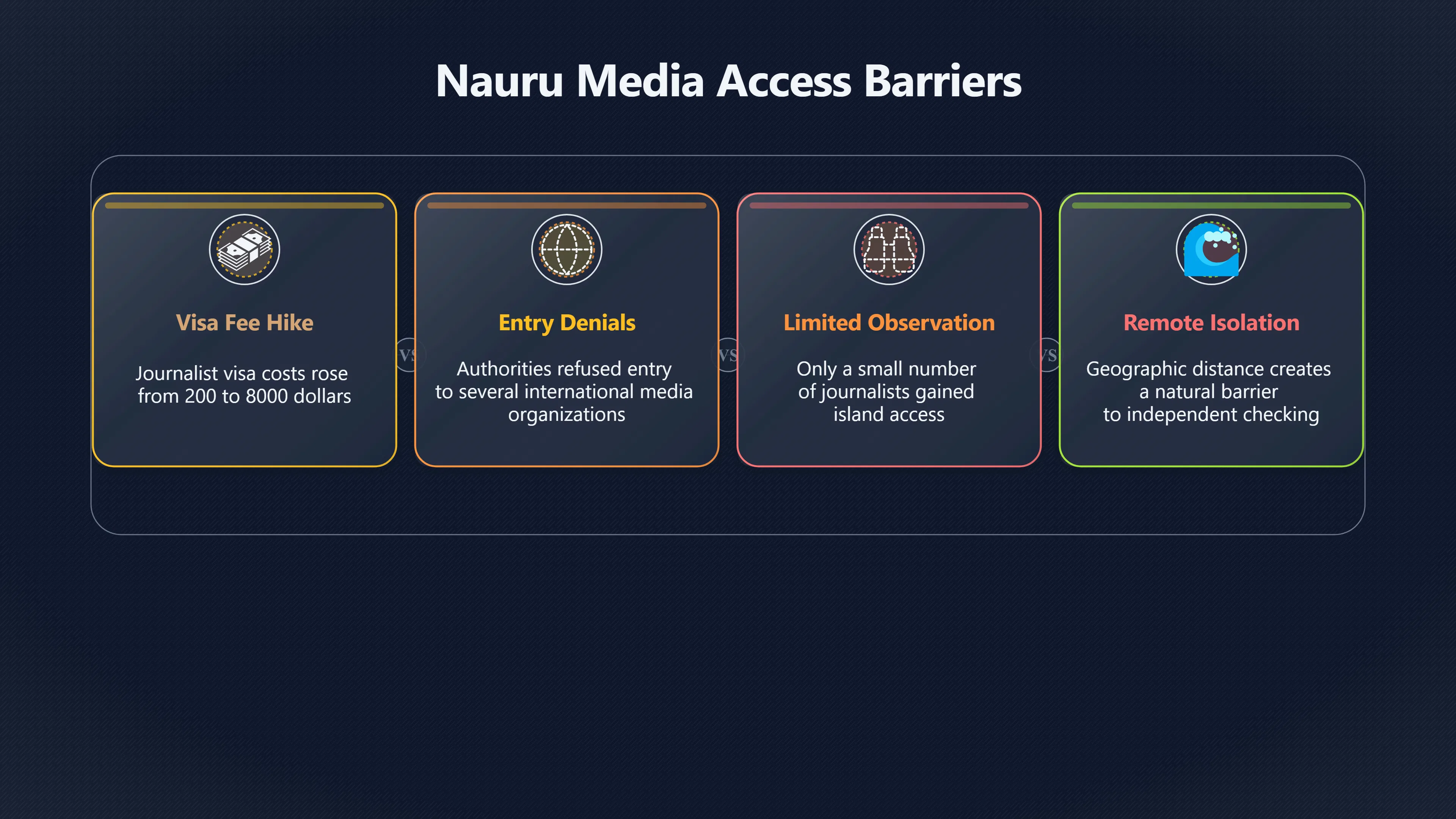
The most important fact about the controversy was that outsiders often struggled to investigate claims directly. Journalists, human-rights organisations and foreign observers repeatedly argued that access restrictions made independent verification unusually difficult.
In 2014, Nauru increased the cost of a foreign journalist visa from US$200 to US$8,000, with no guarantee of approval and no refund if an application was rejected. Critics argued that the policy discouraged scrutiny of the detention regime, while Nauruan authorities maintained that the fee was not intended to suppress reporting.[OUP Academic]academic.oup.comOUP AcademicSuffering to Save Lives: Torture, Cruelty, and Moral…by J Barnes · 2022 · Cited by 29 — Nauru has blocked journalists' acc…
Several international media organisations reported difficulty obtaining permission to enter the island. Human Rights Watch noted that only a very small number of journalists were granted access during key years of the controversy, while Amnesty International and Reporters Without Borders criticised what they described as growing barriers to independent reporting.[hrw.org]hrw.orgwhat nauru hiding danish lawmakersHuman Rights WatchWhat Nauru Is Hiding From Danish Lawmakers31 Aug 2016 — Access to the island is severely restricted – Nauru has issued…
The result was an unusual information environment:
- Many allegations originated from detainees, former staff members or leaked documents rather than on-site reporting.
- Government officials frequently challenged those allegations as exaggerated, politically motivated or inaccurate.
- Independent investigators often had to rely on interviews, internal records and second-hand testimony rather than unrestricted observation.
- Social media became an alternative channel through which detainees attempted to document their experiences directly.[PMC]pmc.ncbi.nlm.nih.govPMCSelf-represented witnessing: the use of social media byPMCSelf-represented witnessing: the use of social media by
This does not automatically prove any particular allegation. It does, however, explain why disputes over evidence became almost as important as the underlying events themselves.
Official Statements, Leaks and Rival Propaganda Claims
The controversy produced two broad and competing narratives.
One narrative, promoted by Australian and Nauruan officials at various times, held that conditions were being misrepresented by activists, political opponents and some sections of the media. Authorities argued that many reports ignored improvements, exaggerated isolated incidents or served broader campaigns against offshore processing. Nauru’s government publicly rejected some high-profile abuse allegations and accused critics of using the issue for political purposes.[Time]time.comNauru Rejects Claims of Refugee Abuse in Australian Detention CampsNauru Rejects Claims of Refugee Abuse in Australian Detention Camps
The opposing narrative came from detainees, whistle-blowers, human-rights organisations and some journalists. They argued that serious mistreatment, inadequate medical care, violence and psychological harm were being concealed behind a system of restricted access. Amnesty International, Human Rights Watch and other organisations published reports alleging widespread abuses and criticised both governments for limiting transparency.[amnesty.org.au]amnesty.org.auISLAND OF DESPAIR FINALProcessing Centre on Nauru is kept well-hidden from international scrutiny; most journalists are denied access and last year the…
Several developments intensified the conflict.
The Moss Review
One of the most significant official investigations was the 2015 Moss Review, commissioned after allegations of sexual assault and other misconduct. The review found that numerous allegations were credible and identified serious concerns requiring further action, although it did not validate every claim that had circulated publicly. Its significance lay in demonstrating that at least some accusations dismissed as rumours or exaggerations had sufficient evidence to warrant official concern.[Department of Home Affairs Website]homeaffairs.gov.auDepartment of Home Affairs Websitereview-conditions-circumstances-nauru.pdfDepartment of Home Affairs Websitereview-conditions-circumstances-nauru.pdf
The Nauru Files
In 2016, leaked incident reports known as the “Nauru Files” brought thousands of internal records into public view. The documents contained reports of self-harm, assaults, sexual allegations, child welfare concerns and other incidents. Supporters of the leak argued that it revealed patterns that officials had downplayed. Critics responded that incident reports record allegations and complaints rather than proven facts, and therefore could not automatically be treated as verified findings.[ABC News]abcnews.comABC News Allegations of Abuse of Asylum Seekers on Remote IslandABC News Allegations of Abuse of Asylum Seekers on Remote Island
This distinction became central to public debate. The leak provided evidence that incidents had been reported, but individual claims still required investigation and corroboration.
How to Separate Proven Falsehoods from Contested Evidence
One reason the Nauru detention controversy remains difficult to discuss is that different types of claims are often mixed together.
Some statements can be treated as established facts. For example, restrictions on media access, the high journalist visa fee, the existence of official inquiries, the publication of major leaks and the operation of Australia’s offshore processing system on Nauru are all matters of public record.[lowyinstitute.org]lowyinstitute.orgmedia access nauru australia s concernThe Lowy InstituteMedia access to Nauru is Australia's concern20 July 2016 — 'The presence on Nauru of media who have no respect for our…
Other claims occupy a more complicated category. Allegations of assault, abuse, neglect or misconduct may be supported by testimony, internal reports, medical evidence or investigative findings, yet still involve disputed details. In these cases, the strongest evidence usually comes from multiple independent sources reaching similar conclusions rather than from a single dramatic accusation. The Moss Review, parliamentary inquiries and reports from several human-rights organisations often carried more weight than isolated anecdotes because they drew on larger bodies of evidence.[homeaffairs.gov.au]homeaffairs.gov.auDepartment of Home Affairs Websitereview-conditions-circumstances-nauru.pdfDepartment of Home Affairs Websitereview-conditions-circumstances-nauru.pdf
A third category consists of claims that were asserted but never conclusively established. In an environment with limited transparency, some allegations could neither be fully confirmed nor definitively disproved. These unresolved claims helped fuel continuing arguments between supporters and critics of offshore detention.
For readers interested in questions of deception, misinformation and contested truth, this distinction is crucial. The Nauru story was rarely about a single fabricated claim. Instead, it was about how competing actors tried to shape public understanding when independent verification was unusually difficult.

What the Nauru Dispute Reveals About Truth and Secrecy
The most enduring lesson from Nauru is not that one side always lied and the other always told the truth. Rather, the controversy demonstrates how restricted access can transform political disputes into battles over credibility itself.
When journalists, observers and investigators cannot freely examine events, official statements gain importance because they may be among the few available sources. At the same time, leaks, whistle-blowers and personal testimony become more influential because they offer rare glimpses behind closed systems. Both sides then compete to persuade the public that their version deserves trust.
Within the broader history of contested truth in Nauru, the detention-centre debate therefore stands apart from straightforward frauds or hoaxes. It is better understood as a struggle over evidence, transparency and verification. The lasting question was not merely what happened inside the detention system, but who possessed enough access to know with confidence.[hrw.org]hrw.orgwhat nauru hiding danish lawmakersHuman Rights WatchWhat Nauru Is Hiding From Danish Lawmakers31 Aug 2016 — Access to the island is severely restricted – Nauru has issued…
Amazon book picks
Further Reading
Books and field guides related to Who Could Verify the Truth on Nauru?. Use these as the next step if you want deeper reading beyond the article.
No Friend But the Mountains
First-hand perspective on detention, access and contested narratives.
Manufacturing Consent
Useful for understanding competing narratives and information control.
On Tyranny
Explores transparency, accountability and the evaluation of official claims.

The Jakarta Method
Illustrates how states, secrecy and narratives interact in contentious political environments.
eBay marketplace picks
Marketplace Samples
Live-tested eBay searches with available results related to this page.



Endnotes
1.
Source: academic.oup.com
Link:https://academic.oup.com/jrs/article/35/4/1508/6646968
Source snippet
OUP AcademicSuffering to Save Lives: Torture, Cruelty, and Moral...by J Barnes · 2022 · Cited by 29 — Nauru has blocked journalists' acc...
2.
Source: amnesty.org
Title: nauru foreign media refused entry after refugee rape claims
Link:https://www.amnesty.org/en/latest/press-release/2015/10/nauru-foreign-media-refused-entry-after-refugee-rape-claims/
Source snippet
Amnesty InternationalNauru: Foreign media refused entry after refugee rape claims9 Oct 2015 — News that Nauru has refused Al Jazeera jour...
3.
Source: ishr.ch
Title: nauru lift the veil of secrecy on human rights
Link:https://ishr.ch/toolbox/resources/nauru-lift-the-veil-of-secrecy-on-human-rights/
Source snippet
Nauru: Lift the veil of secrecy on human rights26 Feb 2015 — (Geneva, Switzerland and Melbourne, Australia) – The Government of Nauru...
4.
Source: pmc.ncbi.nlm.nih.gov
Title: PMCSelf-represented witnessing: the use of social media by
Link:https://pmc.ncbi.nlm.nih.gov/articles/PMC5946660/
5.
Source: time.com
Title: Nauru Rejects Claims of Refugee Abuse in Australian Detention Camps
Link:https://time.com/4453670/nauru-files-refugee-abuse-australia/
6.
Source: amnesty.org
Link:https://www.amnesty.org/en/wp-content/uploads/2021/05/ASA4222792015ENGLISH.pdf
7.
Source: lowyinstitute.org
Title: media access nauru australia s concern
Link:https://www.lowyinstitute.org/the-interpreter/media-access-nauru-australia-s-concern
Source snippet
The Lowy InstituteMedia access to Nauru is Australia's concern20 July 2016 — 'The presence on Nauru of media who have no respect for our...
Published: July 2016
8.
Source: amnesty.org.au
Title: ISLAND OF DESPAIR FINAL
Link:https://www.amnesty.org.au/wp-content/uploads/2016/10/ISLAND-OF-DESPAIR-FINAL.pdf
Source snippet
Processing Centre on Nauru is kept well-hidden from international scrutiny; most journalists are denied access and last year the...
9.
Source: hrw.org
Title: what nauru hiding danish lawmakers
Link:https://www.hrw.org/news/2016/08/31/what-nauru-hiding-danish-lawmakers
Source snippet
Human Rights WatchWhat Nauru Is Hiding From Danish Lawmakers31 Aug 2016 — Access to the island is severely restricted – Nauru has issued...
10.
Source: hrw.org
Title: australia appalling abuse neglect refugees nauru
Link:https://www.hrw.org/news/2016/08/02/australia-appalling-abuse-neglect-refugees-nauru
11.
Source: hrw.org
Title: human rights watch submission committee rights child concerning nauru
Link:https://www.hrw.org/news/2016/09/13/human-rights-watch-submission-committee-rights-child-concerning-nauru
12.
Source: homeaffairs.gov.au
Title: Department of Home Affairs Websitereview-conditions-circumstances-nauru.pdf
Link:https://www.homeaffairs.gov.au/reports-and-pubs/files/review-conditions-circumstances-nauru.pdf
13.
Source: aph.gov.au
Link:https://www.aph.gov.au/Parliamentary_Business/Committees/Senate/Regional_processing_Nauru/Regional_processing_Nauru/~/media/Committees/nauru_ctte/Final_Report/c05.pdf
14.
Source: abcnews.com
Title: ABC News Allegations of Abuse of Asylum Seekers on Remote Island
Link:https://abcnews.com/International/nauru-files-allegations-abuse-asylum-seekers-remote-island/story?id=41298478
15.
Source: aph.gov.au
Link:https://www.aph.gov.au/parliamentary_business/committees/senate/legal_and_constitutional_affairs/completed_inquiries/2004-07/migration_unauthorised_arrivals/report/d02
16.
Source: homeaffairs.gov.au
Title: Independent Reviews
Link:https://www.homeaffairs.gov.au/reports-and-publications/reviews-and-inquiries/departmental-reviews/independent-reviews-regional-processing-centre-nauru
Additional References
17.
Source: rsf.org
Title: pacific island refusing all foreign media visa requests
Link:https://rsf.org/en/pacific-island-refusing-all-foreign-media-visa-requests
Source snippet
Reporters Sans FrontièresPacific island refusing all foreign media visa requests22 Oct 2015 — Reporters Without Borders condemns the Paci...
18.
Source: youtube.com
Link:https://www.youtube.com/watch?v=V2PdudG2jtc
Source snippet
Leaked Nauru report highlights 'appalling' refugee conditions...
19.
Source: youtube.com
Title: Child refugees detained on Nauru Island talk to CNN
Link:https://www.youtube.com/watch?v=EdTHUOumoMQ
Source snippet
How Australia got rid of illegal immigrants | 60 Minutes Australia...
20.
Source: globaldetentionproject.org
Link:https://www.globaldetentionproject.org/wp-content/uploads/2016/06/nauru_detention_profile.pdf
21.
Source: hrlc.org.au
Link:https://www.hrlc.org.au/explainers/timeline-offshore-detention/
22.
Source: idcoalition.org
Link:https://idcoalition.org/nauru-senate-inquiry-reveals-shocking-conditions-in-australian-run-detention-centre/
23.
Source: youtube.com
Title: Manus and Nauru: The Inside Story
Link:https://www.youtube.com/watch?v=7tlZcNlOLBM
Source snippet
Child refugees detained on Nauru Island talk to CNN...
24.
Source: reliefweb.int
Title: senate votes review allegations mistreatment nauru following moss report
Link:https://reliefweb.int/report/nauru/senate-votes-review-allegations-mistreatment-nauru-following-moss-report
25.
Source: theguardian.com
Title: only respectful and objective media outlets are welcome says nauru
Link:https://www.theguardian.com/world/2016/jun/22/only-respectful-and-objective-media-outlets-are-welcome-says-nauru
26.
Source: youtube.com
Title: Leaked Nauru report highlights ‘appalling’ refugee conditions
Link:https://www.youtube.com/watch?v=9bLRHd9W3Dk
Source snippet
Manus and Nauru: The Inside Story...
Topic Tree