Within Singapore Hoaxes
When Singapore's Symbols Began to Feel Ancient
The lion-sighting story and the modern Merlion show how repetition can make symbolism feel like documented history.
On this page
- What the Sang Nila Utama story actually claims
- How the Merlion was deliberately created
- Why repeated symbols gain historical authority
Page outline Jump by section
Introduction
Singapore’s best-known national symbols often feel far older than they really are. The founding story of Sang Nila Utama, the prince who supposedly saw a lion and named the island Singapura, is frequently retold as though it were a straightforward historical event. Meanwhile, the Merlion has become so familiar that many visitors assume it emerged from ancient folklore rather than from a twentieth-century tourism campaign. Together, these examples show how legends and symbols can acquire historical authority through repetition, education, official endorsement and cultural familiarity. They are not classic hoaxes in the sense of deliberate frauds. Instead, they demonstrate how stories that begin as courtly legend or modern branding can gradually take on the appearance of documented history.[BiblioAsia]biblioasia.nlb.gov.sgvol 16 issue 2 jul sep 2020 sang nilaSang Nila Utama: Separating Myth From Reality | BiblioAsia7 Jul 2020 — Singapore probably received its epithet “Lion City” beca…
Understanding this process matters because it reveals how collective memory works. People do not necessarily believe these stories because they have examined the evidence. They believe them because the stories appear everywhere: in textbooks, monuments, tourist attractions, official ceremonies and everyday conversation. Over time, familiarity itself becomes a form of authority.
What the Sang Nila Utama Story Actually Claims
According to the traditional account preserved in the Malay Annals, Sang Nila Utama arrived on the island then known as Temasek after surviving a storm at sea. While exploring the island, he reportedly saw a striking animal with a reddish body, dark head and white breast. His advisers identified it as a lion. Taking the sighting as a favourable omen, he founded a settlement and renamed the island Singapura, meaning “Lion City”.[Wikipedia]WikipediaSang Nila UtamaSang Nila Utama
The story occupies an unusual position between legend and history. Historians generally accept that Singapore was an important fourteenth-century trading settlement, and archaeological discoveries have confirmed the existence of a substantial pre-colonial centre on the island. What remains disputed is whether the lion encounter occurred as described, whether Sang Nila Utama was a historical individual in the modern sense, and whether the naming story should be interpreted literally.[Wikipedia]WikipediaSang Nila UtamaSang Nila Utama
The most obvious difficulty is zoological. Lions were not native to Singapore. Scholars have therefore proposed several possibilities:
- The animal may have been a tiger, which did live in the region.
- The description may have referred to a different creature entirely.
- The episode may have been symbolic from the beginning rather than a report of an actual sighting.
- The lion may have functioned as a royal and religious symbol rather than a biological observation.[nlb.gov.sg]biblioasia.nlb.gov.sgvol 16 issue 2 jul sep 2020 sang nilaSang Nila Utama: Separating Myth From Reality | BiblioAsia7 Jul 2020 — Singapore probably received its epithet “Lion City” beca…
Modern historians increasingly emphasise the symbolic interpretation. In many parts of South and Southeast Asia, lions represented sovereignty, sacred authority and kingship long before the story was written down. From that perspective, the lion episode may have been intended to legitimise rule and elevate the status of the new polity rather than record an encounter with wildlife.[BiblioAsia]biblioasia.nlb.gov.sgvol 16 issue 2 jul sep 2020 sang nilaSang Nila Utama: Separating Myth From Reality | BiblioAsia7 Jul 2020 — Singapore probably received its epithet “Lion City” beca…
How a Courtly Legend Became Historical Common Sense
The remarkable feature of the Sang Nila Utama story is not that it survived. Many societies preserve foundation legends. What is distinctive is how often the tale is repeated in ways that blur the boundary between symbolism and literal history.
Several factors strengthened its authority:
It offered a simple origin story. The idea that Singapore is the “Lion City” because a founder saw a lion is easy to remember and explain. Simplicity helps stories endure.
It connected modern Singapore to a deeper past. The narrative linked the contemporary state to a pre-colonial history extending centuries before British rule. This gave the legend cultural importance beyond the question of whether a lion was actually present.[Wikipedia]WikipediaMalay SingaporeansMalay Singaporeans
It was repeatedly institutionalised. School materials, public monuments, heritage displays and cultural references embedded the story in everyday life. Repetition transformed a traditional narrative into something many people encountered as historical fact.
It matched the city’s name. Because “Singapura” literally contains the Sanskrit-derived word for lion, the story appears self-confirming. The name reinforces the legend and the legend reinforces the name.[Wikipedia]WikipediaEarly history of SingaporeEarly history of Singapore
As a result, many people encounter the tale first as history and only later discover the scholarly debate surrounding it.
How the Merlion Was Deliberately Created
If the Sang Nila Utama story emerged from a centuries-old literary tradition, the Merlion represents almost the opposite phenomenon. Its origins are thoroughly documented and surprisingly recent.
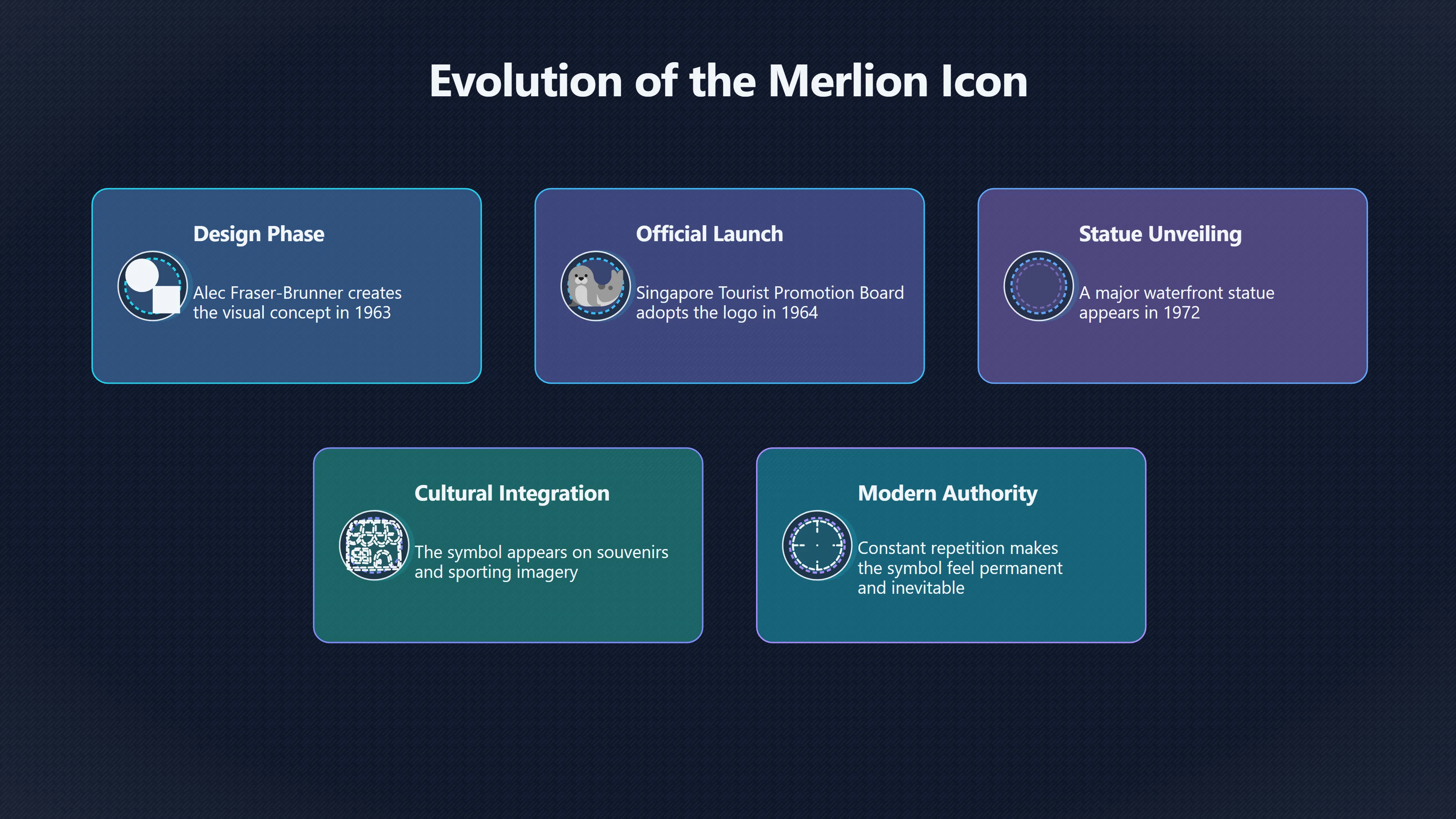
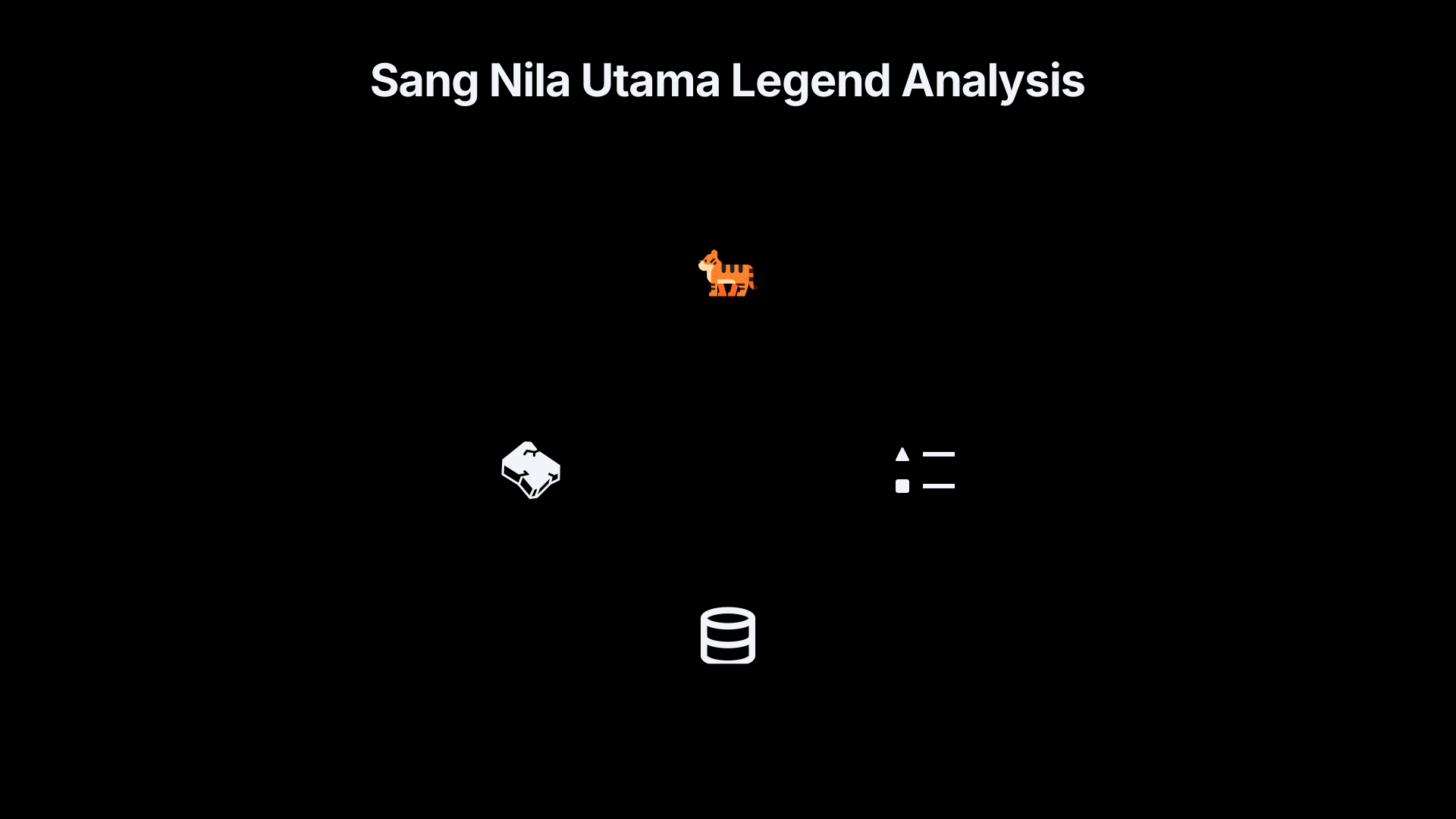
The Merlion was created in 1964 for the Singapore Tourist Promotion Board. British zoologist Alec Fraser-Brunner designed the symbol as part of an effort to promote the young destination internationally. The creature combined two elements: a lion’s head referencing the Singapura foundation legend and a fish body representing Singapore’s maritime heritage and earlier identity as Temasek.[roots.gov.sg]roots.gov.sgRoots Celebrating 50 Years of the Merlion: Stories Behindcreated in 1964 as the corporate logo for the Singapore Tourist Promotion Board (STPB). The Merlion's trademark was registered on 20 July…
The symbol quickly expanded beyond its original marketing role. The tourism board adopted it as its official logo, and in 1972 a major Merlion statue was unveiled on the waterfront. Over subsequent decades, the image appeared on souvenirs, promotional campaigns, monuments, sporting imagery and countless photographs.[nlb.gov.sg]nlb.gov.sgNational Library Board MerlionNational Library BoardMerlion - SingaporeRegarded as a Singapore icon, the Merlion was designed in 1964 for the Singapore Tourist Promoti…
Importantly, the Merlion was never presented as an ancient mythical creature discovered in folklore. Its creators openly described it as a modern design. The historical record is unusually clear about who conceived it, why it was created and when it entered public use.[Roots]roots.gov.sgRoots Celebrating 50 Years of the Merlion: Stories Behindcreated in 1964 as the corporate logo for the Singapore Tourist Promotion Board (STPB). The Merlion's trademark was registered on 20 July…
Why Repeated Symbols Gain Historical Authority
The Merlion demonstrates a broader cultural process. A symbol does not need ancient origins to feel ancient.
Over time, several developments changed how people perceived the Merlion:
- It became visually inseparable from Singapore itself.
- Millions of tourists encountered it as a national icon.
- Its image appeared alongside genuine historical narratives.
- New generations grew up seeing it everywhere without necessarily learning its twentieth-century origin.[National Library Board]nlb.gov.sgNational Library Board MerlionNational Library BoardMerlion - SingaporeRegarded as a Singapore icon, the Merlion was designed in 1964 for the Singapore Tourist Promoti…
The result is an example of what historians sometimes call an invented tradition: a modern creation that acquires the emotional weight and cultural authority usually associated with older customs. The Merlion did not become powerful because people were deceived about its origins. It became powerful because constant repetition made the symbol feel permanent and inevitable.[Roots]roots.gov.sgRoots Celebrating 50 Years of the Merlion: Stories Behindcreated in 1964 as the corporate logo for the Singapore Tourist Promotion Board (STPB). The Merlion's trademark was registered on 20 July…
A similar process affected the lion-city narrative. The story’s authority today depends less on proving that a lion stood on a beach centuries ago and more on the fact that the tale has been repeated across generations.
When Symbolism Is Mistaken for Evidence
The most interesting lesson from these Singaporean examples is that historical authority can emerge without intentional fraud.
The Sang Nila Utama story is best understood as a foundation legend whose symbolic meaning became intertwined with national history. The Merlion is best understood as a modern emblem whose success gave it the aura of ancient tradition. Neither case fits neatly into the category of hoax. Yet both illustrate how narratives gain credibility through familiarity, institutional endorsement and cultural usefulness.[BiblioAsia]biblioasia.nlb.gov.sgvol 16 issue 2 jul sep 2020 sang nilaSang Nila Utama: Separating Myth From Reality | BiblioAsia7 Jul 2020 — Singapore probably received its epithet “Lion City” beca…
For historians, the key distinction is between historical significance and literal accuracy. A story can shape a nation’s identity even if parts of it are symbolic. Likewise, a symbol can become culturally authentic even when its origins are recent and fully documented.
Singapore’s lion and its Merlion therefore reveal something broader about public memory. Repetition can make legends feel factual, and it can make modern inventions feel ancient. Once that process has occurred, questioning the story is often less important than understanding why the story became so persuasive in the first place.[nlb.gov.sg]biblioasia.nlb.gov.sgvol 16 issue 2 jul sep 2020 sang nilaSang Nila Utama: Separating Myth From Reality | BiblioAsia7 Jul 2020 — Singapore probably received its epithet “Lion City” beca…
Amazon book picks
Further Reading
Books and field guides related to When Singapore's Symbols Began to Feel Ancient. Use these as the next step if you want deeper reading beyond the article.
The Invention of Tradition
Directly relevant to symbols that acquire an aura of antiquity.
eBay marketplace picks
Marketplace Samples
Live-tested eBay searches with available results related to this page.



Endnotes
1.
Source: Wikipedia
Title: Sang Nila Utama
Link:https://en.wikipedia.org/wiki/Sang_Nila_Utama
2.
Source: Wikipedia
Title: Early history of Singapore
Link:https://en.wikipedia.org/wiki/Early_history_of_Singapore
3.
Source: Wikipedia
Title: Malay Singaporeans
Link:https://en.wikipedia.org/wiki/Malay_Singaporeans
4.
Source: Wikipedia
Title: Singapore Tourism Board
Link:https://en.wikipedia.org/wiki/Singapore_Tourism_Board
5.
Source: Wikipedia
Title: Tourism in Singapore
Link:https://en.wikipedia.org/wiki/Tourism_in_Singapore
6.
Source: Wikipedia
Link:https://en.wikipedia.org/wiki/Merlion
7.
Source: biblioasia.nlb.gov.sg
Title: vol 16 issue 2 jul sep 2020 sang nila
Link:https://biblioasia.nlb.gov.sg/all-sections/vol-16-issue-2-jul-sep-2020-sang-nila/
Source snippet
Sang Nila Utama: Separating Myth From Reality | BiblioAsia7 Jul 2020 — Singapore probably received its epithet “Lion City” beca...
8.
Source: nlb.gov.sg
Title: National Library Board Merlion
Link:https://www.nlb.gov.sg/main/article-detail?cmsuuid=f9c0fd6c-acfa-4eb0-8585-2aa155c1d74d
Source snippet
National Library BoardMerlion - SingaporeRegarded as a Singapore icon, the Merlion was designed in 1964 for the Singapore Tourist Promoti...
9.
Source: roots.gov.sg
Title: Roots Celebrating 50 Years of the Merlion: Stories Behind
Link:https://www.roots.gov.sg/stories-landing/stories/celebrating-50-years-of-the-merlion-stories-behind-the-national-icon/story
Source snippet
created in 1964 as the corporate logo for the Singapore Tourist Promotion Board (STPB). The Merlion's trademark was registered on 20 July...
10.
Source: sg101.gov.sg
Title: identity merlion
Link:https://www.sg101.gov.sg/resources/archives/identity-merlion/
Source snippet
MerlionBritish zoologist Alec Fraser-Brunner started working on the design of the Merlion in 1963, and it was officially adopted as...
11.
Source: historyhit.com
Title: Merlion Statue
Link:https://www.historyhit.com/locations/merlion-statue/
Additional References
12.
Source: resolve.cambridge.org
Link:https://resolve.cambridge.org/core/services/aop-cambridge-core/content/view/9BEB3BC272D41B2A784204A785373159/9789814951425c7_p65-76_CBO.pdf/the-inception-of-lion-city.pdf
Source snippet
Cambridge University Press & AssessmentThe Inception of Lion CityPrince Sang Nila Utama sailed to the coast of Temasek, glimpsed a powerf...
13.
Source: factsanddetails.com
Title: entry 3170
Link:https://factsanddetails.com/southeast-asia/Singapore/sub5_7a/entry-3170.html
Source snippet
Facts and DetailsLEGENDS, ARCHAEOLOGY AND 14TH CENTURY TRADETaking the sighting as an auspicious sign, Sang Nila Utama resolved to establ...
14.
Source: facebook.com
Link:https://www.facebook.com/groups/348293689060800/posts/1843333062890181/
15.
Source: instagram.com
Link:https://www.instagram.com/p/DaRoth5l2bF/
16.
Source: facebook.com
Link:https://www.facebook.com/thefullertonheritage/videos/merlion-park/906938727874016/
17.
Source: facebook.com
Link:https://www.facebook.com/EVAAirUS/posts/you-may-have-heard-about-singapores-iconic-emblem-the-merlion-the-merlion-is-a-m/3598715380239834/
18.
Source: facebook.com
Link:https://www.facebook.com/SEAheritagehistory/posts/-%F0%9D%97%A6%F0%9D%97%AE%F0%9D%97%BB%F0%9D%97%B4-%F0%9D%97%A1%F0%9D%97%B6%F0%9D%97%B9%F0%9D%97%AE-%F0%9D%97%A8%F0%9D%98%81%F0%9D%97%AE%F0%9D%97%BA%F0%9D%97%AE-the-brave-palembangese-prince-from-south-sumatera-modern-day-in/703791448984816/
19.
Source: facebook.com
Link:https://www.facebook.com/erci.fb/posts/did-you-know-singapores-famous-merlion-statue-was-actually-designed-in-1964-as-a/1109015417932176/
20.
Source: youtube.com
Title: A Thriving Singapore Before Stamford Raffles, From Orang Laut To Craftsmen
Link:https://www.youtube.com/watch?v=_PC7pM3DJYQ
Source snippet
Sang Nila Utama Founder of Singapore?...
21.
Source: youtube.com
Link:https://www.youtube.com/watch?v=Nx-0CPJCkP4&vl=en
Topic Tree