How Romania's Most Famous Deceptions Took Hold
Romania’s best-known stories of deception range from forged Dacian records and a dictator’s manufactured scientific career to a vast pyramid scheme, a fictional academic prize and tourist legends that blur folklore with fact. They did not succeed because Romanians were unusually credulous.
Page outline Jump by section
Introduction
Some cases were deliberate frauds. Others are better described as doubtful artefacts, commercial myth-making or paranormal folklore whose promoters present weak evidence more confidently than it deserves. Romania also offers an important warning against overzealous debunking: the strange Sponsian coins, long dismissed as modern fakes, have recently been defended as genuinely ancient, although their interpretation remains contested.[PLOS]journals.plos.orgAuthenticating coins of the 'Roman emperor' Sponsianby PN Pearson · 2022 · Cited by 5 — The 'Roman emperor' Sponsian is known only fr…
The Dacian past people wanted to discover
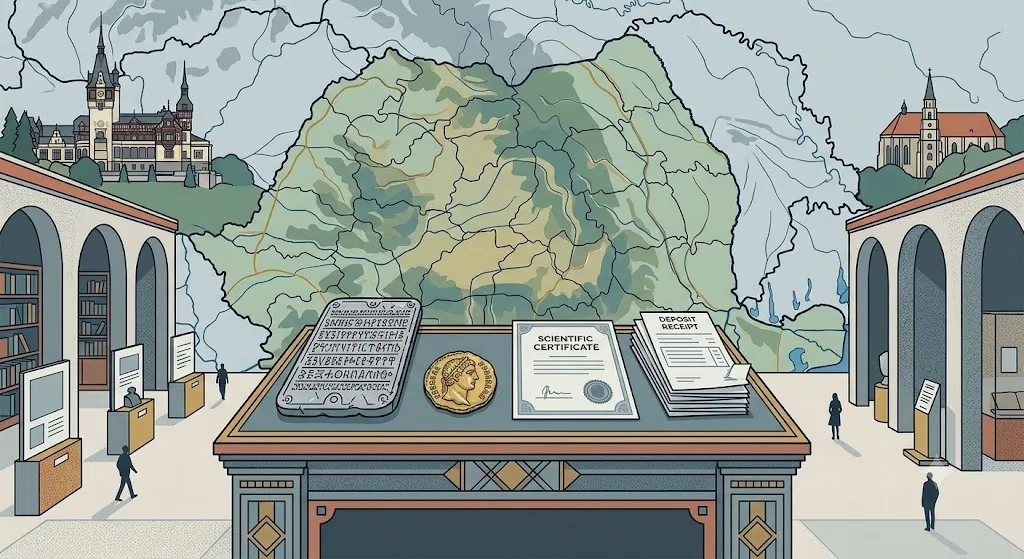
Ancient Dacia occupies a powerful place in Romanian national history. That makes supposed evidence of a lost Dacian civilisation especially attractive, whether the evidence is genuine, misunderstood or fabricated. The most famous disputed objects are the Sinaia lead plates: illustrated metal tablets bearing unfamiliar writing and scenes of rulers, armies, temples and settlements.
The plates supposedly reproduce a lost archive originally made of gold. According to the story, the gold originals were melted down in the nineteenth century, perhaps to help finance Peleș Castle, while lead copies preserved their contents. No reliable chain of custody supports that account, and none of the alleged gold originals has surfaced. Of roughly 200 reported lead plates, only about 35 are known to survive.[Wikipedia]WikipediaSinaia lead platesSinaia lead plates
Several features point towards a modern creation. Scientific analysis found lead resembling nineteenth-century printing material. The inscriptions combine Greek letters with signs and spellings that do not fit securely with the limited evidence for the Dacian language. They also appear to reflect historical knowledge available to nineteenth-century antiquarians, including at least one place-name form later shown to be inaccurate. Most specialists therefore treat the tablets as modern forgeries or fantasies rather than a genuine royal archive.[Wikipedia]WikipediaSinaia lead platesSinaia lead plates
Yet the plates remain popular because they offer something conventional archaeology cannot: a detailed written voice for a people whose own surviving texts are scarce. Their obscurity protects them. Every missing plate, unexplained symbol or unverified story about melted gold can be recast as evidence that institutions are concealing Romania’s true antiquity.
The Sinaia plates belong to a broader tradition sometimes called protochronism: the attempt to give Romanian civilisation exceptional priority in ancient history. Under Nicolae Ceaușescu, selective glorification of the Dacians became useful to nationalist state ideology. Later fringe theories went further, proposing a lost Dacian alphabet or claiming that Dacian was the source of Latin and other major languages—positions rejected by mainstream linguists and archaeologists.[Wikipedia]WikipediaOpen source on wikipedia.org.
The important distinction is that pride in Dacian heritage is not itself deceptive. The problem begins when patriotic desire is used to exempt an object or theory from normal tests: secure excavation records, material dating, linguistic comparison and independent examination.

When a suspected fake may not be fake
The Sponsian coins demonstrate why authentication is more complicated than simply labelling an unusual artefact fraudulent. The gold pieces, reportedly found in Transylvania in the early eighteenth century, depict a figure named Sponsian who appears in no accepted list of Roman emperors. Their designs mix elements from different periods, their inscriptions look crude and the coins appear cast rather than struck. For generations, specialists regarded them as poorly made modern forgeries.
A 2022 study challenged that judgement. Researchers used microscopy and spectroscopy on coins held by the Hunterian museum in Glasgow. They reported deep wear marks resembling those on genuinely circulated ancient coins, along with mineral deposits which they argued were consistent with long burial. The authors suggested that the pieces may have been emergency money produced in isolated Roman Dacia during the third-century crisis, perhaps under a local military ruler.[PLOS]journals.plos.orgAuthenticating coins of the 'Roman emperor' Sponsianby PN Pearson · 2022 · Cited by 5 — The 'Roman emperor' Sponsian is known only fr…
The resulting headlines often went further, announcing the discovery of a forgotten Roman emperor. That remains an inference, not an established fact. Critics argue that artificial wear or later contamination cannot be excluded and that the objects’ extraordinary weight, confused imagery and irregular manufacture still resemble early modern inventions. Even members of the research project have clarified that evidence for an ancient date would not automatically prove that Sponsian was a real emperor.[Antigone]antigonejournal.comAntigone Sponsian: Another Lost EmperorAntigoneSponsian: Another Lost Emperor - Antigone27 Nov 2022 — Every aspect of this coin, from the name, to the gold, to the reverse imag…
This is therefore not a simple tale of either fraud or vindication. It is a lesson in keeping separate questions apart. A coin can be old without accurately recording a historical ruler; it can have circulated without being official currency; and a scientific test can strengthen authenticity without resolving every historical problem.
The state-manufactured scientist
Elena Ceaușescu’s career is Romania’s clearest example of institutional imposture. As the wife of communist leader Nicolae Ceaușescu, she was presented domestically and abroad as an internationally important polymer chemist. Her name appeared on scientific articles, books and patents, while universities and professional organisations granted her honours.
The reputation was largely manufactured through political power. Researchers and historians have described how qualified scientists wrote or supplied work attributed to her, while institutions treated her as an authority they could not safely contradict. Her doctoral credentials and publication record were not merely personal embellishments: they formed part of the regime’s personality cult, presenting the ruling couple as intellectually superior architects of national progress.[ubc.ca]open.library.ubc.caOpen source on ubc.ca.
The deception worked because every layer appeared to confirm the next. State media called her a great scientist. Research institutes gave her senior positions. Publications carrying her name created a paper trail. Foreign institutions, influenced by diplomatic considerations and apparently reassured by existing honours, added further awards. Prestige became self-replicating.
After the communist regime fell in December 1989, Romanian scientists publicly rejected her claimed achievements. The problem did not disappear, however. Publications attributed to her remained in catalogues and continued to receive citations. In 2021, Romanian researchers called on publishers and institutions to remove or formally correct works falsely bearing her authorship and to reconsider honorary distinctions.[The Guardian]theguardian.comThe Guardianthe long tail of Elena Ceaușescu's fraudulent scientific workThe Guardianthe long tail of Elena Ceaușescu's fraudulent scientific work
Her case matters beyond the absurdity of an unqualified political figure being acclaimed as a chemist. It shows how fraud can become embedded in systems that normally signal reliability. A journal article, doctorate or honorary fellowship is persuasive because readers assume earlier checks have taken place. Under authoritarian pressure, those checks can become ceremonial, leaving later generations to untangle a false scholarly record.
Caritas and the promise of effortless wealth
Romania’s largest popular fraud emerged not from ancient history or dictatorship but from the chaotic transition to capitalism. Founded by Ioan Stoica in 1992, Caritas described itself as a mutual-aid game. Participants were promised returns several times larger than their deposits after only a few months. Early investors were paid from the money supplied by later entrants—the defining mechanism of a Ponzi or pyramid scheme.
The offer was economically impossible, but it arrived at an unusually persuasive moment. Inflation was eroding savings, familiar state structures were disappearing and many people had little experience of commercial finance. Caritas seemed to offer ordinary families a route through the insecurity of post-communist reform. Visible payouts to early participants made the promise appear proven rather than speculative.[JSTOR]jstor.orgOpen source on jstor.org.
Political and civic respectability strengthened the illusion. Caritas operated from Cluj-Napoca, received support from prominent local figures and published long lists of people due to be paid. Crowds, offices and newspaper pages full of apparent winners served as advertising. Estimates of participation vary widely, but the scheme drew in millions of people and sums measured in billions of dollars before it failed in 1994.[Wikipedia]WikipediaCaritas (Ponzi schemeCaritas (Ponzi scheme
Warnings existed well before the collapse. Economists explained that no legitimate investment could repeatedly multiply deposits at the advertised rate. Officials were reportedly reluctant to intervene decisively, partly because of Caritas’s popularity and the possibility of public unrest. By the time payments slowed, the scheme had become socially difficult to challenge: critics were accused of trying to destroy an opportunity that appeared to be helping ordinary citizens.
Caritas exposes a central feature of mass fraud. The most persuasive evidence is often not a forged balance sheet but another person receiving money. Real early payments create authentic witnesses whose testimony spreads the false conclusion that the system itself is sustainable. When a scheme becomes large enough, its crowds and political connections can be mistaken for proof of solvency.
Dracula’s castle and the sale of a useful legend
Bran Castle is routinely promoted internationally as Dracula’s Castle. The label is commercially effective but historically weak. Bram Stoker never visited Romania, and there is no solid evidence that Bran directly inspired the castle described in his 1897 novel. Vlad III, the fifteenth-century Wallachian ruler commonly called Vlad the Impaler and later linked with Count Dracula, did not make Bran his long-term residence. His connection to the site was limited at most.[Dracula's Castle]dracula-castle.roOpen source on dracula-castle.ro.
Calling this a straightforward hoax would be too strong. Bran is a real medieval castle with an important history, including its later use as a royal residence. Dracula is openly treated as fiction in many exhibitions and tourist materials. Visitors generally understand that they are entering a mixture of history, literature and entertainment.
The misleading element appears when three different subjects are compressed into one supposedly factual story:
- Stoker’s fictional Transylvanian count;
- Vlad the Impaler, a historical ruler based mainly in Wallachia;[bran castle]bran-castle.comSource details in endnotes. le, whose appearance suits modern expectations of a Gothic vampire fortress.
The association survives because it benefits nearly everyone involved. Tour operators gain an immediately recognisable attraction, visitors receive a physical setting for a famous novel, and the region gains an international cultural brand. Repetition then performs the work of evidence: once enough guidebooks and websites call Bran Dracula’s Castle, the connection begins to seem ancient.
The case illustrates the difference between an invented tradition and a fraudulent claim. Tourist myth-making often develops gradually, without a single identifiable deceiver. Its danger is not that people enjoy a fictional association, but that the marketable story overwhelms the castle’s actual history.
Hoia-Baciu and the manufacture of a haunted landscape
The Hoia-Baciu forest outside Cluj-Napoca has been called the world’s most haunted forest and the Bermuda Triangle of Transylvania. Stories describe ghosts, disappearances, physical sickness, failing electronic equipment and a circular clearing where unusual forces supposedly operate.
Its modern paranormal reputation crystallised around photographs taken in 1968 by Emil Barnea, a military technician who said that he had captured an unidentified flying object above the trees. The grainy images show a disc-like shape, but they do not provide enough information to determine its scale, distance or nature. They have never established the presence of an extraterrestrial craft.[IFLScience]iflscience.comHoia Baciu Forest: Why The "Bermuda TriangleHoia Baciu Forest: Why The "Bermuda Triangle
Later storytelling added missing shepherds, children returning years after disappearing, portals and unexplained bodily symptoms. Many of these accounts lack contemporary police records, named witnesses or other evidence by which they could be checked. The forest’s bent trees and open clearings are real, but strangeness in appearance does not establish a paranormal cause.
Hoia-Baciu is best understood as layered folklore rather than one planned hoax. Photographs, local tales, television programmes, ghost-hunting technology and paid night tours reinforce one another. An electromagnetic-field meter may react to a phone or nearby electrical source, yet in a haunted setting any fluctuation can feel meaningful. A visitor primed to expect nausea or anxiety may interpret ordinary sensations as evidence of the forest’s power.
The legend has also acquired a practical interest: paranormal tourism gives the woodland economic visibility and may encourage efforts to protect it from development. That does not authenticate supernatural claims, but it helps explain why the stories endure even among people who treat them playfully rather than literally.[The Guardian]theguardian.comDespite its fame among paranormal enthusiasts, Hoia-Baciu faces threats from urban development, as it lacks formal environmental protecti…
The fake Nobel that official prestige nearly endorsed
In 2018 and 2019, Romania became the setting for the exposure of an unusually elaborate academic imposture. French lecturer Florent Montaclair promoted a supposed Gold Medal of Philology, presented as a distinction of exceptional international standing. It was supported by professional-looking websites for an International Society of Philology and a University of Philology and Education.
The proposed Romanian recipient was Eugen Simion, a former president of the Romanian Academy. News of the award was repeated by Romanian media and attracted political support, including plans for a ceremony connected with the European Parliament. The claim seemed credible because it arrived wrapped in the language and symbols of academic authority: letterheads, institutional titles, international committees and a list of eminent recipients.[scena9.ro]scena9.roromanian academy nobel florent montaclair chomskyromanian academy nobel florent montaclair chomsky
Journalists at the Romanian cultural publication Scena9 investigated instead of repeating the announcement. They found that the supposed university and learned society appeared to exist chiefly as websites linked back to Montaclair. Claims about the medal’s status, membership and institutional backing could not be independently verified. The planned Romanian ceremony was cancelled after the investigation.[scena9.ro]scena9.roromanian academy nobel florent montaclair chomskyromanian academy nobel florent montaclair chomsky
The story resurfaced prominently in France in 2025 and 2026, when university and legal authorities began examining whether fabricated distinctions or qualifications had been used for professional advantage. Montaclair disputed the characterisation of the medal as a hoax, describing it as an unsuccessful attempt to create a new academic award. That defence leaves the central problem intact: recipients and public bodies were encouraged to treat the organisation as an established international authority rather than a project controlled by its promoter.[The Guardian]theguardian.comThe Guardian French professor accused of 'gigantic hoax' after inventingThe Guardian French professor accused of 'gigantic hoax' after inventing
The episode is memorable because the Romanian institutions initially appeared to be the victims, yet Romanian journalism supplied the decisive scrutiny. A basic verification exercise—checking legal existence, staff, premises, independent references and a documented selection process—proved more valuable than the impressive names surrounding the prize.
What Romania’s famous fakes have in common
These cases used different methods, but their persuasive force came from a small set of recurring mechanisms.
They supplied visible signs of authority. The Sinaia plates looked like ancient documents. Elena Ceaușescu accumulated titles and publications. The fake philology prize had websites, seals and formal letters. Caritas had offices, political patrons and printed lists.
They answered an existing desire. The plates promised access to a glorious Dacian past. The Ceaușescu cult advertised national scientific achievement. Caritas offered protection from economic insecurity. Dracula and Hoia-Baciu give visitors the mysterious Transylvania they expect to encounter.
They made repetition look like independent confirmation. One newspaper copied another; one institution trusted honours granted elsewhere; one tourist account repeated an older guidebook. A claim appearing in ten places may still derive from a single unsupported source.
They blurred categories. Fiction became tourism, folklore became testimony, political propaganda became scholarship and early Ponzi payments became apparent proof of investment success. Effective deception often depends less on inventing everything than on moving genuine elements into a misleading frame.
Romania’s history of hoaxes is therefore also a history of exposure. Archaeologists compared materials and language; economists explained impossible returns; scientists challenged false authorship; and journalists checked whether grand institutions existed beyond their websites. The central lesson is not to reject every strange claim. It is to ask what kind of evidence should exist if the claim were true—and whether that evidence can be examined independently.
Amazon book picks
Further Reading
No matched book cards were available for How Romania's Most Famous Deceptions Took Hold, so this fallback keeps a direct Amazon reading path visible.
Topical books
Florent Montaclair guide
Browse books, explainers and reference titles related to this topic.
Search AmazonRelated search
Caritas Ponzi scheme guide
Browse books, explainers and reference titles related to this topic.
Search AmazonRelated search
Elena Ceaușescu guide
Browse books, explainers and reference titles related to this topic.
Search AmazonEndnotes
1.
Source: journals.plos.org
Link:https://journals.plos.org/plosone/article?id=10.1371%2Fjournal.pone.0274285
Source snippet
Authenticating coins of the 'Roman emperor' Sponsianby PN Pearson · 2022 · Cited by 5 — The 'Roman emperor' Sponsian is known only fr...
2.
Source: Wikipedia
Title: Sinaia lead plates
Link:https://en.wikipedia.org/wiki/Sinaia_lead_plates
3.
Source: Wikipedia
Link:https://en.wikipedia.org/wiki/Dacianism
4.
Source: open.library.ubc.ca
Link:https://open.library.ubc.ca/media/stream/pdf/52966/1.0435640/6
5.
Source: pubs.acs.org
Link:https://pubs.acs.org/doi/10.1021/cen-v068n007.p021
6.
Source: jstor.org
Link:https://www.jstor.org/stable/179204
7.
Source: Wikipedia
Title: Caritas (Ponzi scheme)
Link:https://en.wikipedia.org/wiki/Caritas_%28Ponzi_scheme%29
8.
Source: iflscience.com
Title: Hoia Baciu Forest: Why The “Bermuda Triangle
Link:https://www.iflscience.com/hoia-baciu-forest-why-the-bermuda-triangle-of-transylvania-continues-to-mystify-and-spook-82355
9.
Source: scena9.ro
Title: romanian academy nobel florent montaclair chomsky
Link:https://www.scena9.ro/en/article/romanian-academy-nobel-florent-montaclair-chomsky
10.
Source: nature.com
Link:https://www.nature.com/articles/488253a
11.
Source: theplosblog.plos.org
Title: ancient roman coin only clue that roman leader named sponsian ever existed
Link:https://theplosblog.plos.org/2022/11/ancient-roman-coin-only-clue-that-roman-leader-named-sponsian-ever-existed/
12.
Source: Wikipedia
Title: Holocaust denial
Link:https://en.wikipedia.org/wiki/Holocaust_denial
13.
Source: Wikipedia
Title: Elena Ceaușescu
Link:https://en.wikipedia.org/wiki/Elena_Ceau%C8%99escu
14.
Source: bran-castle.com
Link:https://www.bran-castle.com/en/
15.
Source: antigonejournal.com
Title: Antigone Sponsian: Another Lost Emperor
Link:https://antigonejournal.com/2022/11/sponsian-fake-emperor/
Source snippet
AntigoneSponsian: Another Lost Emperor - Antigone27 Nov 2022 — Every aspect of this coin, from the name, to the gold, to the reverse imag...
16.
Source: theguardian.com
Title: The Guardianthe long tail of Elena Ceaușescu’s fraudulent scientific work
Link:https://www.theguardian.com/world/2021/dec/22/a-moral-issue-to-correct-the-long-tail-of-elena-ceausescus-fraudulent-scientific-work
17.
Source: dracula-castle.ro
Link:https://dracula-castle.ro/history-of-the-dracula-castle/
18.
Source: theguardian.com
Link:https://www.theguardian.com/travel/2025/oct/30/worlds-most-haunted-forest-transylvania-romania
Source snippet
Despite its fame among paranormal enthusiasts, Hoia-Baciu faces threats from urban development, as it lacks formal environmental protecti...
19.
Source: theguardian.com
Title: The Guardian French professor accused of ‘gigantic hoax’ after inventing
Link:https://www.theguardian.com/world/2026/may/07/french-professor-florent-montaclair-accused-award-prize
20.
Source: theguardian.com
Title: coins study suggests fake emperor sponsian was real say scientists
Link:https://www.theguardian.com/science/2022/nov/23/coins-study-suggests-fake-emperor-sponsian-was-real-say-scientists
21.
Source: thedarkatlas.com
Link:https://thedarkatlas.com/posts/bran-castle-dracula-romania
22.
Source: scribd.com
Title: Bran Castle Engleza
Link:https://www.scribd.com/document/233017031/Bran-Castle-Engleza
23.
Source: draculas-castle.com
Title: bran castle history between historical reality and dracula legends
Link:https://draculas-castle.com/bran-castle-history-between-historical-reality-and-dracula-legends/
24.
Source: jahernandez.com
Title: bran castle and the truth behind the dracula legend
Link:https://www.jahernandez.com/posts/bran-castle-and-the-truth-behind-the-dracula-legend
Additional References
25.
Source: academia.edu
Link:https://www.academia.edu/42810503/Of_Romans_Dacians_and_Romanians
Source snippet
Academia(PDF) Of Romans, Dacians and RomaniansIn this article we explore the historical process of how the Romans and Dacians have endure...
26.
Source: lemonde.fr
Link:https://www.lemonde.fr/en/m-le-mag/article/2026/04/19/the-gold-medal-for-deception-how-a-professor-created-an-international-award-out-of-thin-air_6752586_117.html
Source snippet
The deception ran undetected for nearly a decade, boosted by media coverage, official honors, and widespread institutional gullibility, u...
27.
Source: ucl.ac.uk
Title: University College London Ancient Roman coins reveal long-lost emperor
Link:https://www.ucl.ac.uk/news/2022/nov/ancient-roman-coins-reveal-long-lost-emperor
Source snippet
University College LondonAncient Roman coins reveal long-lost emperor - London23 Nov 2022 — A gold coin long dismissed as a forgery appea...
28.
Source: researchgate.net
Title: 392525406 The ‘Roman emperor’ Sponsian update from the project team
Link:https://www.researchgate.net/publication/392525406The%27Roman_emperor%27_Sponsian_update_from_the_project_team
Source snippet
The 'Roman emperor' Sponsian: update from the project team9 Jun 2025 — The coins are very deeply worn, with wear patterns whi...
29.
Source: theartnewspaper.com
Title: lost art the possibly forged but tantalising sinaia lead plates
Link:https://www.theartnewspaper.com/2018/12/04/lost-art-the-possibly-forged-but-tantalising-sinaia-lead-plates
Source snippet
The Art NewspaperLost art: the possibly forged but tantalising Sinaia lead plates4 Dec 2018 — Sinaia lead plates, which are supposedly ca...
30.
Source: youtube.com
Title: Gold coin proves ‘fake’ Roman emperor was real
Link:https://www.youtube.com/watch?v=8B0s4lyAqDY
Source snippet
Archaeological forgeries or the history that never happened...
31.
Source: youtube.com
Title: “New” Roman Emperor Sponsian (Real or Fake?) DOCUMENTARY
Link:https://www.youtube.com/watch?v=xQXwKTEVt9I
Source snippet
Gold coin proves 'fake' Roman emperor was real - BBC News...
32.
Source: youtube.com
Title: Archaeological forgeries or the history that never happened
Link:https://www.youtube.com/watch?v=zlP6DI-tank
Source snippet
Global Debt Survival: A Modern Ponzi Scheme?...
33.
Source: academia.edu
Link:https://www.academia.edu/29757783/Dracula_Tourism_in_Romania_From_National_to_Local_Tourism_Strategies
34.
Source: researchgate.net
Link:https://www.researchgate.net/publication/407243542_The_Sinaia_Lead_Plates_A_Reassessment_of_a_Contested_Epigraphic_and_Iconographic_Corpus
Amazon book picks
Further Reading
Books and field guides related to How Romania's Most Famous Deceptions Took Hold. Use these as the next step if you want deeper reading beyond the article.
In Search of Romania
Helps explain the environment in which famous deceptions emerged.
The Devil in History
Useful for understanding authoritarian narratives in Eastern Europe.
The Romanian Revolution of December 1989
Explores competing narratives and political myths.
Topic Tree
Follow this branch
Related pages 192
- Albanian Hoaxes
- Algerian Hoaxes
- Antigua Deceptions
- Argentina Hoaxes
- Armenian Hoaxes
- +187 more in sidebar