Within Turkey Hoaxes
How Fake Antiquities Rewrote Anatolia's Ancient Past
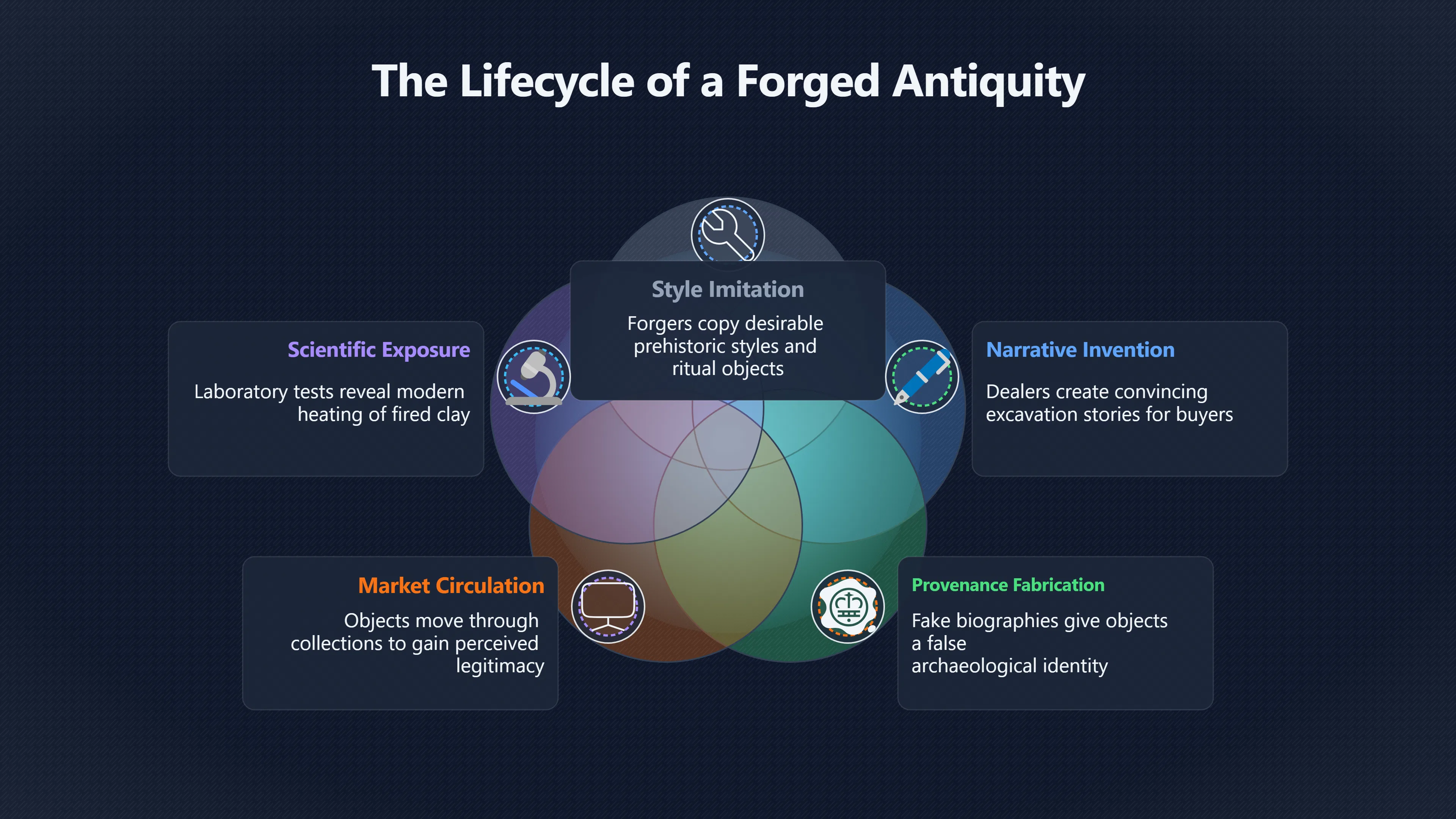
Modern workshops copied desirable prehistoric styles so convincingly that museums needed scientific testing to separate ancient objects from recent fakes.
On this page
- Why Anatolian objects became valuable targets
- The Hacilar style figurines exposed by testing
- How accepted fakes distorted scholarship and collecting
Page outline Jump by section
Introduction
Turkey’s extraordinary archaeological wealth has created a less glamorous shadow history: a thriving trade in fake antiquities. For much of the twentieth century, collectors, dealers and even major museums competed for prehistoric Anatolian objects that seemed to offer direct connections to some of the world’s earliest farming communities. Demand rose faster than secure archaeological evidence. Into that gap stepped skilled forgers who copied desirable styles, invented convincing excavation stories and supplied a market that often preferred exciting discoveries to awkward questions about provenance. The result was more than a commercial fraud. Fake artefacts entered museum collections, academic publications and popular accounts of Anatolia’s ancient past, forcing archaeologists to rethink how authenticity is established and how easily modern creations can rewrite history.[time.com]time.comscience the fakes of hacilarScience: The Fakes of Hacilar5 Sept 1971 — Few things anger archaeologists and art historians more than being taken in by fake antiqu…

Why Anatolian Objects Became Valuable Targets
The conditions that encouraged forgery were unusually favourable. Anatolia contains some of the most important prehistoric sites in the Near East, including settlements associated with the origins of farming and village life. Excavations at places such as Hacılar attracted international attention during the 1950s and 1960s, while the art market developed a strong appetite for small prehistoric figurines, painted pottery and ritual objects said to come from early Anatolian cultures.[ResearchGate]researchgate.netResearch Gate(PDF) Revisiting HacılarResearchGate(PDF) Revisiting HacılarJanuary 1, 2014 — Neolithic figurines as symbols; and the ever-recurring problem of the Hacılar fakes…
Several factors made the market vulnerable:
- Many objects appeared through dealers rather than controlled excavations.
- Buyers often accepted vague claims that pieces came from old private collections.
- Small clay figurines were relatively easy to copy using traditional materials and techniques.
- Genuine examples were rare and highly valuable, making successful forgery financially attractive.[Wikipedia]WikipediaOscar White MuscarellaOscar White Muscarella
The market rewarded stories as much as artefacts. An object supposedly linked to a famous prehistoric culture could become far more valuable than an otherwise similar piece with no documented origin. Forgers therefore learned to imitate not only ancient styles but also the narratives collectors expected to hear.[Wikipedia]WikipediaOscar White MuscarellaOscar White Muscarella
The Hacılar-Style Figurines Exposed by Testing
The most famous example involved figurines attributed to Hacılar, a prehistoric site in south-western Turkey excavated by James Mellaart. Genuine Hacılar finds included distinctive painted pottery and female figurines that became iconic images of Anatolian prehistory. Their popularity created an immediate market for similar objects.[ResearchGate]researchgate.netResearch Gate(PDF) Revisiting HacılarResearchGate(PDF) Revisiting HacılarJanuary 1, 2014 — Neolithic figurines as symbols; and the ever-recurring problem of the Hacılar fakes…
By the late 1960s and early 1970s, doubts were growing about the large number of supposedly ancient Hacılar-style figurines appearing in collections. Some examples looked unusually pristine. Others displayed combinations of features that archaeologists found suspicious. Laboratory testing eventually transformed the debate. Thermoluminescence analysis—a method that estimates when fired clay was last heated—showed that a number of celebrated figurines were modern creations rather than prehistoric artefacts.[Time]time.comscience the fakes of hacilarScience: The Fakes of Hacilar5 Sept 1971 — Few things anger archaeologists and art historians more than being taken in by fake antiqu…
The revelations were embarrassing because several of the objects had already been accepted as authentic. According to contemporary reporting, the tests demonstrated that pieces regarded as important examples of Anatolian prehistoric art had in fact been manufactured in recent times and sold into respected collections.[Time]time.comscience the fakes of hacilarScience: The Fakes of Hacilar5 Sept 1971 — Few things anger archaeologists and art historians more than being taken in by fake antiqu…
What made the episode especially significant was the quality of the forgery. These were not crude tourist souvenirs. The makers had studied genuine archaeological material closely enough to deceive experienced specialists. Scientific examination succeeded where visual judgement alone had failed.[Time]time.comscience the fakes of hacilarScience: The Fakes of Hacilar5 Sept 1971 — Few things anger archaeologists and art historians more than being taken in by fake antiqu…
How Accepted Fakes Distorted Scholarship and Collecting
The damage caused by forged antiquities extends beyond financial loss. Archaeology depends heavily on context: where an object was found, what lay beside it and how it relates to other evidence. A convincing fake enters the historical record carrying false information.[Wikipedia]WikipediaOscar White MuscarellaOscar White Muscarella
In the case of Anatolian figurines, accepted forgeries affected discussions about:
- Religious practices in prehistoric communities.
- The appearance and symbolism of female figurines.
- Regional artistic traditions.
- The spread of cultural influences across ancient Anatolia.[ResearchGate]researchgate.netResearch Gate(PDF) Revisiting HacılarResearchGate(PDF) Revisiting HacılarJanuary 1, 2014 — Neolithic figurines as symbols; and the ever-recurring problem of the Hacılar fakes…
Once published, dubious objects could be cited repeatedly by later researchers. The problem was not merely that individual artefacts were false; entire interpretations could be built upon evidence that never existed in antiquity. This concern became a recurring theme in critiques of the antiquities trade by archaeologists such as Oscar White Muscarella, who argued that objects lacking secure excavation records should be treated with extreme caution regardless of how impressive they appeared.[Wikipedia]WikipediaOscar White MuscarellaOscar White Muscarella
Muscarella’s broader argument was that the antiquities market encourages both looting and forgery. When collectors pay high prices for undocumented artefacts, they create incentives for people to manufacture convincing objects and invent plausible histories for them. In that sense, forged artefacts and illicitly excavated artefacts are connected problems: both sever the link between objects and reliable archaeological evidence.[Wikipedia]WikipediaOscar White MuscarellaOscar White Muscarella
The Market Mechanism Behind the Fraud
The success of fake Anatolian antiquities was not primarily the work of a single master forger. It emerged from a system in which multiple participants benefited from uncertainty.
Dealers could sell attractive objects with little documentation. Collectors gained the prestige of owning apparently rare pieces. Museums sometimes acquired material that filled gaps in their collections. Academic specialists occasionally encountered objects only after they had already entered circulation. Each step increased the appearance of legitimacy.[Wikipedia]WikipediaOscar White MuscarellaOscar White Muscarella
A forged figurine that passed through several collections could begin to look authentic simply because it had a history of ownership. Provenance—the documented chain of custody—became almost as valuable as the object itself. Forgers therefore learned to fabricate biographies as well as artefacts. Muscarella famously described this process as the creation of false proveniences that gave market objects an archaeological identity they never possessed.[Wikipedia]WikipediaOscar White MuscarellaOscar White Muscarella
Research on archaeological forgery in Turkey has highlighted how difficult the problem remains. Visual inspection alone is often insufficient, especially for small portable objects. Increasingly, specialists rely on chemical analysis, thermoluminescence testing, microscopic examination and other scientific techniques to distinguish genuine artefacts from sophisticated modern copies.[ResearchGate]researchgate.netResearch Gate(PDF) Archaeological fakes and forgeries in Turkeyfake items in. Turkish museums: coins, statues, small finds, pottery and… Imitation of archeological artifacts or replacing the authen…
What the Fake Antiquities Episode Reveals
The story of fake Anatolian antiquities is not simply a tale of counterfeit objects. It demonstrates how archaeological knowledge can be shaped by market incentives. The most convincing forgeries succeeded because they matched what collectors, scholars and the public hoped to find: elegant relics from one of humanity’s earliest civilisations.[Time]time.comscience the fakes of hacilarScience: The Fakes of Hacilar5 Sept 1971 — Few things anger archaeologists and art historians more than being taken in by fake antiqu…
The exposure of Hacılar-style fakes helped push archaeology toward stricter standards of provenance and scientific verification. Today, an undocumented artefact may attract more suspicion than admiration, precisely because earlier generations learned how easily attractive objects could deceive experts.[time.com]time.comscience the fakes of hacilarScience: The Fakes of Hacilar5 Sept 1971 — Few things anger archaeologists and art historians more than being taken in by fake antiqu…
Within Turkey’s wider history of hoaxes, contested discoveries and archaeological controversies, fake antiquities occupy a distinctive place. They were not spread primarily by newspapers, legends or political propaganda. They travelled through museums, auction rooms and scholarly publications. Their power came from appearing to be evidence itself—and for a time, many people believed they were.[time.com]time.comscience the fakes of hacilarScience: The Fakes of Hacilar5 Sept 1971 — Few things anger archaeologists and art historians more than being taken in by fake antiqu…
Amazon book picks
Further Reading
Books and field guides related to How Fake Antiquities Rewrote Anatolia's Ancient Past. Use these as the next step if you want deeper reading beyond the article.
Frauds, Myths, and Mysteries: Science and Pseudoscience in Ar...
Shows how archaeologists detect frauds and fabricated finds.
Archaeology : theories, methods, and practice
Covers authentication, excavation standards and evidence evaluation.
eBay marketplace picks
Marketplace Samples
Live-tested eBay searches with available results related to this page.
Endnotes
1.
Source: time.com
Title: science the fakes of hacilar
Link:https://time.com/archive/6876965/science-the-fakes-of-hacilar/
Source snippet
Science: The Fakes of Hacilar5 Sept 1971 — Few things anger archaeologists and art historians more than being taken in by fake antiqu...
2.
Source: Wikipedia
Title: Oscar White Muscarella
Link:https://en.wikipedia.org/wiki/Oscar_White_Muscarella
3.
Source: researchgate.net
Title: Research Gate(PDF) Revisiting Hacılar
Link:https://www.researchgate.net/publication/267632615_Revisiting_Hacilar
Source snippet
ResearchGate(PDF) Revisiting HacılarJanuary 1, 2014 — Neolithic figurines as symbols; and the ever-recurring problem of the Hacılar fakes...
Published: January 1, 2014
4.
Source: Wikipedia
Title: James Mellaart
Link:https://en.wikipedia.org/wiki/James_Mellaart
5.
Source: researchgate.net
Title: Research Gate(PDF) Archaeological fakes and forgeries in Turkey
Link:https://www.researchgate.net/publication/354259115_Archaeological_fakes_and_forgeries_in_Turkey
Source snippet
fake items in. Turkish museums: coins, statues, small finds, pottery and... Imitation of archeological artifacts or replacing the authen...
6.
Source: researchgate.net
Link:https://www.researchgate.net/publication/385225908_Antiquity_market_trends_in_Anatolian_figurines_1999-2022_Studies_in_price_prevalence_and_provenance
Additional References
7.
Source: scholarlypublications.universiteitleiden.nl
Link:https://scholarlypublications.universiteitleiden.nl/access/item%3A4175680/view
Source snippet
Scholarly PublicationsForgeries and archaeologyimitation of something else. A fake is an object that has been altered, such that it appea...
8.
Source: washingtonpost.com
Title: antiquities held by the Met and other museums were stolen or fake.Read more
Link:https://www.washingtonpost.com/obituaries/2022/12/29/oscar-white-muscarella-met-museum-archaeologist-who-exposed-looted-artifacts-fakes-dies-91/
Source snippet
The Washington PostOscar White Muscarella, archaeologist who exposed...29 Dec 2022 — Oscar White Muscarella, archaeologist who exposed l...
9.
Source: brill.com
Title: B9789004502147 s004
Link:https://brill.com/display/book/9789004502147/B9789004502147_s004.pdf?srsltid=AfmBOopJKXX9fVF40ToOnAsL1UJ21GbI8FUNZIK6tTTr5Q9DgV3CqOIf
Source snippet
B. Anatolian Cultures Hacilar28 Aug 1996 — list of fake figurines is much larger. 137. Page 4. 26. A squatting... Museum: "Both fig...
10.
Source: youtube.com
Link:https://www.youtube.com/watch?v=S1rFpNPg_tE
Source snippet
The Dark Trade of Ancient History | Nefertiti: The Lonely Queen | Full Documentary...
11.
Source: youtube.com
Title: How Turkey’s stolen relics ended up in the British Museum and the Louvre?
Link:https://www.youtube.com/watch?v=dtdFuJ35tp8
Source snippet
The Lucrative Smuggling of Turkey's Artefacts...
12.
Source: youtube.com
Title: US gives looted Anatolian artefacts back to Türkiye
Link:https://www.youtube.com/watch?v=pCRf429VUMI
Source snippet
How Turkey's stolen relics ended up in the British Museum and the Louvre?...
13.
Source: youtube.com
Title: The Lucrative Smuggling of Turkey’s Artefacts
Link:https://www.youtube.com/watch?v=-RTfN1sEiAw
Source snippet
AIA Iowa Society Talk: Bjorn Anderson and Erin Daly [10.11.2021]...
14.
Source: revistas.usp.br
Link:https://revistas.usp.br/revmae/article/view/173939/175985
Source snippet
Portal de Revistas da USPVista do Archaeological fakes and forgeries in Turkeyby E Lafli · 2021 · Cited by 2 — fake products, we know lit...
15.
Source: academia.edu
Link:https://www.academia.edu/59639622/Archaeological_fakes_and_forgeries_Falsifica%C3%A7%C3%B5es_arqueol%C3%B3gicas_na_Turquia
16.
Source: prussia.online
Link:https://prussia.online/Data/Book/an/ancient-treasures/Haughton%20B.%20Ancient%20Treasures%20%282013%29%2C%20OCR.pdf
Topic Tree