Within North Korea
How the Kim Dynasty Rewrote National History
North Korea's leadership cult uses heroic biography, sacred geography and selective history to make hereditary rule appear inevitable.
On this page
- Building Kim Il sung's founding legend
- Mount Paektu and the politics of sacred lineage
- Why ritual matters even without private belief
Page outline Jump by section
Introduction
North Korea’s ruling dynasty has not relied on elections, competing parties or public debate to justify hereditary rule. Instead, it has built a carefully managed historical narrative in which the Kim family appears not merely as political leaders but as the natural and inevitable embodiment of the Korean nation. The result is a system of manufactured history that blends selective memory, heroic biography, sacred geography and ritual symbolism into a powerful political mythology.
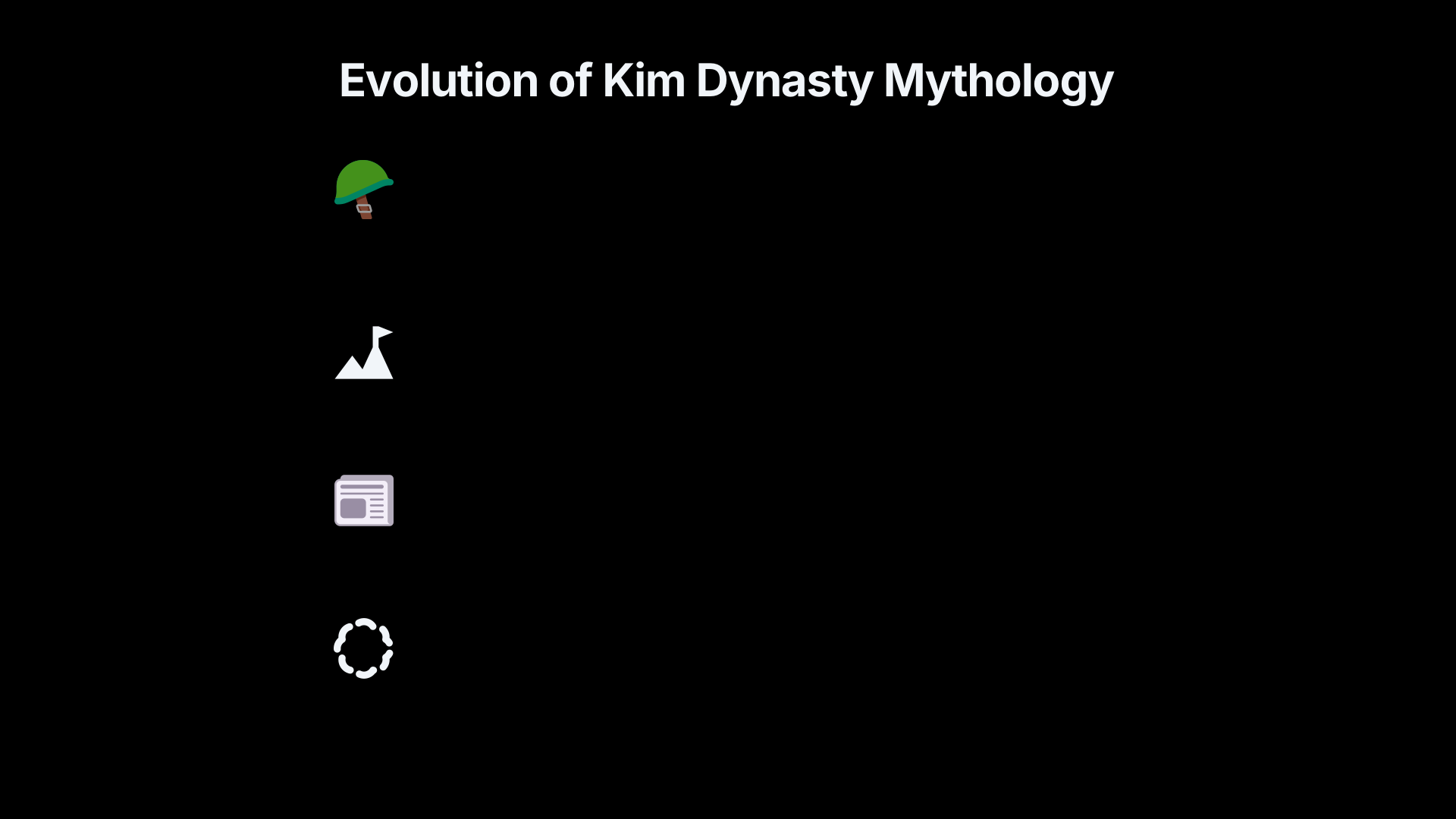
Unlike many famous hoaxes, these stories were not designed primarily to trick outsiders. Their main purpose was domestic legitimacy. By presenting Kim Il-sung as the singular liberator of Korea, Kim Jong-il as the heir of a sacred revolutionary bloodline and Kim Jong-un as the continuation of a historic destiny, the state created a narrative in which loyalty to the family became inseparable from loyalty to the nation itself. Historians, defectors and researchers have shown that many of these claims conflict with documentary evidence, yet the myths remain central to North Korea’s political culture.[researchgate.net]researchgate.netResearch Gate(PDF) A Blatant Lie: The North Korean myth of Kim Il-sungResearchGate(PDF) A Blatant Lie: The North Korean myth of Kim Il-sung…May 18, 2018 — 5 May 2021 — This article deals with one of the c…
Building Kim Il-sung’s Founding Legend
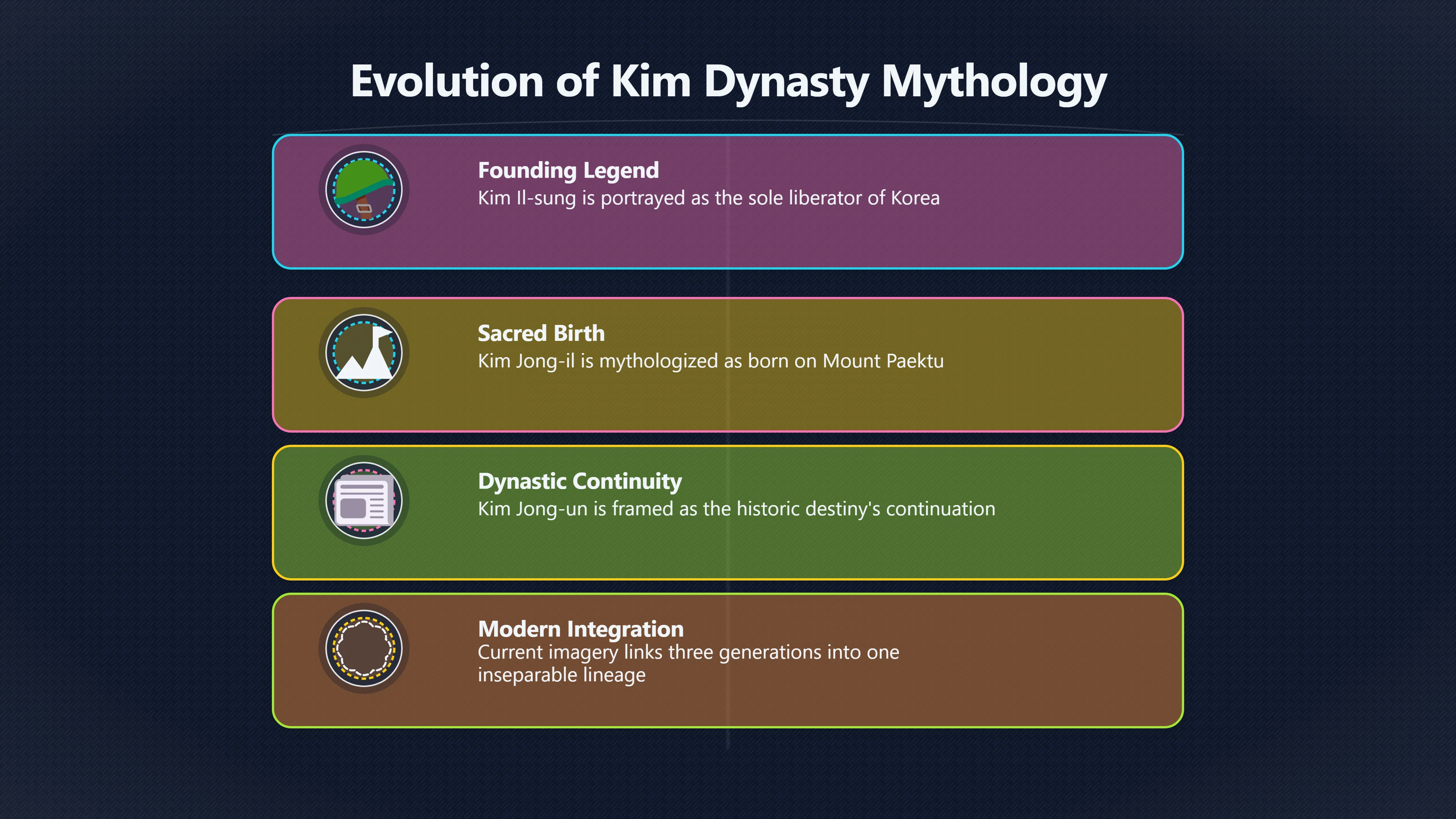
The foundation of North Korea’s dynastic mythology lies in the transformation of Kim Il-sung from a real anti-Japanese guerrilla fighter into an almost superhuman national saviour.
Kim participated in armed resistance against Japanese colonial rule during the 1930s, but official history gradually elevated his role far beyond the available historical record. State narratives portrayed him as the decisive force behind Korea’s liberation in 1945, often minimising or omitting the contributions of Soviet forces, Chinese communist units and other Korean resistance groups. Historians have argued that this version of events effectively rewrote a complex multinational struggle into a single heroic story centred on one man.[ResearchGate]researchgate.netResearch Gate(PDF) A Blatant Lie: The North Korean myth of Kim Il-sungResearchGate(PDF) A Blatant Lie: The North Korean myth of Kim Il-sung…May 18, 2018 — 5 May 2021 — This article deals with one of the c…
This process served several political purposes:
- It gave the new state a founding myth independent of foreign influence.
- It linked national liberation directly to Kim Il-sung personally.
- It justified concentrating authority in a single leader.
- It established a historical framework that later allowed hereditary succession.
Official publications, monuments, museums and school curricula reinforced this narrative for decades. Alternative interpretations largely disappeared from public view. What emerged was not simply propaganda about a leader but a reconstructed national origin story in which the state and the Kim family became inseparable.[researchgate.net]researchgate.netResearch Gate(PDF) A Blatant Lie: The North Korean myth of Kim Il-sungResearchGate(PDF) A Blatant Lie: The North Korean myth of Kim Il-sung…May 18, 2018 — 5 May 2021 — This article deals with one of the c…
Mount Paektu and the Politics of Sacred Lineage
One of the most important elements in North Korea’s manufactured history is Mount Paektu, the volcanic peak on the border with China that occupies a special place in Korean folklore and national identity.
Long before the rise of the Kim dynasty, the mountain was associated with origin myths and cultural symbolism. North Korean ideology repurposed this existing reverence and attached it directly to the ruling family. According to state narratives, Kim Il-sung operated a secret revolutionary base there during the anti-Japanese struggle. More importantly, official biographies claim that Kim Jong-il was born on the mountain in 1942. Historians and documentary evidence instead indicate that he was born in the Soviet Union while his parents were living with Soviet-backed military forces.[wikipedia.org]WikipediaKim Jong IlMay 9, 2026 — Kim's official biography states he was born in the Paektusan Secret Camp on Paektu Mountain in Korea under Japanese rule on…
The symbolic value of the claim was immense. If Kim Jong-il could be presented as literally born on Korea’s sacred mountain, succession looked less like a political inheritance and more like a historical destiny.
State mythology embellished the story further. Official accounts described extraordinary signs accompanying his birth, including a bright star and a double rainbow. Such narratives resemble traditional royal or religious origin legends in which cosmic events announce the arrival of an exceptional figure.[Wikipedia]WikipediaNorth Korean cult of personalityNorth Korean cult of personality
The concept of the “Paektu bloodline” became one of the regime’s most powerful political ideas. Rather than arguing that leadership should pass to the most capable official, the state framed the Kim family itself as uniquely qualified by revolutionary heritage and historical destiny. This language remains visible in official rhetoric under Kim Jong-un.[keia.org]keia.orgthe mountain at the heart of koreas past and futureKorea Economic Institute of AmericaThe Mountain at the Heart of Korea's Past and FutureOct 3, 2018 — In keeping with this narrative, it i…
Turning Biography into Myth
The construction of dynastic legitimacy extended beyond major historical events into the personal biographies of the leaders.
Official publications attributed extraordinary qualities to Kim Jong-il from childhood onward. Stories circulated that he demonstrated exceptional abilities at an unusually young age and possessed remarkable talents across multiple fields. State media also promoted accounts of mysterious natural phenomena linked to important moments in his life. These stories were not always intended to be scientifically persuasive; they functioned as symbolic affirmations of his exceptional status.[Wikipedia]WikipediaNorth Korean cult of personalityNorth Korean cult of personality
After Kim Jong-il’s death in 2011, state media reported unusual natural events associated with national mourning, including dramatic occurrences at Mount Paektu. Such reports reinforced the idea that the fate of the nation and even the natural world were connected to the ruling family.[Wikipedia]WikipediaNorth Korean cult of personalityNorth Korean cult of personality
The broader pattern resembles historical ruler cults elsewhere: political authority is strengthened by narratives that blur the line between ordinary leadership and quasi-sacred destiny. The purpose is not necessarily to convince every citizen literally. Rather, it establishes a symbolic environment in which questioning the leader becomes equivalent to questioning the nation’s history itself.
Why Ritual Matters Even Without Private Belief
A common misunderstanding is that personality cults survive only when everyone sincerely believes the myths. North Korea demonstrates a more complicated reality.
Political rituals can remain effective even when private scepticism exists. Portraits, monuments, commemorative events, revolutionary sites and prescribed language create a shared public performance of loyalty. Participation becomes socially and politically significant regardless of individual conviction.
In this system, the myths serve several functions at once:
- They provide a historical justification for hereditary succession.
- They define political loyalty as a moral duty.
- They create common symbols that structure public life.
- They reinforce the idea that the state has a unique historical mission.
Researchers of authoritarian systems often note that public ritual can matter as much as private belief. Repeated ceremonies, school lessons and symbolic acts constantly remind citizens of the official narrative and demonstrate collective conformity. The mythology therefore operates not only as a set of historical claims but as a framework for everyday political behaviour.[escholarship.org]escholarship.orgqt3xr6542k noSplash 146ce5c244828ad42ef460f819eff87cThe Art of Propaganda in North Korea26 May 2022 — In the previous chapters, we have explored the official myths of the Kim dy…
Adapting the Myth for Kim Jong-un
The dynastic narrative did not end with Kim Jong-il. Since taking power, Kim Jong-un has gradually been incorporated into the same historical framework while also developing his own symbolic identity.
State media increasingly place his image alongside those of his father and grandfather, while official messaging emphasises continuity across three generations of leadership. Analysts view the growing prominence of his portraits, badges and monumental imagery as part of a broader effort to position him as an equal member of the revolutionary lineage rather than merely its current caretaker.[apnews.com]apnews.comOpen source on apnews.com.
The pattern follows the logic established decades earlier. The regime does not simply celebrate a living ruler. It continuously rewrites historical memory so that past, present and future appear connected through a single family line. By embedding political authority within a larger story of national destiny, the state transforms succession from a constitutional question into a matter of historical inevitability.[peninsuladispatch.com]peninsuladispatch.comOpen source on peninsuladispatch.com.
What These Myths Reveal About Manufactured History
The myths surrounding the Kim dynasty are best understood not as isolated falsehoods but as a coordinated system of historical construction. Real events, genuine resistance activities, culturally significant locations and national memories are selectively reshaped into a narrative that supports hereditary rule.
What makes this case especially significant in the history of propaganda is its scale. Entire biographies, historical episodes and symbolic landscapes were reorganised to place one family at the centre of national existence. The result is a form of manufactured history in which political legitimacy derives less from institutions or public consent than from an official story about the past.
For students of hoaxes, propaganda and historical mythmaking, North Korea offers an unusually clear example of how power can be reinforced through narrative. The most enduring deception is not any single miraculous claim. It is the broader suggestion that the rule of one family emerged naturally from history itself rather than from political choices, military circumstances and decades of deliberate image-making.[researchgate.net]researchgate.netResearch Gate(PDF) A Blatant Lie: The North Korean myth of Kim Il-sungResearchGate(PDF) A Blatant Lie: The North Korean myth of Kim Il-sung…May 18, 2018 — 5 May 2021 — This article deals with one of the c…
eBay marketplace picks
Marketplace Samples
Live-tested eBay searches with available results related to this page.
Endnotes
1.
Source: researchgate.net
Title: Research Gate(PDF) A Blatant Lie: The North Korean myth of Kim Il-sung
Link:https://www.researchgate.net/publication/325990388_A_Blatant_Lie_The_North_Korean_myth_of_Kim_Il-sung_liberating_the_country_from_Japan
Source snippet
ResearchGate(PDF) A Blatant Lie: The North Korean myth of Kim Il-sung...May 18, 2018 — 5 May 2021 — This article deals with one of the c...
Published: May 18, 2018
2.
Source: escholarship.org
Title: qt3xr6542k noSplash 146ce5c244828ad42ef460f819eff87c
Link:https://escholarship.org/content/qt3xr6542k/qt3xr6542k_noSplash_146ce5c244828ad42ef460f819eff87c.pdf?t=rfxw63
Source snippet
The Art of Propaganda in North Korea26 May 2022 — In the previous chapters, we have explored the official myths of the Kim dy...
Published: May 2022
3.
Source: Wikipedia
Title: Kim Jong Il
Link:https://en.wikipedia.org/wiki/Kim_Jong_Il
Source snippet
May 9, 2026 — Kim's official biography states he was born in the Paektusan Secret Camp on Paektu Mountain in Korea under Japanese rule on...
Published: May 9, 2026
4.
Source: Wikipedia
Title: Day of the Shining Star
Link:https://en.wikipedia.org/wiki/Day_of_the_Shining_Star
Source snippet
North Korean propaganda dates Kim Jong Il's birth to 16 February 1942. It locates it at the Mount Paektu area in Korea, the mythical plac...
Published: February 1942
5.
Source: noiser.com
Title: dear leader the life and legacy of kim jong il
Link:https://www.noiser.com/real-dictators/dear-leader-the-life-and-legacy-of-kim-jong-il
Source snippet
Dear Leader: The Life and Legacy of Kim Jong-ilKim Jong-il was born in 1941 in the Russian village of Vyatskoye.... It's said when...
6.
Source: Wikipedia
Title: North Korean cult of personality
Link:https://en.wikipedia.org/wiki/North_Korean_cult_of_personality
7.
Source: peninsuladispatch.com
Link:https://www.peninsuladispatch.com/p/the-evolution-of-kim-jong-uns-cult
8.
Source: idfr.gov.my
Link:https://www.idfr.gov.my/my/publication/jdfr?task=article.download&uid=c698a7ed9873ed9a7c58565157205e5f7e1a5896e21fd21a48825269bb4d0bfc
9.
Source: Wikipedia
Link:https://en.wikipedia.org/wiki/North
10.
Source: Wikipedia
Title: Mason Mount
Link:https://en.wikipedia.org/wiki/Mason_Mount
11.
Source: north.tech
Link:https://north.tech/
12.
Source: keia.org
Title: the mountain at the heart of koreas past and future
Link:https://keia.org/analysis/the-mountain-at-the-heart-of-koreas-past-and-future/
Source snippet
Korea Economic Institute of AmericaThe Mountain at the Heart of Korea's Past and FutureOct 3, 2018 — In keeping with this narrative, it i...
13.
Source: monitoring.bbc.co.uk
Link:https://monitoring.bbc.co.uk/product/c2015vkt
14.
Source: apnews.com
Link:https://apnews.com/article/197e63db723e43f76d75cc83d75b4c3c
15.
Source: thetimes.com
Link:https://www.thetimes.com/world/asia/article/north-korea-kim-jong-un-murals-0hm8vxvs0
16.
Source: thetimes.co.uk
Link:https://www.thetimes.co.uk/article/kim-jong-un-fostering-personality-cult-with-face-on-party-badges-9zp5m3xq9
17.
Source: northdesign.co.uk
Link:https://www.northdesign.co.uk/
Additional References
18.
Source: ft.com
Title: Financial Times Accidental Tyrant
Link:https://www.ft.com/content/2886c1ce-c648-4805-9c74-50e29ce6db3d
Source snippet
Drawing from sources in multiple languages, Tertitskiy examines how Kim Il Sung’s power was significantly influenced by figures like Stal...
19.
Source: youtube.com
Link:https://www.youtube.com/watch?v=2Dj8G72pUgc
Source snippet
How North Korea Became What It Is - Cold War DOCUMENTARY...
20.
Source: youtube.com
Link:https://www.youtube.com/watch?v=I9EPmaV7tDo
Source snippet
28th December 1972: Kim Il-sung becomes President of North Korea...
Published: December 1972
21.
Source: youtube.com
Title: How North Korea Became What It Is
Link:https://www.youtube.com/watch?v=dyxXMGYT3ws
Source snippet
The God of Pyongyang: How Christianity Built North Korea | Korea Deconstructed #125...
22.
Source: youtube.com
Title: Why North Korea is so good at propaganda
Link:https://www.youtube.com/watch?v=ilfYpHEf9VA
Source snippet
Kim Jong-il: The Dictator Who Starved Millions and Ruled Through Fear | The Dictator in 4K...
23.
Source: reddit.com
Link:https://www.reddit.com/r/AskHistorians/comments/d4bqg2/how_did_cult_of_personality_evolve_in_north_korea/
24.
Source: ebsco.com
Link:https://www.ebsco.com/research-starters/biography/kim-jong-il
25.
Source: academia.edu
Link:https://www.academia.edu/144973930/LEGACY_The_Rule_of_North_Koreas_Kim_Dynasty
26.
Source: reddit.com
Link:https://www.reddit.com/r/northkorea/comments/1acukmn/myth_regarding_the_birth_of_kim_ilsung/
27.
Source: merriam-webster.com
Link:https://www.merriam-webster.com/dictionary/north
Topic Tree