Within Liechtenstein Deceptions
When Propaganda Turned Accusation Into Fatal Violence
Antisemitic accusations against the Rotter brothers turned a business collapse into propaganda that helped incite a fatal kidnapping attempt.
On this page
- How bankruptcy was recast as criminal conspiracy
- The press campaign and unsupported financial claims
- The kidnapping attempt and its political purpose
Page outline Jump by section
Introduction
The Rotter case is one of the clearest examples in Liechtenstein’s history of propaganda helping to transform a financial dispute into political violence. In 1933, the Jewish theatre entrepreneurs Alfred and Fritz Rotter, who had fled Germany after the Nazi rise to power, became the target of an intense campaign portraying them as dishonest financiers who had supposedly engineered their own bankruptcy and hidden their wealth abroad. Those allegations circulated widely despite a lack of convincing evidence. The resulting atmosphere of suspicion and hostility helped create the conditions for a kidnapping plot organised by Nazi sympathisers in Liechtenstein and Germany. The attempt ended in tragedy when Alfred Rotter and his wife Gertrud died while trying to escape their attackers.[Wikipedia]wikipedia.orgRotter kidnappingRotter kidnapping

Within the history of deception and propaganda in Liechtenstein, the significance of the episode lies not in a fabricated artefact or commercial fraud but in the way unsupported claims were repeated until they appeared credible enough to justify direct action. The case demonstrates how political propaganda can turn accusation into apparent fact and transform prejudice into violence.
How Bankruptcy Was Recast as Criminal Conspiracy
Before becoming targets of Nazi agitation, Alfred and Fritz Rotter were among the most prominent figures in Berlin’s entertainment industry. Their theatre empire suffered severe financial difficulties during the economic turmoil of the early 1930s. After Adolf Hitler’s appointment as German chancellor in January 1933, the brothers, who were Jewish, left Germany and sought safety in Liechtenstein, where they had already obtained citizenship.[Wikipedia]wikipedia.orgRotter kidnappingRotter kidnapping
The collapse of their business provided an opportunity for political opponents and antisemitic campaigners. Instead of presenting the bankruptcy primarily as a consequence of economic pressures and business failure, hostile commentators increasingly framed it as evidence of deliberate criminal behaviour. The Rotters were accused of orchestrating their own insolvency, concealing assets and transferring money beyond the reach of creditors. German newspapers hostile to the brothers promoted these claims and demanded that they be returned to Germany for prosecution.[Wikipedia]wikipedia.orgRotter kidnappingRotter kidnapping
The propaganda worked because it merged several themes that already resonated with Nazi audiences:
- Economic resentment during a period of financial hardship.
- Existing antisemitic stereotypes portraying Jewish businessmen as dishonest or conspiratorial.
- Public suspicion surrounding high-profile bankruptcies.
- Anger that the brothers had found refuge outside Germany.[Wikipedia]wikipedia.orgRotter kidnappingRotter kidnapping
What made the campaign especially powerful was that allegations were repeatedly presented as though they were established facts. The distinction between accusation and proof gradually disappeared from public discussion.
The Press Campaign and Unsupported Financial Claims
The anti-Rotter campaign extended beyond criticism of two businessmen. It became a vehicle for attacking Liechtenstein itself. German press outlets criticised the principality for granting citizenship to the brothers and portrayed the country as a shelter for alleged financial criminals. According to contemporary accounts and later historical studies, pressure mounted for the Rotters to be extradited to Germany.[Wikipedia]wikipedia.orgRotter kidnappingRotter kidnapping
A key feature of the propaganda was the assertion that the brothers had secretly removed large sums of money from Germany before declaring bankruptcy. Yet historians examining the affair have found that the public claims often ran ahead of the available evidence. Later research has noted that the image of the Rotters as wealthy fugitives carrying hidden fortunes abroad was greatly exaggerated and politically useful to their opponents.[Wikipedia]WikipediaListe der Stolpersteine in VaduzListe der Stolpersteine in Vaduz
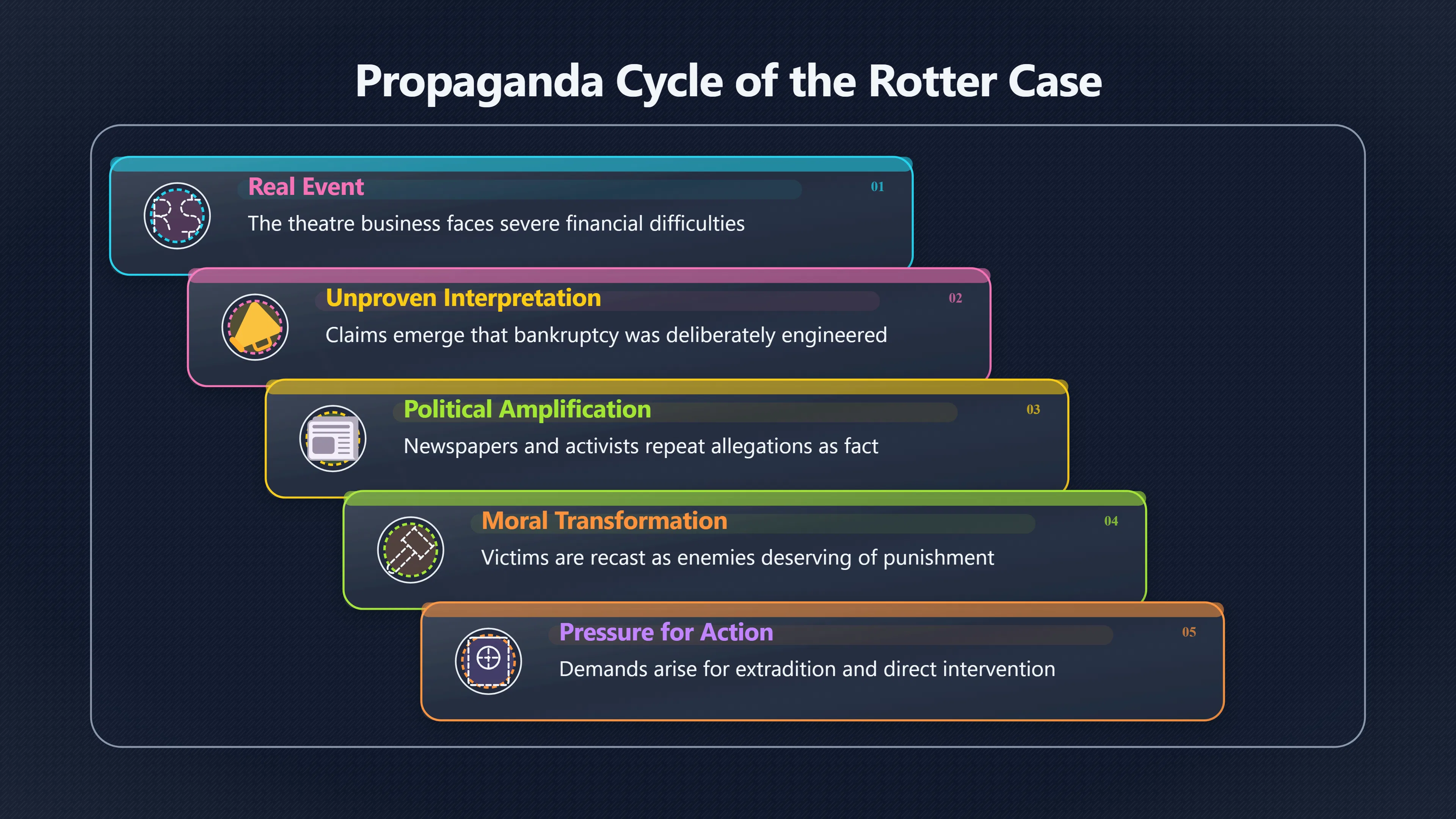
The campaign followed a familiar propaganda pattern:
- A real event — the bankruptcy of the Rotter theatre business.
- An unproven interpretation — claims that the bankruptcy had been deliberately engineered.
- Political amplification — newspapers and activists repeated the allegations.
- Moral transformation — the accused were presented not merely as debtors but as enemies deserving punishment.

- Pressure for action — demands arose for extradition and direct intervention. Wikipedia
By the spring of 1933, the brothers had become symbols in a broader political struggle rather than simply participants in a legal dispute.
The Kidnapping Attempt and Its Political Purpose
On 5 April 1933, the propaganda campaign moved from words to action. Four Liechtenstein Nazi sympathisers and several German collaborators lured Alfred and Fritz Rotter, together with Gertrud Rotter and Julie Wolff, to the mountain area of Gaflei. There they attempted to seize the group and transport the brothers back to Germany against their will. Wikipedia
The operation was not a random criminal act. Contemporary and later accounts indicate that the kidnappers were acting in line with demands circulating in the German press that the Rotters be returned to Germany. The plot also coincided with efforts to strengthen organised Nazi activity inside Liechtenstein. The kidnapping therefore carried a clear political message: opponents of Nazism could be pursued even beyond Germany’s borders. Wikipedia+2Wikipedia
The victims resisted. During the chaotic escape, Alfred Rotter and his wife Gertrud fell into a ravine and died. Fritz Rotter managed to escape after jumping from a vehicle, while Julie Wolff survived despite injuries. What had begun as a campaign of accusations ended in deaths directly connected to politically motivated violence. Wikipedia
Why the Propaganda Mattered
The importance of the Rotter case lies in the relationship between rhetoric and action. The kidnappers did not emerge from a vacuum. They operated in an environment where repeated allegations had already portrayed the victims as criminals and outsiders. Propaganda did not merely accompany the violence; it helped create a moral justification for it. Wikipedia
Historians of Liechtenstein’s Nazi era have therefore treated the episode as more than an isolated crime. It reveals how quickly a small country could be affected by political currents from neighbouring Germany and how media campaigns could undermine legal norms. Instead of allowing courts to determine the truth of financial allegations, activists attempted to impose their own solution through force. Wikipedia
The case also demonstrates an important distinction in the study of deception. The central falsehood was not a forged document or fabricated object. It was the conversion of unproven claims into accepted public “knowledge”. Once enough people accepted the narrative that the Rotters were guilty, extraordinary actions could be presented as reasonable responses.
What Rotter Case reveals about belief and deception
The Rotter kidnapping remains one of the most disturbing episodes in modern Liechtenstein history because it shows how propaganda can bridge the gap between accusation and violence. Later commemorations, historical research and memorial projects have increasingly emphasised that Alfred and Gertrud Rotter were victims of Nazi persecution and of a campaign that portrayed them as criminals before guilt had been established. Wikipedia
For a history of deception and contested truth in Liechtenstein, the lesson is stark. The most consequential falsehoods are not always elaborate hoaxes. Sometimes they are politically useful narratives repeated so often that they appear self-evident. In the Rotter case, unsupported financial accusations became a propaganda weapon, and that weapon helped pave the way for fatal violence in the principality in 1
9
3
Amazon book picks
Further Reading
Books and field guides related to When Propaganda Turned Accusation Into Fatal Violence. Use these as the next step if you want deeper reading beyond the article.
The Death of Democracy
Provides direct context for propaganda and political radicalisation in the Rotter era.
The Coming of the Third Reich
Explains the political environment that enabled campaigns against Jewish targets.
eBay marketplace picks
Marketplace Samples
Live-tested eBay searches with available results related to this page.


Endnotes
2.
Source: Wikipedia
Title: Josef Hoop
Link:https://en.wikipedia.org/wiki/Josef_Hoop
3.
Source: Wikipedia
Title: Liechtenstein in der Zeit des Nationalsozialismus
Link:https://de.wikipedia.org/wiki/Liechtenstein_in_der_Zeit_des_Nationalsozialismus
4.
Source: Wikipedia
Title: Liste der Stolpersteine in Vaduz
Link:https://de.wikipedia.org/wiki/Liste_der_Stolpersteine_in_Vaduz
5.
Source: Wikipedia
Title: German National Movement in Liechtenstein
Link:https://en.wikipedia.org/wiki/German_National_Movement_in_Liechtenstein
6.
Source: Wikipedia
Title: 1939 Liechtenstein putsch
Link:https://en.wikipedia.org/wiki/1939_Liechtenstein_putsch
Additional References
7.
Source: resolve.cambridge.org
Title: Konkurs und die gegen die Rotter gerichtete Stimmung im Prozess gegen ihre
Link:https://resolve.cambridge.org/core/services/aop-cambridge-core/content/view/E8B85915B988CB9D546730CFDF72C628/9781107279681c14_p258-273_CBO.pdf/operetta_and_propaganda_in_the_third_reich_cultural_politics_and_the_metropoltheater.pdf
Source snippet
and propaganda in the Third Reich: cultural politics and...von Alfred und Fritz Rotter im Januar 1933: Die Berichte über den Berliner...
8.
Source: iwm.org.uk
Link:https://www.iwm.org.uk/sites/default/files/files/2023-10/holocaust_galleries_large_print_guide.pdf
Source snippet
World War in a bid to end anti-Jewish propaganda. Efforts to combat antisemitism...Read more...
9.
Source: johnwhitwell.co.uk
Link:https://www.johnwhitwell.co.uk/wp-content/uploads/2025/04/The-Stranger-in-Our-Midst-Manuscript-2025.pdf
Source snippet
For their part the Nazis were obviously interested...Read more...
10.
Source: brill.com
Link:https://brill.com/display/book/9789004734630/9789004734630_webready_content_text.pdf?srsltid=AfmBOoq3HgW8yU7hTD7S3ze94-4z4OkAPNSD87Dc3dvvmyu50JFq4rkY
Source snippet
In the film about the persecution of Germans by...Read more...
11.
Source: youtube.com
Title: The Nazis Burned His Books. His Ideas Won an Election 80 Years Later
Link:https://www.youtube.com/watch?v=cKqX-hg_dhs
Source snippet
This video production details the history and tragic displacement of the Rotter brothers as they fled Nazi persecution...
12.
Source: youtube.com
Link:https://www.youtube.com/watch?v=ruq6zh47iwA
Source snippet
The Nazis Burned His Books. His Ideas Won an Election 80 Years Later...
13.
Source: state.gov
Link:https://www.state.gov/report/custom/3179059048-2/
14.
Source: theladosgroup.com
Link:https://theladosgroup.com/timeline
Source snippet
The Lados GroupMarr popularized the term "antisemitism" (1881). 1881. In Russia newly enacted repressive anti-Jewish laws are passed and...
15.
Source: dokumen.pub
Link:https://dokumen.pub/final-sale-in-berlin-the-destruction-of-jewish-commercial-activity-1930-1945-9781782388135.html
16.
Source: jm-hohenems.at
Link:https://www.jm-hohenems.at/static/uploads/2013/12/der-katalog-zur-dauerausstellung-englisch.pdf
Topic Tree