When Spectacle, Authority and Rumour Collide
The United Arab Emirates does not have one universally recognised “great national hoax” comparable with the Piltdown Man forgery or the Cottingley Fairies.
Page outline Jump by section
Introduction
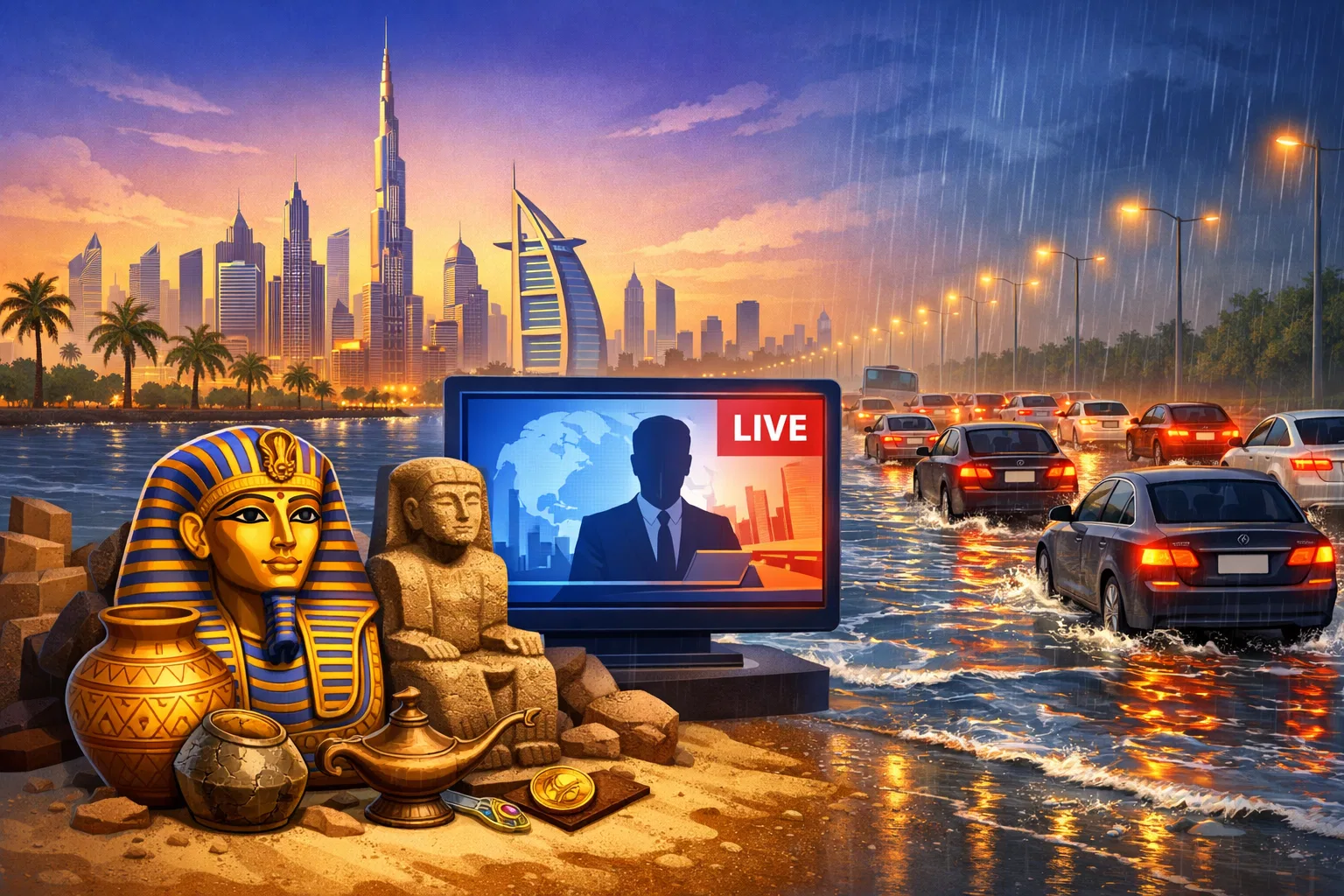
These cases matter because the UAE is unusually fertile ground for stories that look almost believable. Rapid development makes improbable engineering feats seem possible; great wealth lends plausibility to tales of private islands and princely generosity; a large expatriate population allows rumours to cross several languages and countries at speed; and intense regional politics gives fabricated news potentially serious consequences. The recurring lesson is not that Emiratis or UAE residents are especially credulous. It is that deception succeeds when it borrows the authority of institutions, familiar brands, spectacular images or an already convincing story about the country.
Counterfeit antiquities and invented histories
One of the clearest conventional fraud cases occurred in Abu Dhabi in 2011, when police stopped an attempted sale of supposedly pre-Islamic antiquities valued at AED3.2 million. The objects were fakes, presented as ancient pieces to justify an extraordinary price. According to Abu Dhabi Police, officers arrested the accused during the attempted transaction.[Abu Dhabi Police]adpolice.gov.aeAbu Dhabi Police foils selling of fake of antiques worth AED 3 2 millionAbu Dhabi PoliceAbu Dhabi Police foils selling of fake of antiques worth…30 Jun 2021 — Police foiled selling of fake Pre-Islamic era a…
The method was simple but effective. An object that looks old is paired with an impressive historical description, while the seller creates urgency or restricts opportunities for independent examination. The victim is not merely buying stone, metal or pottery; they are buying privileged access to a vanished civilisation. That emotional promise can discourage the basic questions that matter most: Where was the object excavated? When did it leave its country of origin? Who owned it previously? Are its papers verifiable? Has an independent specialist tested its materials and manufacturing techniques?
Such frauds exploit a genuine difficulty in the antiquities trade. Authentic artefacts may have incomplete histories, particularly when they have passed through several dealers or old private collections. Forgers can imitate this uncertainty by supplying vague ownership stories, misleading export documents or fabricated certificates. A lack of evidence is made to resemble the ordinary obscurity of an old object.
The more consequential Louvre Abu Dhabi antiquities investigation illustrates a related problem: an object itself may be ancient while its documented history is false. French investigators examined allegations concerning the provenance of Egyptian works acquired for the museum, and former Louvre president Jean-Luc Martinez was charged in France in connection with the wider trafficking inquiry. Another curator, Jean-François Charnier, was accused of supplying false provenance information. The accused have contested wrongdoing, and a charge is not a conviction. Louvre Abu Dhabi joined the proceedings as a civil party, seeking access to the evidence and clarification of what had happened.[Artnet News]news.artnet.comNews A Curator Has Been Charged With Giving FalseArtnet NewsA Curator Has Been Charged With Giving False…August 1, 2022 — 1 Aug 2022 — Martinez is suspected of “turning a blind eye” t…
This distinction is important. The controversy was not simply a story of museum exhibits being exposed as modern imitations. It concerned whether genuine antiquities had been laundered through invented or misleading ownership records, potentially concealing illicit excavation or export. In high-value cultural-property markets, forged paperwork can perform the same function as a forged artefact: it creates the appearance of legitimacy.
These episodes connect the UAE to a much wider international trade rather than revealing a uniquely local tradition of fakery. The Emirates’ wealthy collectors, galleries and museums participate in markets that pass through Europe, North America, the Middle East and offshore commercial centres. The most reliable defence is therefore procedural rather than instinctive: complete provenance research, scientific examination, consultation with source countries and a willingness to abandon a prestigious purchase when the documentary trail cannot withstand scrutiny.
The hacked story that helped ignite a Gulf crisis
The most politically significant falsehood associated with the UAE emerged outside its borders but directly involved its regional rivalry with Qatar. On 24 May 2017, fabricated remarks attributed to Qatar’s emir appeared on the website of the state-run Qatar News Agency. The statements appeared to praise Iran, criticise aspects of United States policy and take positions certain to provoke Qatar’s neighbours. Qatar said its news service had been hacked and that the remarks were invented.
The false material was quickly repeated by regional broadcasters and newspapers. Within weeks, the UAE, Saudi Arabia, Bahrain and Egypt had cut diplomatic and transport links with Qatar, accusing it of supporting terrorism and destabilising the region. The dispute had deeper causes, but the planted statements provided an immediate and highly visible trigger.[The Washington Post]washingtonpost.comThe Washington Post UAE orchestrated hacking of Qatari government siteshacked, but it has not released the results of its investigation. Intelligence officials said their working theory since the Qatar hacks…
This was more powerful than an ordinary counterfeit article because it appeared on an authentic government platform. Readers did not have to trust an obscure website or anonymous social-media account. The attackers had apparently borrowed the authority of Qatar’s own official news agency. Once screenshots and quotations escaped into television coverage and social networks, later deletion could not retrieve them.
Attribution remains contested and should not be simplified into a settled tale. The Washington Post reported that United States intelligence officials believed senior UAE officials had discussed the operation before the hacking occurred. Qatar’s investigators said evidence pointed towards interests in the UAE but initially stopped short of publicly identifying the perpetrators with certainty. The UAE firmly denied arranging the attack, calling the allegation false. Earlier reports had also discussed possible Russian involvement, demonstrating how uncertain and politically charged cyberattack attribution can become.[washingtonpost.com]washingtonpost.comThe Washington Post UAE orchestrated hacking of Qatari government siteshacked, but it has not released the results of its investigation. Intelligence officials said their working theory since the Qatar hacks…
The case nevertheless shows how a forged statement can become politically “real” even after its authenticity is disputed. It did not create every disagreement behind the Gulf crisis, but it supplied material that fitted pre-existing suspicions. Audiences inclined to distrust Qatar had little difficulty accepting it; media outlets operating in a tense regional environment had incentives to publish it immediately; and repetition made the quotation familiar before forensic investigation could catch up.
It also demonstrates why exposure does not automatically repair the damage. A fabricated government statement can influence officials, markets and public opinion within minutes, while technical analysis and intelligence assessment may take weeks. By the time the origin of a document becomes the central question, political actors may already have acted on the version that best served their interests.
Did cloud seeding cause the Dubai floods?
When record-breaking rain flooded parts of the UAE in April 2024, an appealing explanation spread almost immediately: Dubai had supposedly brought the disaster upon itself through cloud seeding. The country really does operate a weather-modification programme, so the claim contained the crucial ingredient of a persuasive rumour—a true fact attached to an unsupported conclusion.
Cloud seeding does not manufacture a vast storm from a clear sky. It introduces particles into suitable existing clouds in an attempt to encourage droplets or ice crystals to form. Its effects are limited, local and scientifically difficult to measure. Meteorologists said the enormous weather system responsible for the April deluge had been forecast in advance and affected a broad region, including Oman. The UAE’s National Centre of Meteorology said it had not conducted seeding operations during the event.[apnews.com]apnews.comOpen source on apnews.com.
The false explanation spread because the images were extraordinary: aircraft moving through floodwater, submerged roads and abandoned vehicles in a city internationally associated with desert conditions. Cloud seeding offered a dramatic cause that could be conveyed in one sentence—humans had tried to control nature and lost control—whereas the real meteorology involved low-pressure systems, atmospheric moisture, thunderstorms, regional geography and questions about the influence of a warming climate.
Some early news coverage contributed to the confusion by mentioning recent seeding flights or suggesting that weather modification had worsened the storm. Experts subsequently stressed that no existing cloud-seeding technology could produce rainfall on the scale observed. The claim was repeatedly rejected by meteorologists and independent fact-checkers.[wired.com]wired.comNo, Dubai's Floods Weren't Caused by Cloud SeedingNo, Dubai's Floods Weren't Caused by Cloud Seeding
Calling the story a deliberate hoax would be too broad. Much of its circulation appears to have come from sincere misunderstanding, speculative reporting and social-media users connecting two visually compelling facts: the UAE seeds clouds, and the UAE experienced a historic rainstorm. More manipulative versions used the floods to support wider claims that climate science was fraudulent or that weather-control experiments were secretly causing disasters.
The episode reveals a recurring feature of pseudoscientific explanations. They often begin with a real technology but exaggerate its power beyond what evidence supports. Debunking therefore requires more than saying “cloud seeding did not do it”. Readers also need to understand what the technology can plausibly achieve, why the genuine storm was so severe and why an engineered-disaster story travelled faster than a complicated meteorological account.

Dubai’s spectacular-image problem
Dubai’s global image creates an unusual credibility trap. The city contains genuine projects that once sounded implausible: artificial islands, an indoor ski slope, a building more than 800 metres tall and vast climate-controlled attractions. Against that background, fabricated or exaggerated stories can survive the ordinary test of disbelief. “That cannot be real” is not a dependable filter in a place deliberately marketed through record-breaking spectacle.
A good example is the recurring claim that the Burj Khalifa has no proper sewer connection and that fleets of tankers must continuously carry away the tower’s human waste. The story has circulated through videos, blogs and social posts, often accompanied by footage of sewage trucks queueing elsewhere in Dubai. It appears to have grown from genuine historical problems in parts of Dubai’s wastewater network, where rapid development once outpaced treatment and connection capacity. The viral version transformed that broader infrastructure story into a claim specifically about the world’s tallest building.[Envirology* Ltd.]envirology.co.nzEnvirology* Ltd.The Incredible Story Of How The Burj Khalifa's Poop isEnvirology* Ltd.The Incredible Story Of How The Burj Khalifa's Poop is
The myth works because it offers a satisfying reversal. A symbol of futuristic luxury supposedly conceals a crude and embarrassing flaw. It also benefits from recycled imagery: footage of real tanker queues seems like direct proof even when it is not tied to the building in question. The lesson is to separate a photograph’s visible content from the caption’s assertion about place, date and cause.
Stories about Dubai’s wealthy residents use similar mechanics. In 2024, posts claimed that a Dubai-based millionaire had bought his wife a private island worth roughly US$50 million so she could wear a bikini in privacy. Newspapers around the world repeated the social-media claim, although publicly available reporting offered little independent evidence of the purchase, the island’s identity or the stated price. The tale functioned perfectly as viral lifestyle content because it matched a familiar online caricature of Dubai: limitless wealth expressed through extravagant personal gifts.[The Independent]independent.co.ukThe Independent Dubai woman says husband bought her private island soThe Independent Dubai woman says husband bought her private island so
The central issue is not whether every detail was consciously fabricated. Influencer content frequently occupies a blurred space between performance, exaggeration, advertising and autobiography. A statement may be designed first to generate views and only secondarily to communicate a checkable fact. Once conventional media rewrite it as news, qualifications disappear and the original creator gains attention regardless of whether outsiders can verify the story.
Dubai-themed misinformation therefore often travels internationally rather than originating with ordinary UAE residents. Publishers elsewhere use the city as shorthand for wealth, technological excess or social strangeness. The location itself becomes a credibility device: a weakly sourced claim is treated as plausible because readers have already been taught that almost anything can happen in Dubai.
Chain messages, fake officials and borrowed trust
Not all UAE hoaxes are spectacular. Many are ordinary chain messages adapted to local institutions and fears. In 2020, a widely forwarded notice falsely claimed that people who had worked in the UAE between 1990 and 2020 could withdraw AED4,000 from the Ministry of Labour. No such payment had been announced. A similar message had circulated in India, with the agency name and currency changed for a different audience.[Gulf News]gulfnews.comno you wont get dh4000 for working between 1990 and 2020 in the uae 1.71529621no you wont get dh4000 for working between 1990 and 2020 in the uae 1.71529621
This localisation is one reason old hoaxes survive. The underlying template remains constant—a government benefit, health warning or technical threat—but names, logos and monetary amounts are replaced. Recipients recognise the institution and may forward the message to relatives or colleagues “just in case”. The sender’s personal trustworthiness substitutes for evidence about the original source.
Health scares have used the same pathway. A false warning about supposedly dangerous batches of Panadol repeatedly circulated in the UAE from at least 2005. The manufacturer said the cited batch had never been sold in the country, yet the message resurfaced years later in emails and forwards. Its survival depended on precaution: people were encouraged to share it because failing to warn someone seemed riskier than distributing an unverified claim.[Gulf News]gulfnews.comGulf News Panadol hoax does the rounds again this yearGulf News Panadol hoax does the rounds again this year
Commercial criminals turn borrowed authority into direct profit. Fake recruitment notices have imitated major UAE employers, malls and hotels, sometimes leading applicants towards fraudulent offer letters, visa fees or demands for personal information. Mall of the Emirates publicly disowned one such campaign and directed applicants to official recruitment channels. Other schemes have used photographs and names of prominent UAE businesspeople to promote fictitious investments or giveaways.[Gulf News]gulfnews.comGulf News Don't fall for these fake Dubai job ads on social mediaGulf News Don't fall for these fake Dubai job ads on social media
More recent frauds can add synthetic audio, altered video or impersonated social-media accounts. Romance scammers have posed as members of Dubai’s ruling family, using the public image of wealthy princes to cultivate relationships and request money. These operations succeed through a mixture of aspiration and apparent intimacy: the victim believes they have private access to someone famous, while the scammer gradually isolates them from independent verification.[AFP Fact Check]factcheck.afp.comOpen source on afp.com.
The most dependable warning sign is not imperfect spelling or an implausible accent. Modern fakes can be polished. The stronger test is whether the claim can be confirmed outside the message itself. Genuine government grants appear on official portals; real employers do not require applicants to pay recruitment or visa-processing charges to unofficial intermediaries; and a public figure’s identity cannot be established merely by photographs, video calls or documents supplied by the same person asking for money.
Why exposure is unusually complicated
The UAE has adopted strict legal measures against online rumours and false information. Federal Decree-Law No. 34 of 2021 on Countering Rumours and Cybercrimes took effect in January 2022 and includes offences involving the publication or circulation of misleading material that threatens public order, security, health or economic interests. Official guidance urges residents to rely on verified sources and avoid forwarding unconfirmed reports.[UAE Legislation]uaelegislation.gov.aeOpen source on uaelegislation.gov.ae.
That framework can deter malicious fabrications and panic-inducing rumours, but it also makes the category of “fake news” politically sensitive. A false medical cure, a forged job advertisement and a disputed report about government conduct are not the same kind of speech. Effective scepticism requires separating provably fabricated material from reporting that is incomplete, contested or embarrassing to powerful organisations.
The strongest UAE hoax investigations have generally relied on evidence that can be independently tested: laboratory or stylistic examination of an artefact, comparison with official employment channels, meteorological data, analysis of a hacked server, or verification that a quoted agency never issued the claimed announcement. Authority alone—whether governmental, commercial or journalistic—is not a complete substitute for that process.
Across the UAE cases, the most successful falsehoods share several features:
- They attach themselves to something already true, such as cloud seeding, regional political hostility or Dubai’s conspicuous wealth.
- They borrow a trusted identity: a ministry, museum, royal figure, medicine brand or official news service.
- They use images or documents that appear to remove the need for further checking.
- They reward rapid sharing through fear, financial hope, outrage or amusement.
- They continue circulating after correction because the original story is simpler and more memorable than the evidence against it.
The UAE’s hoax history is therefore less a cabinet of eccentric old curiosities than a study of modern credibility. Its forged artefacts show how paperwork can manufacture a past; the Qatar news-agency hack shows how planted words can accelerate a political crisis; the cloud-seeding story shows how scientific uncertainty becomes a ready-made explanation; and Dubai’s viral legends show how a city’s real extravagance can make invention unusually difficult to recognise.
Amazon book picks
Further Reading
Books and field guides related to When Spectacle, Authority and Rumour Collide. Use these as the next step if you want deeper reading beyond the article.
A History of Fake Things on the Internet
Covers modern forms of deception and amplification.
City of Gold
Provides context for why spectacular stories about the UAE seem plausible.
eBay marketplace picks
Marketplace Samples
Live-tested eBay searches with available results related to this page.

Endnotes
1.
Source: news.artnet.com
Title: News A Curator Has Been Charged With Giving False
Link:https://news.artnet.com/art-world-archives/louvre-curator-antiquities-trafficking-2154181
Source snippet
Artnet NewsA Curator Has Been Charged With Giving False...August 1, 2022 — 1 Aug 2022 — Martinez is suspected of “turning a blind eye” t...
Published: August 1, 2022
2.
Source: time.com
Link:https://time.com/4808609/russia-hacker-qatar-diplomatic-crisis/
3.
Source: wired.com
Title: No, Dubai’s Floods Weren’t Caused by Cloud Seeding
Link:https://www.wired.com/story/dubai-flooding-uae-cloud-seeding-climate-change
4.
Source: factcheck.afp.com
Link:https://factcheck.afp.com/doc.afp.com.34WF8VU
5.
Source: factcheck.afp.com
Link:https://factcheck.afp.com/doc.afp.com.B9WG8CT
6.
Source: factcheck.afp.com
Link:https://factcheck.afp.com/doc.afp.com.99J38KH
7.
Source: adpolice.gov.ae
Title: Abu Dhabi Police foils selling of fake of antiques worth AED 3 2 million
Link:https://www.adpolice.gov.ae/en/Media-Center/News/2021/06/30/Abu-Dhabi-Police-foils-selling-of-fake-of-antiques-worth-AED-3-2-million
Source snippet
Abu Dhabi PoliceAbu Dhabi Police foils selling of fake of antiques worth...30 Jun 2021 — Police foiled selling of fake Pre-Islamic era a...
8.
Source: washingtonpost.com
Title: The Washington Post UAE orchestrated hacking of Qatari government sites
Link:https://www.washingtonpost.com/world/national-security/uae-hacked-qatari-government-sites-sparking-regional-upheaval-according-to-us-intelligence-officials/2017/07/16/00c46e54-698f-11e7-8eb5-cbccc2e7bfbf_story.html
Source snippet
hacked, but it has not released the results of its investigation. Intelligence officials said their working theory since the [Qatar hacks]({{ 'qatar-hack/' | relative_url }})...
9.
Source: washingtonpost.com
Link:https://www.washingtonpost.com/world/national-security/qatars-investigation-of-cyberattack-stops-just-short-of-naming-suspects/2017/07/20/de721b26-6d8a-11e7-96ab-5f38140b38cc_story.html
Source snippet
The Washington PostQatar's investigation of cyberattack stops just short...21 Jul 2017 — Officials said only that 'the anticipation and...
10.
Source: apnews.com
Link:https://apnews.com/article/2f8c12854017e11ac7438579646b3758
11.
Source: reading.ac.uk
Title: Cloud seeding did not cause Dubai floods expert says
Link:https://www.reading.ac.uk/news/2024/Expert-Comment/Cloud-seeding-did-not-cause-Dubai-floods-expert-says
12.
Source: envirology.co.nz
Title: Envirology* Ltd.The Incredible Story Of How The Burj Khalifa’s Poop is
Link:https://www.envirology.co.nz/bridgette-meinhold-the-incredible-story-of-how-the-burj-khalifa-s-poop-is-trucked-out-of-town/
13.
Source: independent.co.uk
Title: The Independent Dubai woman says husband bought her private island so
Link:https://www.independent.co.uk/news/world/middle-east/dubai-wife-island-beach-bikini-50million-b2620013.html
14.
Source: gulfnews.com
Title: no you wont get dh4000 for working between 1990 and 2020 in the uae 1.71529621
Link:https://gulfnews.com/uae/no-you-wont-get-dh4000-for-working-between-1990-and-2020-in-the-uae-1.71529621
15.
Source: gulfnews.com
Title: Gulf News Panadol hoax does the rounds again this year
Link:https://gulfnews.com/uae/health/panadol-hoax-does-the-rounds-again-this-year-1.98993
16.
Source: gulfnews.com
Title: Gulf News Don’t fall for these fake Dubai job ads on social media
Link:https://gulfnews.com/going-out/society/dont-fall-for-these-fake-dubai-job-ads-on-social-media-1.2282920
17.
Source: gulfnews.com
Title: beware facebook scammers using uae billionaires names 1.2105798
Link:https://gulfnews.com/uae/crime/beware-facebook-scammers-using-uae-billionaires-names-1.2105798
18.
Source: uaelegislation.gov.ae
Link:https://uaelegislation.gov.ae/en/legislations/1526
19.
Source: gulfnews.com
Title: cyber fraud warning how to spot a new ai driven investment scams 1.500156116
Link:https://gulfnews.com/uae/cyber-fraud-warning-how-to-spot-a-new-ai-driven-investment-scams-1.500156116
20.
Source: gulfnews.com
Title: whatsapp scam targets uae users tra warns 1.1541677409572
Link:https://gulfnews.com/technology/whatsapp-scam-targets-uae-users-tra-warns-1.1541677409572
21.
Source: gulfnews.com
Link:https://gulfnews.com/business/energy/when-fake-news-meets-oil-markets-new-threat-behind-crude-price-spikes-1.500568433
22.
Source: gulfnews.com
Title: damac founder warns residents of a scam made in his name 1.1563948887628
Link:https://gulfnews.com/uae/crime/damac-founder-warns-residents-of-a-scam-made-in-his-name-1.1563948887628
23.
Source: gulfnews.com
Title: saudi arabia women drivers licence scams spotted on social media 1.72390544
Link:https://gulfnews.com/world/gulf/saudi/saudi-arabia-women-drivers-licence-scams-spotted-on-social-media-1.72390544
24.
Source: gulfnews.com
Title: Fake Hospital Offering Jobs
Link:https://gulfnews.com/uae/fake-hospital-offering-jobs-1.468744
25.
Source: gulfnews.com
Link:https://gulfnews.com/uae/people/uae-cybersecurity-council-warns-against-spreading-rumours-and-unverified-news-1.500463121
Additional References
26.
Source: theartnewspaper.com
Link:https://www.theartnewspaper.com/2022/06/10/antiquities-trafficking-case-escalates-as-louvre-abu-dhabi-joins-civil-action-and-swiss-collector-files-criminal-complaint
Source snippet
Art NewspaperAntiquities trafficking case escalates as Louvre Abu Dhabi...10 Jun 2022 — The Louvre Abu Dhabi has also decided to become...
27.
Source: arabtimesonline.com
Title: washington post reports uae denies qatar hacking sparked crisis
Link:https://www.arabtimesonline.com/news/washington-post-reports-uae-denies-qatar-hacking-sparked-crisis/
Source snippet
arabtimesWashington Post reports, UAE denies Qatar hacking17 Jul 2017 — Washington Post reports, UAE denies Qatar hacking... officials s...
28.
Source: youtube.com
Link:https://www.youtube.com/watch?v=opUoWol7t8I
Source snippet
Fraud & Scams in the UAE | What You Need to Know to Stay Protected...
29.
Source: youtube.com
Title: No, the Dubai floods weren’t caused by cloud seeding • FRANCE 24 English
Link:https://www.youtube.com/watch?v=anHwQIaZlZ0
Source snippet
"Misleading Content", UAE Orders Arrest of 19 Indians Over War Videos | Firstpost America...
30.
Source: theguardian.com
Title: uae denies arranging hack of qatar news agency
Link:https://www.theguardian.com/world/2017/jul/17/uae-denies-arranging-hack-of-qatar-news-agency
Source snippet
This article is more than 8 years old. Alleged hack reported by...Read more...
31.
Source: youtube.com
Title: Qatar lashes out at UAE over QNA hacking
Link:https://www.youtube.com/watch?v=LcH61g8xxx0
Source snippet
No, the Dubai floods weren't caused by cloud seeding • FRANCE 24 English...
32.
Source: instagram.com
Link:https://www.instagram.com/reel/DVeH6QXgGe8/?hl=en
33.
Source: instagram.com
Link:https://www.instagram.com/reel/DVVtykyEW4E/?hl=en
34.
Source: reddit.com
Link:https://www.reddit.com/r/dubai/comments/p8o14j/burj_khalifa_sewage_system_hoax/
35.
Source: linkedin.com
Link:https://www.linkedin.com/posts/ashish-kumar-t-82387836_fblifestyle-activity-7404686864370102274-d0tK
Topic Tree
Follow this branch
Related pages 192
- Albanian Hoaxes
- Algerian Hoaxes
- Antigua Deceptions
- Argentina Hoaxes
- Armenian Hoaxes
- +187 more in sidebar