Within Slovenian Hoaxes
Were Slovenes Really Descended From the Ancient Veneti?
The Venetic theory promised Slovenes an ancient European ancestry but relied on linguistic comparisons rejected by mainstream scholarship.
On this page
- What the Venetic theory claimed
- Why linguists rejected its word comparisons
- How national identity helped the theory spread
Page outline Jump by section
Introduction
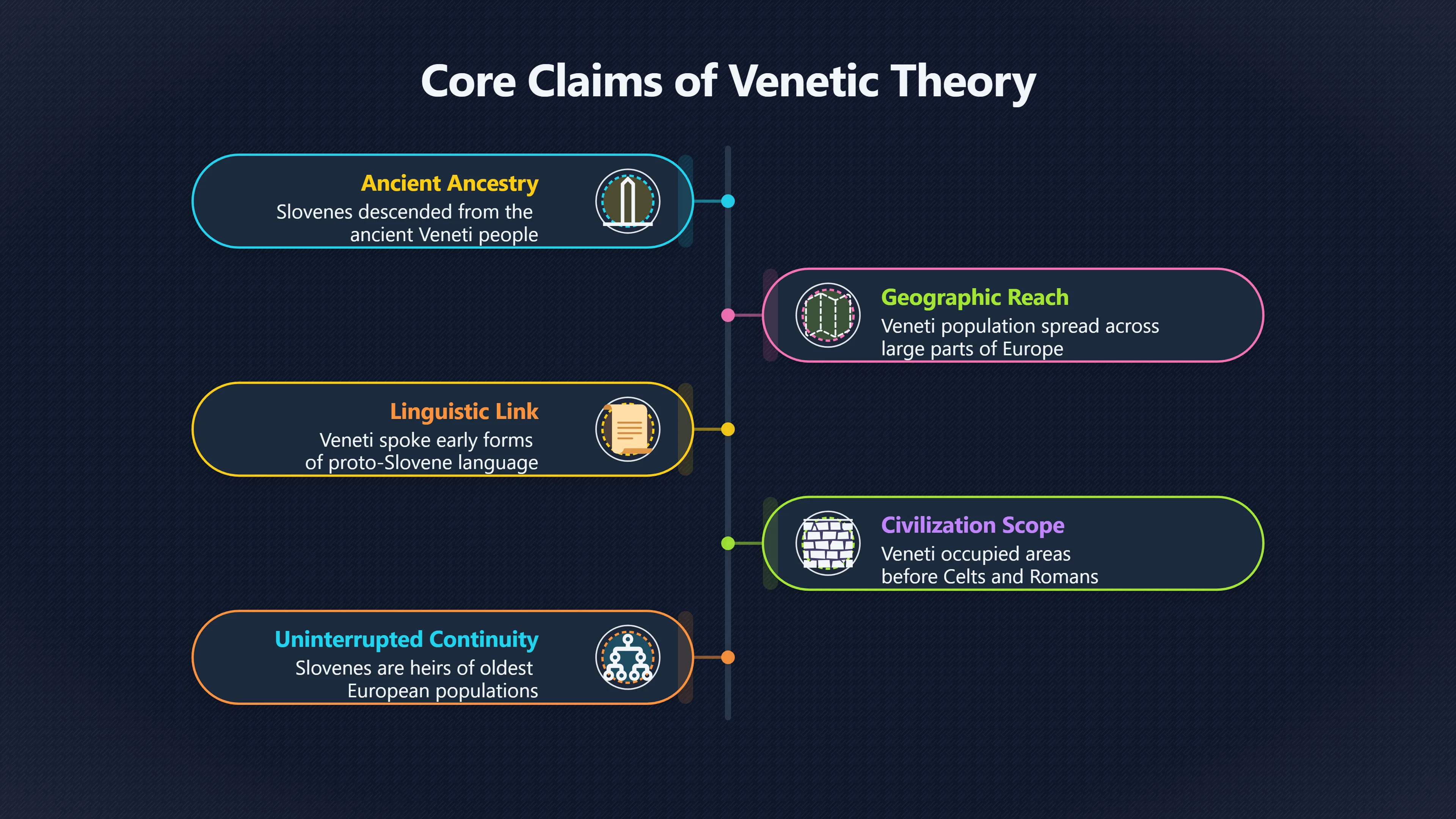
The Venetic theory is one of the most influential examples of pseudohistory in modern Slovenia. Unlike a forged artefact or fabricated news story, it was an alternative account of national origins. Its supporters argued that Slovenes were not primarily descendants of Slavic-speaking groups who arrived in the Eastern Alps during the early Middle Ages. Instead, they claimed that Slovenes descended from the ancient Veneti, a people supposedly spread across large parts of Europe long before the traditional dates assigned to Slavic settlement. The theory became highly visible during the 1980s and 1990s and sparked fierce public debate. Yet despite its popularity, mainstream historians, archaeologists and linguists rejected its central claims, arguing that its methods ignored established standards of historical and linguistic research.[Wikipedia]WikipediaVenetic theoryVenetic theory
The controversy matters because it reveals how attractive national origin stories can become when they promise deeper roots, greater antiquity and a more distinctive identity. In Slovenia, the Venetic theory became a cultural phenomenon not because scholars found convincing evidence for it, but because it offered an emotionally powerful answer to the question of who the Slovenes were and how long they had belonged in their homeland.[eTD]etd.ceu.eduCEU eTD CollectionThe massive success of the Venetic Theory uncovered the crisis of the Slavic and demotic-ethnicist frame of Slovene…
What the Venetic theory claimed
The modern form of the theory was developed and popularised in the 1980s by Jožko Šavli, Matej Bor and Ivan Tomažič. Their books argued that the ancestors of modern Slovenes were not migrants who arrived during the sixth century but descendants of an ancient European population known as the Veneti. According to their interpretation, various peoples called Veneti in classical and medieval sources—from northern Italy to the Baltic region—were related groups speaking an early form of a Slavic or proto-Slovene language.[Wikipedia]WikipediaVenetic theoryVenetic theory
This was a dramatic departure from the mainstream historical account. Conventional scholarship places Slovene within the South Slavic branch of the Slavic language family and links the emergence of Slovene-speaking populations in the Eastern Alps to broader Slavic migrations and settlement processes during the early medieval period.[Wikipedia]WikipediaSlovene languageApril 25, 2026 — a South Slavic language of the Balto-Slavic branch of the Indo-European language family. Most of its 2.5 million speaker…
The Venetic theory sought to replace that narrative with one of uninterrupted continuity. In this version of history, Slovenes were not late arrivals but descendants of one of Europe’s oldest populations. Some advocates extended the argument even further, portraying the Veneti as a widespread civilisation that occupied large areas of Europe before the arrival of Celts, Romans and Germanic peoples.[Wikipedia]WikipediaVenetic theoryVenetic theory
For supporters, the theory offered more than an academic revision. It transformed Slovenes from a relatively small Slavic nation into heirs of an ancient European people whose influence supposedly stretched across the continent.[eTD]etd.ceu.eduCEU eTD CollectionThe massive success of the Venetic Theory uncovered the crisis of the Slavic and demotic-ethnicist frame of Slovene…
Why linguists rejected its word comparisons
The theory’s most controversial feature was its use of language as evidence. Supporters argued that inscriptions associated with the ancient Veneti could be interpreted through Slovene and other Slavic languages. They also pointed to place names and similarities between words as proof of a deep connection between ancient Venetic speakers and modern Slovenes.[Wikipedia]WikipediaVenetic theoryVenetic theory
Professional linguists objected not because historical language relationships are impossible to reconstruct, but because the proposed comparisons did not follow accepted methods. Historical linguistics relies on systematic sound changes, consistent grammatical patterns and large bodies of comparative evidence. Chance resemblances between individual words are not enough to demonstrate common ancestry. Scholars argued that the Venetic theory depended heavily on selective similarities while overlooking contradictory evidence and established linguistic classifications.[ResearchWorks]journals.lib.washington.eduOpen source on washington.edu.
Critics also noted that the ancient Venetic language known from inscriptions in north-eastern Italy is generally treated by specialists as an ancient Indo-European language distinct from Slavic. The attempt to read Venetic inscriptions directly through modern Slovene was therefore viewed as methodologically unsound. Academic critiques described the approach as amateur historical linguistics because it began with a desired conclusion and then searched for supporting resemblances rather than testing hypotheses against the full body of linguistic evidence.[ResearchWorks]journals.lib.washington.eduOpen source on washington.edu.
The same criticism applied to many of the theory’s place-name arguments. Similar-looking names occurring across Europe were treated as proof of ancient Slovene presence, but specialists argued that place names can arise through multiple historical processes and cannot be interpreted reliably through superficial resemblance alone.[Wikipedia]WikipediaVenetic theoryVenetic theory
Why historians and archaeologists were unconvinced
The linguistic objections were accompanied by historical and archaeological criticism. Mainstream researchers argued that the theory required overturning a large body of evidence concerning population movements, language development and early medieval settlement patterns. Yet its supporters did not produce archaeological discoveries capable of demonstrating the uninterrupted continuity they proposed.[Zenodo]zenodo.orgOn the issue of continuity between the Veneti and…6 Oct 2023 — The classical Venetic theory that appeared in the eighties advoca…
Historians pointed out that ancient authors used names such as “Veneti” for several different peoples in different regions. Sharing a name did not automatically mean these groups were ethnically, linguistically or culturally identical. The Venetic theory often treated these separate references as evidence of a single vast people spread across Europe, a conclusion that scholars considered unsupported.[Wikipedia]WikipediaVenetic theoryVenetic theory
Prominent Slovenian historians including Bogo Grafenauer and Peter Štih publicly challenged the theory, arguing that it ignored established historical methods and selectively interpreted evidence. By the 1990s, rejection of the theory had become the dominant academic position among specialists in Slovenian history, archaeology and linguistics.[Wikipedia]WikipediaVenetic theoryVenetic theory
As a result, the dispute was not a balanced scholarly controversy with two equally accepted sides. It was a case in which a popular alternative narrative gained public attention while failing to persuade the relevant academic disciplines.[Wikipedia]WikipediaVenetic theoryVenetic theory
How national identity helped the theory spread
The remarkable aspect of the Venetic theory is not that it convinced specialists, but that it attracted such a large audience. Its rise coincided with the final decade of socialist Yugoslavia, a period when questions of national identity were becoming increasingly important across the region.[eTD]etd.ceu.eduCEU eTD CollectionThe massive success of the Venetic Theory uncovered the crisis of the Slavic and demotic-ethnicist frame of Slovene…
For many readers, the theory offered an appealing alternative to existing historical narratives. Rather than presenting Slovenes as one branch of a broader Slavic world, it portrayed them as a uniquely ancient European people with roots stretching back into pre-Roman antiquity. In a period of political change and growing interest in national history, that message resonated far beyond academic circles.[eTD]etd.ceu.eduCEU eTD CollectionThe massive success of the Venetic Theory uncovered the crisis of the Slavic and demotic-ethnicist frame of Slovene…
The theory also benefited from a wider cultural trend visible in many countries: the search for autochthonous, or indigenous, origins. Such narratives often emphasise continuity, antiquity and uniqueness. They can be emotionally attractive because they provide a sense of permanence and historical importance that conventional scholarly accounts may not emphasise.[ResearchGate]researchgate.netResearchGate(PDF) Myths of nationhood: Slovenians, Caranthania and…Drawing on the example of Slovenian ethno-national identity constru…
Institutional support helped the theory remain visible. Publications, conferences and advocacy by sympathetic organisations ensured that it circulated widely even as academic criticism mounted. Its influence also overlapped with debates about other contested symbols and origin stories in Slovenian national history.[Wikipedia]WikipediaVenetic theoryVenetic theory
Why the debate still survives
Although mainstream scholarship continues to reject the Venetic theory, it has not disappeared. Books, websites and cultural groups still promote versions of the argument, and new attempts periodically appear to revive or update it.[ResearchGate]researchgate.netOpen source on researchgate.net.
Part of its persistence comes from the fact that the theory addresses questions of identity rather than merely questions of evidence. Historical claims that reinforce a group’s sense of uniqueness often survive longer in popular culture than in academic debate. Once an origin story becomes linked to pride, heritage or collective memory, disproving specific arguments does not necessarily eliminate the broader appeal.[eTD]etd.ceu.eduCEU eTD CollectionThe massive success of the Venetic Theory uncovered the crisis of the Slavic and demotic-ethnicist frame of Slovene…
The Venetic controversy therefore occupies an unusual place in Slovenia’s history of contested truth. It was not a simple fraud in which forged objects or fabricated documents were exposed. Instead, it was a pseudohistorical interpretation that gained influence by offering an emotionally satisfying account of the past. Its lasting significance lies less in what it revealed about ancient Europe than in what it revealed about the power of national origin stories, and about the difficulty of separating identity from evidence when history becomes part of a nation’s self-image.[Wikipedia]WikipediaVenetic theoryVenetic theory
Amazon book picks
Further Reading
Books and field guides related to Were Slovenes Really Descended From the Ancient Veneti?. Use these as the next step if you want deeper reading beyond the article.
The Demon-Haunted World
Rating: 4.5/5 from 43 Google Books ratings
Supports critical evaluation of pseudohistorical claims.
The Horse, the Wheel, and Language
Demonstrates evidence-based approaches to ancient population questions.
The Invention of Tradition
Explains how historical narratives are constructed and adopted.
eBay marketplace picks
Marketplace Samples
Live-tested eBay searches with available results related to this page.


Endnotes
1.
Source: Wikipedia
Title: Venetic theory
Link:https://en.wikipedia.org/wiki/Venetic_theory
2.
Source: zenodo.org
Link:https://zenodo.org/records/8415286
Source snippet
On the issue of continuity between the Veneti and...6 Oct 2023 — The classical Venetic theory that appeared in the eighties advoca...
3.
Source: researchgate.net
Link:https://www.researchgate.net/publication/272824220_Myths_of_nationhood_Slovenians_Caranthania_and_the_Venetic_theory
Source snippet
ResearchGate(PDF) Myths of nationhood: Slovenians, Caranthania and...Drawing on the example of Slovenian ethno-national identity constru...
4.
Source: Wikipedia
Title: Teoria veneta
Link:https://it.wikipedia.org/wiki/Teoria_veneta
5.
Source: Wikipedia
Title: Slovene language
Link:https://en.wikipedia.org/wiki/Slovene_language
Source snippet
April 25, 2026 — a South Slavic language of the Balto-Slavic branch of the Indo-European language family. Most of its 2.5 million speaker...
Published: April 25, 2026
6.
Source: Wikipedia
Title: Vistula Veneti
Link:https://en.wikipedia.org/wiki/Vistula_Veneti
7.
Source: Wikipedia
Title: Jožko Šavli
Link:https://en.wikipedia.org/wiki/Jo%C5%BEko_%C5%A0avli
8.
Source: researchgate.net
Link:https://www.researchgate.net/publication/383057639_On_the_issue_of_continuity_between_the_Veneti_and_the_Slovenes_written_by
9.
Source: Wikipedia
Link:https://en.wikipedia.org/wiki/Slovenes
10.
Source: slovenia.si
Title: would you like to learn slovene
Link:https://slovenia.si/inside-view/would-you-like-to-learn-slovene
11.
Source: etd.ceu.edu
Link:https://www.etd.ceu.edu/2008/lisjak-gabrijelcic_luka.htm
Source snippet
CEU eTD CollectionThe massive success of the Venetic Theory uncovered the crisis of the Slavic and demotic-ethnicist frame of Slovene...
12.
Source: journals.lib.washington.edu
Link:https://journals.lib.washington.edu/index.php/ssj/article/view/3795
13.
Source: zgodovinazavse.si
Link:https://zgodovinazavse.si/zv/en/article/view/4876
Additional References
14.
Source: amazon.com
Link:https://www.amazon.com/Veneti-Builders-European-Community-Ancestors/dp/0968123600?tag=searcht-20
Source snippet
Veneti: First Builders of European Community: Tracing the...Part two, the author inerprets Venetic and Old Etruscan inscriptions w...
15.
Source: academia.edu
Link:https://www.academia.edu/80568738/The_Dissolution_of_the_Slavic_Identity_of_the_Slovenes_in_the_1980S_The_Case_of_the_Venetic_Theory
Source snippet
The Dissolution of the Slavic Identity of the Slovenes in...The Venetic Theory asserted Slovenes descended from proto-Slavic Ven...
16.
Source: youtube.com
Title: Carantania – The Forgotten Realm: Birthplace of the Slovenian Nation
Link:https://www.youtube.com/watch?v=WIvz3jOWbRs
Source snippet
Carantania | The Forgotten Slavic Principality That Shaped Slovenia...
17.
Source: 50languages.com
Link:https://www.50languages.com/slovenian-for-free
18.
Source: zdjp.si
Link:https://zdjp.si/wp-content/uploads/2015/10/ASHS_21-2011-2_Bajt.pdf
19.
Source: korenine.si
Link:https://www.korenine.si/zborniki/zbornik01/htm/bryant_refinements%20.htm
20.
Source: ernie.uva.nl
Link:https://ernie.uva.nl/viewer.p/21/56/object/122-160361
21.
Source: scispace.com
Link:https://scispace.com/papers/the-linguistic-premises-of-matej-bor-s-slovene-venetic-n9rst109sm
22.
Source: slonline.si
Link:https://www.slonline.si/
23.
Source: jutro.si
Link:https://jutro.si/media/knjige/9015/pdf/P_-ZD-29-_9015_vxUi9tJ.pdf
Topic Tree