Within Japan Hoaxes
How Planted Tools Rewrote Japan's Prehistory
Shinichi Fujimura's planted stone tools survived because spectacular discoveries gained authority faster than they were independently checked.
On this page
- The discoveries that pushed settlement deeper into the past
- Why researchers and institutions accepted the finds
- The hidden footage that exposed the fraud
Page outline Jump by section
Introduction
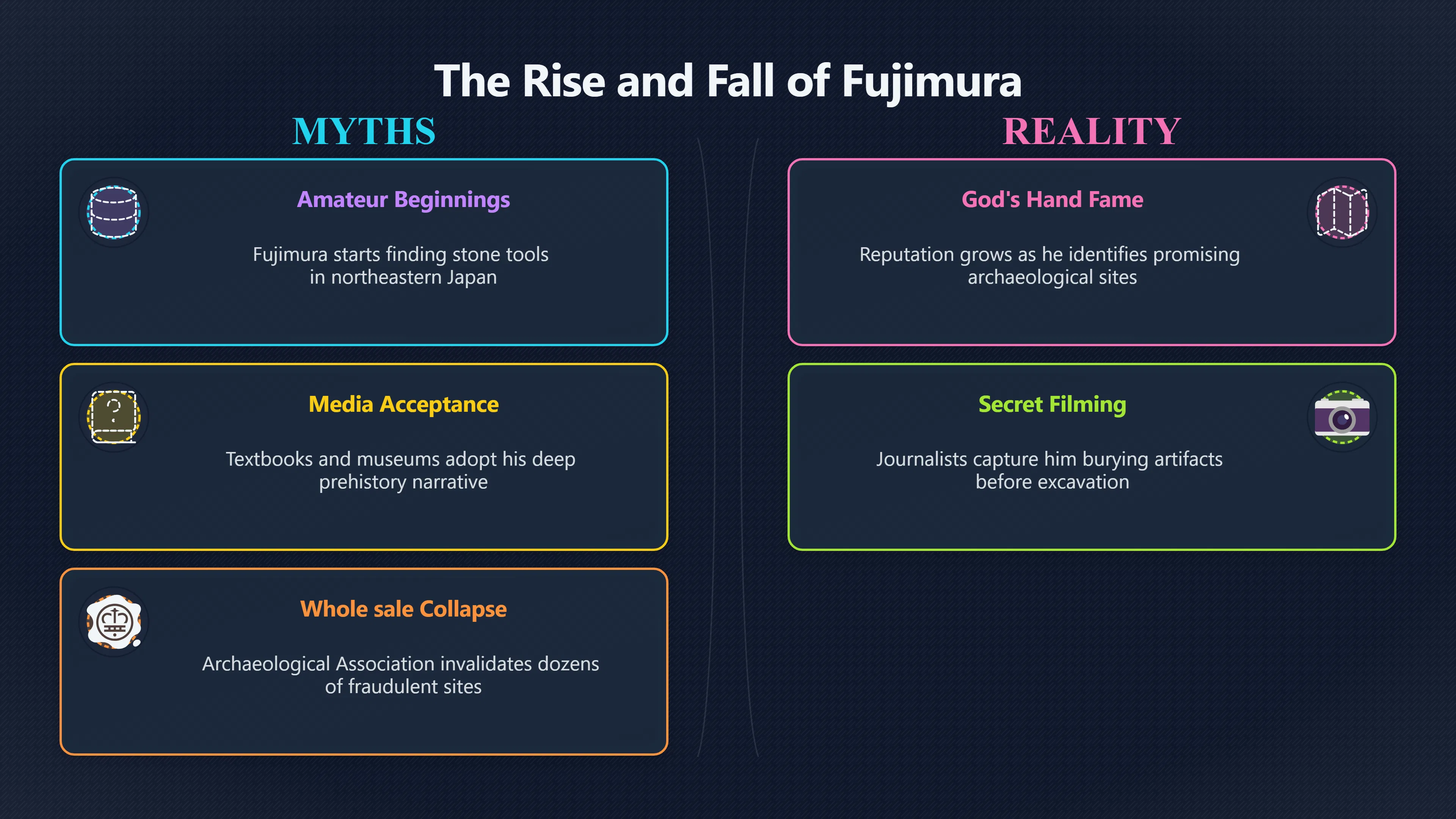
Few archaeological scandals have rewritten a nation’s prehistory as dramatically as the fraud carried out by Shinichi Fujimura. For more than two decades, Fujimura was celebrated as the discoverer of astonishingly ancient stone tools that appeared to push human occupation of the Japanese islands hundreds of thousands of years further into the past. His finds were accepted by many archaeologists, displayed in museums, featured in textbooks and promoted by local authorities. Then, in November 2000, newspaper reporters secretly filmed him burying artefacts before they were supposedly “discovered”. The resulting scandal did not merely expose one dishonest researcher. It forced a wholesale re-examination of Japan’s proposed Early Palaeolithic record and raised uncomfortable questions about how institutions, experts and the media had allowed extraordinary claims to become accepted history.[Science]science.orgArchaeologist Faked Important DiscoveryFujimura's downfall came on 5 November, when the Mainichi Shimbun newspaper reported that i…
The Discoveries That Pushed Settlement Deeper Into the Past
Shinichi Fujimura was not a university-trained archaeologist. He began as an amateur enthusiast in northeastern Japan during the 1970s, yet he rapidly gained a reputation for finding stone tools where others could not. His uncanny success earned him the nickname “God’s Hand”, reflecting a widespread belief that he possessed an almost supernatural ability to identify promising sites.[EBSCO]ebsco.comLocale Tokyo… fraud involving one of Japan's most trusted and admired amateur archaeologists, Shinichi Fujimura.Read more…
The importance of these discoveries lay in their apparent age. Before Fujimura’s rise, evidence for human occupation of Japan was generally thought to extend back tens of thousands of years. His finds appeared to show that humans had been present hundreds of thousands of years earlier. Sites such as Zazaragi, Kamitakamori and others produced stone tools allegedly buried beneath volcanic ash layers that could be dated to immense antiquity. Each new discovery seemed to confirm the last, creating an increasingly elaborate picture of a deep Japanese prehistory.[Wikipedia]WikipediaJapanese Paleolithic hoaxJapanese Paleolithic hoax
The implications reached far beyond archaeology. If the finds were genuine, Japan would possess one of East Asia’s oldest records of human occupation. Museums mounted exhibitions around the discoveries, textbooks incorporated the new chronology and local governments promoted archaeological tourism connected to the sites. Some locations even gained official recognition and funding because of their supposed significance.[Wikipedia]WikipediaJapanese Paleolithic hoaxJapanese Paleolithic hoax
By the late 1990s, the existence of a Japanese Early Palaeolithic stretching back more than half a million years had become widely accepted. Much of that narrative rested directly or indirectly on Fujimura’s discoveries.[ResearchGate]researchgate.netResearch Gatepostwar Japanese archaeology and the Early Paleolithicpostwar Japanese archaeology and the Early Paleolithic…August 1, 2005 — From at least 1976 until his exposure by the media…
Why Researchers and Institutions Accepted the Finds
The obvious question is why the fraud lasted so long.
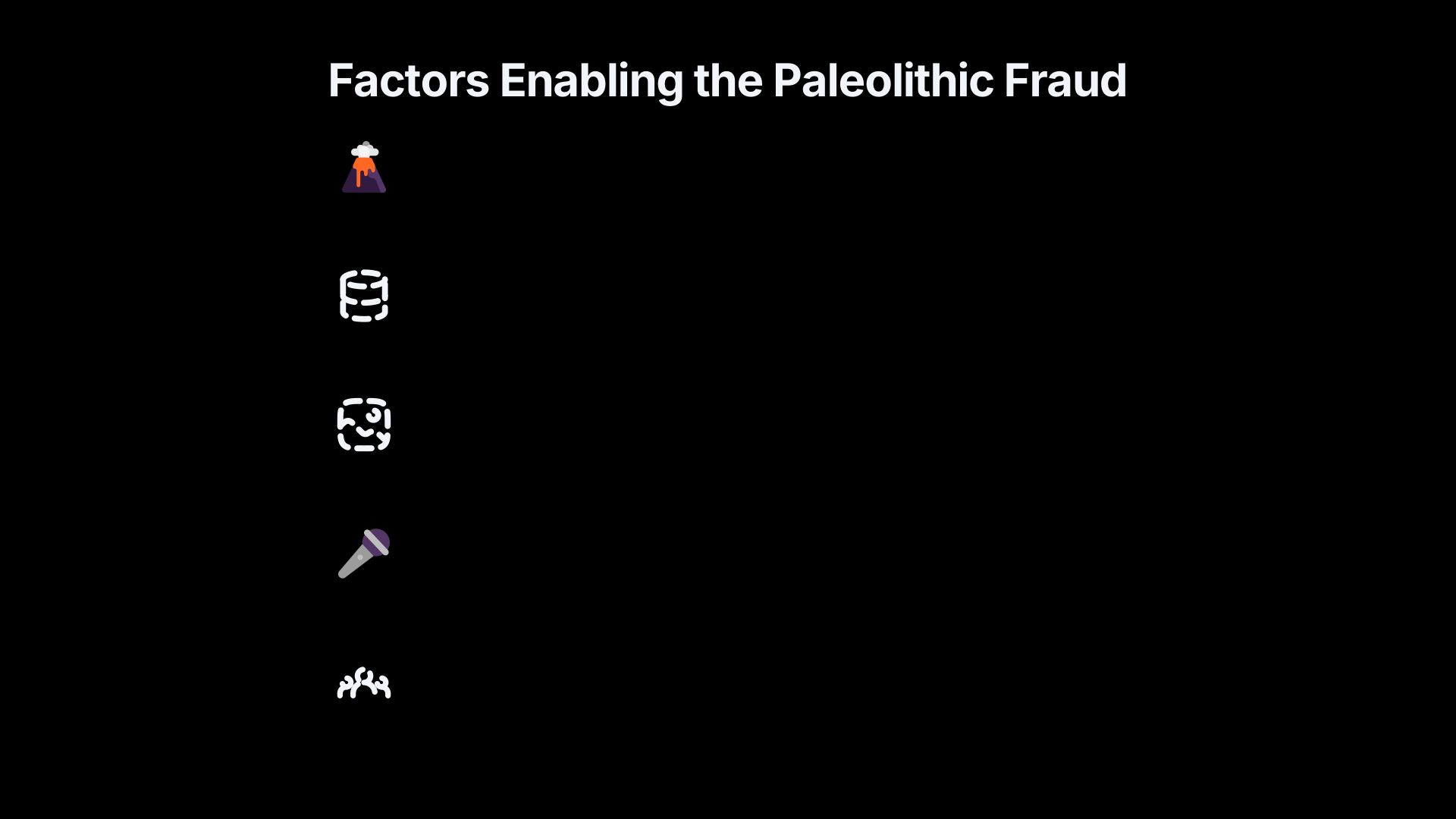
Part of the answer lies in the nature of archaeological evidence. The volcanic history of Japan creates layers of ash that can often be dated with considerable precision. If an artefact appears within an ancient layer, it is tempting to assume that the artefact is equally ancient. Fujimura exploited this confidence. The volcanic deposits themselves were real, but the objects had been inserted later.[Wikipedia]WikipediaJapanese PaleolithicJapanese Paleolithic
There were warning signs. A small number of archaeologists, geologists and anthropologists questioned the discoveries. Critics pointed to inconsistencies in the geological context and to stone tools that looked strange when compared with known Early Palaeolithic technology elsewhere. Papers raising doubts appeared years before the scandal broke. Yet these concerns remained largely marginal.[Wikipedia]WikipediaJapanese Paleolithic hoaxJapanese Paleolithic hoax
Several broader factors helped the claims gain authority:
- Repetition created credibility. Every new discovery appeared to confirm earlier discoveries, creating a self-reinforcing chain of evidence.
- Institutional investment grew. Museums, research institutes and local governments had committed resources and prestige to the sites.
- Media enthusiasm rewarded spectacular claims. Dramatic discoveries attracted attention far more readily than cautious criticism.
- National significance amplified interest. The question of when humans first reached Japan was a major historical issue, making extraordinary finds especially attractive.[researchgate.net]researchgate.netOpen source on researchgate.net.
Historian and archaeologist Mark Hudson has argued that post-war Japanese archaeology developed a strong public character as a form of “people’s history”. Archaeology was not confined to universities; local groups, volunteers and community projects played major roles. That democratic tradition brought many benefits, but it also helped create an environment in which a charismatic and apparently gifted amateur could acquire exceptional authority.[ResearchGate]researchgate.netResearch Gatepostwar Japanese archaeology and the Early Paleolithicpostwar Japanese archaeology and the Early Paleolithic…August 1, 2005 — From at least 1976 until his exposure by the media…
The Hidden Footage That Exposed the Fraud
The collapse came suddenly.
Journalists at the Mainichi Shimbun received information suggesting that Fujimura might be planting artefacts. Rather than publishing rumours, they conducted a covert investigation. In 2000 they secretly observed a dig at Kamitakamori in Miyagi Prefecture and recorded Fujimura placing objects in the ground before excavation began. The following day, those same objects were presented as remarkable archaeological discoveries.[science.org]science.orgArchaeologist Faked Important DiscoveryFujimura's downfall came on 5 November, when the Mainichi Shimbun newspaper reported that i…
When confronted with the evidence, Fujimura confessed. He later claimed that he had been driven by an irresistible urge and admitted planting artefacts at numerous sites. The revelation shocked Japanese archaeology because the deception was not confined to a single excavation. Investigations soon suggested a pattern stretching back decades.[Science]science.orgArchaeologist Faked Important DiscoveryFujimura's downfall came on 5 November, when the Mainichi Shimbun newspaper reported that i…
The image of the celebrated “God’s Hand” secretly burying stone tools became one of the defining moments in the history of archaeological fraud. It was not a dispute over interpretation or dating methods. The central evidence was direct observation of the act itself.[Science]science.orgArchaeologist Faked Important DiscoveryFujimura's downfall came on 5 November, when the Mainichi Shimbun newspaper reported that i…
How Much of the Early Palaeolithic Record Survived?
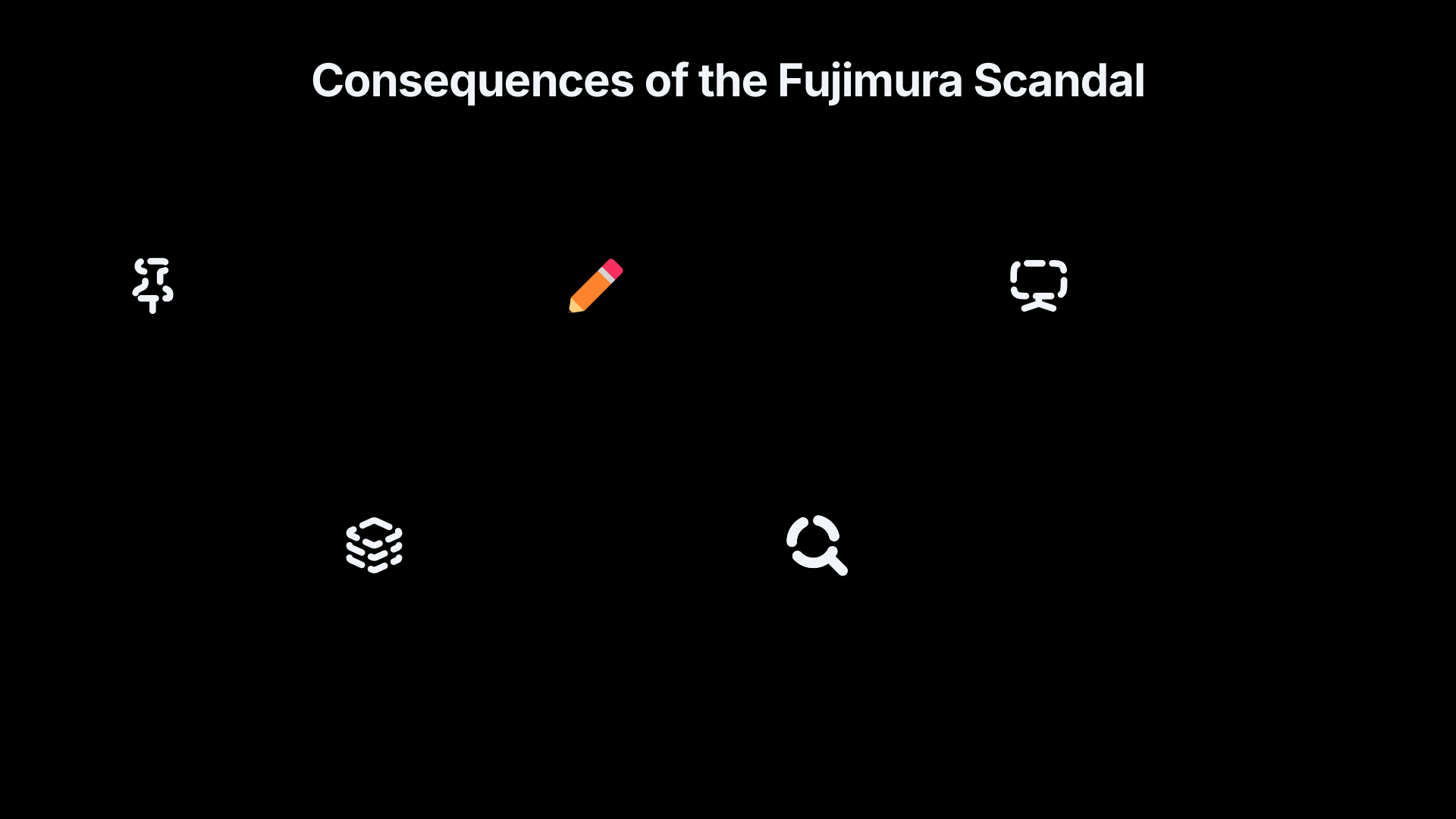
After the exposure, the Japanese Archaeological Association established a special committee to review the evidence associated with Fujimura and the sites connected to his work. The investigation lasted several years and produced devastating conclusions. Many supposedly ancient discoveries could no longer be trusted, and numerous sites lost their archaeological value as evidence for extremely early human occupation.[Wikipedia]WikipediaJapanese Paleolithic hoaxJapanese Paleolithic hoax
Researchers concluded that Fujimura had planted artefacts at dozens of excavations, while broader analyses suggested his influence extended across more than 180 sites over the course of his career. The result was the collapse of much of the accepted Early Palaeolithic sequence that had been built during the previous two decades.[Wikipedia]WikipediaShinichi FujimuraShinichi Fujimura
The damage extended beyond academic publications. Museums removed artefacts from display. Educational materials were revised. Local heritage projects based on the discoveries lost their foundations. What had seemed like one of Japan’s great archaeological success stories became an example of how a persuasive narrative can overwhelm critical scrutiny.[Spyscape]spyscape.comThe Scientific Hoax That Rocked JapanThe Scientific Hoax That Rocked Japan…. fraudulent artifacts. School books were rewritten…
Yet the scandal did not erase all evidence for ancient human activity in Japan. Later excavations, conducted under stricter standards and independent scrutiny, continued to investigate early occupation. The key difference was that claims now faced much more rigorous examination than before.[archaeopress.com]archaeopress.comRevelations in Japanese ArchaeologyRevelations in Japanese Archaeology
What the Scandal Revealed About Archaeological Governance
The Fujimura affair is often remembered as the story of a fraudulent archaeologist, but many scholars regard the larger lesson as institutional rather than personal.
Commentators noted that archaeological claims were frequently publicised through press conferences and media coverage before receiving extensive critical review. Questions about excavation methods, stratigraphy and artefact context sometimes received less attention than dramatic announcements of record-breaking discoveries. The scandal exposed weaknesses in oversight, peer criticism and independent verification.[ResearchGate]researchgate.netOpen source on researchgate.net.
In response, archaeological practice became more cautious. Greater emphasis was placed on documenting excavation contexts, encouraging independent review and treating spectacular discoveries with scepticism until they could be replicated or confirmed. The scandal became a case study in how scientific and historical institutions can be misled when authority, reputation and appealing narratives substitute for verification.[J-STAGE]jstage.jst.go.jpJ-STAGEpostwar Japanese archaeology and the Early Paleolithic…28 Feb 2005 — Fujimura's hoax continued until he was filmed burying tool…
The enduring significance of the case is therefore not simply that one man planted stone tools. It is that an entire reconstruction of the distant past gained legitimacy through a combination of trust, institutional momentum and the desire for a compelling historical story. When the fraud collapsed, Japan was forced to rewrite a substantial chapter of its prehistory—and to reconsider how historical knowledge is created in the first place.[ResearchGate]researchgate.netResearch Gatepostwar Japanese archaeology and the Early Paleolithicpostwar Japanese archaeology and the Early Paleolithic…August 1, 2005 — From at least 1976 until his exposure by the media…
Amazon book picks
Further Reading
Books and field guides related to How Planted Tools Rewrote Japan's Prehistory. Use these as the next step if you want deeper reading beyond the article.
Frauds, Myths, and Mysteries: Science and Pseudoscience in Ar...
Strong fit for archaeological fraud and critical evaluation.
The Demon-Haunted World
Rating: 4.5/5 from 43 Google Books ratings
Relevant to extraordinary claims accepted without sufficient evidence.
Archaeology : theories, methods, and practice
Explains the methods that should detect fabricated discoveries.
eBay marketplace picks
Marketplace Samples
Live-tested eBay searches with available results related to this page.



Endnotes
1.
Source: ebsco.com
Link:https://www.ebsco.com/research-starters/anthropology/japanese-amateur-archaeologists-discoveries-are-proven-fakes
Source snippet
Locale Tokyo... fraud involving one of Japan's most trusted and admired amateur archaeologists, Shinichi Fujimura.Read more...
2.
Source: Wikipedia
Title: Japanese Paleolithic hoax
Link:https://en.wikipedia.org/wiki/Japanese_Paleolithic_hoax
3.
Source: spyscape.com
Link:https://spyscape.com/article/the-man-who-forged-ancient-artifacts
Source snippet
The Scientific Hoax That Rocked JapanThe Scientific Hoax That Rocked Japan.... fraudulent artifacts. School books were rewritten...
4.
Source: researchgate.net
Title: Research Gatepostwar Japanese archaeology and the Early Paleolithic
Link:https://www.researchgate.net/publication/279027490_For_the_people_by_the_people_postwar_Japanese_archaeology_and_the_Early_Paleolithic_hoax
Source snippet
postwar Japanese archaeology and the Early Paleolithic...August 1, 2005 — From at least 1976 until his exposure by the media...
Published: August 1, 2005
5.
Source: Wikipedia
Title: Japanese Paleolithic
Link:https://en.wikipedia.org/wiki/Japanese_Paleolithic
6.
Source: Wikipedia
Title: Shinichi Fujimura
Link:https://en.wikipedia.org/wiki/Shinichi_Fujimura
7.
Source: researchgate.net
Link:https://www.researchgate.net/publication/12139062_ARCHAEOLOGY_Japanese_Fraud_Highlights_Media-Driven_Research_Ethic
8.
Source: researchgate.net
Link:https://www.researchgate.net/publication/250004741_For_the_people_by_the_people_Postwar_Japanese_archaeology_and_the_Early_Paleolithic_hoax
9.
Source: archaeopress.com
Title: Revelations in Japanese Archaeology
Link:https://www.archaeopress.com/Archaeopress/DMS/67F55F755F934C4B9E4524B6C042DA3A/9781803279855-sample.pdf
10.
Source: nature.com
Link:https://www.nature.com/articles/35042725
11.
Source: science.org
Link:https://www.science.org/content/article/archaeologist-faked-important-discovery
Source snippet
Archaeologist Faked Important DiscoveryFujimura's downfall came on 5 November, when the Mainichi Shimbun newspaper reported that i...
12.
Source: jstage.jst.go.jp
Link:https://www.jstage.jst.go.jp/article/ase/advpub/0/advpub_0_0502260021/_pdf/-char/en
Source snippet
J-STAGEpostwar Japanese archaeology and the Early Paleolithic...28 Feb 2005 — Fujimura's hoax continued until he was filmed burying tool...
13.
Source: latimes.com
Title: la xpm 2000 nov 09 mn 49447 story
Link:https://www.latimes.com/archives/la-xpm-2000-nov-09-mn-49447-story.html
14.
Source: apjjf.org
Link:https://apjjf.org/2022/15/hudson
15.
Source: pure.mpg.de
Link:https://pure.mpg.de/rest/items/item_3689092_2/component/file_3689093/content
Additional References
16.
Source: aeon.co
Title: from piltdown to mormon seer stones prehistory has always beckoned the trickster
Link:https://aeon.co/essays/from-piltdown-to-mormon-seer-stones-prehistory-has-always-beckoned-the-trickster
Source snippet
From Piltdown to Mormon seer stones, prehistory has...Jul 28, 2015 —... archaeological hoaxes, and the difficulty of uncoupling...
17.
Source: youtube.com
Link:https://www.youtube.com/watch?v=WhIc-aWkk0U&vl=en
Source snippet
The BIGGEST Fraud in Japanese ArchaeologyFujimura's findings pushed back the date of the earliest known humans in Japan from 30,00...
18.
Source: facebook.com
Link:https://www.facebook.com/groups/583301279532596/posts/1722182925644420/
19.
Source: youtube.com
Title: America’s Biggest Archaeological Hoax
Link:https://www.youtube.com/watch?v=As6cMTKj6sQ
Source snippet
From Ancient Mystery to Modern Fake | Legend of the Crystal Skulls...
20.
Source: youtube.com
Title: Japan: Mysteries Caught on Camera
Link:https://www.youtube.com/watch?v=vYV8EiBNSDU
Source snippet
10 Biggest Archaeology Hoaxes of 2025-26...
21.
Source: genoplot.com
Title: japanese paleolithic hoax fraud case mars archaeology in japan
Link:https://genoplot.com/discussions/topic/14439/japanese-paleolithic-hoax-fraud-case-mars-archaeology-in-japan
22.
Source: youtube.com
Title: From Ancient Mystery to Modern Fake | Legend of the Crystal Skulls
Link:https://www.youtube.com/watch?v=cq3b0G2Blo0
23.
Source: youtube.com
Link:https://www.youtube.com/watch?v=jDjTZn31usY
Source snippet
America's Biggest Archaeological Hoax...
24.
Source: youtube.com
Title: The ‘Dangun Myth’ That Became History
Link:https://www.youtube.com/watch?v=NPtgWITXUU0
Source snippet
Japan: Mysteries Caught on Camera...
25.
Source: journals.sagepub.com
Link:https://journals.sagepub.com/doi/10.1177/0308275X06070123
Topic Tree