When False Stories Changed Guinea's History
Guinea’s best-documented history of deception is not a parade of amusing newspaper pranks or forged monsters.
Page outline Jump by section
Introduction
These episodes require careful labels. The counterfeit-currency operation was deliberate deception. The false claim that health workers were infecting children was a rumour whose original author remains unclear. Wider Ebola stories about organ theft and invented disease mixed conspiracy theory, fear, misunderstanding and, sometimes, calculated agitation. Modern doctored photographs were straightforward digital fabrications. Taken together, they show that falsehoods become persuasive not because Guineans are unusually credulous, but because official secrecy, colonial conflict, unfamiliar medical procedures and political upheaval can make even extraordinary claims seem plausible.
The counterfeit francs meant to weaken a new nation
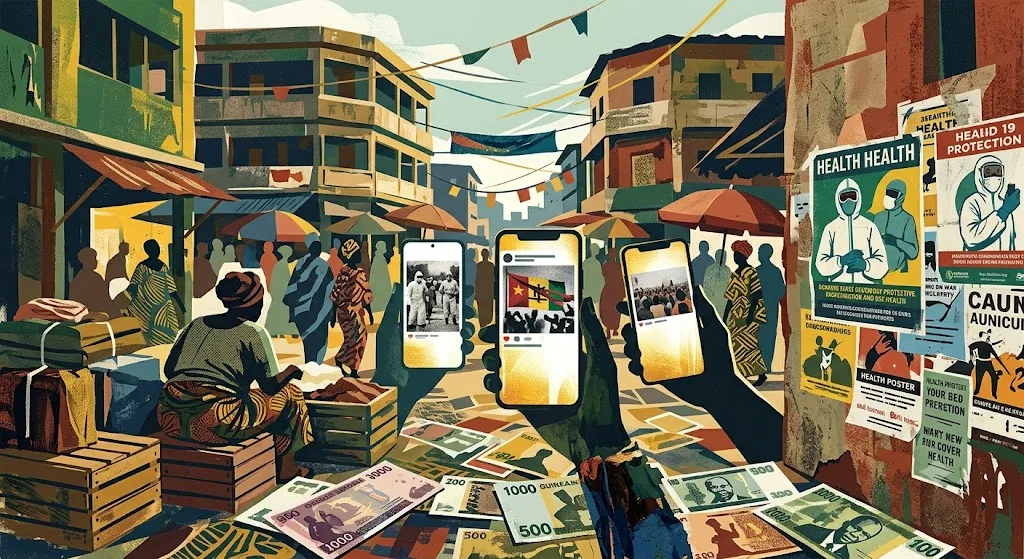
The most remarkable Guinean case is Operation Persil, a covert French campaign associated with the rupture between France and its former colony after independence. Guinea voted against joining Charles de Gaulle’s proposed French Community in September 1958 and became independent on 2 October. Relations rapidly deteriorated, particularly over Guinea’s determination to control its own economic and monetary policy.
When Guinea introduced the Guinean franc and left the French-managed franc system in 1960, French intelligence officers planned measures to undermine President Ahmed Sékou Touré. Accounts by former intelligence personnel and later historians describe Operation Persil as combining support for armed opponents with the production and introduction of counterfeit Guinean banknotes. The intention was to damage confidence in the new currency, drive inflation and make political independence appear economically disastrous. Economist Ndongo Samba Sylla has described the counterfeiting as a warning to other former French territories considering monetary independence.[Wikipedia]WikipediaOperation PersilOperation Persil
This was more than ordinary forgery for profit. A conventional counterfeiter wants false notes to pass unnoticed so that goods can be purchased with them. In economic warfare, widespread circulation and eventual discovery can both serve the attacker: the notes add money to the economy, while uncertainty about which notes are genuine weakens trust in every transaction. The target is therefore not simply a bank but the credibility of a state.
Former French intelligence official Maurice Robert later acknowledged that French services had sought to make Touré vulnerable and unpopular. He specifically identified the introduction of large quantities of false Guinean notes as one of the destabilising measures. Accounts of the operation also describe efforts to train or arm Guinean exiles, although leaks, diplomatic objections and the seizure of a weapons shipment in Senegal complicated the campaign.[Wikipedia]WikipediaOperation PersilOperation Persil
Some colourful details repeated in modern retellings are harder to verify independently. One popular claim says that the counterfeit notes were better suited to Guinea’s humid climate than the genuine notes printed abroad. The story is memorable, but it is often repeated through secondary accounts rather than demonstrated through surviving technical records. Likewise, it is difficult to separate the precise economic effect of forged currency from Guinea’s wider post-independence problems, including disrupted trade, administrative upheaval, political repression and isolation from former commercial networks.
The central deception, however, is well supported by testimony from participants and by historical work on French covert policy in Africa. Operation Persil matters because it reverses the usual pattern of a national hoax. Here, the young state and its population were not the authors of the fake. They were its intended victims.

When a real epidemic was called an invention
The Ebola epidemic that began in Guinea in late 2013 produced the country’s most lethal crisis of contested truth. Ebola itself was real, but many people encountered it through institutions and procedures that appeared secretive, violent or incomprehensible. Patients were removed by strangers in protective clothing. Families could not nurse relatives in the customary manner. Bodies were handled under strict infection controls, and traditional funerals were restricted because contact with a deceased patient could transmit the virus.
The outbreak was also initially difficult to recognise. The World Health Organization reported that nearly three months passed before Ebola was identified as the cause of the unexplained illness in Guinea. By then, transmission chains had become established. Weak health services, inconsistent early messaging and unfamiliar emergency measures created ideal conditions for suspicion.[World Health Organization]who.intWorld Health OrganizationFactors that contributed to undetected spreadCHAPTER 3 - In Guinea, it took nearly three months for health offic…
Rumours claimed that Ebola had been invented to attract foreign money, that outsiders had deliberately brought the virus, or that treatment centres were fronts for stealing blood, organs or bodies. These stories were false, but they drew strength from visible facts that frightened communities could not independently interpret: relatives entered isolation units and sometimes never returned; burial teams arrived in protective equipment; and officials offered changing instructions during an unprecedented emergency. Studies of Ebola communication found that conspiracy theories about deliberate infection and Western exploitation circulated alongside genuine uncertainty about the disease.[nih.gov]pmc.ncbi.nlm.nih.govPMCThe communication aspects of the Ebola virus diseaseby J Allgaier · 2015 · Cited by 133 — Some conspiracy theories claimed that Ebola was brought to the region on purpose by Westerners a…
It would be misleading to dismiss all resistance as simple superstition. Guinea’s political history included colonial coercion, covert foreign interference and long periods of authoritarian government. Its health system was under-resourced, while some rural communities had limited experience of state services that they regarded as reliable or accountable. Anthropologists working on the response consequently described Ebola as an epidemic of mistrust as well as a biological epidemic.[Institute of Development Studies]ids.ac.uka real time and anthropological response to the ebola crisisa real time and anthropological response to the ebola crisis
The consequences were severe. Families concealed sick relatives, avoided clinics or resisted contact tracing. Public-health teams were threatened or attacked. The World Health Organization later concluded that inaccurate media messages, denial and false rumours contributed to rejection of control measures and sometimes to violence against health workers.[WHO | Regional Office for Africa]afro.who.intRegional Office for AfricaAFR/RC65/10 24 October 2015 REGIONAL COMMITTEE FOR…27 Nov 2020 — Denial and false rumours contributed…
The killings at Womey
The most terrible incident occurred at Womey, near Nzérékoré, in September 2014. A delegation of health workers, local officials and journalists visited the village to provide information about Ebola. Eight members of the group were killed, and their bodies were later found concealed in a latrine or septic tank.
Reports linked the attack to intense distrust of the authorities and to beliefs that Ebola was an invention or that visiting teams were spreading it. Three of those killed were journalists, including staff connected with regional radio services. The case demonstrated that a false explanation of a real danger can become more immediately persuasive than the danger itself.[Wikipedia]WikipediaWomey massacreWomey massacre
It is important not to turn Womey into a morality tale about an irrational village confronting enlightened outsiders. Public-health communication had often been too top-down, while frightening practices were introduced before relationships of trust had been established. Later assessments stressed the value of local leaders, anthropologists, community dialogue and burial practices that allowed families greater visibility and participation without exposing them to infection.[WHO Apps]apps.who.intOpen source on who.int.
The lesson was not that rumours should be indulged as equally valid explanations. It was that correction works poorly when authorities answer only the literal claim and ignore the experience that made it credible. Saying “no organs are being stolen” could not, by itself, explain why families were excluded from treatment tents or why burial procedures had changed overnight.
The false school-vaccination panic
In February 2015, a more specific rumour spread through Conakry and other parts of Guinea: the Red Cross was supposedly entering schools to vaccinate children against Ebola or spraying schools in order to infect them. There was no such school vaccination programme.
Parents rushed to remove children from classrooms, schools were disrupted, and Red Cross personnel and other workers faced threats or attacks. Guinea’s health minister publicly rejected the claim as baseless and said the Red Cross could not independently conduct a national vaccination campaign without the Ministry of Health.[ReliefWeb]reliefweb.intguinea scrambles shut down false vaccination rumorguinea scrambles shut down false vaccination rumor
A United Nations report recorded that rumours about the Red Cross spraying schools to infect pupils had contributed to a security incident in Forécariah. A later review of risk communication in Guinea noted that the panic led parents to withdraw children and increased threats against schools and health workers.[United Nations Digital Library System]digitallibrary.un.orgited Nations Digital Library System A/69/812* General Assemblyited Nations Digital Library System A/69/812* General Assembly
The rumour was especially powerful because it combined several anxieties in one simple story:
- Children were the alleged targets, making delay feel dangerous.
- The Red Cross was a recognisable organisation, so the claim sounded specific rather than abstract.
- Spraying and disinfection were real practices, although their purpose was reversed in the rumour.
- Vaccine research was genuinely under discussion, making a fictional school campaign seem less impossible.
- Trust had already been damaged, so official denials did not automatically settle the matter.
The distinction between the false rumour and subsequent reality is striking. Genuine Ebola vaccination later became a major part of outbreak control. A ring-vaccination trial in Guinea vaccinated people who had been in contact with confirmed cases, and its results helped establish the effectiveness of the vaccine. During the smaller 2021 outbreak, vaccination of people at high risk began within days of confirmation.[reuters.com]reuters.comHundreds in Guinea get Ebola vaccine in fight against flareHundreds in Guinea get Ebola vaccine in fight against flare
This later success does not mean the 2015 rumour was a confused advance report. The alleged clandestine school programme did not exist. Rather, the case shows how fragments of real science can be rearranged into a false and frightening narrative.
Doctored pictures after the 2021 coup
Digital deception surrounding Guinea became internationally visible after soldiers overthrew President Alpha Condé on 5 September 2021. Political shocks create intense demand for immediate visual proof: who supports the coup, which foreign government approves, and whether troops or leaders are taking sides. That demand makes recycled and manipulated photographs unusually effective.
One widely shared image appeared to show Ethiopian prime minister Abiy Ahmed draped in Guinea’s red, yellow and green flag, supposedly demonstrating support for the military takeover. Fact-checkers found that the flag had been digitally added to an existing photograph. Another altered image placed Abiy among soldiers in a way that also encouraged a false connection with events in Guinea.[Pesacheck]pesacheck.orgOpen source on pesacheck.org.
These fabrications were not necessarily created inside Guinea, and their principal subject was not Guinean. They nevertheless belonged to Guinea’s post-coup information environment because the country’s upheaval supplied the false meaning attached to the pictures. They reveal a common feature of modern political fakery: the image itself may be old or authentic, while the crucial element is an altered symbol, caption or setting.
Such posts benefit from emotional speed. A photograph of a prominent African leader apparently wrapped in Guinea’s flag can communicate continental solidarity in a fraction of a second. Checking the original photograph, comparing edges and shadows, or tracing the earliest upload takes longer. By the time a correction appears, the fabricated image may already have become part of a political narrative.
Why Guinea’s false stories remain believable
Guinea’s most enduring deception stories share a structure even though their authors and motives differ.
First, they use something genuine as scaffolding. Operation Persil exploited a real new currency. Ebola rumours used real protective clothing, spraying, isolation and experimental vaccine research. Coup-era image manipulation used real politicians and authentic photographs.
Secondly, the false explanation often fills a gap left by secrecy. Covert operations are secret by definition. Treatment centres restricted access for medical reasons. Military takeovers produce uncertain chains of command and incomplete information. Where direct observation is impossible, people construct explanations from history, fear and whatever evidence is visible.
Thirdly, later confirmation of one hidden plot can strengthen belief in unrelated ones. Operation Persil provides a documented example of foreign interference against Guinea. That does not validate claims that Ebola was invented or that medical workers harvested organs. It does, however, help explain why blanket demands to “trust the authorities” may fail. A population aware that genuine conspiracies have occurred may reasonably seek proof, even while reaching the wrong conclusion in a particular case.
Finally, the word hoax can obscure more than it clarifies. Guinea’s cases belong to several different categories:
[Operation Persil]WikipediaOperation Persil rsil** was state-directed forgery and covert economic sabotage.
- Organ-harvesting and invented-Ebola stories were conspiracy narratives, with mixed and often untraceable origins.
- The school-vaccination panic was a false rumour that triggered real disruption and violence.
- Post-coup photographs were deliberate digital manipulation.
- Community resistance to medical teams was behaviour shaped by false claims, but also by genuine failures of trust and communication.
Keeping these distinctions matters. A forged banknote requires forensic and archival investigation. A health rumour requires rapid correction combined with credible community engagement. A doctored photograph can often be exposed by finding its earlier version. Treating every case simply as “fake news” hides who created it, who benefited and what kind of evidence can defeat it.
What the exposures changed
Operation Persil did not end Guinea’s independence, but its later exposure deepened understanding of how far post-colonial powers were prepared to go to retain influence. It also complicated interpretations of Sékou Touré’s rule. His government exploited fears of conspiracy to justify repression, yet at least some external destabilisation was real. The historical challenge is therefore to recognise genuine covert action without accepting every allegation made in its name.
The Ebola crisis produced a more practical change. Health organisations increasingly recognised that accurate instructions were not enough. Communities needed to see how treatment and burial systems worked, ask questions through trusted local figures, and participate in decisions affecting families. WHO’s reviews emphasised local ownership, civil-society involvement and culturally appropriate communication.[WHO | Regional Office for Africa]afro.who.intRegional Office for AfricaAFR/RC65/10 24 October 2015 REGIONAL COMMITTEE FOR…27 Nov 2020 — Denial and false rumours contributed…
The later vaccination campaigns offered the clearest counterpoint to the 2015 panic. A technology once woven into a story about secret infection became a demonstrated tool for protecting contacts and ending outbreaks. Guinea’s 2021 Ebola episode was declared over after 16 recorded infections and 12 deaths, following rapid tracing, vaccination and response measures.[Reuters]reuters.comwho declares ebola outbreak guinea overwho declares ebola outbreak guinea over
Guinea’s history of contested truth is therefore not merely a collection of strange falsehoods. It is a record of how deception operates where authority is disputed. The counterfeit note, the medical rumour and the altered photograph all gain power by imitating something trusted: money, scientific procedure or visual evidence. Their exposure depends not only on proving that a claim is false, but on explaining why the imitation looked convincing in the first place.
Amazon book picks
Further Reading
Books and field guides related to When False Stories Changed Guinea's History. Use these as the next step if you want deeper reading beyond the article.
The Misinformation Age
Helps explain rumor and misinformation episodes discussed on the page.
Africa Since Independence
Places Guinea's political and social developments in context.
eBay marketplace picks
Marketplace Samples
Example marketplace items related to this page. Use the search link to explore similar finds on eBay.
Endnotes
1.
Source: Wikipedia
Title: Operation Persil
Link:https://en.wikipedia.org/wiki/Operation_Persil
2.
Source: who.int
Link:https://www.who.int/news-room/spotlight/one-year-into-the-ebola-epidemic/factors-that-contributed-to-undetected-spread-of-the-ebola-virus-and-impeded-rapid-containment
Source snippet
World Health OrganizationFactors that contributed to undetected spreadCHAPTER 3 - In Guinea, it took nearly three months for health offic...
3.
Source: afro.who.int
Link:https://www.afro.who.int/sites/default/files/sessions/documents/afr-rc65-10en0911.pdf
Source snippet
Regional Office for AfricaAFR/RC65/10 24 October 2015 REGIONAL COMMITTEE FOR...27 Nov 2020 — Denial and false rumours contributed...
Published: October 2015
4.
Source: pmc.ncbi.nlm.nih.gov
Title: PMCThe communication aspects of the Ebola virus disease
Link:https://pmc.ncbi.nlm.nih.gov/articles/PMC4655935/
Source snippet
by J Allgaier · 2015 · Cited by 133 — Some conspiracy theories claimed that Ebola was brought to the region on purpose by Westerners a...
5.
Source: acaps.org
Title: Ebola in West Africa
Link:https://www.acaps.org/fileadmin/Data_Product/Main_media/b._ebola_in_west_africa_protection_and_security_october_2014.pdf
Source snippet
Ebola in West Africa - ACAPS14 Oct 2014 — Rumours of cannibalism, organ trafficking and international workers' witchcraft are widesp...
6.
Source: apps.who.int
Link:https://apps.who.int/gb/ebwha/pdf_files/wha69/a69_21-en.pdf
7.
Source: Wikipedia
Title: Womey massacre
Link:https://en.wikipedia.org/wiki/Womey_massacre
8.
Source: Wikipedia
Title: Ebola virus epidemic in Guinea
Link:https://en.wikipedia.org/wiki/Ebola_virus_epidemic_in_Guinea
9.
Source: reliefweb.int
Title: guinea scrambles shut down false vaccination rumor
Link:https://reliefweb.int/report/guinea/guinea-scrambles-shut-down-false-vaccination-rumor
10.
Source: reuters.com
Title: Hundreds in Guinea get Ebola vaccine in fight against flare
Link:https://www.reuters.com/article/world/hundreds-in-guinea-get-ebola-vaccine-in-fight-against-flare-up-idUSKCN0WY3YH/
11.
Source: afro.who.int
Title: ebola vaccination starts guinea curb new outbreak
Link:https://www.afro.who.int/news/ebola-vaccination-starts-guinea-curb-new-outbreak
12.
Source: pesacheck.org
Link:https://pesacheck.org/altered-this-image-of-ethiopias-prime-minister-abiy-ahmed-draped-in-a-guinean-flag-is-doctored/
13.
Source: pesacheck.org
Link:https://pesacheck.org/altered-this-image-of-prime-minister-abiy-ahmed-surrounded-by-soldiers-is-doctored/
14.
Source: reuters.com
Title: who declares ebola outbreak guinea over 2021 06 19
Link:https://www.reuters.com/world/africa/who-declares-ebola-outbreak-guinea-over-2021-06-19/
15.
Source: Wikipedia
Title: Archaeological forgery
Link:https://en.wikipedia.org/wiki/Archaeological_forgery
16.
Source: Wikipedia
Title: List of political disinformation website campaigns
Link:https://en.wikipedia.org/wiki/List_of_political_disinformation_website_campaigns
17.
Source: Wikipedia
Title: List of scams
Link:https://en.wikipedia.org/wiki/List_of_scams
18.
Source: who.int
Link:https://www.who.int/news/item/18-12-2025-message-by-the-director-of-the-department-of-immunization–vaccines-and-biologicals-at-who—november-december-2025
Published: december 2025
19.
Source: who.int
Title: health has an obligatory place on any post 2015 agenda
Link:https://www.who.int/news-room/speeches/item/health-has-an-obligatory-place-on-any-post-2015-agenda
20.
Source: iris.who.int
Title: 9789241512442 eng.pdf;sequence=1
Link:https://iris.who.int/bitstream/handle/10665/255355/9789241512442-eng.pdf%3Bsequence%3D1
21.
Source: apps.who.int
Title: 978924508858 handbook eng.pdf;sequence=1
Link:https://apps.who.int/iris/bitstream/handle/10665/172619/978924508858_handbook_eng.pdf%3Bsequence%3D1
22.
Source: terrance.who.int
Link:https://terrance.who.int/mediacentre/data/sage/SAGE_Docs_Ppt_Oct2015/8_session_gvap/Oct2015_session8_GVAP_secretariat_report.pdf
23.
Source: who.int
Link:https://www.who.int/docs/default-source/coronaviruse/blueprint-feasiblitiy-potential-value-limitations-draft-.pdf
24.
Source: afro.who.int
Title: AFRO SPRP COVID 19 FULL
Link:https://www.afro.who.int/sites/default/files/2022-10/WHO-AFRO_SPRP_COVID-19_FULL.pdf
25.
Source: reuters.com
Title: guinea trial shows historic success for ebola vaccine id USKBN14C0HR
Link:https://www.reuters.com/article/world/guinea-trial-shows-historic-success-for-ebola-vaccine-idUSKBN14C0HR/
26.
Source: reuters.com
Link:https://www.reuters.com/article/world/guinea-tracks-potential-ebola-contacts-says-can-overcome-new-outbreak-idUSKBN2AF0Y3/
27.
Source: reuters.com
Link:https://www.reuters.com/video/watch/idRW362826052026RP1/
28.
Source: reuters.com
Title: spike in ebola in guinea could reflect access to hidden patients id USKBN0MG27D
Link:https://www.reuters.com/article/world/spike-in-ebola-in-guinea-could-reflect-access-to-hidden-patients-idUSKBN0MG27D/
29.
Source: ids.ac.uk
Title: a real time and anthropological response to the ebola crisis
Link:https://www.ids.ac.uk/opinions/a-real-time-and-anthropological-response-to-the-ebola-crisis/
30.
Source: digitallibrary.un.org
Title: ited Nations Digital Library System A/69/812* General Assembly
Link:https://digitallibrary.un.org/record/789858/files/A_69_812-EN.pdf
31.
Source: theguardian.com
Title: ebola vaccine trial proves 100 successful in guinea
Link:https://www.theguardian.com/world/2015/jul/31/ebola-vaccine-trial-proves-100-successful-in-guinea
32.
Source: pmc.ncbi.nlm.nih.gov
Link:https://pmc.ncbi.nlm.nih.gov/articles/PMC10106894/
33.
Source: pmc.ncbi.nlm.nih.gov
Link:https://pmc.ncbi.nlm.nih.gov/articles/PMC12151338/
34.
Source: pmc.ncbi.nlm.nih.gov
Link:https://pmc.ncbi.nlm.nih.gov/articles/PMC5493099/
35.
Source: pmc.ncbi.nlm.nih.gov
Link:https://pmc.ncbi.nlm.nih.gov/articles/PMC4456362/
36.
Source: parliament.gov.pg
Title: communications committee to inquire into fake newsbad news reporting and so
Link:https://www.parliament.gov.pg/index.php/news/view/communications-committee-to-inquire-into-fake-newsbad-news-reporting-and-so
Additional References
37.
Source: mronline.org
Title: confronting monetary imperialism in francophone africa with ndongo samba sylla
Link:https://mronline.org/2019/03/15/confronting-monetary-imperialism-in-francophone-africa-with-ndongo-samba-sylla/
Source snippet
French secret services flooded the Guinean economy with counterfeit bank notes. Through a large scale military operation called Operation...
38.
Source: afrolegends.com
Title: African Heritage Guinea
Link:https://afrolegends.com/tag/guinea/
Source snippet
African HeritageGuinea - African HeritageAmong these destabilizing actions, I can cite Operation Persil... counterfeit Guinean banknotes...
39.
Source: youtube.com
Title: Rumor and suspicion about the origin of the West Africa Ebola outbreak
Link:https://www.youtube.com/watch?v=S5zSAaW_uVY
Source snippet
Inside Guinea's Troubled Early Response to Ebola...
40.
Source: youtube.com
Title: How France Destroyed Guinea’s Economy In 48 Hours
Link:https://www.youtube.com/watch?v=0iqsnUM0nzI
Source snippet
Rumor and suspicion about the origin of the West Africa Ebola outbreak...
41.
Source: youtube.com
Title: The terrifying story of Operation Persil against Guinea
Link:https://www.youtube.com/watch?v=YvdTXZfsFYU
Source snippet
France vs. Guinea: A Secret Economic War? (1958)...
42.
Source: conseilsdejournalistes.com
Link:https://conseilsdejournalistes.com/en/fact-checking/11-le-fact-checking-est-un-sport-de-combat/
43.
Source: experian.co.uk
Link:https://www.experian.co.uk/blogs/latest-thinking/fraud-prevention/5-of-the-most-remarkable-instances-in-the-history-of-fraud/
44.
Source: unicef.org
Link:https://www.unicef.org/media/134816/file/COVID19-ACT-A-SitRep-December%202022.pdf
45.
Source: instagram.com
Link:https://www.instagram.com/p/DaqIb7qiB29/
46.
Source: cipesa.org
Link:https://cipesa.org/wp-content/files/briefs/report/Disinformation-Pathways-and-Effects-Case-Studies-from-Five-African-Countries-Report-2.pdf
Topic Tree
Follow this branch
Related pages 192
- Albanian Hoaxes
- Algerian Hoaxes
- Antigua Deceptions
- Argentina Hoaxes
- Armenian Hoaxes
- +187 more in sidebar