Within Togo Hoaxes
Why Do False Togo Images Spread So Fast?
Photos and videos from other countries are repeatedly relabelled online as evidence of protests, violence or crisis in Togo.
On this page
- How unrelated images are given a Togolese caption
- The political tensions that make them persuasive
- Ways investigators trace the original source
Page outline Jump by section
Introduction
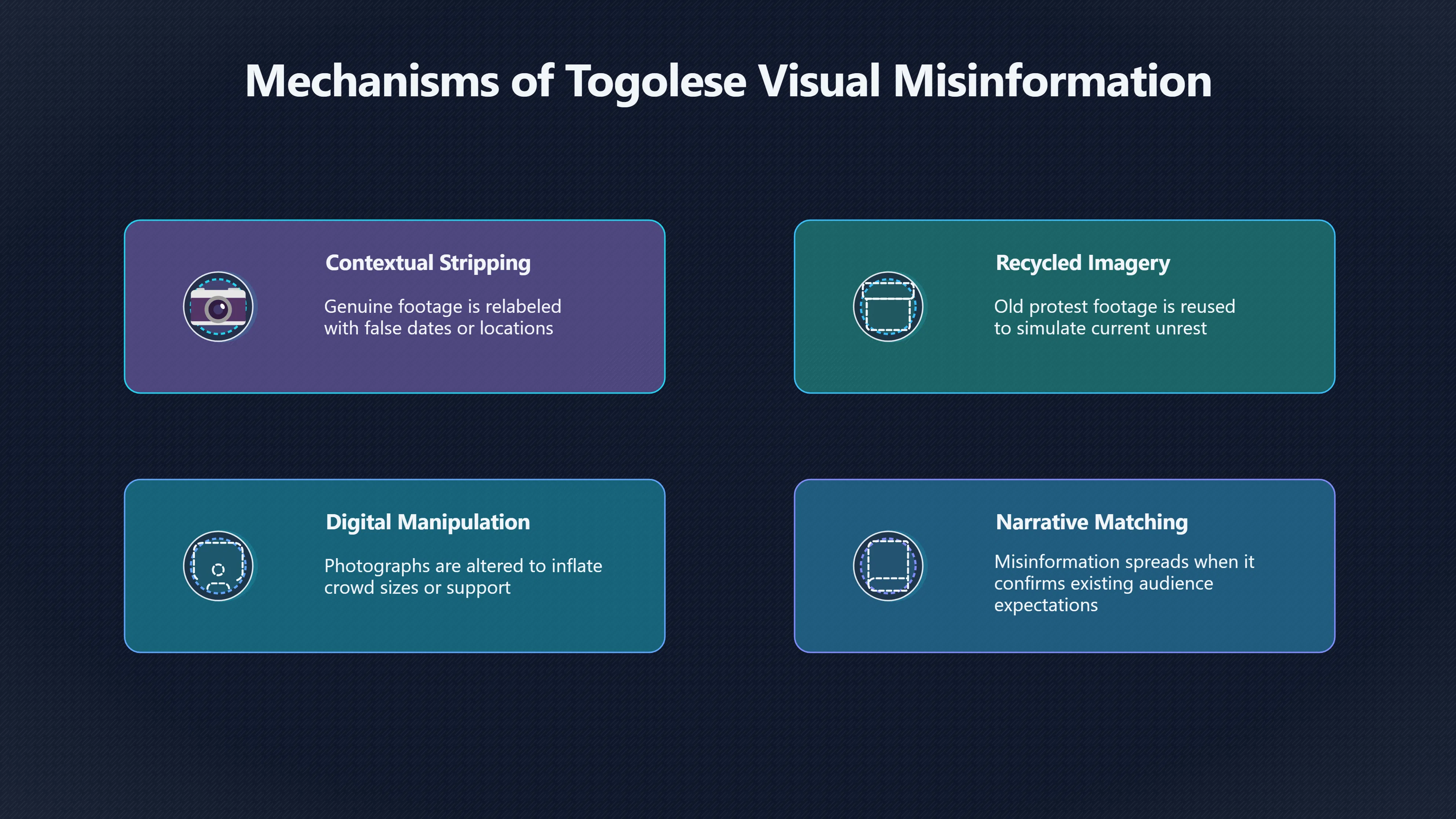
False images attached to events in Togo are one of the country’s most persistent forms of modern misinformation. Unlike a traditional hoax, which invents an event from nothing, these cases usually involve real photographs or videos that have been stripped of their original context and relabelled as evidence of unrest, repression, demonstrations or political developments in Togo. The visual material itself is genuine; the deception lies in the caption, date, location or claimed significance.
This pattern has become especially visible during periods of political tension. Whenever protests, constitutional disputes or allegations of government repression dominate discussion, social-media users often circulate dramatic images that appear to confirm a preferred narrative. Investigations repeatedly show that many of the most viral examples actually originated elsewhere. Some come from demonstrations in neighbouring African countries. Others come from events years earlier. A few are digitally manipulated. The result is a cycle in which authentic images are transformed into misleading evidence about Togo.[AFP Fact Check]factcheck.afp.comHowever, the claim is false; the video wasAFP Fact CheckVideo shows protest in Kenya, not a demonstration against…21 Jul 2025 — A video widely shared on social media claims to…
The phenomenon matters because it affects how outsiders perceive events in Togo, influences political debate inside the country and provides ammunition for competing claims about censorship, propaganda and media bias. In modern Togolese misinformation, the central question is often not whether an image is fake, but whether it is being used honestly.
Why Political Crises Create Ideal Conditions for Mislabelled Images
False image campaigns flourish during moments of uncertainty. Togo has experienced recurring political tensions linked to presidential succession, constitutional reforms, disputed elections and anti-government demonstrations. Protest movements have appeared repeatedly, including major unrest in 2012–2013, 2017–2018 and 2025.[Wikipedia]Wikipedia2012–2013 Togolese protests2012–2013 Togolese protests
In such circumstances, audiences are hungry for visual confirmation. Images appear to provide immediate proof that something important has happened. A dramatic photograph of a huge crowd, a confrontation with security forces or a burning barricade can spread far faster than a written report.
Researchers studying visual misinformation describe this as “out-of-context” misinformation: genuine images are repurposed to support a different narrative than the one they originally documented. Because the photograph itself is real, viewers often assume the accompanying claim must also be true.[arXiv]arxiv.orgOpen-Domain, Content-based, Multi-modal Fact-checking of Out-of-Context Images via Online ResourcesNovember 30, 2021…
For Togo, this mechanism is particularly effective because international media coverage is comparatively limited. Many foreign readers know little about specific Togolese locations, languages or political actors. A photograph from another African country can therefore appear plausible when relabelled as being from Lomé, Sokodé or Kara.
The 2025 Protest Wave and the Kenya Video Case
The clearest recent example emerged during the anti-government protests of 2025. Demonstrations erupted amid controversy surrounding constitutional changes that critics argued could further entrench President Faure Gnassingbé’s hold on power. Protesters and security forces clashed in Lomé, and reports of arrests, injuries and internet restrictions attracted international attention.[apnews.com]apnews.comDemonstrations, called by civil society groups and social media influencers for June 26-28, were met with heavy police force, including t…
Against this backdrop, a widely shared video claimed to show a massive anti-government demonstration in Togo. The footage circulated across multiple social-media platforms and was presented as evidence of huge crowds opposing the government.
AFP Fact Check investigated the clip and concluded that the claim was false. The video had not been filmed in Togo at all. It originated in Nairobi, Kenya, during demonstrations directed at Kenyan President William Ruto. Investigators identified Kenyan landmarks and noted that voices in the footage were speaking Swahili rather than languages commonly heard in Togo. The original Kenyan context was therefore recoverable through basic verification techniques.[AFP Fact Check]factcheck.afp.comHowever, the claim is false; the video wasAFP Fact CheckVideo shows protest in Kenya, not a demonstration against…21 Jul 2025 — A video widely shared on social media claims to…
The misinformation spread widely because it matched existing expectations. Genuine protests were occurring in Togo at the time. Large demonstrations were also occurring in Kenya. To viewers already convinced that huge crowds must be gathering in Lomé, the Kenyan footage appeared believable.
The case became so widespread that even media organisations were forced to issue corrections after initially sharing the claim. Roya News publicly acknowledged that footage it had described as showing protests in Togo was actually recorded in Kenya.[Royanews]en.royanews.tvOpen source on royanews.tv.
Old Videos and Recycled Protest Imagery
The Kenya example was not an isolated incident. Fact-checkers examining online discussions about Togo’s 2025 protests found multiple examples of unrelated videos being circulated as supposedly current evidence from the country.
DUBAWA, a fact-checking organisation focused on Africa, documented how old and unrelated videos were used to intensify narratives surrounding demonstrations in Togo. Investigators found social-media pages distributing misleading visual material to exaggerate or distort the scale and nature of events. Rather than creating new content, those spreading misinformation relied on emotionally charged footage that had already proven effective elsewhere.[Dubawa]dubawa.orgtogo protest old unrelated videos used charge demonstration spread falsehoodsTogo protest: Old, unrelated videos used to charge…28 Jul 2025 — Image of a protest scene against the president of Togo. some pa…
This recycling strategy is common because it requires little technical skill. Someone seeking to influence opinion does not need advanced image-editing software. A dramatic video from another protest movement can simply be reposted with a new caption.
The visual impact remains powerful even after corrections appear. Research on image-based misinformation consistently shows that emotional visual content often spreads faster than later fact-checks. Once an image becomes associated with a particular narrative, many viewers remember the picture but forget the correction.[arXiv]arxiv.orgarXiv Fact-Checking Meets Fauxtography: Verifying Claims About ImagesarXiv Fact-Checking Meets Fauxtography: Verifying Claims About Images
Not All False Images Support the Same Side
An important feature of Togolese visual misinformation is that it does not consistently favour one political camp.
Opposition activists have complained about fabricated or manipulated images that appear designed to exaggerate support for the government. During earlier political disputes, critics identified doctored photographs that allegedly inflated crowd sizes or created misleading impressions of public enthusiasm. One reported example involved a manipulated image that appeared to duplicate groups of supporters in order to make a gathering seem larger than it really was. The altered image was quickly challenged and circulated as an example of political deception.[Blankspot]blankspot.seThe people behind the uprising against the GnassingbéThe people behind the uprising against the Gnassingbé
At the same time, anti-government networks have also circulated misleading imagery intended to demonstrate larger protests, harsher repression or more widespread unrest than could be independently verified. The Kenya footage case falls into this broader category because it used genuine protest scenes from another country to reinforce claims about opposition mobilisation in Togo.[AFP Fact Check]factcheck.afp.comHowever, the claim is false; the video wasAFP Fact CheckVideo shows protest in Kenya, not a demonstration against…21 Jul 2025 — A video widely shared on social media claims to…
The pattern illustrates an important point: false images attached to Togolese events are often less about ideology than persuasion. Different actors employ the same technique when they believe dramatic visuals will strengthen their argument.
How Investigators Discover the Original Source
One reason these cases are valuable is that they demonstrate how modern fact-checking works.
Investigators rarely begin by asking whether an image has been digitally altered. Instead, they ask whether the claimed context is accurate.
Several methods are commonly used:
- Reverse-image searches can reveal earlier appearances of a photograph online.
- Geolocation compares visible landmarks, road signs, buildings and terrain with known locations.
- Language analysis examines speech, banners and written signs visible in the image.
- Chronology checks determine whether the image existed online before the claimed event occurred.
- Cross-platform tracking identifies the earliest known upload of a video or photograph.[afp.com]factcheck.afp.comHowever, the claim is false; the video wasAFP Fact CheckVideo shows protest in Kenya, not a demonstration against…21 Jul 2025 — A video widely shared on social media claims to…
The Kenya protest video attributed to Togo was exposed through precisely these techniques. Fact-checkers compared visual clues with known locations in Nairobi and analysed the language spoken by participants. The evidence pointed overwhelmingly to Kenya rather than Togo.[AFP Fact Check]factcheck.afp.comHowever, the claim is false; the video wasAFP Fact CheckVideo shows protest in Kenya, not a demonstration against…21 Jul 2025 — A video widely shared on social media claims to…
Such investigations often reveal that the deception is surprisingly simple. The image itself may be entirely authentic. Only the accompanying text is false.
Why These Images Spread So Quickly
Several factors make Togo especially vulnerable to this kind of misinformation.
First, political tensions create strong demand for dramatic visual evidence. During protests or constitutional controversies, audiences actively search for images confirming what they believe is happening.[AP News]apnews.comDemonstrations, called by civil society groups and social media influencers for June 26-28, were met with heavy police force, including t…
Second, social-media algorithms reward emotionally engaging content. Images of crowds, confrontations and violence attract more attention than nuanced reporting or official statements.
Third, internet restrictions and information shortages can unintentionally increase the appeal of unverified material. During periods when communication is disrupted or trusted information is scarce, rumours and mislabelled visuals fill the gap. Reports from 2025 noted concerns about internet restrictions and growing disputes over online information during the protest movement.[apnews.com]apnews.comDemonstrations, called by civil society groups and social media influencers for June 26-28, were met with heavy police force, including t…
Finally, many viewers outside Togo lack the local knowledge needed to recognise mistakes. A road in Nairobi, Lagos or Kampala may appear plausible as a street in Lomé if the viewer has never visited either location.
What These Cases Reveal About Modern Hoaxes in Togo
The history of false images attached to events in Togo shows a shift away from traditional hoaxes toward contextual deception. The deception no longer depends primarily on forged photographs, elaborate fabrications or fictional events. Instead, it depends on real images detached from their original circumstances.
The most influential examples are often visually authentic but contextually false. A crowd exists, but not in the claimed country. A protest happened, but not on the claimed date. A confrontation occurred, but in another political crisis entirely. The image serves as borrowed evidence.
For that reason, the most important question for anyone encountering dramatic photographs linked to events in Togo is not whether the picture looks real. It is whether the picture actually shows what the caption claims. The repeated exposure of Kenyan protest footage, recycled demonstration videos and manipulated political imagery demonstrates that in the digital age, the location and context of an image can be just as important as the image itself.[afp.com]factcheck.afp.comHowever, the claim is false; the video wasAFP Fact CheckVideo shows protest in Kenya, not a demonstration against…21 Jul 2025 — A video widely shared on social media claims to…
eBay marketplace picks
Marketplace Samples
Live-tested eBay searches with available results related to this page.



Endnotes
1.
Source: factcheck.afp.com
Title: However, the claim is false; the video was
Link:https://factcheck.afp.com/doc.afp.com.67CQ8CQ
Source snippet
AFP Fact CheckVideo shows protest in Kenya, not a demonstration against...21 Jul 2025 — A video widely shared on social media claims to...
2.
Source: dubawa.org
Title: togo protest old unrelated videos used charge demonstration spread falsehoods
Link:https://dubawa.org/togo-protest-old-unrelated-videos-used-charge-demonstration-spread-falsehoods/
Source snippet
Togo protest: Old, unrelated videos used to charge...28 Jul 2025 — Image of a protest scene against the president of Togo. some pa...
3.
Source: Wikipedia
Title: 2012–2013 Togolese protests
Link:https://en.wikipedia.org/wiki/2012%E2%80%932013_Togolese_protests
4.
Source: Wikipedia
Title: 2017–2018 Togolese protests
Link:https://en.wikipedia.org/wiki/2017%E2%80%932018_Togolese_protests
5.
Source: arxiv.org
Link:https://arxiv.org/abs/2112.00061
Source snippet
Open-Domain, Content-based, Multi-modal Fact-checking of Out-of-Context Images via Online ResourcesNovember 30, 2021...
Published: November 30, 2021
6.
Source: arxiv.org
Link:https://arxiv.org/abs/2408.09939
7.
Source: amnesty.org
Title: togo protesters tortured
Link:https://www.amnesty.org/en/latest/news/2025/06/togo-protesters-tortured/
Source snippet
Amnesty InternationalTogo: Authorities must investigate allegations protesters...17 Jun 2025 — The Togolese authorities must investigate...
8.
Source: amnesty.org
Title: togo repression protests
Link:https://www.amnesty.org/en/latest/news/2025/07/togo-repression-protests/
Source snippet
Amnesty InternationalViolent repression of protests in Togo3 Jul 2025 — Testimonies gathered by Amnesty International in June and July 20...
9.
Source: en.royanews.tv
Link:https://en.royanews.tv/news/61489/Correction%3A-Viral-video-falsely-claimed-to-show-protest-in-Togo%2C-footage-is-from-Kenya
10.
Source: arxiv.org
Title: arXiv Fact-Checking Meets Fauxtography: Verifying Claims About Images
Link:https://arxiv.org/abs/1908.11722
11.
Source: arxiv.org
Link:https://arxiv.org/abs/2010.03159
12.
Source: blankspot.se
Title: The people behind the uprising against the Gnassingbé
Link:https://blankspot.se/the-people-behind-the-uprising-against-the-gnassingbe-dynasty/
13.
Source: factcheck.afp.com
Link:https://factcheck.afp.com/AFP-Africa
14.
Source: factcheck.afp.com
Link:https://factcheck.afp.com/
15.
Source: factcheck.afp.com
Link:https://factcheck.afp.com/AFP-Kenya
16.
Source: apnews.com
Link:https://apnews.com/article/ad20d3d5c2e3b0fa767210cdb70fca2d
Source snippet
Demonstrations, called by civil society groups and social media influencers for June 26-28, were met with heavy police force, including t...
17.
Source: constitutionnet.org
Link:https://constitutionnet.org/country/265
Additional References
18.
Source: youtube.com
Link:https://www.youtube.com/watch?v=4a70qdzCFvI
Source snippet
Togo Protest: Hundreds Protest Over President Gnassingbé's Changes To Constitution | WION Dispatch...
19.
Source: youtube.com
Title: Ivory Coast, Togo: Mackerel caught in the nets of disinformation • FRANCE 24
Link:https://www.youtube.com/watch?v=p8kr4XkcHLM
Source snippet
Did France's President Emmanuel Macron Apologise To Former African Colonies? | The Proof | 21-07-23...
20.
Source: youtube.com
Link:https://www.youtube.com/watch?v=ahP9vy_mZoI
Source snippet
How Russia disinformation operations are targeting Africa – BBC News...
21.
Source: youtube.com
Title: How Russia disinformation operations are targeting Africa – BBC News
Link:https://www.youtube.com/watch?v=9_O-fqXcuxc
Source snippet
Police warning over misleading protest videos...
22.
Source: africacheck.org
Link:https://africacheck.org/
23.
Source: trtafrika.com
Link:https://www.trtafrika.com/english/article/14222596
24.
Source: facebook.com
Link:https://www.facebook.com/naijamustworkagain/posts/please-disregard-viral-news-circulating-on-social-media-that-the-togolese-presid/1306078301080903/
25.
Source: facebook.com
Link:https://www.facebook.com/TheEastAfrican/posts/togo-suspends-rfi-and-france-24-accuses-them-of-bias/1286611476798945/
26.
Source: facebook.com
Link:https://www.facebook.com/AfricaCheck/posts/-misinformation-around-kenyas-protests-is-spreading-fast-from-recycled-old-video/1150681810418879/
27.
Source: youtube.com
Link:https://www.youtube.com/watch?v=SLyoLi3a9G4
Topic Tree