Within Nigeria Deceptions
Can a Complete Nok Sculpture Be Trusted?
Fake, restored and looted Nok sculptures blurred the line between valuable antiquity and modern fabrication.
On this page
- Why complete Nok figures attracted suspicion
- How forgers mixed ancient and modern material
- What scientific testing could and could not prove
Page outline Jump by section
Introduction
The story of Nok forgery is not simply about fake artefacts. It is about how the international demand for ancient Nigerian sculpture created a market in which genuine antiquities, looted fragments, restored objects and outright fabrications became difficult to separate. Nok terracottas, made more than 2,000 years ago in central Nigeria, are among the most recognisable works of ancient African art. Yet the very qualities collectors prized—large size, dramatic faces and complete figures—often became reasons for suspicion. By the 1990s, specialists, dealers and museums faced an uncomfortable reality: many of the impressive “masterpieces” appearing on the market were either modern forgeries or heavily reconstructed objects assembled from ancient fragments.[Trafficking Culture]traffickingculture.orgTrafficking CultureNok Terracottasby N Brodie — The increasing number of fakes on the market established the importance of thermoluminesc…
The resulting controversy reveals how forgery and looting can reinforce one another. Illegal excavation destroyed archaeological evidence, while forgers exploited collectors’ desire for complete sculptures. Scientific testing helped expose some deceptions, but it also revealed the limits of laboratory proof when ancient and modern materials were combined into a single object.[AfricAvenir]africavenir.orgProperly excavated, such pieces might have shed valuable light on…
Can a Complete Nok Sculpture Be Trusted?
One of the most striking lessons from the Nok market is that completeness itself became a warning sign.
Archaeologists excavating genuine Nok sites frequently recover sculptures in fragmentary condition. Centuries underground, agricultural activity, erosion and later disturbance often leave only heads, torsos or scattered pieces. By contrast, collectors and museums preferred complete human figures that could be displayed as finished artworks. That demand created a powerful commercial incentive to manufacture completeness where none existed.[Trafficking Culture]traffickingculture.orgTrafficking CultureNok Terracottasby N Brodie — The increasing number of fakes on the market established the importance of thermoluminesc…
According to evidence discussed by authenticity-testing specialists and researchers of the antiquities trade, before the early 1990s many Nok objects offered for sale were believed to be modern fakes, while genuinely ancient finds were more commonly damaged fragments. A perfectly preserved figure with no documented excavation history could therefore be less trustworthy than a broken fragment recovered under archaeological supervision.[Trafficking Culture]traffickingculture.orgTrafficking CultureNok Terracottasby N Brodie — The increasing number of fakes on the market established the importance of thermoluminesc…
This created a paradox for buyers. The object most likely to attract attention in a gallery or auction catalogue was often the object that deserved the closest scrutiny.
How Forgers Mixed Ancient and Modern Material
The most sophisticated Nok deceptions were not always entirely modern creations.
Some workshops produced wholly new sculptures modelled on recognised Nok styles. Others adopted a more effective strategy: combining genuine ancient fragments with newly made sections. A damaged ancient head might be attached to a modern body, or several unrelated fragments could be assembled into a convincing complete figure. Because part of the object was genuinely ancient, the forgery became harder to detect.[Enact Africa]enact-africa.s3.amazonaws.com2020 11 12 calture in ruins nigeria case studyEnact AfricaC A SE STUD Yby J Stanyard · 2020 · Cited by 4 — The entry of looted Nok objects onto antiquities markets was followed by an…
The illicit antiquities market encouraged these practices. Looted fragments that might have had limited value on their own could become far more profitable when transformed into apparently complete sculptures. In some cases restorations went beyond conservation and crossed into fabrication, creating objects that looked ancient but represented modern artistic decisions rather than authentic Nok works.[AfricAvenir]africavenir.orgProperly excavated, such pieces might have shed valuable light on…
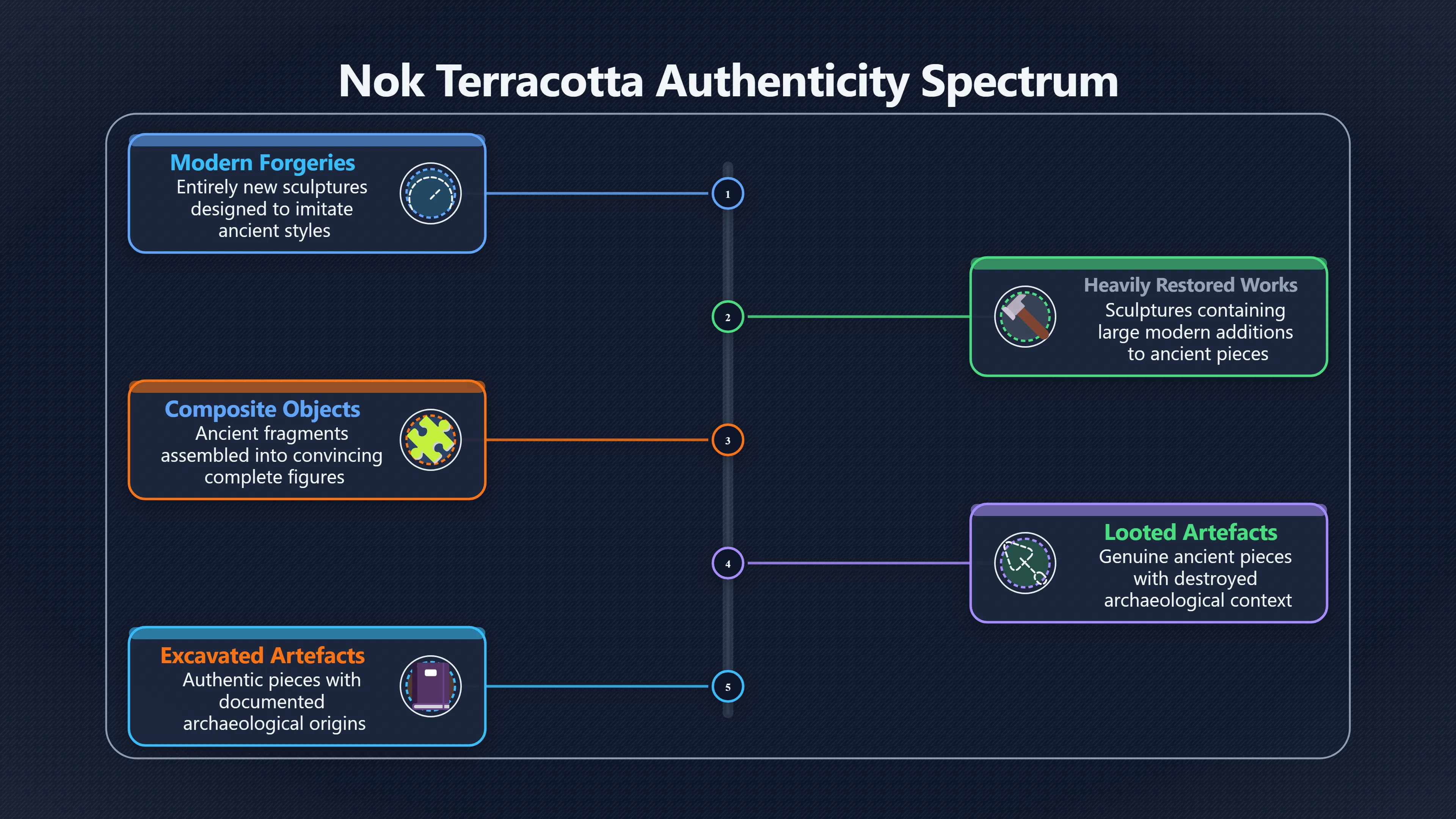
The result was a spectrum rather than a simple division between real and fake:
- Authentic excavated artefacts with documented archaeological origins.
- Authentic but looted artefacts whose context had been destroyed.
- Composite objects assembled from ancient pieces.
- Heavily restored sculptures containing large modern additions.
- Entirely modern forgeries designed to imitate Nok art.[Enact Africa]enact-africa.s3.amazonaws.com2020 11 12 calture in ruins nigeria case studyEnact AfricaC A SE STUD Yby J Stanyard · 2020 · Cited by 4 — The entry of looted Nok objects onto antiquities markets was followed by an…
For museums and collectors, the question was often not whether an object contained ancient material, but how much of the visible sculpture was genuinely ancient.
Why Looting Made Authentication So Difficult
Forgery flourished because looting had already removed the most reliable evidence.
When archaeologists excavate an artefact scientifically, they record its exact location, associated materials and relationship to surrounding deposits. This context helps establish authenticity and historical meaning. Looters remove objects for sale, not for research. Once an artefact is extracted and smuggled into the market, much of that information is permanently lost.[AfricAvenir]africavenir.orgProperly excavated, such pieces might have shed valuable light on…
Research projects in Nok territory have reported extensive looting, with some surveys suggesting that the overwhelming majority of known sites in certain study areas had been disturbed illegally. Thousands of terracotta pieces entered international circulation without proper archaeological documentation.[Wikipedia]WikipediaNok cultureNok culture
This loss of context created ideal conditions for deception. A buyer presented with a sculpture lacking excavation records often had little choice but to rely on visual style, dealer assurances or laboratory tests. Forgers understood these weaknesses and adapted accordingly.[zammagazine.com]zammagazine.comInside the illicit trade in West Africa's oldest artworksNigeria as the rightful owner of the Nok sculptures. along with the results of a thermoluminescence…
What Scientific Testing Could and Could Not Prove
The principal scientific tool used to authenticate Nok terracottas has been thermoluminescence dating, usually shortened to TL dating.
Thermoluminescence measures energy trapped within minerals in fired clay. When tested, it can estimate when a ceramic object was last heated to a high temperature. Because Nok sculptures were fired in antiquity, TL dating became an important way of distinguishing ancient terracotta from recently manufactured imitations.[ResearchGate]researchgate.netOpen source on researchgate.net.
The problem is that TL testing answers a narrower question than many buyers assumed. It can indicate whether a sampled piece of clay is ancient. It does not automatically prove that an entire sculpture is ancient in its current form.[stitah.yale.edu]stitah.yale.eduescence, or TL, dating, discussed below); roughly 2000 BP (before present)…
Forgers learned to exploit this limitation. By incorporating authentic ancient fragments into reconstructed sculptures, they could obtain favourable laboratory results from the ancient components. A positive test might confirm the age of part of the object while leaving unanswered questions about the rest. Researchers examining the illicit trade have noted that increasingly sophisticated forgery methods emerged specifically to circumvent reliance on thermoluminescence testing alone.[Enact Africa]enact-africa.s3.amazonaws.com2020 11 12 calture in ruins nigeria case studyEnact AfricaC A SE STUD Yby J Stanyard · 2020 · Cited by 4 — The entry of looted Nok objects onto antiquities markets was followed by an…
Consequently, experts increasingly combined laboratory analysis with stylistic study, conservation examination, provenance research and scrutiny of restoration work. No single test could settle every authenticity dispute.
Museums, Collectors and the Provenance Problem
As Nok sculptures entered major collections outside Nigeria, questions shifted from authenticity alone to provenance—the documented history of ownership and export.
Many objects circulating internationally lacked clear records showing when they had left Nigeria or whether export laws had been respected. Investigations and repatriation efforts have repeatedly highlighted problems ranging from undocumented ownership histories to disputed paperwork and alleged falsified export documentation.[CHASING APHRODITE]chasingaphrodite.comOpen source on chasingaphrodite.com.
This does not mean every Nok sculpture outside Nigeria is fake. Rather, the market developed during a period when demand often exceeded reliable supply. In such conditions, buyers could encounter forged objects, looted objects, or genuine objects whose histories could not be verified with confidence.[zammagazine.com]zammagazine.comInside the illicit trade in West Africa's oldest artworksNigeria as the rightful owner of the Nok sculptures. along with the results of a thermoluminescence…
The controversy therefore extends beyond questions of artistic authenticity. It also concerns who owns archaeological heritage, how cultural objects enter international collections, and whether collectors inadvertently create incentives for further looting.
What the Nok Forgery Story Reveals
The Nok case demonstrates that forgery in the antiquities world is rarely a matter of simple imitation. The most successful deceptions emerged from a market already distorted by looting, incomplete records and intense demand for spectacular objects.
Collectors wanted complete masterpieces. Looters supplied fragments. Forgers bridged the gap by creating convincing reconstructions and fabrications. Scientific testing exposed some frauds but could not always distinguish an entirely authentic sculpture from a composite object built from ancient parts.[Trafficking Culture]traffickingculture.orgTrafficking CultureNok Terracottasby N Brodie — The increasing number of fakes on the market established the importance of thermoluminesc…
For historians and archaeologists, the greatest loss was not merely financial fraud. Every undocumented excavation removed evidence that could have helped explain one of West Africa’s most important ancient cultures. Even when a sculpture is genuinely ancient, its historical value is diminished when the circumstances of its discovery have been erased.[AfricAvenir]africavenir.orgProperly excavated, such pieces might have shed valuable light on…
The enduring question raised by the Nok market is therefore not simply whether an object is old. It is whether the story attached to that object can be trusted. In a market shaped by looting, restoration and forgery, that question has often proved harder to answer than the age of the clay itself.[Enact Africa]enact-africa.s3.amazonaws.com2020 11 12 calture in ruins nigeria case studyEnact AfricaC A SE STUD Yby J Stanyard · 2020 · Cited by 4 — The entry of looted Nok objects onto antiquities markets was followed by an…
Amazon book picks
Further Reading
Books and field guides related to Can a Complete Nok Sculpture Be Trusted?. Use these as the next step if you want deeper reading beyond the article.
The Medici Conspiracy
Shows how forged and looted antiquities enter elite collections.
eBay marketplace picks
Marketplace Samples
Live-tested eBay searches with available results related to this page.
Endnotes
1.
Source: africavenir.org
Link:https://www.africavenir.org/revisiting-looted-nigerian-nok-terracotta-sculptures-in-louvre-musee-du-quai-branly-paris/
Source snippet
Properly excavated, such pieces might have shed valuable light on...
2.
Source: Wikipedia
Title: Nok culture
Link:https://en.wikipedia.org/wiki/Nok_culture
3.
Source: zammagazine.com
Title: Inside the illicit trade in West Africa’s oldest artworks
Link:https://www.zammagazine.com/arts/1324-inside-the-illicit-trade-in-west-africa-s-oldest-artworks
Source snippet
Nigeria as the rightful owner of the Nok sculptures. along with the results of a thermoluminescence...
4.
Source: stitah.yale.edu
Link:https://stitah.yale.edu/sites/default/files/nok_case_study2_0.pdf
Source snippet
escence, or TL, dating, discussed below); roughly 2000 BP (before present)...
5.
Source: researchgate.net
Link:https://www.researchgate.net/publication/230369808_Thermoluminescent_Dating_of_a_Terracotta_of_the_Nok_Culture_Nigeria
6.
Source: chasingaphrodite.com
Link:https://chasingaphrodite.com/tag/nok/
7.
Source: link.mellonfellows.high.org
Title: nok sculptures
Link:https://link.mellonfellows.high.org/essay/nok-sculptures/
8.
Source: researchgate.net
Link:https://www.researchgate.net/publication/391730401_Nok_Terracotta_Sculptures_A_Reflection_of_Ancient_Ideology_and_Philosophy_Found_in_the_Earlier_and_Recent_Discovered_Sculptures
9.
Source: traffickingculture.org
Link:https://traffickingculture.org/encyclopedia/case-studies/nok-terracottas/
Source snippet
Trafficking CultureNok Terracottasby N Brodie — The increasing number of fakes on the market established the importance of thermoluminesc...
10.
Source: enact-africa.s3.amazonaws.com
Title: 2020 11 12 calture in ruins nigeria case study
Link:https://enact-africa.s3.amazonaws.com/site/uploads/2020-11-12-calture-in-ruins-nigeria-case-study.pdf
Source snippet
Enact AfricaC A SE STUD Yby J Stanyard · 2020 · Cited by 4 — The entry of looted Nok objects onto antiquities markets was followed by an...
Additional References
11.
Source: pambazuka.org
Title: damage nok sculpture private western collection
Link:https://www.pambazuka.org/index.php/damage-nok-sculpture-private-western-collection
Source snippet
Damage to Nok sculpture in private Western collection10 May 2012 — Many of the Nok sculptures in the West are presumed to be of doubtful...
Published: May 2012
12.
Source: archaeology.org
Title: Magazine Features
Link:https://archaeology.org/issues/online/features/the-nok-of-nigeria/
Source snippet
Archaeology MagazineFeatures - The Nok of NigeriaA terracotta head created by the Nok culture, one of ancient West Africa's most advanced...
13.
Source: facebook.com
Link:https://www.facebook.com/groups/archeologyandcivilizations/posts/27193828016950698/
14.
Source: guardian.ng
Title: The Guardian Nigeria Inside illicit trade in West Africa’s oldest artworks
Link:https://guardian.ng/art/inside-illicit-trade-in-west-africas-oldest-artworks-part-2/
15.
Source: youtube.com
Link:https://www.youtube.com/watch?v=7ja_BMeBeiQ
16.
Source: shs-conferences.org
Link:https://www.shs-conferences.org/articles/shsconf/pdf/2024/13/shsconf_apmm2024_04011.pdf
17.
Source: youtube.com
Title: Nok Terracotta: Nigeria’s Forgotten Masterpieces
Link:https://www.youtube.com/watch?v=9J4elOLE3lY
Source snippet
THE STOLEN BENIN ARTEFACTS...
18.
Source: youtube.com
Title: THE STOLEN BENIN ARTEFACTS
Link:https://www.youtube.com/watch?v=nCo7Ko7WC7c
Source snippet
Art, Loot and Empire: The Benin Bronzes...
19.
Source: facebook.com
Link:https://www.facebook.com/groups/archeologyandcivilizations/posts/26305887299078112/
20.
Source: scientia.global
Title: Professor Peter Breunig
Link:https://www.scientia.global/professor-peter-breunig-the-significance-of-nok-culture-sculptures-in-nigerian-prehistory/
Topic Tree