Which Dominican Stories Were Real, Fake or Unproven?
The Dominican Republic has no single, universally famous “great hoax”. Its more revealing history of contested truth is scattered across museum collections, disputed relics, supernatural rumours and modern viral media.
Page outline Jump by section
Introduction
These episodes did not succeed because Dominicans were unusually credulous. They worked because the claims attached themselves to powerful sources of authority: museums, national monuments, newspaper reporting, scientific language and apparently self-explanatory photographs or videos. Some were deliberate commercial deceptions. Others were folklore, honest misidentification or political theatre that became misleading through repetition. Together they show how difficult it can be to separate fraud from cultural invention when an appealing story meets incomplete evidence.
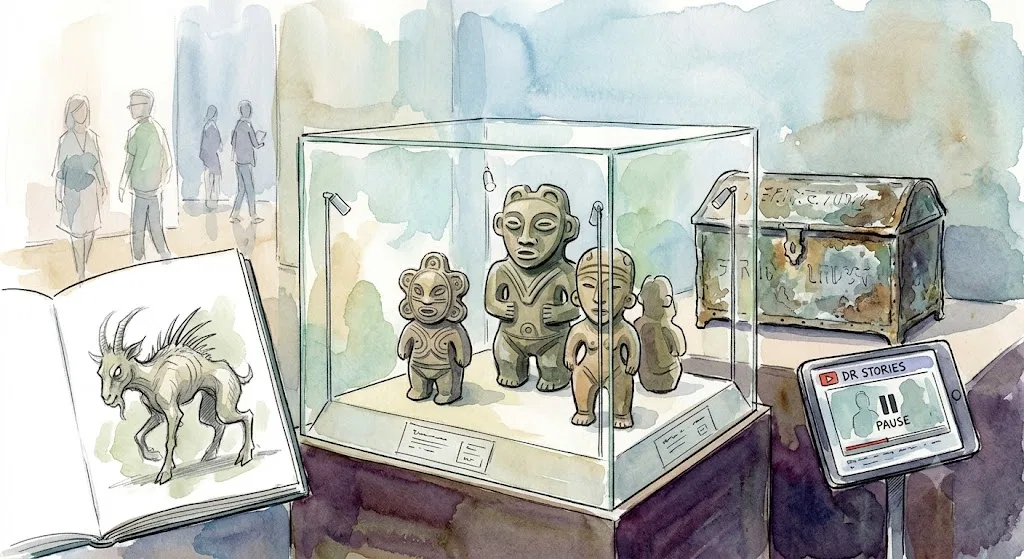
When “Taíno” treasures are newly made
The trade in supposed pre-Columbian artefacts is the clearest documented form of material fakery associated with the Dominican Republic. Genuine Indigenous objects from Hispaniola can be extraordinarily rare, historically important and financially valuable. That combination encourages looting, undocumented dealing and the production of modern objects designed to resemble ancient stone carvings, ceremonial figures and ritual equipment.
Archaeologists studying the Caribbean heritage market have described genuine objects, recent replicas and outright forgeries circulating together. One field photograph from a Santo Domingo market in 2004 shows fake Taíno objects intermingled with archaeological material offered for sale. The problem is not confined to street souvenirs: scholars have warned that objects acquired through purchases, gifts or poorly documented private collections can find their way into museums, where display cases give doubtful pieces an appearance of institutional certainty.[arcgis.com]storymaps.arcgis.comArc GIS Story Maps Material relationsArcGIS StoryMapsMaterial relationsMay 6, 2023 — 3 May 2023 — Intermingled fake Taíno objects and genuine archaeological artifacts for sal…
The deception works partly because there is no single simple visual test for authenticity. A convincing object may imitate known Indigenous forms while lacking a secure excavation history, scientifically useful surface wear or reliable records of ownership. Conversely, genuine artefacts can look crude or unfamiliar. Provenance — the documented history of where an object was found and how it changed hands — is therefore often more important than artistic polish.
Modern carvers can also produce pieces that seem almost too recognisably “Taíno”. Symmetrical faces, repeated motifs and dramatic spiritual imagery satisfy what tourists and collectors expect Indigenous art to look like. Once such pieces are photographed, catalogued or donated, their modern origin may be forgotten. Academic work on Caribbean collections consequently treats “replica”, “inspired object” and “forgery” as different categories: a labelled educational copy is not fraudulent, whereas an imitation knowingly sold or exhibited as ancient is.[uchicago.edu]journals.uchicago.eduUniversity of Chicago JournalsReal, Recent, or Replica: Precolumbian Caribbean…Real, Recent, or Replica is an important contribution t…
The damage is greater than the loss of a collector’s money. Forged objects can distort the record of Indigenous religion, technology and style. If researchers treat a modern carving as archaeological evidence, they may infer traditions that never existed. Fakes can also eclipse authentic Dominican heritage by replacing complicated historical cultures with a market-friendly visual stereotype.

Are Columbus’s bones really in Santo Domingo?
The most prominent Dominican dispute over authenticity concerns human remains rather than artwork. The Columbus Lighthouse in Santo Domingo Este houses bones said to be those of Christopher Columbus. Seville Cathedral in Spain also claims to possess his remains. The rivalry arose from a long chain of burials and transfers after Columbus died in Valladolid in 1506.
Columbus’s body was moved more than once. Historical accounts place his remains in Santo Domingo, followed by a transfer to Havana in 1795 when Spain ceded the eastern part of Hispaniola to France. After Spain lost Cuba in 1898, remains believed to be his were taken to Seville. The Dominican claim rests largely on a separate discovery made in Santo Domingo Cathedral in 1877: a lead container holding bone fragments and bearing an inscription that was interpreted as identifying Columbus.[wikipedia.org]WikipediaTomb of Christopher ColumbusTomb of Christopher Columbus
Dominican supporters argued that Spanish officials had removed the wrong body in 1795, leaving the explorer’s actual remains behind. The discovery became more than an archaeological puzzle. It supported Santo Domingo’s place in the history of European colonisation and eventually supplied the central relic for the Columbus Lighthouse, inaugurated in 1992.
DNA work in Spain has substantially strengthened Seville’s case. Researchers led by forensic scientist José Antonio Lorente compared the Seville fragments with remains attributed to Columbus’s son Fernando and brother Diego. In October 2024 the team announced that the relationship had been confirmed with what it described as extremely high reliability.[theguardian.com]theguardian.comOpen source on theguardian.com.
That finding does not automatically prove that the Dominican bones are fraudulent. The Seville remains are incomplete, so it is physically possible that Columbus’s skeleton was divided or that fragments remained in Santo Domingo. The Dominican material has not undergone an equivalent publicly reported genetic comparison, despite requests associated with the Spanish investigation. The fairest conclusion is therefore asymmetrical: Seville possesses genetically supported Columbus remains, while the identity of the bones in Santo Domingo remains unverified.[researchgate.net]researchgate.net395289280 THE DNA ANALYSIS OF CHRISTOPHER COLUMBUS395289280 THE DNA ANALYSIS OF CHRISTOPHER COLUMBUS
This is better understood as a disputed relic than a proven Dominican hoax. The original mistake, if there was one, could have occurred during eighteenth-century exhumation rather than through deliberate fraud. Later institutions nevertheless benefited from presenting uncertainty as certainty. Monumental architecture, ceremonial language and national prestige helped turn a difficult identification problem into two apparently definitive tombs.
How the chupacabra crossed the Mona Passage
The chupacabra offers a different kind of false belief. It was not primarily a carefully planned Dominican deception but a travelling media legend. Reports emerged in Puerto Rico in the mid-1990s, describing a strange creature that supposedly attacked goats and other livestock and drained their blood. Similar stories soon appeared around Latin America, including in the Dominican Republic.[nationalgeographic.com]nationalgeographic.com101028 chupacabra evolution halloween science monsters chupacabras picture101028 chupacabra evolution halloween science monsters chupacabras picture
The story was unusually portable. Any unexplained livestock death could be fitted into it, while changing descriptions made the creature difficult to disprove. It was variously portrayed as reptilian, alien-like, winged, canine or upright. Newspaper sketches, television reports and repeated use of the memorable name created the impression that separate incidents must involve the same newly discovered animal.
Investigations have never produced a recognised chupacabra species. Claims that victims were emptied of blood were generally not supported by proper necropsies. In many North American cases, supposed carcasses of the creature proved to be coyotes or other canids suffering from severe mange, which causes hair loss, thickened skin and an unfamiliar silhouette. Ordinary dogs and scavengers can also create livestock wounds that appear mysterious when examined without veterinary expertise.[nationalgeographic.com]nationalgeographic.com101028 chupacabra evolution halloween science monsters chupacabras picture101028 chupacabra evolution halloween science monsters chupacabras picture
Sceptical investigator Benjamin Radford argued that the influential early Puerto Rican description closely resembled the creature in the 1995 science-fiction film Species. That theory does not demonstrate that every witness consciously lied. It suggests instead that popular imagery supplied a ready-made shape for ambiguous experiences. Once the monster had a name and a recognisable appearance, later witnesses interpreted unfamiliar animals and unexplained deaths through the same story.[Live Science]livescience.comLive Science El Chupacabra Mystery Solved: Case of Mistaken IdentityLive Science El Chupacabra Mystery Solved: Case of Mistaken Identity
The Dominican Republic’s role in the legend is therefore regional rather than foundational. Its proximity to Puerto Rico, shared media networks and similar rural concerns made the story easy to import. The case illustrates the boundary between hoax and folklore: individual reports may include jokes, exaggerations or publicity seeking, but the larger phenomenon can spread without a central deceiver.

A real Dominican crash with a fake global story
A widely circulated video of a Volvo striking people during a demonstration shows how misinformation can grow around authentic footage. The incident occurred at a dealership in Santo Domingo in 2015. In the clip, a vehicle reverses and then accelerates towards a group, hitting two men.
Online versions later claimed that the victim was Volvo’s chief executive or managing director personally testing an automatic pedestrian-braking system. Some posts added that he had been paralysed. The video accumulated hundreds of thousands of views under variations of this story.[AFP Fact Check]factcheck.afp.commen viral video are not volvo bosses company saidmen viral video are not volvo bosses company said
The basic incident was real, but the explanatory caption was not. Volvo told AFP that the men were not company executives and were not paralysed. More importantly, the vehicle had the manufacturer’s City Safety system but did not have the optional pedestrian-detection function that would have been required for the claimed demonstration. Heavy driver acceleration could also override some automatic intervention.[AFP Fact Check]factcheck.afp.commen viral video are not volvo bosses company saidmen viral video are not volvo bosses company said
The false version survived because the clip appeared to verify its own caption. Viewers saw a safety demonstration apparently going disastrously wrong, so the story felt complete even though the footage contained no proof of the victims’ identities, the car’s equipment or the purpose of the gathering. Humour and corporate irony made it more shareable: a supposed safety executive being hit by his own product was a better internet story than a badly managed dealership demonstration.
This case reverses the usual geography of a hoax. The footage came from the Dominican Republic, but much of the misleading narrative was added as it travelled internationally. Santo Domingo became merely the unnoticed setting for a global cautionary tale about technology.
Political fakery in the age of synthetic video
The Dominican Republic has also been drawn into deceptive media made elsewhere. In March 2025 Spain’s conservative People’s Party published an artificial-intelligence-generated political video attacking the Spanish government. It parodied a reality programme filmed in the Dominican Republic and used Dominican national imagery while presenting an invented “island of corruption”.
The clip received more than 400,000 views before it was removed. The Dominican Foreign Ministry condemned the use of the country’s symbols in an internal Spanish political attack, and Spanish prime minister Pedro Sánchez apologised. The party said it had not intended to damage the Dominican Republic’s reputation.[Reuters]reuters.comDominican Republic rebukes Spanish opposition party over 'vicious' AI videoDominican Republic rebukes Spanish opposition party over 'vicious' AI video
The episode was openly satirical rather than a covert attempt to pass fabricated scenes as documentary footage. Even so, it demonstrates how synthetic images can blur parody, propaganda and reputational harm. A country can be used as a visual shorthand in someone else’s political argument, with beaches, flags and television associations compressed into an insinuation that spreads faster than any later clarification.
Unlike the forged artefact market, such content does not depend on hiding how an object was made. Its persuasive force comes from emotional association. The fabrication may be obvious, yet the implied connection between a real country and alleged wrongdoing can still take hold.
What these cases reveal
Dominican cases of fakery are most instructive when their differences are kept clear. Forged Taíno objects are commercial and cultural frauds when they are knowingly presented as ancient. The Columbus bones are an unresolved identification dispute amplified by national institutions, not a demonstrated conspiracy. Chupacabra reports belong largely to modern folklore, misidentification and media feedback. The Volvo clip is genuine evidence paired with a fabricated caption, while the Spanish political video was synthetic satire whose symbolism caused a diplomatic dispute.
Across these cases, the recurring mechanism is borrowed authority. A museum label authenticates an object. A monumental tomb appears to settle a historical question. A television report turns scattered animal deaths into a monster pattern. A video seems to prove the words posted above it. Artificial imagery borrows the emotional weight of a national flag and a recognisable landscape.
The most reliable response is therefore not simply to ask whether a strange claim sounds believable. It is to ask what kind of claim it is and what evidence should exist. Ancient objects need documented provenance and scientific examination. Human remains require transparent comparison with known relatives. Animal-attack stories need veterinary evidence rather than descriptions of bloodless bodies. Viral videos require the original upload, location, date and technical context.
The Dominican Republic’s history of contested truth is not a parade of spectacular swindles. It is a more useful record of how heritage, national memory, folklore and digital media create different opportunities for error and deception. The stories endure because they offer something more satisfying than uncertainty: a recovered Indigenous treasure, the tomb of a world-famous navigator, a hidden predator or a perfectly ironic technological failure. Investigation matters because the less dramatic explanation is often the one that preserves the most accurate history.
Amazon book picks
Further Reading
Books and field guides related to Which Dominican Stories Were Real, Fake or Unproven?. Use these as the next step if you want deeper reading beyond the article.
Frauds, Myths, and Mysteries: Science and Pseudoscience in Ar...
Covers how hoaxes, forgeries and dubious historical claims gain credibility.
Archaeological Theory
Provides context for evaluating disputed artefacts and interpretations.
The Tainos
Supplies background on authentic Taíno culture often misrepresented by fakes.
eBay marketplace picks
Marketplace Samples
Live-tested eBay searches with available results related to this page.

Endnotes
1.
Source: storymaps.arcgis.com
Title: Arc GIS Story Maps Material relations
Link:https://storymaps.arcgis.com/stories/02ad17d3086846dc912dbebba892e4d5
Source snippet
ArcGIS StoryMapsMaterial relationsMay 6, 2023 — 3 May 2023 — Intermingled fake Taíno objects and genuine archaeological artifacts for sal...
Published: May 6, 2023
2.
Source: dokumen.pub
Link:https://dokumen.pub/real-recent-or-replica-precolumbian-caribbean-heritage-as-art-commodity-and-inspiration-9780817320874.html
Source snippet
cts seen today in the Dominican Republic. The issue of...Read more...
3.
Source: Wikipedia
Title: Tomb of Christopher Columbus
Link:https://en.wikipedia.org/wiki/Tomb_of_Christopher_Columbus
4.
Source: reuters.com
Link:https://www.reuters.com/science/spanish-scientists-shed-light-mystery-columbus-origins-burial-2024-10-10/
Source snippet
Historically thought to be from Genoa, Italy, theories about Columbus' heritage include possibilities like Spanish Jew, Greek, Basque, or...
5.
Source: researchgate.net
Title: 395289280 THE DNA ANALYSIS OF CHRISTOPHER COLUMBUS
Link:https://www.researchgate.net/publication/395289280_THE_DNA_ANALYSIS_OF_CHRISTOPHER_COLUMBUS
6.
Source: Wikipedia
Link:https://es.wikipedia.org/wiki/Chupacabras
7.
Source: factcheck.afp.com
Title: men viral video are not volvo bosses company said
Link:https://factcheck.afp.com/men-viral-video-are-not-volvo-bosses-company-said
8.
Source: reuters.com
Title: Dominican Republic rebukes Spanish opposition party over ‘vicious’ AI video
Link:https://www.reuters.com/world/dominican-republic-rebukes-spanish-opposition-party-over-vicious-ai-video-2025-03-07/
9.
Source: reuters.com
Title: disease misinformation threaten health workers 2026 05 07
Link:https://www.reuters.com/sustainability/disease-misinformation-threaten-health-workers-2026-05-07/
10.
Source: factcheck.afp.com
Link:https://factcheck.afp.com/doc.afp.com.84AR9T3
11.
Source: factcheck.afp.com
Link:https://factcheck.afp.com/doc.afp.com.B8DR7T9
12.
Source: factcheck.afp.com
Link:https://factcheck.afp.com/these-drugs-are-covid-19-treatments-not-vaccines-and-they-are-available-western-countries
13.
Source: factcheck.afp.com
Link:https://factcheck.afp.com/photo-shows-indonesias-foreign-minister-reacting-after-indonesia-was-elected-un-security-council-non
14.
Source: factcheck.afp.com
Link:https://factcheck.afp.com/doc.afp.com.9EB8C9
15.
Source: factcheck.afp.com
Link:https://factcheck.afp.com/doc.afp.com.329V44U
16.
Source: factcheck.afp.com
Link:https://factcheck.afp.com/doc.afp.com.34JD337
17.
Source: factcheck.afp.com
Link:https://factcheck.afp.com/doc.afp.com.9R94PR
18.
Source: Wikipedia
Link:https://en.wikipedia.org/wiki/Chupacabra
19.
Source: storymaps.arcgis.com
Link:https://storymaps.arcgis.com/stories/bb51093a25154e4cad07eb188484619e
20.
Source: researchgate.net
Link:https://www.researchgate.net/publication/256695718_Geological_fakes_and_frauds
21.
Source: ubcpress.ca
Title: UBC Press Real, Recent, or Replica
Link:https://www.ubcpress.ca/real-recent-or-replica
Source snippet
UBC PressReal, Recent, or Replica - Precolumbian Caribbean Heritage...Amerindian art, including “Taíno” art, has become... art forgery...
22.
Source: journals.uchicago.edu
Link:https://www.journals.uchicago.edu/doi/10.1086/719309
Source snippet
University of Chicago JournalsReal, Recent, or Replica: Precolumbian Caribbean...Real, Recent, or Replica is an important contribution t...
23.
Source: theguardian.com
Link:https://www.theguardian.com/world/2024/oct/11/dna-study-christopher-columbus-remains-seville-cathedral
24.
Source: english.elpais.com
Title: research confirms authenticity of christopher columbus remains in spain
Link:https://english.elpais.com/culture/2024-10-10/research-confirms-authenticity-of-christopher-columbus-remains-in-spain.html
25.
Source: nationalgeographic.com
Title: 101028 chupacabra evolution halloween science monsters chupacabras picture
Link:https://www.nationalgeographic.com/culture/article/101028-chupacabra-evolution-halloween-science-monsters-chupacabras-picture
26.
Source: agrilifetoday.tamu.edu
Title: unmasking the chupacabra
Link:https://agrilifetoday.tamu.edu/2024/10/15/unmasking-the-chupacabra/
27.
Source: livescience.com
Title: Live Science El Chupacabra Mystery Solved: Case of Mistaken Identity
Link:https://www.livescience.com/13356-el-chupacabra-mystery-solved.html
28.
Source: nationalgeographic.com
Title: most infamous scams hoaxes
Link:https://www.nationalgeographic.com/travel/article/most-infamous-scams-hoaxes
29.
Source: nationalgeographic.com
Title: chasing chupacabras you may find something even more extraordinary here
Link:https://www.nationalgeographic.com/travel/article/chasing-chupacabras-you-may-find-something-even-more-extraordinary-here
30.
Source: uncommoncaribbean.com
Link:https://www.uncommoncaribbean.com/puerto-rico/chupacabra/
Additional References
31.
Source: uapress.ua.edu
Link:https://www.uapress.ua.edu/9780817320874/real-recent-or-replica/
Source snippet
University of Alabama PressReal, Recent, or ReplicaAmerindian art, including “Taíno” art, has become highly coveted by... Archaeological...
32.
Source: youtube.com
Title: TOMB OF CHRISTOPHER COLUMBUS! OR IS IT?! FARO A COLON HISTORY!
Link:https://www.youtube.com/watch?v=3__P33EGJh4
Source snippet
The Christopher Columbus Lighthouse and Tomb...
33.
Source: instagram.com
Link:https://www.instagram.com/reel/DYQyxfyjEir/?hl=en
34.
Source: academia.edu
Link:https://www.academia.edu/22597524/Origins_of_the_word_TAINO_edited_LG_2_
35.
Source: academia.edu
Link:https://www.academia.edu/2049110/Review_of_the_book_Taino_Indian_Myth_and_Practice_The_Arrival_of_the_Stranger_King_by_William_F_Keegan
36.
Source: jurateamber.com
Link:https://jurateamber.com/blogs/caring-for-your-baltic-amber-jewelry/7-proven-ways-to-tell-if-amber-jewelry-is-real-or-fake?srsltid=AfmBOopMWS-9x_SgGoBtCd6vhnLtLV6HURbdcVS8jQHObNlIY2a8kFgZ
37.
Source: academia.edu
Link:https://www.academia.edu/121339588/A_Multispecies_Caribbean_The_Aesthetics_of_Ecological_Reinvention_in_Art_by_Dhara_Rivera
38.
Source: academia.edu
Link:https://www.academia.edu/43099712/ATKINSON_Lesley_Gail_ed_2006_The_Earliest_inhabitants_The_dynamics_of_the_Jamaican_Ta%C3%ADno_University_of_the_West_Indies_Press_EUA
39.
Source: amnh.org
Link:https://www.amnh.org/explore/ology/ology-cards/281-chupacabra
40.
Source: audible.com
Link:https://www.audible.com/author/Benjamin-Radford/B016QYPI8M?srsltid=AfmBOoqdHGhxmi6wNwGT-6BDsb7pHQ_cvFbQGx9XqiRY8Yw6oA8ml_fl
Topic Tree
Follow this branch
Related pages 192
- Albanian Hoaxes
- Algerian Hoaxes
- Antigua Deceptions
- Argentina Hoaxes
- Armenian Hoaxes
- +187 more in sidebar