Within Montenegro Hoaxes
How a False Tsar Came to Rule Montenegro
An obscure newcomer became Montenegro's ruler by allowing people to believe he was the supposedly dead Russian emperor Peter III.
On this page
- The rumour that made him Peter III
- Why exposure failed to remove him
- Impostor, state builder and folk hero
Page outline Jump by section
Introduction
Few impostors in European history achieved what Šćepan Mali did. In the late 1760s, an obscure stranger arrived in Montenegro and became ruler of the country by allowing people to believe that he was Peter III, the Russian emperor who had supposedly died years earlier. The claim was implausible on its face: Peter III had been overthrown in 1762 and officially declared dead. Yet many Montenegrins accepted the newcomer, and even after Russian authorities exposed him as a fraud, he continued to govern for several years.[Wikipedia]WikipediaŠćepan MaliŠćepan Mali
The story is often presented as a colourful historical curiosity, but it reveals something more important about belief and authority. Šćepan’s success depended not simply on deception but on political circumstances. Montenegro was divided by clan rivalries, admired Orthodox Russia, and hoped for powerful allies. In that environment, the appearance of a living Russian tsar seemed less important than what such a figure represented.[Wikipedia]WikipediaŠćepan MaliŠćepan Mali
The Rumour That Made Him Peter III
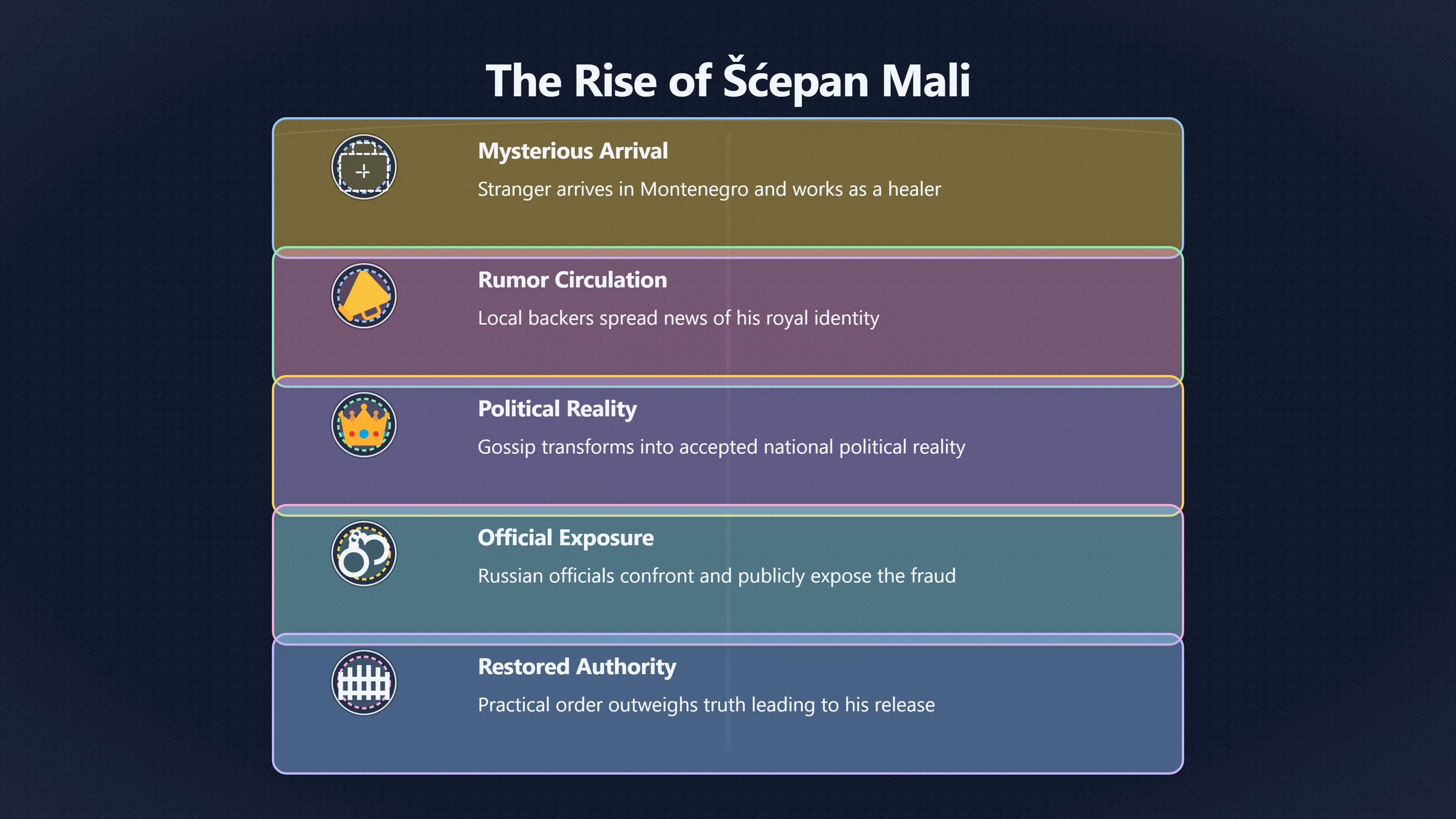
When Šćepan Mali appeared in Montenegro around 1766, little was known about his origins. He worked as a healer and quickly attracted attention. Before long, influential supporters began circulating a rumour that he was actually Peter III of Russia, living in disguise after escaping assassination. Historians still debate exactly who started the story, but contemporary accounts suggest that local backers played a major role in spreading it.[Wikipedia]WikipediaŠćepan MaliŠćepan Mali
What made the claim believable was not evidence but context. Montenegro’s Orthodox population looked to Russia as a fellow Slavic and Orthodox power that might offer protection against larger neighbours, particularly the Ottoman Empire. News travelled slowly, communications were unreliable, and reports from distant capitals often carried less weight than the testimony of respected local figures.[Wikipedia]WikipediaŠćepan MaliŠćepan Mali
Šćepan’s genius lay in ambiguity. Rather than loudly proclaiming himself emperor, he allowed others to draw the conclusion. Sources indicate that he cultivated mystery, made suggestive remarks and behaved in ways that encouraged identification with the dead tsar while avoiding a direct claim that could easily be disproved.[Wikipedia]WikipediaŠćepan MaliŠćepan Mali
The strategy worked. By 1767 the rumour had spread widely, and leading Montenegrins increasingly treated him as Peter III. What began as gossip became political reality.[Wikipedia]WikipediaŠćepan MaliŠćepan Mali
Why Exposure Failed to Remove Him
From a modern perspective, the most surprising part of the story is not that people believed the rumour but that they continued to support Šćepan after it was challenged.
Prince-Bishop Sava Petrović, one of Montenegro’s traditional leaders, knew that Peter III had died and sought confirmation from Russian representatives. Russian officials repeatedly stated that the emperor was dead. Catherine the Great’s government regarded the pretender as a dangerous fraud and dispatched Prince Yuri Dolgorukov to investigate.[Wikipedia]WikipediaŠćepan MaliŠćepan Mali
Dolgorukov confronted Šćepan directly. Under pressure, the supposed tsar admitted that he was not Peter III. He was arrested, interrogated and publicly exposed. In theory, the imposture should have collapsed.[Wikipedia]WikipediaŠćepan MaliŠćepan Mali
Instead, events took an unexpected turn.
Once Šćepan was removed, old clan rivalries immediately resurfaced. Disorder increased, and the Russians discovered that the man they had exposed as a fraud was also one of the few figures capable of maintaining internal stability. Dolgorukov found himself unable to govern effectively and eventually concluded that practical order mattered more than proving a point about identity. Šćepan was released and effectively restored to authority.[Wikipedia]WikipediaŠćepan MaliŠćepan Mali
This episode highlights an important feature of successful impostures. People do not always abandon a falsehood when contrary evidence appears. If the falsehood serves a political, social or emotional need, exposure may have surprisingly little effect. In Montenegro, many supporters had come to value what Šćepan did more than who he really was.[JSTOR]jstor.orgCatherine II and a False Peter III in Montenegroby MB Petrovich · 1955 · Cited by 8 — At first a source of vexation to the Russian E…
An Impostor Who Became a Ruler
Although remembered as a pretender, Šćepan’s historical significance rests largely on his actions as ruler.
Montenegro in the eighteenth century lacked strong central institutions. Authority was fragmented among clans, religious leaders and local power brokers. Šćepan sought to impose a more unified system of government. He acted against blood feuds, enforced decisions through punishment, and attempted to strengthen central authority. Later accounts credit him with establishing a more permanent court structure and creating greater political cohesion than the country had previously experienced.[Wikipedia]WikipediaPrince-Bishopric of MontenegroPrince-Bishopric of Montenegro
His success created an unusual paradox. The same man denounced by Russia as an impostor was increasingly valued within Montenegro as an effective ruler. Even hostile observers sometimes acknowledged his administrative ability. Modern retellings often emphasise this contradiction: the fraud was real, yet so were some of the reforms.[La Brújula Verde]labrujulaverde.comLa Brújula VerdeŠcepan Mali, the first and only tsar of Montenegro, who…20 Aug 2024 — Everyone knew that Šćepan was an impostor, but h…
The distinction matters because Šćepan’s story was not merely a confidence trick. He did not seize power, loot the treasury and disappear. Instead, he converted a false identity into genuine political authority. His rule lasted several years, far longer than most pretenders who relied on similar claims.[Wikipedia]WikipediaŠćepan MaliŠćepan Mali
Why Montenegrins Found the Story Convincing
Several factors combined to make the imposture unusually persuasive:
- Russia’s prestige: Russia was admired as a powerful Orthodox state and potential protector. A living Russian emperor carried enormous symbolic value.[Wikipedia]WikipediaPrince-Bishopric of MontenegroPrince-Bishopric of Montenegro
- Slow information networks: Verification was difficult. News about events in Russia travelled through letters, diplomats and rumours rather than instant communication.[Wikipedia]WikipediaŠćepan MaliŠćepan Mali
- Political fragmentation: Many Montenegrins wanted stronger leadership capable of reducing clan conflict.[Wikipedia]WikipediaPrince-Bishopric of MontenegroPrince-Bishopric of Montenegro
- Deliberate ambiguity: Šćepan benefited from letting supporters make the claim for him instead of openly asserting it. This gave him room to evade direct contradiction.[Wikipedia]WikipediaŠćepan MaliŠćepan Mali
- Performance of authority: Once he began governing effectively, his practical success reinforced belief in his legitimacy.[Wikipedia]WikipediaPrince-Bishopric of MontenegroPrince-Bishopric of Montenegro
These conditions transformed what might have remained a local rumour into a national political movement.
From Fraud to Folk Hero
Šćepan Mali was eventually assassinated in 1773, reportedly as part of a plot linked to regional opponents who saw him as a threat. His death ended the experiment, but it did not end the fascination.[Wikipedia]WikipediaPrince-Bishopric of MontenegroPrince-Bishopric of Montenegro
Over time, his image evolved. Historians generally agree that he was not Peter III and that the imperial identity was false. Yet Montenegrin memory often treats him as more than a simple swindler. Plays, historical works and popular retellings have portrayed him variously as a charlatan, a clever opportunist, a political reformer and even a folk hero who brought temporary unity to a divided land.[Wikipedia]WikipediaŠćepan MaliŠćepan Mali
That dual reputation explains why the story remains so compelling. Most impostors are remembered only for the deception. Šćepan Mali is remembered because the deception succeeded well enough to change a country’s history.
What the Tsar Imposture Reveals
The case of Šćepan Mali illustrates that successful impostures are rarely built on lies alone. They thrive when a claim satisfies existing hopes, fears or political needs. Montenegro’s acceptance of a false tsar was not simply a matter of credulity. The rumour offered unity, prestige and a connection to a powerful ally at a moment when those things were badly needed.[JSTOR]jstor.orgCatherine II and a False Peter III in Montenegroby MB Petrovich · 1955 · Cited by 8 — At first a source of vexation to the Russian E…
For historians of hoaxes and pretenders, the episode stands out because exposure did not destroy the impostor. Even after his identity collapsed under investigation, his authority endured. The lesson is strikingly modern: evidence matters, but people often judge leaders by the benefits they appear to provide. In eighteenth-century Montenegro, a man who was not a tsar became ruler because enough people decided that the role mattered more than the truth behind it.[Wikipedia]WikipediaŠćepan MaliŠćepan Mali
Amazon book picks
Further Reading
No matched book cards were available for How a False Tsar Came to Rule Montenegro, so this fallback keeps a direct Amazon reading path visible.
Topical books
Montenegro clan rivalries guide
Browse books, explainers and reference titles related to this topic.
Search AmazonRelated search
Šćepan Mali deception guide
Browse books, explainers and reference titles related to this topic.
Search AmazonRelated search
Montenegro court structure guide
Browse books, explainers and reference titles related to this topic.
Search AmazonAmazon book picks
Further Reading
Books and field guides related to How a False Tsar Came to Rule Montenegro. Use these as the next step if you want deeper reading beyond the article.
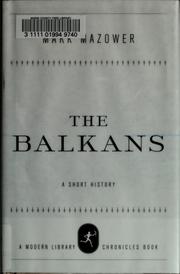
The Balkans
First published 2000. Subjects: Histoire, History, Historia, New York Times reviewed, Balkan peninsula, history.
eBay marketplace picks
Marketplace Samples
Live-tested eBay searches with available results related to this page.


Endnotes
1.
Source: Wikipedia
Title: Šćepan Mali
Link:https://en.wikipedia.org/wiki/%C5%A0%C4%87epan_Mali
2.
Source: jstor.org
Link:https://www.jstor.org/stable/3000742
Source snippet
Catherine II and a False Peter III in Montenegroby MB Petrovich · 1955 · Cited by 8 — At first a source of vexation to the Russian E...
3.
Source: Wikipedia
Title: Prince-Bishopric of Montenegro
Link:https://en.wikipedia.org/wiki/Prince-Bishopric_of_Montenegro
4.
Source: Wikipedia
Title: Yuri Vladimirovich Dolgorukov
Link:https://en.wikipedia.org/wiki/Yuri_Vladimirovich_Dolgorukov
5.
Source: Wikipedia
Title: Peter III of Russia
Link:https://en.wikipedia.org/wiki/Peter_III_of_Russia
6.
Source: labrujulaverde.com
Link:https://www.labrujulaverde.com/en/2024/08/scepan-mali-the-first-and-only-tsar-of-montenegro-who-pretended-to-be-the-russian-peter-iii/
Source snippet
La Brújula VerdeŠcepan Mali, the first and only tsar of Montenegro, who...20 Aug 2024 — Everyone knew that Šćepan was an impostor, but h...
7.
Source: sigedon.com
Title: peter iii of russia
Link:https://sigedon.com/peter-iii-of-russia/
Additional References
8.
Source: avclub.com
Link:https://www.avclub.com/wiki-wormhole-america-con-artist-montenegro-scepan-mali
Source snippet
· What it's about: · Biggest controversy: Šćepan managed to take the throne by dressing...
9.
Source: reddit.com
Title: the greatest tsar in all of montenegros history
Link:https://www.reddit.com/r/HistoryMemes/comments/1k4e0s6/the_greatest_tsar_in_all_of_montenegros_history/
Source snippet
The greatest Tsar in all of Montenegro's historyIn the 1760s, a man by the name of Šćepan Mali came to what was now Montenegro, and claim...
10.
Source: reddit.com
Link:https://www.reddit.com/r/ActLikeYouBelong/comments/kl8xj5/random_guy_shows_up_to_the_small_country_of/
Source snippet
the ruler of Montenegro from 1767 to 1773, Šćepan Mali ('Stephen the Little') gained power by pretending to be Tsar Pet...
11.
Source: billsjohn.wordpress.com
Title: an illustrated history of slavic misery scepan mali and the power of conviction
Link:https://billsjohn.wordpress.com/2018/09/22/an-illustrated-history-of-slavic-misery-scepan-mali-and-the-power-of-conviction/
Source snippet
Four years after Peter III was killed, Fake Peter III was killed.Read more...
12.
Source: youtube.com
Title: THE FAKE RUSSIAN TSAR WHO RULED MONTENEGRO?The story of a fake tsar Šćepan mali
Link:https://www.youtube.com/watch?v=CTHZl0vPLSs
Source snippet
How They Tried to Kill Šćepan Mali – The Fake Russian Tsar Who Fooled Montenegro...
13.
Source: youtube.com
Title: How They Tried to Kill Šćepan Mali – The Fake Russian Tsar Who Fooled Montenegro
Link:https://www.youtube.com/watch?v=Lu6bSnU_bew
Source snippet
The Man Who Sold a Nonexistent Country (And Got Away With It)...
14.
Source: youtube.com
Title: The Man Who Sold a Nonexistent Country (And Got Away With It)
Link:https://www.youtube.com/watch?v=3F2hR9vFUDk
Source snippet
The Woman Who Was Peter the Great's Son | Fake Dmitry and the Impostor Tsars...
15.
Source: facebook.com
Link:https://www.facebook.com/groups/coolfreakswikipediaclub/posts/3876424512475172/
16.
Source: cracked.com
Link:https://www.cracked.com/article_35947_the-guy-who-impersonated-a-russian-tsar-so-well-they-made-him-king-for-real.html
17.
Source: facebook.com
Title: august 13 1913german citizen and circus acrobat otto witte claims to have impers
Link:https://www.facebook.com/100081634959454/posts/august-13-1913german-citizen-and-circus-acrobat-otto-witte-claims-to-have-impers/845716759478335/
Topic Tree