When Gabon's Strangest Stories Became Believable
Gabon does not have a large, neatly documented catalogue of classic newspaper hoaxes or celebrated impostors. Its most revealing stories instead sit at the borders between fraud, rumour, scientific wonder and disputed authenticity.
Page outline Jump by section
Introduction
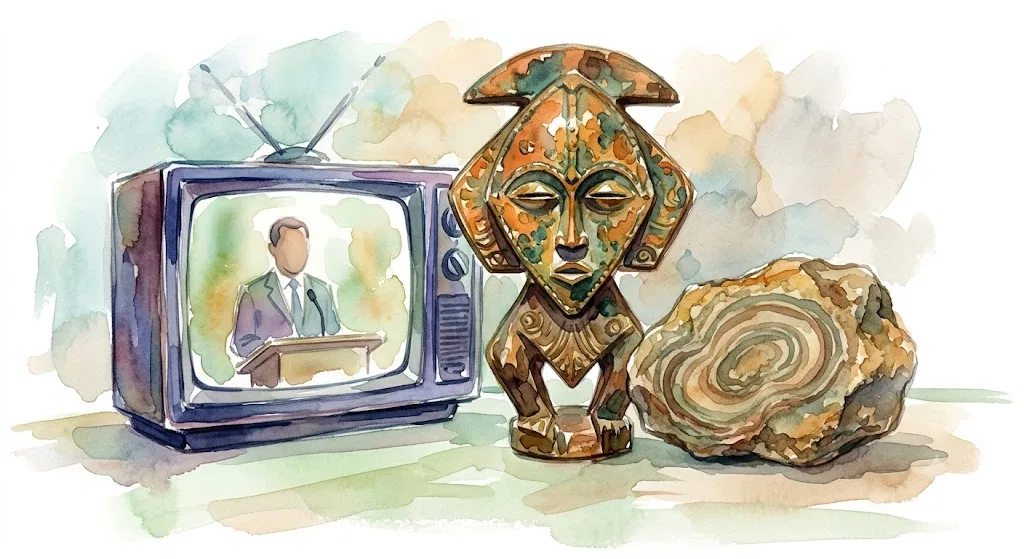
These episodes worked for different reasons. The Bongo rumour filled an information vacuum surrounding an ill and absent president. Art-market deception exploited collectors’ appetite for supposedly untouched “traditional” objects. Oklo pseudohistory turned an extraordinary but well-explained geological discovery into a mystery that sounded too advanced to be natural. Together they show that the most persuasive falsehoods rarely begin with nothing. They attach themselves to a real uncertainty, a valuable object or a fact already strange enough to resist ordinary explanation.
Was Ali Bongo’s 2019 address a deepfake?
The most consequential Gabonese “hoax” story began with a genuine political crisis rather than a proven fake. President Ali Bongo suffered a stroke in late 2018 and disappeared from public view while receiving treatment abroad. Conflicting and incomplete official accounts encouraged rumours that he was incapacitated, dead or being secretly replaced. When a recorded New Year address appeared on 1 January 2019, his stiff movements, altered appearance and carefully controlled setting were treated by some opponents as evidence that the video had been fabricated or that a body double was being used.[amazonaws.com]democracyreporting.s3.eu-central-1.amazonaws.comDemocracy Reporting A NEW DISINFORMATION THREAT?Amid a fragile political and economic sitution, Gabonese. President Ali Bongo was reported ill and disapeared.Read more…
The suspicion was politically potent because it addressed a question the authorities had failed to answer convincingly: who was actually governing Gabon? Bongo’s family had dominated national politics for decades, his disputed 2016 re-election had already damaged trust, and the government’s secrecy about his health made even extreme explanations appear plausible to some viewers. The video did not need to contain an obvious technical defect. Its unusualness, combined with existing distrust, allowed the label “deepfake” to become a shorthand for a wider belief that the presidency was concealing the truth.[The Washington Post]washingtonpost.comThe Washington PostAnalysis | How misinformation helped spark an attempted…The video was probably not a deepfake, and the coup was mos…
On 7 January, a small group of soldiers seized the national radio station and announced an attempted takeover. Their action was rapidly defeated. The suspect video was not the sole cause of the mutiny, but later reporting and research treated the surrounding misinformation as part of the atmosphere that made the attempt possible. This distinction matters: the claim did not merely mislead people about pixels on a screen; it intensified a constitutional crisis by making the head of state’s existence and capacity seem unknowable.[washingtonpost.com]washingtonpost.comThe Washington Post'Fakeout': A series about misinformation from The Factfraud. Three months after his disappearance from… Others called the video a deepfake: a fake video created by artificial intelligence…
Subsequent technical work has not produced persuasive evidence that Bongo’s face was synthetically generated. One study using the address as a real-world test found that a detector classified the original footage as authentic, while lower-quality, more heavily compressed versions could trigger false “fake” results. That finding illustrates a major weakness in automated verification: social-media compression, poor lighting and unfamiliar facial movement can resemble the defects that detection systems are trained to associate with manipulation.[arXiv]arxiv.orgarXiv Practical Deepfake Detection: Vulnerabilities in Global ContextsPractical Deepfake Detection: Vulnerabilities in Global ContextsJune 20, 2022…
Bongo later appeared publicly, including in live settings, visibly affected by his stroke. That did not prove that every frame of the New Year video was untouched; political broadcasts are routinely edited, staged and selected to present leaders favourably. It did, however, weaken the dramatic claims that he had died or been wholly replaced. The most responsible conclusion is therefore not “a deepfake caused a coup”, but that an authentic or conventionally edited video was widely misread as artificial because the government had allowed an information vacuum to grow around a visibly unwell president.[The Washington Post]washingtonpost.comThe Washington PostAnalysis | How misinformation helped spark an attempted…The video was probably not a deepfake, and the coup was mos…
The episode also anticipated what has become known as the “liar’s dividend”: once realistic synthetic media exists, inconvenient but genuine recordings can be dismissed as fabricated. In Gabon, the mere possibility of deepfakes mattered more than proof that one had been used. The technology supplied a modern vocabulary for an older political suspicion—that the public was being shown a performance rather than the reality of power.[PMC]pmc.ncbi.nlm.nih.govOpen source on nih.gov.

How fake Gabonese reliquaries enter the art market
Gabon’s best-known traditional artworks include wooden and metal-covered guardian figures associated with ancestral reliquaries, especially works attributed to Kota, Obamba and Fang communities. These objects were not originally free-standing ornaments. They protected containers holding ancestral remains and acquired meaning through use, placement and ritual history. Once European collectors and museums began treating them as modernist-looking sculptures, however, they also became financially valuable models for copies, imitations and deliberately aged pieces.[Horizon Documentation]horizon.documentation.ird.frHorizon Documentationancestral art ofgabonHorizon Documentationancestral art ofgabon
The resulting deception is more complicated than simply spotting a crude souvenir. A recently made figure may be an honest contemporary artwork, a replica produced for tourists, a stylistic exercise or a forgery offered with an invented age and history. Fraud enters when a seller presents recent production as an old, ritually used object, or supplies a false provenance designed to increase its price.
A scientific examination published in 2015 demonstrates how such claims can unravel. Researchers studied a metal-covered wooden figure stylistically consistent with a Gabonese Kota reliquary guardian. Microscopy and chemical analysis examined its brass covering and surface deposits, while accelerator mass spectrometry was used to date the wooden support. The wood proved to be from after 1950, far later than the period implied by an old funerary attribution. Some green and whitish deposits also appeared only partly consistent with natural corrosion, raising the possibility that age had been simulated.[Aimnet]aimnet.itOpen source on aimnet.it.
The case is valuable because the object was not exposed through one theatrical mistake. Its form looked plausible, the metal had been worked by hand, and its surface carried apparently convincing signs of age. What changed the assessment was the combination of radiocarbon dating, metallography and close examination of corrosion. The researchers also noted that demand from Western collectors had encouraged the proliferation of sculptures without the original funerary function.[Aimnet]aimnet.itOpen source on aimnet.it.
Museums face the same difficulty. The Mobile Museum of Art has described how specialists examined a Gabonese Kota-Obamba guardian in its collection for wear, insect damage and evidence of actual use. The museum acknowledged that twentieth-century craftsmen had produced similar figures and artificially aged them for sale. In that instance, expert comparison supported authenticity, but the process shows why a persuasive appearance alone is insufficient.[mobilemuseumofart.com]mobilemuseumofart.comOpen source on mobilemuseumofart.com.
Three kinds of evidence are especially important:
- Provenance: a documented chain of ownership, ideally reaching back to the object’s place and circumstances of collection.
- Material age: radiocarbon analysis of wood and technical examination of metal, pigments, fastenings and corrosion.
- Evidence of function: wear and alteration consistent with long use as a reliquary guardian, rather than damage applied to imitate age.
Even these tests require caution. Old wood can be reused in a new carving, genuine components can be assembled into a misleading composite, and authentic ritual objects may have incomplete or troubling colonial collection histories. “Authentic” must not become a romantic code for work supposedly untouched by commerce or change. Gabonese artists continued to create after colonial collecting began; recent manufacture is not inherently fraudulent. The deception lies in the claim made about the object, not merely in its date.
The trade also reveals an unequal geography of profit. Local makers may receive modest sums for objects that acquire vastly higher values once dealers, experts and auction catalogues assign them age and cultural authority. The Western appetite for a pure, timeless African past helps create the very market for fakes that collectors then blame on African producers.
Why Oklo attracts ancient-civilisation stories
Near Franceville in south-eastern Gabon lies one of the strangest genuine sites in the history of science: the remains of naturally occurring nuclear chain reactions. In 1972, routine analysis in France found that uranium originating from the Oklo mine contained slightly less uranium-235 than expected. Repeated checks ruled out simple measurement error. Further investigation found isotopic products showing that parts of the ore body had undergone sustained fission roughly two billion years ago.[IAEA]iaea.orgOpen source on iaea.org.
The accepted explanation depends on conditions that no longer exist. Uranium at that time contained a much larger proportion of fissile uranium-235 than natural uranium does today. Rich deposits were concentrated in a suitable geological arrangement, while groundwater slowed neutrons sufficiently to maintain chain reactions. Changes in water content probably caused the reactors to pulse on and off. The International Atomic Energy Agency’s early account emphasised that the reactions were inferred from uranium depletion, geological structure and identifiable fission products—not from buildings, tools or machinery.[IAEA]iaea.orgOpen source on iaea.org.
Online retellings often remove those mechanisms and replace them with a misleading question: how could a “nuclear reactor” exist before humans? Some posts have claimed that the site was constructed by an advanced prehistoric civilisation or by extraterrestrials. Others describe it as an impossibly precise nuclear installation, using language such as “plant” or “reactor complex” to imply engineered walls, control systems and fuel assemblies that were never found. Fact-checkers have traced and rejected versions of the ancient-builder claim, noting that the evidence is entirely compatible with natural geology and nuclear physics.[Lead Stories]leadstories.comLead Stories Fact Check: Nuclear Fission Reactors In Gabon Were NOTLead Stories Fact Check: Nuclear Fission Reactors In Gabon Were NOT
The story spreads because the misleading version preserves the most astonishing fact while discarding the explanation. “Nature once sustained nuclear fission” sounds almost as unbelievable as “an unknown civilisation built a reactor”, but the second claim supplies intentional designers and a hidden-history plot. It is emotionally easier to imagine lost engineers than to understand isotope ratios, neutron moderation and geological time.
Oklo is therefore not itself a hoax. It is a genuine discovery repeatedly used as raw material for pseudoscientific narratives. Its scientific importance is greater than the fabricated mystery: researchers have studied the site to understand the movement of fission products over immense periods and to test models relevant to radioactive-waste containment and fundamental physics.[ScienceDirect]sciencedirect.comOpen source on sciencedirect.com.
What should not be labelled a hoax?
A careful history of deception must avoid turning unfamiliar Gabonese beliefs into a catalogue of “superstitions”. Religious experience, oral tradition, masked performance and stories about spirits are not automatically frauds simply because outsiders do not accept their literal claims. A deliberate fake requires evidence of intentional misrepresentation; folklore may instead communicate identity, danger, memory or moral expectation without functioning as a factual news report.
The same caution applies to political rumours. A false claim can spread sincerely among people who have good reason to distrust official information. In the Bongo case, uncertainty about the president’s health was real even though the strongest deepfake and body-double claims lacked evidence. Calling everyone who repeated them gullible would obscure the government secrecy and political tensions that made the rumours persuasive.
Nor is every recent Gabonese-style sculpture a forgery. A contemporary carving sold honestly as new work is not fake. A replica made for teaching or display is not deceptive when properly labelled. The fraud occurs when age, ritual use, authorship or provenance is invented to secure authority or profit.
These distinctions separate four commonly blurred categories:
- Deliberate fraud: a seller fabricates provenance or artificially ages an object while marketing it as old.
- Unverified political allegation: a video is called a deepfake without adequate forensic evidence.
- Pseudoscientific embellishment: a natural phenomenon such as Oklo is repackaged as proof of ancient technology.
- Folklore or living belief: a narrative circulates for cultural or spiritual reasons without necessarily being offered as documentary evidence.
Why these stories endure
Gabon’s most memorable contested-truth episodes share a common structure. Each begins with something real: a president whose health was concealed, artworks whose histories are difficult to reconstruct, or rocks that genuinely record natural nuclear fission. The misleading story then offers a simpler explanation—synthetic video, guaranteed antiquity or lost civilisation—than the evidence can support.
They also reward different participants. Political opponents can use uncertainty to challenge authority; governments can dismiss legitimate scrutiny by grouping it with wild rumours; dealers can convert ambiguity into market value; and online publishers can turn a complicated scientific discovery into shareable wonder. None of these incentives requires a single mastermind.
The practical lesson is to investigate the gap between the claim and the underlying fact. For videos, that means seeking original files, medical and chronological context, independent appearances and more than one forensic method. For artefacts, it means examining provenance, materials and signs of genuine use rather than trusting style alone. For extraordinary science stories, it means asking whether the mystery remains once the mechanism is restored.
Gabon’s hoax history is therefore less a procession of spectacular fabrications than a study in how uncertainty is converted into certainty. The strongest debunkings do not make the real stories duller. They reveal something more interesting: a political video whose reception mattered more than its technical construction, artworks whose value depends on contested histories, and a natural reactor more remarkable than the invented civilisation used to explain it.

Amazon book picks
Further Reading
Books and field guides related to When Gabon's Strangest Stories Became Believable. Use these as the next step if you want deeper reading beyond the article.
Factfulness
Explains why plausible-sounding claims gain traction despite weak evidence.
The Demon-Haunted World
Rating: 4.5/5 from 43 Google Books ratings
Addresses pseudoscience, rumours and extraordinary claims.
eBay marketplace picks
Marketplace Samples
Live-tested eBay searches with available results related to this page.

Endnotes
1.
Source: arxiv.org
Title: arXiv Practical Deepfake Detection: Vulnerabilities in Global Contexts
Link:https://arxiv.org/abs/2206.09842
Source snippet
Practical Deepfake Detection: Vulnerabilities in Global ContextsJune 20, 2022...
Published: June 20, 2022
2.
Source: pmc.ncbi.nlm.nih.gov
Link:https://pmc.ncbi.nlm.nih.gov/articles/PMC9453721/
3.
Source: mobilemuseumofart.com
Link:https://www.mobilemuseumofart.com/wp-content/uploads/2020/05/storiesfromthecollection_whenexpertisematters_ver2.pdf
4.
Source: aimnet.it
Link:https://www.aimnet.it/allpdf/pdf_pubbli/apr15/soffritti.pdf
5.
Source: iaea.org
Link:https://www.iaea.org/sites/default/files/17304780204.pdf
6.
Source: iaea.org
Title: meet oklo the earths two billion year old only known natural nuclear reactor
Link:https://www.iaea.org/newscenter/news/meet-oklo-the-earths-two-billion-year-old-only-known-natural-nuclear-reactor
7.
Source: sciencedirect.com
Link:https://www.sciencedirect.com/science/article/abs/pii/S0016703796002451
8.
Source: arxiv.org
Title: arXiv Oklo reactors and implications for nuclear science
Link:https://arxiv.org/abs/1404.4948
9.
Source: iaea.org
Link:https://www.iaea.org/sites/default/files/17105192224.pdf
10.
Source: history.com
Title: nuclear reactor earth
Link:https://www.history.com/articles/nuclear-reactor-earth
11.
Source: democracyreporting.s3.eu-central-1.amazonaws.com
Title: Democracy Reporting A NEW DISINFORMATION THREAT?
Link:https://democracyreporting.s3.eu-central-1.amazonaws.com/images/20842020-09-01-DRI-deepfake-publication-no-1.pdf
Source snippet
Amid a fragile political and economic sitution, Gabonese. President Ali Bongo was reported ill and disapeared.Read more...
12.
Source: deepfakes.virtuality.mit.edu
Link:https://deepfakes.virtuality.mit.edu/part2/pg10/
Source snippet
Media Literacy in the Age of DeepfakesPart 2, pg10Bongo's stilted movements and the staged quality of the video caused many (including po...
13.
Source: washingtonpost.com
Link:https://www.washingtonpost.com/politics/2020/02/13/how-sick-president-suspect-video-helped-sparked-an-attempted-coup-gabon/
Source snippet
The Washington PostAnalysis | How misinformation helped spark an attempted...The video was probably not a deepfake, and the coup was mos...
14.
Source: washingtonpost.com
Title: The Washington Post’Fakeout’: A series about misinformation from The Fact
Link:https://www.washingtonpost.com/politics/2020/03/12/fakeout-fact-checker-video/
Source snippet
fraud. Three months after his disappearance from... Others called the video a deepfake: a fake video created by artificial intelligence...
15.
Source: Wikipedia
Title: Ali Bongo
Link:https://en.wikipedia.org/wiki/Ali_Bongo
16.
Source: horizon.documentation.ird.fr
Title: Horizon Documentationancestral art ofgabon
Link:https://horizon.documentation.ird.fr/exl-doc/pleins_textes/divers18-08/23103.pdf
17.
Source: science.org
Title: natural nuclear reactor explained
Link:https://www.science.org/content/article/natural-nuclear-reactor-explained
18.
Source: leadstories.com
Title: Lead Stories Fact Check: Nuclear Fission Reactors In Gabon Were NOT
Link:https://leadstories.com/hoax-alert/2022/11/fact-check-nuclear-fission-reactors-in-gabon-were-not-built-by-ancient-civilization-naturally-formed.html
Additional References
19.
Source: apnews.com
Link:https://apnews.com/article/a3322deaf184616dddc0314c61d79f03
Source snippet
He might be wrongAli Bongo Ondimba, president of Gabon, has been placed under house arrest by Gabonese security forces, who accuse him of...
20.
Source: youtube.com
Title: The Very Real 2 Billion Year Old Nuclear Reactor Found in Africa
Link:https://www.youtube.com/watch?v=37qZVHjMp4Q
Source snippet
The 2 Billion Year Old Natural Nuclear Reactor; A Geologic Oddity...
21.
Source: youtube.com
Title: Meet Earth’s 2-Billion Year Old NATURAL Nuclear Reactor
Link:https://www.youtube.com/watch?v=CM8-o9rwDaI
Source snippet
The Very Real 2 Billion Year Old Nuclear Reactor Found in Africa...
22.
Source: youtube.com
Title: The suspicious video that helped spark an attempted coup in Gabon
Link:https://www.youtube.com/watch?v=F5vzKs4z1dc
Source snippet
Politics, porn and toxic world of deepfake...
23.
Source: researchgate.net
Link:https://www.researchgate.net/publication/372258596_Monkeypox_Disinformation_and_Fact-Checking_A_Review_of_Ten_Iberoamerican_Countries_in_the_Context_of_Public_Health_Emergency
24.
Source: facebook.com
Link:https://www.facebook.com/trtworld/posts/an-ai-generated-video-falsely-claimed-a-coup-was-happening-in-france-and-went-vi/1332096282285943/
25.
Source: facebook.com
Link:https://www.facebook.com/groups/149844915349213/posts/2129427590724259/
26.
Source: researchgate.net
Link:https://www.researchgate.net/publication/285470689_Fakes_in_African_art_Study_of_a_reliquary_figure_Mbulu-Ngulu_from_Gabon
27.
Source: researchgate.net
Link:https://www.researchgate.net/figure/Footage-of-Gabons-former-president-Ali-Bongo-delivering-a-New-Years-address-with_fig1_378281954
28.
Source: apnews.com
Link:https://apnews.com/hub/gabon
Topic Tree
Follow this branch
Related pages 192
- Albanian Hoaxes
- Algerian Hoaxes
- Antigua Deceptions
- Argentina Hoaxes
- Armenian Hoaxes
- +187 more in sidebar