Within Somalia
When Real War Photos Tell False Stories
Authentic images repeatedly acquired false places, dates and stories as they moved through African social media.
On this page
- The Bakara market fire falsely presented as an intelligence attack
- How Somali conflict images migrated into Kenya, Ethiopia and Nigeria
- Reverse image searches, captions and other clues that exposed the reuse
Page outline Jump by section
Introduction
Many of the most misleading “Somalia photos” on social media are not fake photographs at all. They are genuine images from real conflicts that have been stripped of their original context and given a new caption, location or date. In Somalia’s information environment, where war, insurgency and regional insecurity are familiar realities, a dramatic image can appear believable even when the story attached to it is wrong.

This pattern has become one of the most persistent forms of visual misinformation linked to Somalia. Photographs from Somali battlefields have been reused to describe events in Kenya, Ethiopia and Nigeria, while authentic images from Mogadishu have been repackaged as evidence of attacks that never occurred. The deception lies not in the camera image itself but in the false narrative wrapped around it. Fact-checkers have repeatedly found that reverse-image searches, location clues and older news reports reveal the true origins of these photographs.[Fact Check AFP]factcheck.afp.comFact Check AFPVideo of market fire misrepresented as blast at Somalia…11 Apr 2024 — Through a reverse image search on a screenshot fro…
When a Market Fire Became an Intelligence Attack
One of the clearest recent examples involved a major fire at Mogadishu’s Bakara market in March 2024. Videos of the blaze circulated online accompanied by claims that al-Shabaab had attacked and burned the headquarters of Somalia’s National Intelligence and Security Agency (NISA).
The footage itself was genuine. What was false was the caption. Investigators traced the video back to the Bakara market fire through reverse-image searches and comparisons with contemporary news photographs. Somali authorities also stated that the intelligence agency’s headquarters had not been attacked. AFP and Africa Check independently concluded that the viral posts had misidentified the event.[Fact Check AFP]factcheck.afp.comFact Check AFPVideo of market fire misrepresented as blast at Somalia…11 Apr 2024 — Through a reverse image search on a screenshot fro…
The episode shows why recycled captions are so effective. A large fire produces dramatic visuals but often contains few obvious geographical markers. Viewers who already know that Mogadishu has experienced militant attacks may find the alternative explanation plausible. The image supplies emotional force, while the false caption supplies the desired political or military narrative.[Fact Check AFP]factcheck.afp.comFact Check AFPVideo of market fire misrepresented as blast at Somalia…11 Apr 2024 — Through a reverse image search on a screenshot fro…
How Somali Conflict Images Migrated Across Africa
The movement of photographs across national borders has become a recurring pattern in African social media networks.
A notable case emerged in 2022 when a photograph of a burned drilling truck was shared online as evidence that al-Shabaab had attacked a village in Kenya’s Wajir County. Fact-checkers established that the image actually showed a vehicle destroyed during an attack in Somalia. The photograph was authentic, but its location had been changed.[Fact Check AFP]factcheck.afp.comFact Check AFPPhoto of Al-Shabaab attack in Somalia falsely shared as…21 Oct 2022 — A photo shared in multiple social media posts clai…
This kind of migration happens because neighbouring countries often face related security concerns. Kenya, Ethiopia and Somalia all confront cross-border militant activity linked to al-Shabaab. An image from one conflict zone can therefore appear convincing when reassigned to another. The visual details may look broadly consistent with the new claim, especially for audiences unfamiliar with the original event.[Fact Check AFP]factcheck.afp.comFact Check AFPPhoto of Al-Shabaab attack in Somalia falsely shared as…21 Oct 2022 — A photo shared in multiple social media posts clai…
Several characteristics make Somali conflict photographs especially vulnerable to reuse:
- Military vehicles and damaged infrastructure often look similar across the region.
- Rural landscapes can be difficult for outsiders to identify precisely.
- Conflict reporting frequently travels through social media before professional verification occurs.
- Older photographs remain searchable and downloadable years after the original event.[Fact Check AFP]factcheck.afp.comFact Check AFPPhoto of Al-Shabaab attack in Somalia falsely shared as…21 Oct 2022 — A photo shared in multiple social media posts clai…
As a result, photographs may repeatedly acquire new identities long after the original incident has faded from public memory.
Why Real Images Make False Stories More Convincing
The most successful false captions usually attach themselves to something that is already true.
Somalia has experienced decades of conflict involving al-Shabaab, government forces, clan militias and foreign military missions. Because attacks, explosions and military operations genuinely occur, audiences often evaluate a claim by asking whether it sounds plausible rather than whether the specific image matches the specific event.
Researchers studying “out-of-context” misinformation have identified this as a particularly effective form of deception. Instead of fabricating evidence, the creator reuses authentic material and alters only the surrounding narrative. The image retains the credibility that comes from being real, while the caption redirects that credibility toward a different story.[arXiv]arxiv.orgOpen source on arxiv.org.
In practical terms, this means a genuine photograph from southern Somalia can later become supposed evidence of:
- a Kenyan border attack;[facebook.com]facebook.comSource details in endnotes.
- a Nigerian security incident;
- an Ethiopian military operation;
- a fresh Somali battlefield development that never occurred.
The image remains unchanged, but its meaning changes completely.
How Investigators Expose Reused Conflict Photos
Fact-checkers have developed a fairly consistent toolkit for identifying recycled war imagery.
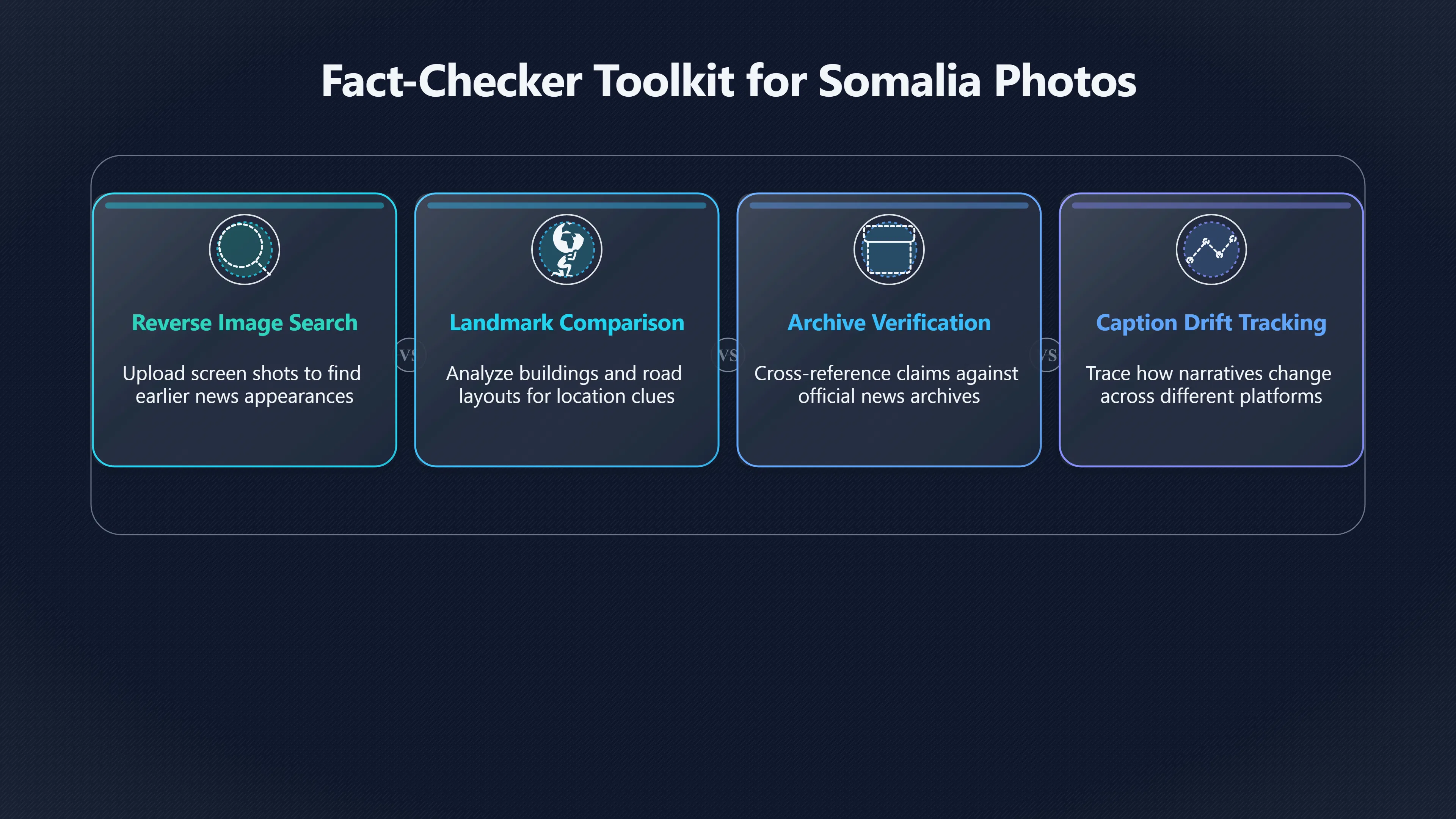
Reverse-image searches
The most common method is the reverse-image search. Investigators upload a screenshot or photograph to search engines and image databases, looking for earlier appearances. In many cases, the supposedly new image can be traced to a news report published months or years before the viral claim. The Bakara market example was uncovered partly through this process.[Fact Check AFP]factcheck.afp.comFact Check AFPVideo of market fire misrepresented as blast at Somalia…11 Apr 2024 — Through a reverse image search on a screenshot fro…
Comparing landmarks and physical details
Buildings, road layouts, terrain features and damaged vehicles can reveal where a photograph was originally taken. Even when captions change, visual details often remain identifiable. Fact-checkers compare these elements against archived news coverage and official photographs.[Fact Check AFP]factcheck.afp.comFact Check AFPVideo of market fire misrepresented as blast at Somalia…11 Apr 2024 — Through a reverse image search on a screenshot fro…

Checking dates and news archives
A dramatic claim attached to a photograph should usually leave traces elsewhere. If an alleged attack on a major government facility occurred, reputable news organisations, official agencies or local reporters would normally report it. The absence of corroborating evidence often becomes an important clue. This approach helped expose claims that the NISA headquarters had been destroyed.[Africa Check]africacheck.orgno evidence widespread claims somalias intelligenceA fire broke out in the Bakara market early 10 March, The website also reported about the Bakara…
Looking for caption drift
Many recycled images accumulate layers of new explanations over time. A photo may begin as documentation of one attack, then reappear years later with a different location and later still with a different political interpretation. Tracking these changing captions often reveals the path by which misinformation spread across platforms and countries.[Fact Check AFP]factcheck.afp.comFact Check AFPPhoto of Al-Shabaab attack in Somalia falsely shared as…21 Oct 2022 — A photo shared in multiple social media posts clai…
What These Cases Reveal About Modern Visual Misinformation
The Somali examples are notable because they blur the distinction between truth and falsehood. The photographs are usually not forged. The fires burned, the vehicles were destroyed and the battles happened. The deception occurs when the evidence is detached from its original setting.
That makes these cases different from classic photographic hoaxes involving staged scenes or manipulated images. Instead, they belong to a broader category of context fraud: real evidence supporting the wrong story. Researchers increasingly regard this form of misinformation as one of the hardest to detect because the image itself can pass every test of authenticity.[arXiv]arxiv.orgOpen source on arxiv.org.
Within the wider history of Somali misinformation, recycled war photographs illustrate a recurring lesson. People are often misled not by completely fabricated evidence but by genuine evidence presented in the wrong place, at the wrong time and with the wrong explanation. The photograph may be real, yet the story it appears to tell can be entirely false.[Fact Check AFP]factcheck.afp.comFact Check AFPVideo of market fire misrepresented as blast at Somalia…11 Apr 2024 — Through a reverse image search on a screenshot fro…
eBay marketplace picks
Marketplace Samples
Live-tested eBay searches with available results related to this page.



Endnotes
1.
Source: factcheck.afp.com
Link:https://factcheck.afp.com/doc.afp.com.34P69N6
Source snippet
Fact Check AFPVideo of market fire misrepresented as blast at Somalia...11 Apr 2024 — Through a reverse image search on a screenshot fro...
2.
Source: factcheck.afp.com
Link:https://factcheck.afp.com/doc.afp.com.32LT4GE
Source snippet
Fact Check AFPPhoto of Al-Shabaab attack in Somalia falsely shared as...21 Oct 2022 — A photo shared in multiple social media posts clai...
3.
Source: arxiv.org
Link:https://arxiv.org/abs/2112.00061
4.
Source: arxiv.org
Title: arXiv Fact-Checking Meets Fauxtography: Verifying Claims About Images
Link:https://arxiv.org/abs/1908.11722
5.
Source: factcheck.afp.com
Link:https://factcheck.afp.com/
Source snippet
Fact CheckAFP Fact Check is a department within Agence France-Presse (AFP), a multi-lingual, multicultural news agency whose mission is t...
6.
Source: factcheck.afp.com
Title: Middle East North Africa
Link:https://factcheck.afp.com/AFP-Middle-East-North-Africa
7.
Source: africacheck.org
Title: no evidence widespread claims somalias intelligence
Link:https://africacheck.org/fact-checks/meta-programme-fact-checks/no-evidence-widespread-claims-somalias-intelligence
Source snippet
A fire broke out in the Bakara market early 10 March, The website also reported about the Bakara...
8.
Source: factcheck.africa
Link:https://factcheck.africa/false-ethiopia-has-no-coast-news-images-dont-show-three-warships-close-to-the-country-520e946ab9da
9.
Source: toolbox.google.com
Link:https://toolbox.google.com/factcheck
Additional References
10.
Source: pesacheck.org
Link:https://pesacheck.org/partly-false-the-al-shabaab-attack-that-killed-civilians-drilling-a-borehole-happened-in-somalia/
Source snippet
PARTLY FALSE: The Al Shabaab attack that killed civilians...16 Oct 2022 — A tweet claiming that Al Shabaab militants killed civ...
11.
Source: crisisgroup.org
Title: 265 al shabaab five years after westgate still menace east africa
Link:https://www.crisisgroup.org/rpt/africa/kenya/265-al-shabaab-five-years-after-westgate-still-menace-east-africa
Source snippet
Crisis GroupAl-Shabaab Five Years after Westgate: Still a Menace in...21 Sept 2018 — Al-Shabaab remains focused on recapturing power in...
12.
Source: youtube.com
Title: Fact check: How do I spot manipulated images? | DW News
Link:https://www.youtube.com/watch?v=75ErawNvXGI
Source snippet
Combat disinformation with Google's Reverse Image Search...
13.
Source: youtube.com
Link:https://www.youtube.com/watch?v=CxCbjiaVzSw
Source snippet
How to do a reverse image search...
14.
Source: facebook.com
Link:https://www.facebook.com/AFPFactCheck/?locale=en_GB
15.
Source: x.com
Link:https://x.com/AFPFactCheck?lang=en
16.
Source: facebook.com
Link:https://www.facebook.com/AFPFactCheck/posts/inflammatory-posts-circulating-on-facebook-claimed-popular-music-stars-had-attac/1495043422624536/
17.
Source: facebook.com
Link:https://www.facebook.com/cgtnafrica/posts/at-least-ten-kenya-defence-forces-troops-were-killed-when-a-vehicle-they-were-tr/334277118738679/
18.
Source: reuters.com
Link:https://www.reuters.com/fact-check/
19.
Source: instagram.com
Link:https://www.instagram.com/p/DYrwqPSDJ_7/
Topic Tree