Within Cameroon Hoaxes
How Forged Certificates Made Dubious Art Seem Official
Fake UNESCO-style paperwork turned uncertain African art deals into transactions that appeared officially approved.
On this page
- What buyers were promised
- How logos and paperwork created trust
- How UNESCO exposed the false authority
Page outline Jump by section
Introduction
One of the most revealing Cameroon-linked frauds in the international art market did not depend on forging a masterpiece. Instead, it depended on forging authority. Fraudsters offered African artworks accompanied by documents that appeared to come from UNESCO or other respected cultural organisations, creating the impression that a private sale had been officially reviewed, authenticated and approved. In reality, the paperwork was counterfeit. UNESCO repeatedly warned that criminals were using its name, logo and even the identities of real officials to persuade buyers that uncertain transactions were legitimate. The deception is a useful case study in how modern fraud often works: the most valuable fake is not the object itself but the appearance of institutional trust.[UNESCO]unesco.orgUNESCO cautions against false certificates claiming to…20 Apr 2023 — These false documents fraudulently bear UNESCO's name and l…
What Buyers Were Promised
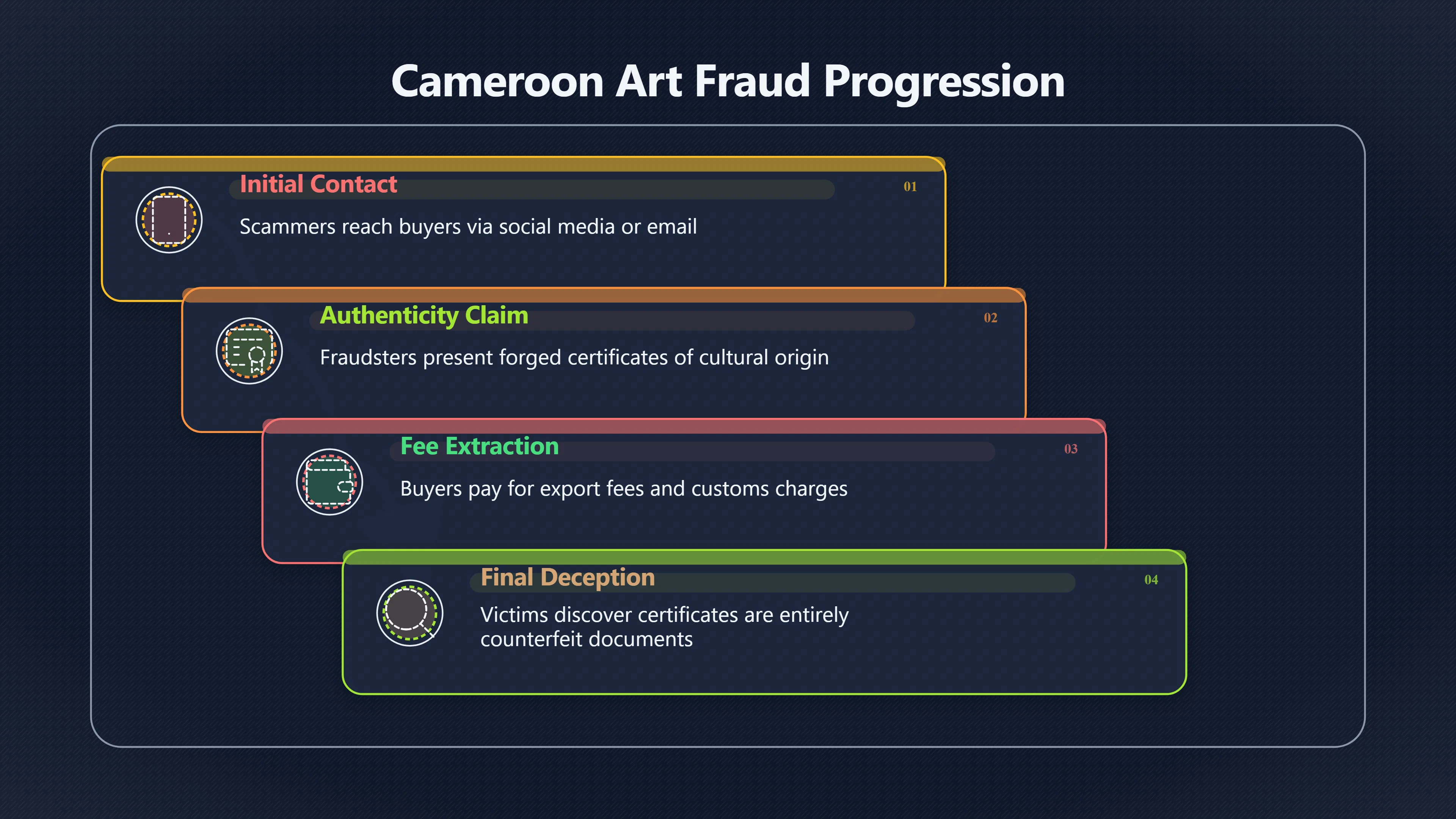
The scheme generally targeted people interested in African art, cultural artefacts and collecting. Potential buyers were approached through social media, email or personal contacts and introduced to supposedly valuable objects linked to African villages or traditional communities. Cameroon frequently appeared in these stories because the sellers claimed to have access to local cultural objects that could not easily be obtained through ordinary commercial channels.[The World from PRX]theworld.orgunesco says scammers are using agencys logo scam art collectorsThe World from PRXUNESCO says scammers are using its logo to defraud art…9 Jul 2020 — Scammers are using fake certificates with UNESCO…
The offer was rarely limited to the artwork itself. Buyers were shown certificates that supposedly proved:
- The object was authentic.
- The object had been officially examined.
- Export from Africa had been authorised.
- International cultural authorities had approved the transaction.
- Additional fees were required to complete legal export procedures.
This was persuasive because genuine cultural-property laws do exist. Many countries regulate the export of archaeological and cultural objects, and international organisations are involved in protecting heritage from looting and trafficking. Fraudsters exploited that reality by presenting fabricated paperwork as proof that all legal hurdles had already been cleared.[UNESCO]unesco.orgUNESCO cautions against false certificates claiming to…20 Apr 2023 — These false documents fraudulently bear UNESCO's name and l…
In one documented case, an art collector was shown photographs of objects allegedly located in Cameroon and paid roughly €6,000 in supposed administrative and export expenses before discovering that the UNESCO certificates were false.[The World from PRX]theworld.orgunesco says scammers are using agencys logo scam art collectorsThe World from PRXUNESCO says scammers are using its logo to defraud art…9 Jul 2020 — Scammers are using fake certificates with UNESCO…
How Logos and Paperwork Created Trust
The scam’s most important feature was not the art but the documents.
UNESCO reported that the forged certificates carried its name and logo and sometimes included fake business cards or the names of actual UNESCO personnel. The documents were designed to look bureaucratic and official, mimicking the appearance of international approval. Victims often believed they were participating in a regulated cultural transaction rather than an informal private sale.[UNESCO]unesco.orgUNESCO cautions against false certificates claiming to…20 Apr 2023 — These false documents fraudulently bear UNESCO's name and l…
The process often unfolded in stages. A buyer would first become interested in an artwork. A certificate would then appear to confirm authenticity. After that came requests for export fees, customs charges, transport costs or additional certifications. Each new payment seemed plausible because earlier paperwork had already established an illusion of legitimacy. According to investigators at UNESCO, the fraud depended on creating confidence before extracting successive payments.[The World from PRX]theworld.orgunesco says scammers are using agencys logo scam art collectorsThe World from PRXUNESCO says scammers are using its logo to defraud art…9 Jul 2020 — Scammers are using fake certificates with UNESCO…
What made the scheme effective was its careful borrowing of genuine authority:
- UNESCO is widely known for protecting cultural heritage.
- Cultural artefacts are often subject to legal restrictions.
- Museums and governments do issue certain official documents.
- International cooperation against illicit trafficking is real.
The forged paperwork blended these truths into a false conclusion: that UNESCO itself was certifying private sales and export rights.[UNESCO]unesco.orgUNESCO cautions against false certificates claiming to…20 Apr 2023 — These false documents fraudulently bear UNESCO's name and l…
How UNESCO Exposed the False Authority
UNESCO’s public warning was unusually direct. The organisation stated that it does not authorise private trade in cultural objects, does not certify the market value of collections and does not issue certificates approving the export of artworks for commercial transactions. Any document claiming otherwise should be treated with extreme suspicion.[UNESCO]unesco.orgUNESCO cautions against false certificates claiming to…20 Apr 2023 — These false documents fraudulently bear UNESCO's name and l…
The organisation estimated cumulative losses from the broader fraud at more than €1 million and considered legal action against those misusing its identity. Many victims were reported to be in France, often with connections to French-speaking African countries, making the claims appear more credible and culturally familiar.[UNESCO]unesco.orgUNESCO cautions against false certificates claiming to…20 Apr 2023 — These false documents fraudulently bear UNESCO's name and l…
The exposure also highlighted a common misunderstanding. UNESCO helps countries cooperate against illicit trafficking in cultural property and promotes implementation of international heritage agreements. It does not function as an art-market regulator or authenticity service for private collectors. Fraudsters exploited public confusion about that distinction.[UNESCO]unesco.orgUNESCO cautions against false certificates claiming to…20 Apr 2023 — These false documents fraudulently bear UNESCO's name and l…
The Parallel Warning from Museums
The scam was serious enough that the International Council of Museums (ICOM) issued its own warning. ICOM reported that fraudsters were offering fake certificates of authenticity, false import-export permissions and other documents supposedly issued by respected cultural institutions. The organisation stressed that it does not provide such certificates and that no international organisation has a mandate to authenticate cultural objects for private transactions in the way claimed by the scammers.[International Council of Museums]icom.museumscam alert icom false certificatesInternational Council of MuseumsScam alert: ICOM false certificates30 Apr 2020 — Some websites and individuals pretend to be ICOM and cla…
Significantly, ICOM noted that the fraud had already affected numerous victims and specifically identified Cameroon as a recurring context in the scheme. The warning showed that the deception was not limited to one forged logo. Rather, it relied on a broader strategy of appropriating the reputations of trusted institutions.[International Council of Museums]icom.museumscam alert icom false certificatesInternational Council of MuseumsScam alert: ICOM false certificates30 Apr 2020 — Some websites and individuals pretend to be ICOM and cla…
Why the Scheme Matters Beyond the Art Market
This episode belongs in the history of Cameroon-linked deception not because it revealed a giant forgery workshop or a fabricated archaeological discovery, but because it demonstrated how authority itself can be counterfeited.
The buyers were not persuaded by expert analysis of an artwork. They were persuaded by symbols of legitimacy: official-looking certificates, institutional logos, bureaucratic language and references to heritage protection. The fraud succeeded by transforming uncertainty into apparent certainty. A risky private deal suddenly looked as though it had passed through an international approval process.[unesco.org]unesco.orgUNESCO cautions against false certificates claiming to…20 Apr 2023 — These false documents fraudulently bear UNESCO's name and l…
The lesson extends far beyond African art. Whether the subject is cultural heritage, finance, science or government, forged credentials often work because they mimic institutions people already trust. In the Cameroon-linked art certificate cases, the counterfeit object was not necessarily the artefact on offer. The most important forgery was the appearance of official authority itself.[UNESCO]unesco.orgUNESCO cautions against false certificates claiming to…20 Apr 2023 — These false documents fraudulently bear UNESCO's name and l…

eBay marketplace picks
Marketplace Samples
Live-tested eBay searches with available results related to this page.

Endnotes
1.
Source: unesco.org
Link:https://www.unesco.org/en/articles/unesco-cautions-against-false-certificates-claiming-authorize-export-african-cultural-artefacts
Source snippet
UNESCO cautions against false certificates claiming to...20 Apr 2023 — These false documents fraudulently bear UNESCO's name and l...
2.
Source: unesdoc.unesco.org
Link:https://unesdoc.unesco.org/ark%3A/48223/pf0000266098
Source snippet
UNESCO Digital LibraryFighting the illicit trafficking of cultural property: a toolkit for...Fake export certificates/Falsified customs...
3.
Source: icom.museum
Title: scam alert icom false certificates
Link:https://icom.museum/en/news/scam-alert-icom-false-certificates/
Source snippet
International Council of MuseumsScam alert: ICOM false certificates30 Apr 2020 — Some websites and individuals pretend to be ICOM and cla...
4.
Source: unesco.org
Link:https://www.unesco.org/en/articles/crises-are-affecting-cultural-heritage-cameroon
Source snippet
In December 2020, UNESCO supported the Ministry of Arts and Culture, local stakeholders and communities...Read more...
Published: December 2020
5.
Source: unesco.org
Title: condemns theft objects priceless heritage value louvre museum
Link:https://www.unesco.org/en/articles/unesco-condemns-theft-objects-priceless-heritage-value-louvre-museum
Source snippet
Such acts jeopardise the...Read more...
6.
Source: youtube.com
Title: UNESCO to tackle illicit trafficking in cultural property
Link:http://www.youtube.com/watch?v=C2emzmI84ow
Source snippet
The trail of stolen cultural objects - stop trafficking and save culture...
7.
Source: youtube.com
Title: Fakes in the art world
Link:http://www.youtube.com/watch?v=1lNSXB4i4fE
Source snippet
UNESCO fake certificates African art scam Beware! New IMPROVED Nigerian Romance Scam Trick - works 100% SE CYBERSAFE...
8.
Source: theworld.org
Title: unesco says scammers are using agencys logo scam art collectors
Link:https://theworld.org/stories/2020/07/09/unesco-says-scammers-are-using-agencys-logo-scam-art-collectors
Source snippet
The World from PRXUNESCO says scammers are using its logo to defraud art...9 Jul 2020 — Scammers are using fake certificates with UNESCO...
9.
Source: nigeria-del-unesco.org
Link:https://nigeria-del-unesco.org/unesco-cautions-against-false-certificates-claiming-to-authorize-export-of-african-cultural-artefacts/
10.
Source: unesco.org.uk
Title: UNESC O Scam Alert
Link:https://unesco.org.uk/news/unesco-scam-alert-stay-vigilant
11.
Source: facebook.com
Link:https://www.facebook.com/unesco/posts/scam-alert-stay-vigilantongoing-phishing-campaigns-fraudulently-impersonate-unes/1246558660853013/
12.
Source: theartnewspaper.com
Title: unesco stop citing bogus dollar10bn figure art trade pleads
Link:https://www.theartnewspaper.com/2020/11/12/unesco-stop-citing-bogus-dollar10bn-figure-art-trade-pleads
Additional References
13.
Source: onart.media
Title: And this is only a very approximate value.Read more
Link:https://www.onart.media/events-centered-on-contemporary-african-art/scams-to-african-works-of-art-unesco-sounds-alarm-bell/
Source snippet
ON ART MEDIAScams to African works of art: UNESCO sounds alarm bell6 Jul 2020 — According to UNESCO, the cost of these scams to African a...
14.
Source: youtube.com
Title: The trail of stolen cultural objects
Link:http://www.youtube.com/watch?v=JymJQP5lWOQ
Source snippet
Warning! Preventing the looting of cultural property in Africa...
15.
Source: youtube.com
Title: The Exchange: Art and crime
Link:http://www.youtube.com/watch?v=w_0L6DijDEE
Source snippet
Fakes in the art world - The mystery conman | DW Documentary...
16.
Source: youtube.com
Title: Warning! Preventing the looting of cultural property in Africa
Link:http://www.youtube.com/watch?v=m4o6VZJDsPI
Source snippet
The Exchange: Art and crime - the dark side of the antiquities trade...
Topic Tree