Within Chad Hoaxes
Was Toumai a Human Ancestor or an Overstated Claim?
Toumai is an authentic fossil at the centre of an unresolved argument about ancestry, upright walking and how securely the evidence was handled.
On this page
- Why the skull transformed ideas about human origins
- What the skull and limb bones can and cannot prove
- Why scientific disagreement was recast as fraud
Page outline Jump by section
Introduction
The Toumaï fossil is not a hoax. The skull discovered in Chad’s Djurab Desert in 2001 is a genuine fossil, and few palaeoanthropologists doubt its authenticity. The real controversy is whether researchers overstated what the fossil could prove about the earliest stages of human evolution. At the centre of the dispute is a deceptively simple question: was Sahelanthropus tchadensis—nicknamed Toumaï—an early human ancestor that walked upright, or an ancient ape that happened to share some human-like features?[Human Origins]humanorigins.si.edusahelanthropus tchadensisHuman OriginsSahelanthropus tchadensisJan 3, 2024 — Sahelanthropus tchadensis is one of the oldest known species in the human family tree…

The argument matters because Toumaï dates to roughly seven million years ago, close to the estimated split between the human and chimpanzee lineages. If it was habitually bipedal, it could be among the earliest known members of the human family. If not, one of the most celebrated fossil discoveries of the twenty-first century becomes far less certain evidence for humanity’s origins. In Chad’s history of contested claims, Toumaï is a classic example of how a genuine scientific discovery can become entangled with disputes over evidence, interpretation and professional rivalry rather than outright fraud.[si.edu]humanorigins.si.edusahelanthropus tchadensisHuman OriginsSahelanthropus tchadensisJan 3, 2024 — Sahelanthropus tchadensis is one of the oldest known species in the human family tree…
Why the Skull Transformed Ideas About Human Origins
When French and Chadian researchers announced Toumaï in 2002, the discovery immediately challenged prevailing assumptions about where the earliest human ancestors lived. Most major fossil finds linked to early human evolution had come from eastern or southern Africa. Toumaï was found far to the west, in what is now northern Chad.[Human Origins]humanorigins.si.edusahelanthropus tchadensisHuman OriginsSahelanthropus tchadensisJan 3, 2024 — Sahelanthropus tchadensis is one of the oldest known species in the human family tree…
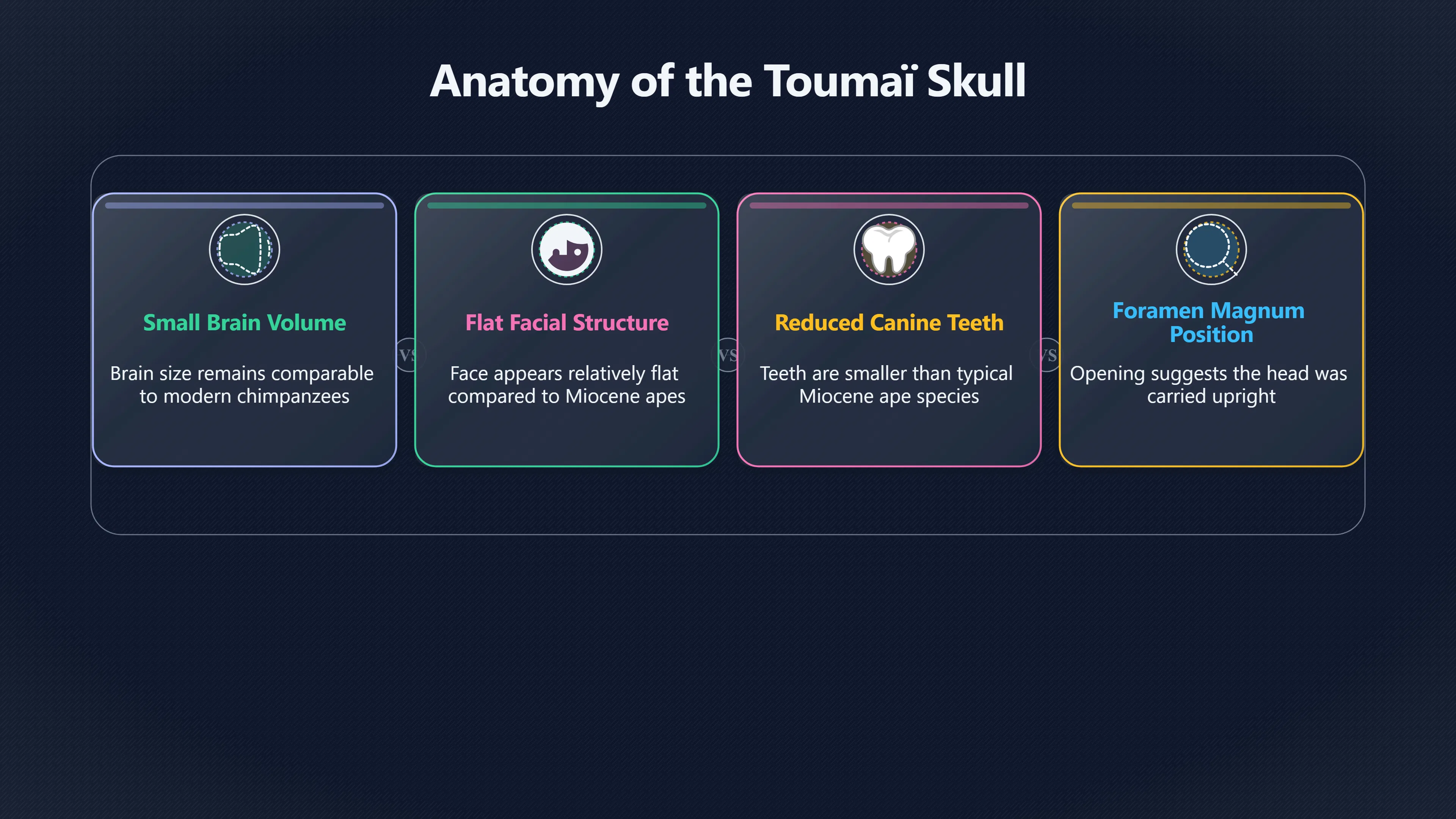
The skull itself appeared to combine ape-like and human-like traits. It had a small brain comparable to that of a chimpanzee, but its face was relatively flat and its canine teeth were smaller than expected for a Miocene ape. Most importantly, the discoverers argued that the position of the foramen magnum—the opening through which the spinal cord enters the skull—suggested the head was carried on a more upright body.[si.edu]humanorigins.si.edusahelanthropus tchadensisHuman OriginsSahelanthropus tchadensisJan 3, 2024 — Sahelanthropus tchadensis is one of the oldest known species in the human family tree…
This interpretation produced a dramatic headline: a seven-million-year-old fossil potentially representing one of the earliest known hominins, the group that includes humans and our extinct ancestors after the split from chimpanzees. If correct, Toumaï would push evidence for human-like upright posture deeper into the past than many researchers had expected.[Human Origins]humanorigins.si.edusahelanthropus tchadensisHuman OriginsSahelanthropus tchadensisJan 3, 2024 — Sahelanthropus tchadensis is one of the oldest known species in the human family tree…
Not everyone agreed. Critics argued that skull reconstruction involved assumptions and that the position of the foramen magnum alone could not conclusively demonstrate habitual bipedalism. They accepted the fossil’s importance but questioned whether it justified such strong evolutionary claims.[mpg.de]mpg.dewhat about bipedalism in sahelanthropusWhat about bipedalism in Sahelanthropus?5 Jul 2024 — In 2020, researchers described a partial femur from the same fossiliferous spot a…
What the Skull and Limb Bones Can and Cannot Prove
The debate intensified because the skull was never the only relevant evidence. A femur (thigh bone) and two forearm bones from the same fossil locality were discovered early on, but they were not fully described in the scientific literature for many years. Their delayed publication became almost as controversial as the bones themselves.[The Guardian]theguardian.comThe Guardian The curse of Toumaï: an ancient skull, a disputed femurThe GuardianThe curse of Toumaï: an ancient skull, a disputed femur…May 27, 2025 — 27 May 2025 — In Brunet's opinion the femur obvious…
In 2022, a major study argued that the femur showed several features associated with habitual bipedalism while the forearm bones indicated that the animal still spent substantial time climbing. The researchers proposed a creature capable of walking upright on the ground while retaining strong arboreal abilities.[Nature]nature.comOpen source on nature.com.
Supporters of this interpretation point to several anatomical details:
- Features of the femur that they argue resemble those of known bipedal hominins.[washingtonpost.com]washingtonpost.comSource details in endnotes.
- Evidence that weight-bearing stresses acted differently from those seen in typical quadrupedal apes.
- A combination of lower-limb and upper-limb anatomy suggesting upright walking alongside climbing behaviour.[Nature]nature.comOpen source on nature.com.
Critics remain unconvinced. They argue that the femur is incomplete, damaged and difficult to interpret. Some contend that the bone’s overall proportions remain more ape-like than human-like and that the evidence for regular bipedal walking is weaker than supporters claim.[mpg.de]mpg.dewhat about bipedalism in sahelanthropusWhat about bipedalism in Sahelanthropus?5 Jul 2024 — In 2020, researchers described a partial femur from the same fossiliferous spot a…
The key point often lost in popular retellings is that the dispute is not simply “biped” versus “not biped”. Some researchers suggest Toumaï may have occupied a middle ground, moving on two legs in some situations while retaining locomotor habits more similar to those of living apes.[Futura]futura-sciences.comtoumai fossil upends our understanding of human history 19273toumai fossil upends our understanding of human history 19273
Recent analyses have continued to reopen the question rather than settle it. A 2026 study identified additional femoral features that its authors interpreted as evidence for upright walking, while critics replied that the damaged state of the fossil leaves too much room for disagreement.[nih.gov]pmc.ncbi.nlm.nih.govOpen source on nih.gov.
Why Scientific Disagreement Was Recast as Fraud
Because the fossil became so important, disagreements over its interpretation gradually took on a more dramatic public character. The delayed treatment of the femur generated accusations that evidence had been neglected, minimised or effectively hidden from scrutiny. Critics argued that if the bone weakened the case for bipedalism, it should have been analysed and published sooner.[The Guardian]theguardian.comThe Guardian The curse of Toumaï: an ancient skull, a disputed femurThe GuardianThe curse of Toumaï: an ancient skull, a disputed femur…May 27, 2025 — 27 May 2025 — In Brunet's opinion the femur obvious…
Those allegations helped create a narrative that something improper had occurred. Yet the evidence does not support claims that Toumaï itself was fabricated or that the fossil was exposed as a fake. Even some of the harshest critics of the original interpretation accept that the fossil is genuine and scientifically important. The dispute concerns classification, anatomical interpretation and research practices, not forgery.[John Hawks]johnhawks.netJohn Hawks Did somebody bury the bones of Toumaï?John Hawks Did somebody bury the bones of Toumaï?
The controversy became especially attractive to journalists and online commentators because it combined several elements that often generate public interest:
- A fossil linked to humanity’s earliest origins.
- Competing scientific camps.
- Long delays in publication.
- Questions about access to specimens and data.
- Personal rivalries among prominent researchers.[The Guardian]theguardian.comThe Guardian The curse of Toumaï: an ancient skull, a disputed femurThe GuardianThe curse of Toumaï: an ancient skull, a disputed femur…May 27, 2025 — 27 May 2025 — In Brunet's opinion the femur obvious…
As often happens in scientific controversies, nuanced disagreement was sometimes retold as a story of deception. The resulting public impression could be that Toumaï had been “debunked” or “exposed”. In reality, the fossil remains a central piece of evidence in discussions of early hominin evolution, even among researchers who reject the strongest claims made for it.[mpg.de]mpg.dewhat about bipedalism in sahelanthropusWhat about bipedalism in Sahelanthropus?5 Jul 2024 — In 2020, researchers described a partial femur from the same fossiliferous spot a…
What Still Remains Unresolved
More than two decades after its discovery, Toumaï remains one of the most important and disputed fossils in palaeoanthropology. Several questions are still open.
First, researchers continue to debate whether Sahelanthropus tchadensis belongs within the human lineage or represents an extinct ape lineage that evolved some similar traits independently. Second, even if it was a hominin, the extent of its bipedalism remains uncertain. Third, the limited fossil sample means that individual bones carry enormous interpretive weight.[bradshawfoundation.com]bradshawfoundation.comOpen source on bradshawfoundation.com.
What would resolve the argument is not another round of debate over the existing skull and femur, but the discovery of additional fossils from the same species. Researchers on multiple sides of the dispute acknowledge that new material is needed before stronger conclusions can be drawn.[The Washington Post]washingtonpost.comOpen source on washingtonpost.com.
The Real Lesson of the Toumaï Debate
Within Chad’s wider history of contested claims and misunderstood evidence, Toumaï stands out because it demonstrates how scientific uncertainty can be mistaken for scandal. The fossil was real. The discovery was genuine. What remains contested is the meaning of the evidence.
For the public, the lasting lesson is that major scientific announcements often arrive before every question has been answered. Toumaï changed thinking about the geography and timing of early human evolution, but it also revealed how fragile grand evolutionary narratives can be when they rest on a handful of ancient bones. The debate survives not because a hoax was uncovered, but because the evidence is significant enough that reasonable experts still disagree about what it shows.[nature.com]nature.comOpen source on nature.com.
Amazon book picks
Further Reading
Books and field guides related to Was Toumai a Human Ancestor or an Overstated Claim?. Use these as the next step if you want deeper reading beyond the article.
Human Evolution
Explains how scientists evaluate fossil evidence and competing interpretations.
The Complete World of Human Evolution
Provides background needed to assess claims about Toumaï.
The Greatest Show on Earth
Helps readers understand how scientific claims are tested and challenged.
eBay marketplace picks
Marketplace Samples
Live-tested eBay searches with available results related to this page.




Endnotes
1.
Source: sciencedirect.com
Link:https://www.sciencedirect.com/science/article/abs/pii/S0047248420301597
Source snippet
Nature and relationships of Sahelanthropus tchadensisby R Macchiarelli · 2020 · Cited by 74 — Was Toumaï (Sahelanthropus tch...
2.
Source: nature.com
Link:https://www.nature.com/articles/d41586-022-02313-7
Source snippet
Formal description of the leg bone, which belongs to Sahelanthropus...Read more...
3.
Source: mpg.de
Title: what about bipedalism in sahelanthropus
Link:https://www.mpg.de/22183908/what-about-bipedalism-in-sahelanthropus
Source snippet
What about bipedalism in Sahelanthropus?5 Jul 2024 — In 2020, researchers described a partial femur from the same fossiliferous spot a...
4.
Source: nature.com
Link:https://www.nature.com/articles/s41586-022-04901-z
5.
Source: pmc.ncbi.nlm.nih.gov
Link:https://pmc.ncbi.nlm.nih.gov/articles/PMC12758524/
6.
Source: nature.com
Title: news020708 12
Link:https://www.nature.com/news/2002/020711/full/news020708-12.html
7.
Source: humanorigins.si.edu
Title: sahelanthropus tchadensis
Link:https://humanorigins.si.edu/evidence/human-fossils/species/sahelanthropus-tchadensis
Source snippet
Human OriginsSahelanthropus tchadensisJan 3, 2024 — Sahelanthropus tchadensis is one of the oldest known species in the human family tree...
8.
Source: theguardian.com
Title: fresh bone analysis earliest ancestor of humankind but doubts remain
Link:https://www.theguardian.com/science/2026/jan/02/fresh-bone-analysis-earliest-ancestor-of-humankind-but-doubts-remain
Source snippet
The GuardianFresh bone analysis makes case for earliest 'ancestor of...3 Jan 2026 — Scientists argue ape-like Sahelanthropus tchadensis...
9.
Source: becominghuman.org
Link:https://becominghuman.org/hominin-fossils/sahelanthropus-tchadensis/
Source snippet
Becoming HumanSahelanthropus tchadensisOne way to tell from the skull (head) of an extinct hominin is by looking at the position of the f...
10.
Source: pubmed.ncbi.nlm.nih.gov
Link:https://pubmed.ncbi.nlm.nih.gov/41481701/
Source snippet
Earliest evidence of hominin bipedalism in Sahelanthropus...by SA Williams · 2026 · Cited by 2 — Recently, two partial ulnae and a...
11.
Source: theguardian.com
Title: The Guardian The curse of Toumaï: an ancient skull, a disputed femur
Link:https://www.theguardian.com/science/2025/may/27/the-curse-of-toumai-ancient-skull-disputed-femur-feud-humanity-origins
Source snippet
The GuardianThe curse of Toumaï: an ancient skull, a disputed femur...May 27, 2025 — 27 May 2025 — In Brunet's opinion the femur obvious...
Published: May 27, 2025
12.
Source: washingtonpost.com
Link:https://www.washingtonpost.com/science/2026/01/02/human-ancestor-biped/
13.
Source: futura-sciences.com
Title: toumai fossil upends our understanding of human history 19273
Link:https://www.futura-sciences.com/en/toumai-fossil-upends-our-understanding-of-human-history_19273/
14.
Source: johnhawks.net
Title: John Hawks Did somebody bury the bones of Toumaï?
Link:https://www.johnhawks.net/p/sahelanthropus-burial-beauvilain-2009
15.
Source: bradshawfoundation.com
Link:https://www.bradshawfoundation.com/origins/sahelanthropus_tchadensis.php
16.
Source: theguardian.com
Link:https://www.theguardian.com/
17.
Source: theguardian.com
Link:https://www.theguardian.com/news/audio/2025/jul/21/the-curse-of-toumai-an-ancient-skull-a-disputed-femur-and-a-bitter-feud-over-humanitys-origins-podcast
18.
Source: instagram.com
Link:https://www.instagram.com/guardian/
19.
Source: science.org
Link:https://www.science.org/doi/10.1126/sciadv.adv0130
20.
Source: Wikipedia
Title: The Guardian
Link:https://en.wikipedia.org/wiki/The_Guardian
21.
Source: Wikipedia
Link:https://de.wikipedia.org/wiki/Sahelanthropus
22.
Source: Wikipedia
Link:https://en.wikipedia.org/wiki/Sahelanthropus
23.
Source: johnhawks.net
Title: how sahelanthropus tchadensis moved
Link:https://www.johnhawks.net/p/how-sahelanthropus-tchadensis-moved
24.
Source: facebook.com
Title: The Guardian | London
Link:https://www.facebook.com/theguardian/
25.
Source: play.google.com
Link:https://play.google.com/store/apps/details?id=com.guardian
26.
Source: x.com
Title: The Guardian (@guardian) / Posts / X
Link:https://x.com/guardian
27.
Source: australian.museum
Title: sahelanthropus tchadensis
Link:https://australian.museum/learn/science/human-evolution/sahelanthropus-tchadensis/
Additional References
28.
Source: livescience.com
Link:https://www.livescience.com/archaeology/human-evolution/tiny-bump-on-7-million-year-old-fossil-suggests-ancient-ape-walked-upright-and-might-even-be-a-human-ancestor
Source snippet
This finding reignites a long-standing debate about whether *S. tchadensis* is the earliest known hominin or merely a bipedal ape unrelat...
29.
Source: youtube.com
Title: Standing Up in the Sahel
Link:https://www.youtube.com/watch?v=9qFnkPxR2-M
Source snippet
This SciShow video explains why the femur of the Toumaï fossil was kept hidden from independent researchers for decades, directly providi...
30.
Source: facebook.com
Link:https://www.facebook.com/groups/252029351211252/posts/714441304970052/
31.
Source: reddit.com
Link:https://www.reddit.com/r/Anthropology/comments/1q2gklf/evidence_of_upright_walking_found_in/
32.
Source: museoevolucionhumana.com
Link:https://museoevolucionhumana.com/en/scientific-news/seven-million-year-old-femur-suggests-ancient-human-relative-walked-upright
33.
Source: realclearscience.com
Link:https://www.realclearscience.com/2025/05/28/the_curse_of_toumai_a_bitter_feud_over_humanitys_origins_1112908.html
34.
Source: reddit.com
Link:https://www.reddit.com/r/EverythingScience/comments/1kwowp1/the_curse_of_touma%C3%AF_an_ancient_skull_a_disputed/
35.
Source: popular-archaeology.com
Link:https://popular-archaeology.com/article/sahelanthropus-the-oldest-representative-of-humanity-was-indeed-bipedal-but-thats-not-all/
36.
Source: youtube.com
Title: Our Oldest Ancestor: the Toumaï Mystery
Link:https://www.youtube.com/watch?v=ANTFooeKe5A
Source snippet
A Researcher Hid This Fossil For Decades. Here's Why...
37.
Source: researchgate.net
Title: 399393521 Earliest evidence of hominin bipedalism in Sahelanthropus tchadensis
Link:https://www.researchgate.net/publication/399393521_Earliest_evidence_of_hominin_bipedalism_in_Sahelanthropus_tchadensis
Topic Tree