Which Tajikistan Stories Were Really True?
Tajikistan does not have a well-documented catalogue of spectacular national hoaxes comparable with the Piltdown Man forgery or the Cottingley fairy photographs.
Page outline Jump by section
Introduction
These cases matter because they show how falsehood flourishes when reliable evidence is scarce. Tajikistan’s remote mountains have encouraged cryptozoological speculation, while political repression and restricted journalism have made ordinary claims difficult to verify. The central lesson is not that Tajik society is unusually credulous. It is that isolation, fear, institutional authority and gaps in trustworthy reporting can make weak stories appear plausible—and can make real abuses resemble fabricated ones.
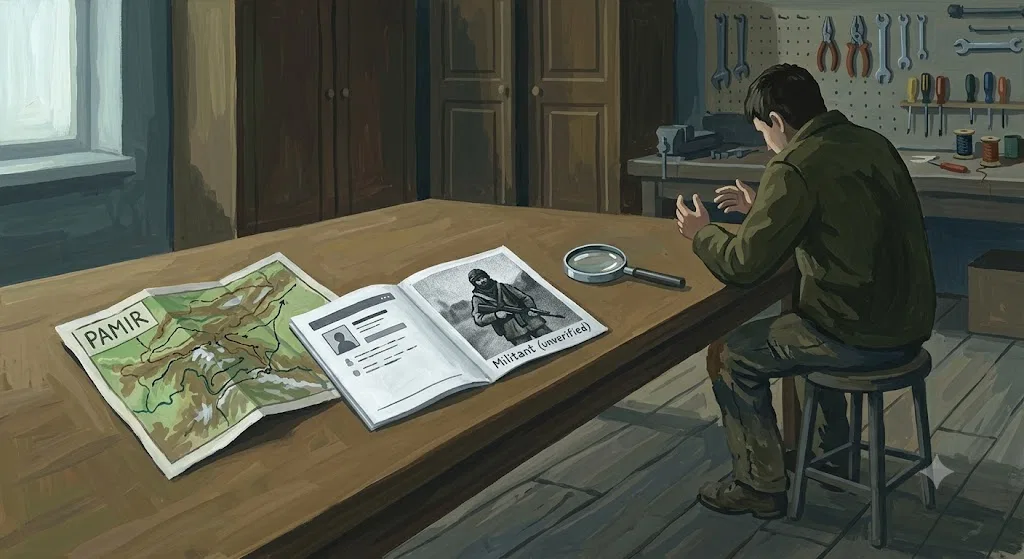
Did Soviet scientists really hunt a wild human in the Pamirs?
The Pamir Mountains became the setting for Tajikistan’s most enduring fortean story: reports of a hairy, upright creature sometimes treated as a Central Asian relative of the yeti. The story was not simply an old folk belief invented to entertain tourists. In the late 1950s it became, briefly, a recognised subject of Soviet scientific investigation.
Interest surged after the hydrologist Aleksandr Pronin said he had twice seen a strange creature during an August 1957 expedition in the Tajik Pamirs. His account arrived when international fascination with the Himalayan yeti was already intense. Soviet newspapers had previously mocked Western “snowman” sensationalism, but Pronin’s reported sightings prompted scientists and readers to ask whether an equivalent creature might exist on Soviet territory.[Cryptozoological Reference Library]cryptozoologicalreferencelibrary.wordpress.comCryptozoological Reference Library
The Soviet Academy of Sciences established a special commission to examine the question. Its members considered stories about a Pamir wild man and assembled a report running to hundreds of pages. They eventually selected the Sarez basin and the Muk-Su valley in Tajikistan as promising search areas, reasoning that an unknown primate might have migrated westwards from the Himalayas. The resulting 1958 expedition included zoologists, botanists, archaeologists and mountaineers.[Cryptozoological Reference Library]cryptozoologicalreferencelibrary.wordpress.comCryptozoological Reference Library
Nothing decisive was found. The expedition returned without a body, photograph, trackway or biological specimen demonstrating the existence of an unknown hominid. The academy treated the matter as settled and closed official journals to further research on the creature. Enthusiasts continued their work at the margins of Soviet science, arguing that the search had been badly organised or conducted in the wrong places.[Cryptozoological Reference Library]cryptozoologicalreferencelibrary.wordpress.comCryptozoological Reference Library
Reports continued nonetheless. In 1988, Soviet researcher Igor Tatsl told the international press that an expedition had recorded several nocturnal sightings in the Pamirs. Such announcements generated headlines but did not produce independently testable physical evidence.[UPI]upi.comThe leader of a Soviet scientific expedition in search20 Jan 1988 — Igor Tatsl, a veteran 'Yeti' hunter and scientist, said his expedition recorded 'several' nocturnal sightings of the abo…
This episode is best described as a mixture of folklore, sincere investigation and scientific error rather than a proven deliberate hoax. Individual witnesses may have misidentified bears, people, shadows or distant animals. Some later storytellers almost certainly embellished the tradition. Yet the original investigators did not simply manufacture a monster for profit. They were responding to eyewitness testimony, international excitement and the attraction of unexplored terrain.
The case also shows how official attention can strengthen a doubtful claim. Once an academy commission, professional scientists and a large expedition became involved, the creature appeared more credible than the evidence justified. The investigation itself became part of the legend: enthusiasts could say that the Soviet state had taken the wild man seriously, even though its expedition ultimately found nothing.

How an imaginary dissident fooled the news
A much clearer hoax appeared online in April 2019. A Facebook account belonging to “Alisher Alikhonov” claimed that Tajik police were preparing criminal charges against him after he criticised the head of the country’s telecommunications regulator. The supposed dissident said officers had visited and intimidated his elderly parents and accused him of links to the banned Islamic Renaissance Party.[Eurasianet]eurasianet.orgTajikistan: Plight of fake government critic highlights dangers of credulity | Eurasianet…
The account looked persuasive because every part of the story fitted known conditions in Tajikistan. Human rights organisations had documented pressure on relatives of opposition figures living abroad. Criticism of senior officials could carry serious consequences, and independent reporters had limited ability to question the authorities or conduct rapid investigations. A fabricated account therefore resembled many authentic testimonies.[Eurasianet]eurasianet.orgTajikistan: Plight of fake government critic highlights dangers of credulity | Eurasianet…
Several outlets repeated the story before doubts emerged. Reporters then discovered that Alikhonov apparently did not exist. His profile photograph had been taken from another person, biographical details could not be confirmed, and acquaintances cited by the account were equally elusive. The creator’s identity and precise motive remained unknown. Possibilities included a prank, a test of journalists’ credulity or an attempt by a politically connected provocateur to embarrass opposition media.[Eurasianet]eurasianet.orgTajikistan: Plight of fake government critic highlights dangers of credulity | Eurasianet…
The episode worked because it exploited narrative plausibility. Fabricated stories are not always outlandish. The most effective ones often copy events that genuinely happen. Nothing in Alikhonov’s account sounded impossible; indeed, its familiarity discouraged scepticism.
That creates a particular difficulty in restrictive political systems. Dismissing every poorly documented allegation risks ignoring real victims. Publishing every plausible anonymous claim, however, allows impostors and provocateurs to pollute the record. Verification requires independent contact, reverse-image searches, corroborating witnesses and evidence that the person existed before the crisis—not merely a social-media page containing a convincing grievance.
The hoax may also have benefited those who wished to undermine reports of repression. Once one prominent victim was exposed as imaginary, officials and supporters of the government could imply that other allegations were invented too. A successful political fabrication therefore damages more than the outlet that published it; it gives cover to anyone who wants authentic testimony treated as suspect.
Why militants might fake their own deaths
During the war in Syria and Iraq, reports concerning Tajik members of the Islamic State group repeatedly blurred the line between propaganda, battlefield confusion and deliberate deception. In 2015, online posts and a “martyr” video announced the deaths of several Tajik militants. At least some of these reports were doubtful, while rumours that former Tajik police commander Gulmurod Halimov had died proved false or greatly exaggerated when later photographs showed him injured but alive.[RadioFreeEurope/RadioLiberty]rferl.orgOpen source on rferl.org.
A Tajik prosecutor offered a practical explanation for staged deaths. When a citizen was suspected of joining Islamic State, security officers might question relatives at home. If a family announced that the militant had been killed and conducted funeral rites, investigators could stop returning. According to the official, militants had previously “played dead” for this reason.[RadioFreeEurope/RadioLiberty]rferl.orgOpen source on rferl.org.
This was not necessarily a single centrally organised hoax. Several mechanisms could produce a false martyrdom:
- Operational concealment: a living fighter could escape attention or move under another identity.
- Protection of relatives: a death announcement might reduce pressure on a family in Tajikistan.
- Propaganda value: extremist organisations glorified “martyrs” and used death notices as recruitment material.
- Battlefield uncertainty: hurried reports were copied before bodies or identities were confirmed.
- Recycled imagery: photographs of corpses could be presented without a clear date, place or reliable identification.
The evidence in individual cases was often incomplete, so it would be wrong to treat every incorrect death report as a proven conspiracy. What can be established is that militant media operated without normal standards of identification and that interested parties had reasons to declare someone dead prematurely.
These stories also reveal why photographs are not automatically proof. A bloody body shown in a video may establish that somebody died, but not the name of the dead person, the date of the recording or the circumstances. Verification depends on matching distinctive features, tracing the earliest upload, locating the scene and finding subsequent evidence of the alleged victim’s activity.
When official denial and false rumour fed each other
Tajikistan’s coronavirus crisis produced the country’s most consequential struggle over contested truth. During March and April 2020, officials insisted that the virus had not reached Tajikistan, despite reports of suspicious illness and rising concern among doctors, journalists and social-media users. The government confirmed its first cases only on 30 April, immediately before a visit by World Health Organization specialists.[ARTICLE 19]article19.orgARTICLE 19…
Before that admission, a deputy health minister attributed an increase in pneumonia to unusually rainy weather. State television repeatedly presented Tajikistan as free of COVID-19, while journalists and medical workers raising concerns faced pressure. Independent efforts to record deaths possibly associated with the disease were later blocked.[IPHR]iphronline.orgIPHRTajikistan and the COVID pandemic: denial, cover-up and downplayIPHRTajikistan and the COVID pandemic: denial, cover-up and downplay
The information vacuum encouraged genuine misinformation as well. Unconfirmed reports about infections, deaths and shortages circulated rapidly, and fear contributed to panic buying. In such an atmosphere, accurate warnings, mistaken suspicions and wild rumours could travel through the same informal channels. Readers had few dependable ways to distinguish between them.
The government responded by introducing penalties for distributing “false” pandemic information through the press, internet or social networks. Amendments approved in June 2020 allowed fines and up to 15 days’ administrative detention. Press-freedom groups warned that the wording could permit authorities to define government figures as the only acceptable version of events, even when those figures were being questioned.[ARTICLE 19]article19.orgARTICLE 19…
This was not a conventional hoax with a named trickster and a dramatic confession. It was a collision between several kinds of unreliable information:
- official statements that downplayed or denied a developing crisis;
- rumours produced by fear and missing data;
- incomplete reporting based on anonymous medical sources;
- accusations of “fake news” used to deter scrutiny;
- disputed mortality figures that could not readily be audited.
The important distinction is between misinformation and censorship. Some pandemic rumours were undoubtedly false. That did not make official claims automatically correct, nor did it justify punishing all reporting that departed from the state’s account. When authorities restrict verification and then prosecute uncertainty, they may worsen the very rumour problem they claim to be solving.
Why convincing falsehoods spread in Tajikistan
The cases differ sharply, but each relied on an evidence gap. The Pamir wild-man story flourished in inaccessible mountains where sightings were difficult to reproduce. The invented dissident thrived because repression made his claims plausible while also obstructing verification. False militant deaths emerged from war zones and secretive extremist networks. Pandemic rumours expanded when public-health information was delayed or tightly controlled.
Tajikistan’s media environment makes those gaps particularly serious. Independent outlets and news websites have faced blocking, pressure and closures, while journalists have reported intimidation and imprisonment. The Committee to Protect Journalists described the independent media sector in early 2024 as being in its worst condition since the country’s civil war.[Reporters Without Borders]rsf.orgtajikistan turns chinese model large scale internet censorshipLeading news…Read more…
A 2024 media assessment found that false and propagandistic material had increased substantially on Tajik-language social media since the pandemic. Its contributors also reported limited access to fact-checking resources, low public awareness of media verification and a shortage of dependable factual information. These findings describe structural vulnerabilities, not an inherent national tendency to believe falsehoods.[IREX]irex.orgVIBE 2024 TajikistanVIBE 2024 Tajikistan
Fact-checking organisations have begun addressing the problem through media-literacy campaigns and public explanations of manipulated content. By 2026, Tajik fact-checkers were also warning about artificial intelligence tools capable of producing convincing false text, voices and images at scale.[Information Saves Lives | Internews]internews.orgOpen source on internews.org.
For readers, the most useful warning sign is not that a claim sounds strange. Several Tajik fabrications succeeded precisely because they sounded ordinary. Better questions are whether the named person can be independently located, whether an image predates the accompanying story, whether the source benefits from secrecy, whether officials permit outside inspection, and whether later evidence confirms the original account.
What these stories reveal
Tajikistan’s history of contested truth is not dominated by ingenious physical forgeries. Its characteristic cases arise where folklore, political fear, remote geography and restricted information overlap.
The Pamir creature demonstrates how sincere testimony can harden into pseudoscientific tradition after an inconclusive investigation. Alisher Alikhonov shows how an invented identity can borrow credibility from genuine repression. False martyrdoms illustrate the strategic value of uncertain death in extremist networks. The coronavirus episode shows the wider danger of treating “fake news” solely as a problem caused by unofficial speakers while leaving official claims beyond scrutiny.
Across all four cases, exposure came through the same basic methods: tracing sources, checking identities, comparing dates, demanding physical evidence and allowing independent reporters or researchers to test the claim. Where those processes are weak or punished, even a clumsy fabrication can survive—and a true story may remain almost as difficult to prove.
Amazon book picks
Further Reading
Books and field guides related to Which Tajikistan Stories Were Really True?. Use these as the next step if you want deeper reading beyond the article.
The Great Game
Provides historical context for the region including modern Tajikistan.
Central Asia
Helps readers understand political and social contexts behind disputed stories.
eBay marketplace picks
Marketplace Samples
Live-tested eBay searches with available results related to this page.

Endnotes
1.
Source: cryptozoologicalreferencelibrary.wordpress.com
Title: Cryptozoological Reference Library
Link:https://cryptozoologicalreferencelibrary.wordpress.com/wp-content/uploads/2021/03/roeder-afinogenov-2018.pdf
2.
Source: upi.com
Title: The leader of a Soviet scientific expedition in search
Link:https://www.upi.com/Archives/1988/01/20/The-leader-of-a-Soviet-scientific-expedition-in-search/2007569653200/
Source snippet
20 Jan 1988 — Igor Tatsl, a veteran 'Yeti' hunter and scientist, said his expedition recorded 'several' nocturnal sightings of the abo...
3.
Source: eurasianet.org
Link:https://eurasianet.org/tajikistan-plight-of-fake-government-critic-highlights-dangers-of-credulity
Source snippet
Tajikistan: Plight of fake government critic highlights dangers of credulity | Eurasianet...
4.
Source: article19.org
Link:https://www.article19.org/resources/tajikistan-limitations-on-media-freedom-keenly-felt-during-covid-19-pandemic/
Source snippet
ARTICLE 19...
5.
Source: iphronline.org
Title: IPHRTajikistan and the COVID pandemic: denial, cover-up and downplay
Link:https://iphronline.org/articles/tajikistan-and-the-covid-pandemic-denial-cover-up-and-downplay/
6.
Source: irex.org
Title: VIBE 2024 Tajikistan
Link:https://www.irex.org/sites/default/files/VIBE_2024_Tajikistan.pdf
7.
Source: internews.org
Link:https://internews.org/blog/fact-checkers-in-tajikistan-go-beyond-journalism/
8.
Source: upi.com
Title: Scientist reports seeing Abominable Snowman
Link:https://www.upi.com/Archives/1988/01/20/Scientist-reports-seeing-Abominable-Snowman/2361569653200/
9.
Source: upi.com
Title: The abominable snowman exists, according to a Soviet
Link:https://www.upi.com/Archives/1981/11/12/The-abominable-snowman-exists-according-to-a-Soviet-mountaineerSoviet/8305374389200/
10.
Source: eurasianet.org
Link:https://eurasianet.org/region/tajikistan?page=28
11.
Source: eurasianet.org
Link:https://eurasianet.org/latest?page=262&quicktabs_11=1
12.
Source: eurasianet.org
Link:https://eurasianet.org/region/central-asia?page=115
13.
Source: facebook.com
Link:https://www.facebook.com/groups/visitsikkim/posts/1789461687820063/
14.
Source: facebook.com
Link:https://www.facebook.com/AnimalPlanet/posts/could-the-yeti-lurk-in-the-foothills-of-mt-everest-the-people-who-live-there-see/728027039371742/
15.
Source: facebook.com
Link:https://www.facebook.com/ktvznews/posts/for-centuries-humans-have-been-searching-for-the-yeti-and-now-in-an-unceremoniou/10161612629520534/
16.
Source: facebook.com
Link:https://www.facebook.com/bloombergbusiness/posts/russias-stealth-disinformation-weapon-storm-1516-uses-fabricated-videos-phony-we/1384299016889521/
17.
Source: facebook.com
Link:https://www.facebook.com/Realitysikkim/posts/police-debunk-pen-bomb-whatsapp-rumour-yet-fake-message-continues-to-spreaddespi/1600763384950637/
18.
Source: facebook.com
Link:https://www.facebook.com/gmanews/posts/it-is-easy-to-get-the-public-to-believe-disinformation-spread-online-at-least-tw/989722793199378/
19.
Source: facebook.com
Link:https://www.facebook.com/groups/631842173528412/posts/27396087403343859/
20.
Source: facebook.com
Link:https://www.facebook.com/groups/soviet/posts/2818733691683625/
21.
Source: facebook.com
Title: biavan, Gul’bi-yavan, Guli-b’yabon, Gulibyavan)
Link:https://www.facebook.com/groups/616771346969235/posts/673133441333025/
22.
Source: irex.org
Link:https://www.irex.org/files/vibrant-information-barometer-2023-tajikistan.pdf
23.
Source: article19.org
Link:https://www.article19.org/resources/tajikistan-false-information-legislation-incompatible-with-freedom-of-expression-standards/
24.
Source: rferl.org
Link:https://www.rferl.org/a/islamic-state-tajikistan-tracking-/27104720.html
25.
Source: rsf.org
Title: tajikistan turns chinese model large scale internet censorship
Link:https://rsf.org/en/tajikistan-turns-chinese-model-large-scale-internet-censorship
Source snippet
Leading news...Read more...
26.
Source: rferl.org
Link:https://www.rferl.org/a/uzbekistan-gulnara-karimova-fake-twitter-account/28053426.html
27.
Source: Wikipedia
Link:https://en.wikipedia.org/wiki/Yeti
28.
Source: centralasia-travel.com
Link:https://www.centralasia-travel.com/en/expeditions/communism/history
29.
Source: rsf.org
Title: new tajik legislation hampers coronavirus coverage
Link:https://rsf.org/en/new-tajik-legislation-hampers-coronavirus-coverage
30.
Source: rsf.org
Title: coronavirus crisis makes reporting even harder tajikistan
Link:https://rsf.org/en/coronavirus-crisis-makes-reporting-even-harder-tajikistan
31.
Source: accessnow.org
Link:https://www.accessnow.org/wp-content/uploads/2021/11/Joint-UPR-Submission-2021-Tajikistan.pdf
Additional References
32.
Source: cpj.org
Link:https://cpj.org/2020/06/tajikistan-parliament-approves-amendments-imposing-fines-detentions-for-false-news-amid-covid-19-pandemic/
Source snippet
Committee to Protect JournalistsTajikistan parliament approves amendments imposing fines, detentions for ‘false news’ amid COVID-19 pande...
33.
Source: cpj.org
Title: in tajikistan independent media throttled by state repression
Link:https://cpj.org/2024/01/in-tajikistan-independent-media-throttled-by-state-repression/
Source snippet
Committee to Protect JournalistsIn Tajikistan, independent media throttled by state repression4 Jan 2024 — Now, Tajikistan's media are in...
34.
Source: youtube.com
Link:https://www.youtube.com/watch?v=vwIHQLpG7r8
Source snippet
Yeti Tracks in the Pamir Mountains: A Story That Will Excite...
35.
Source: youtube.com
Title: The Yeti: Real Cryptid or Himalayan Myth? | Mythical Creatures Explained
Link:https://www.youtube.com/watch?v=MAA-5D9jzgE
Source snippet
[ENG SUB] Unveiling Pamir's Secrets: Life on the Roof of the World #PICKDOCU...
36.
Source: youtube.com
Title: TAJIKISTAN: Mystery of the Roof of Central Asia | 4K Travel Documentary
Link:https://www.youtube.com/watch?v=794Xg2RzycI
Source snippet
The Yeti: Real Cryptid or Himalayan Myth? | Mythical Creatures Explained...
37.
Source: youtube.com
Title: Yeti Tracks in the Pamir Mountains: A Story That Will Excite
Link:https://www.youtube.com/watch?v=zDxNrusIpSk
Source snippet
TAJIKISTAN: Mystery of the Roof of Central Asia | 4K Travel Documentary...
38.
Source: alpinejournal.org.uk
Link:https://www.alpinejournal.org.uk/Contents/Contents_1956_files/AJ61%201956%20110-117%20Pranavananda%20Snowman.pdf
39.
Source: academia.edu
Link:https://www.academia.edu/43891226/_A_historiographical_inquiry_into_the_falsification_of_Persian_art_in_Proceedings_of_the_Eighth_European_Conference_of_Iranian_Studies_Volume_2_Studies_on_Iran_and_the_Persianate_World_after_Islam_ed_Olga_M_Yastrebova_St_Petersburg_State_Hermitage_Museum_2020_pp
40.
Source: un-glaciers.org
Link:https://www.un-glaciers.org/en/partners-content/crucial-drilling-expedition-tajikistan-glaciers-pamir-region-central-asia
41.
Source: icnl.org
Link:https://www.icnl.org/wp-content/uploads/Emergency-Powers-Final.pdf
Topic Tree
Follow this branch
Related pages 192
- Albanian Hoaxes
- Algerian Hoaxes
- Antigua Deceptions
- Argentina Hoaxes
- Armenian Hoaxes
- +187 more in sidebar