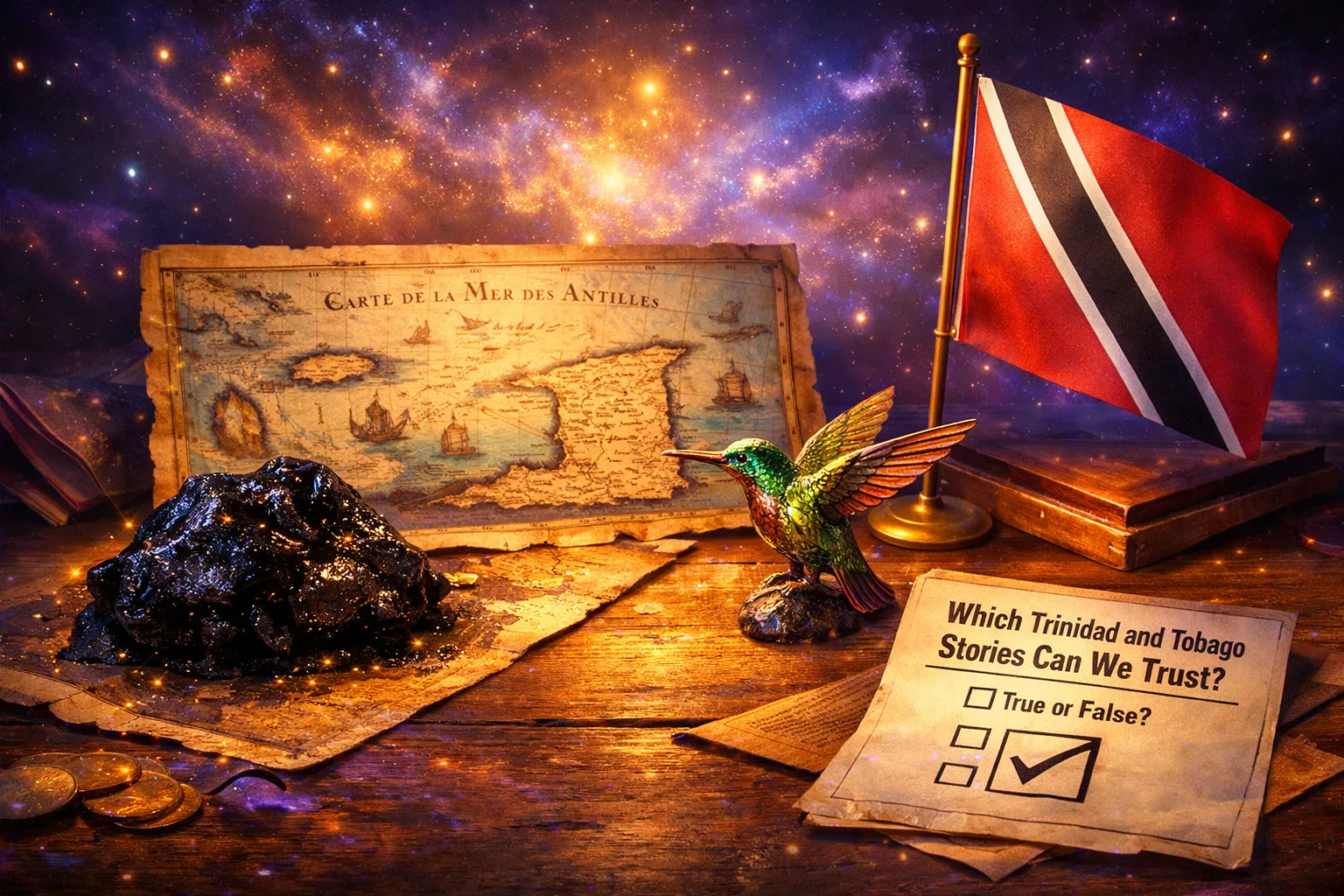
Which Trinidad and Tobago Stories Can We Trust?
Trinidad and Tobago does not have a single, universally recognised “great national hoax” comparable with Piltdown Man or the Cardiff Giant.
Page outline Jump by section
Introduction
These stories do not all belong in the same moral category. The Pitch Lake’s tale of a village swallowed for killing sacred hummingbirds is folklore, not necessarily fraud. Tobago’s claim to be Robinson Crusoe’s island is an arguable literary tradition rather than a straightforward deception. By contrast, confidence tricks involving supposed supernatural powers and covert attempts to manipulate voters are deliberate. Understanding the differences matters, because calling every doubtful story a hoax can obscure how legends, advertising, political propaganda and calculated fraud actually work.
The Pitch Lake legend: folklore presented as history
Visitors to the Pitch Lake at La Brea are often told that an Indigenous community was swallowed by the earth after its people killed and ate sacred hummingbirds. In the most familiar version, the birds carried the spirits of the people’s ancestors. A winged god punished the offence by opening the ground and engulfing the entire settlement in pitch.
The story is deeply embedded in descriptions of the site. Lake Asphalt of Trinidad and Tobago recounts it as the “Colibrie Bird Legend”; the National Library and Information System Authority identifies it as one of two traditional explanations for the lake; and Trinidad and Tobago’s submission placing the Pitch Lake on UNESCO’s tentative World Heritage list repeats the account as a legend associated with Indigenous significance.[trinidadlakeasphalt.com]trinidadlakeasphalt.comThe Colibrie (Humming) Bird LegendThis legend is about the Chima Indians, a tribe which existed on the very spot where the present lake o…
What changes the story is geology. The Pitch Lake is not the residue of a suddenly destroyed village. It is a natural deposit of bitumen associated with petroleum rising through faults, losing its lighter components and leaving heavier asphalt near the surface. Its physical origin therefore belongs to geology, while the hummingbird narrative belongs to oral tradition and later heritage interpretation.[Wikipedia]WikipediaPitch LakePitch Lake
The distinction sounds obvious, yet public retellings sometimes blur it. Archaeological discoveries in or around the pitch have occasionally been used to make the swallowing episode sound like a remembered disaster rather than a sacred explanation of an unusual landscape. Finding Indigenous objects near a place occupied and used by Indigenous communities, however, does not establish that an entire village was supernaturally engulfed.
It would be misleading to call the legend itself a fraud. Origin stories commonly explain striking natural formations through moral events, divine punishment or ancestral memory. The questionable step occurs when a story whose surviving form is legendary is marketed as if it were a verified historical report. That transformation benefits tourism because a lake of asphalt becomes not merely a geological wonder but the scene of a lost people’s catastrophe.
The tale also illustrates a wider problem in Caribbean heritage writing. European travellers, colonial administrators, tourism promoters and later popular authors frequently recorded, reshaped or standardised stories described as “Indian legends”. Once the wording was printed on signs, in guidebooks and on institutional websites, repetition gave it an appearance of documentary certainty. The result is not necessarily an invented tale, but a tradition whose exact age, authorship and transmission are much less secure than confident retellings imply.
Was Tobago really Robinson Crusoe’s island?
Tobago has long cultivated an association with Daniel Defoe’s Robinson Crusoe. The island has a Crusoe Cave, tourism material has described its forests and beaches through the novel, and advocates have argued that Tobago’s position near Trinidad and the mouth of the Orinoco fits the geography given in the book. The claim was being publicly debated by at least the late nineteenth and early twentieth centuries; a 1927 Trinidad publication was devoted to the question, “Is Tobago Robinson Crusoe’s island?”[HathiTrust]catalog.hathitrust.orgHathi Trust Catalog Record: Is Tobago Robinson Crusoe's island?Is Tobago Robinson Crusoe's island?: (Reprint from the Trinidad guardian, February 20, 1927) Published [Trinidad]: Printed by the Trini…
There is a genuine basis for the connection. Defoe places Crusoe’s unnamed island off the northern coast of South America, near the Orinoco and within sight or knowledge of Trinidad. Tobago is therefore a more convincing match for the fictional island’s Caribbean location than the Pacific island on which the Scottish sailor Alexander Selkirk was marooned.[Wikipedia]WikipediaRobinson CrusoeRobinson Crusoe
But matching the geography is not the same as proving that Defoe modelled the island specifically on Tobago. Selkirk’s survival in the Juan Fernández archipelago was only one of several castaway narratives available to Defoe. Literary historians have also identified other possible influences, including the experiences of Henry Pitman and earlier accounts of marooned sailors. The novel combines real travel knowledge, existing survival stories, religious allegory and invention rather than reproducing one man’s experience on one identifiable island.[Wikipedia]WikipediaRobinson CrusoeRobinson Crusoe
The popular formulation that Tobago is “the real Robinson Crusoe island” therefore promises more certainty than the evidence allows. Tobago resembles Defoe’s stated setting; Selkirk supplied a famous castaway parallel; neither fact establishes a single real-world original. Even the Chilean island now named Robinson Crusoe Island acquired that name in 1966, partly to promote the literary association and tourism. The supposedly rival claims are both later acts of cultural branding attached to a fictional place.[National Geographic]nationalgeographic.comrobinson crusoe alexander selkirk historyrobinson crusoe alexander selkirk history
This is best understood as an invented or elaborated tradition, not a malicious hoax. Local writers and tourism promoters gained a memorable identity for Tobago, while travellers gained the pleasure of standing in a landscape that seemed to make a famous novel tangible. The claim survives because it is plausible enough to resist a simple debunking: Defoe’s island is imaginary, but its described location really does point towards the waters around Trinidad, Tobago and Venezuela.
The “Do So!” campaign and the politics of hidden persuasion
The most internationally significant deception connected with modern Trinidad and Tobago is the alleged “Do So!” campaign during the 2010 general election. The account became famous after the collapse of Cambridge Analytica and its parent company, Strategic Communication Laboratories, or SCL.
According to company material and later testimony, political consultants working for an unnamed client sought to discourage young people—particularly young Afro-Trinidadians—from voting. The proposed mechanism was not an ordinary party advertisement. It was a youth movement apparently independent of formal politics, using the slogan “Do So!” to present abstention as fashionable resistance to the established political system. Because young Afro-Trinidadians were expected to favour the People’s National Movement more than SCL’s client, reducing their participation could confer an electoral advantage without openly persuading them to support another party. The episode was discussed during the British Parliament’s investigation into disinformation and SCL’s overseas election work.[UK Parliament]publications.parliament.ukOpen source on parliament.uk.
The deceptive element lay in disguised sponsorship. A message that appeared to come from frustrated young citizens was allegedly designed by professional political strategists. This technique is often called “astroturfing”: an organised campaign made to look like a grassroots movement. Its power comes from social identification. Young people may reject an instruction from a political party but accept the same behaviour when it appears to be emerging from music, street culture and their own peers.
Cambridge Analytica later presented Trinidad and Tobago as a successful demonstration of its methods. Yet the company had strong commercial reasons to magnify its influence. Its executives sold clients the idea that data analysis, psychological profiling and covert campaigning could transform elections. Journalists and scholars have repeatedly warned that its claims of near-magical electoral power were difficult to verify and sometimes rested heavily on the company’s own promotional accounts. Even footage of executives discussing entrapment, false identities and fabricated material did not prove that every tactic they described had actually been carried out; some statements may have been salesmanship or boasting.[WIRED]wired.comCambridge Analytica Execs Caught Discussing Extortion and Fake NewsCambridge Analytica Execs Caught Discussing Extortion and Fake News
That uncertainty does not make the Trinidad episode unimportant. The available evidence supports serious concern that consultants promoted politically useful disengagement while hiding the interests behind it. What remains harder to establish is the campaign’s precise scale and effect. The claim that “Do So!” decisively changed the election is much weaker than the claim that voter suppression was discussed or attempted.
The episode contains two overlapping forms of manipulation. The first is the disguised campaign itself. The second is Cambridge Analytica’s later mythology about its own power. Political influence firms benefit when prospective clients believe they possess secret methods capable of controlling whole populations. A campaign can therefore become a sales legend even when its measurable influence is uncertain.
Supernatural fear as a commercial confidence trick
Belief in spirits, spiritual healing or ritual practice should not automatically be treated as deception. Trinidad and Tobago’s religious landscape includes traditions that colonial authorities historically grouped under the label “obeah”, often criminalising practices they did not understand or approve of. Research on obeah prosecutions shows that the law blurred distinctions between religion, healing, feared magic, unlicensed medicine and fraud.[JSTOR]jstor.orgOpen source on jstor.org.
Fraud enters when a person knowingly manufactures a danger and then sells the supposed cure. In 2018, Newsday investigated a “black magic” scheme in which leaflets advertised protection from witchcraft, evil spirits, obeah and negative energy. One reported victim said she had paid increasing sums after being frightened into believing that supernatural harm threatened her or her family. Police and immigration officials were reportedly alerted as concerns grew about people distributing such offers in commercial districts.[Trinidad and Tobago Newsday]newsday.co.ttTrinidad and Tobago Newsday'Black magic' scamTrinidad and Tobago Newsday'Black magic' scam
The structure resembles an ordinary confidence trick:
- The promoter identifies a private anxiety—illness, relationship trouble, business failure or unexplained misfortune.
- The anxiety is redefined as evidence of a hidden curse or hostile spiritual action.
- The promoter claims exclusive ability to diagnose and remove it.
- An initial payment leads to further discoveries, rituals and escalating demands.
- Any setback becomes proof that the danger is stronger than first believed.
This mechanism is effective because it makes disconfirmation difficult. If nothing bad happens, the ritual supposedly worked. If something does happen, the victim is told that more intervention is needed. The promoter controls both the diagnosis and the interpretation of every outcome.
The important boundary is conduct, not culture. A healer who sincerely offers a religious service is not equivalent to a fraudster who fabricates threats, guarantees impossible results or repeatedly extracts money through fear. Historical anti-obeah laws often failed to respect that boundary, treating marginalised religions themselves as inherently fraudulent. Modern sceptical analysis should avoid repeating the same mistake.
How social media turned rumours into instant accusations
Older hoaxes often required a newspaper, a stage show or an official-looking document. Digital rumours require only a photograph, a voice note and a request to “share urgently”. Trinidad and Tobago’s compact social networks can make such posts especially potent: a face or name may quickly reach colleagues, relatives and neighbours.
A stark example appeared in 2017 when a woman said that social media had “ruined” her life after users circulated her photograph and wrongly associated her with criminal activity. A rumour begun by one person was repeatedly shared, acquiring credibility through volume rather than evidence.[Trinidad and Tobago Newsday]archives.newsday.co.ttTrinidad and Tobago Newsday Fake newsTrinidad and Tobago Newsday Fake news
False security alerts follow a similar pattern. Bomb threats, invented kidnappings and warnings about supposed child abductors exploit situations in which responsible people feel that they cannot risk ignoring the message. Trinidad and Tobago police have repeatedly investigated threats that proved false; officials have stressed that hoax calls consume emergency resources and can carry severe criminal penalties.[Trinidad and Tobago Newsday]newsday.co.ttOpen source on newsday.co.tt.
These rumours spread because they combine three persuasive features:
- Urgency: recipients are told that delay could cost a life.
- Local detail: a school, shopping centre, vehicle or neighbourhood makes the message feel verifiable.
- Moral pressure: forwarding is presented as public service, while hesitation feels irresponsible.
The same design makes corrections less successful. The original warning is vivid and emotional; the later denial is procedural and dull. Screenshots continue circulating after the initial post has been deleted, and old warnings can reappear with new locations attached.
Not every false message begins as a calculated hoax. Some arise from misunderstanding, misidentification or a report that was unverified when first circulated. Responsibility changes, however, when users add invented details, attach an uninvolved person’s photograph, or continue sharing after police, relatives or credible news organisations have corrected the claim.
Why national legends and deliberate hoaxes feel alike
The Pitch Lake story, Tobago’s Crusoe identity, an occult confidence trick and an astroturf political campaign are very different phenomena. They resemble one another because each creates a persuasive bridge between something familiar and something difficult to verify.
At the Pitch Lake, a strange natural formation is connected to a morally complete story of offence and punishment. In Tobago, recognisable geography links a real island to a fictional castaway. In a spiritual scam, genuine misfortune is attributed to an invisible hostile force. In covert campaigning, authentic youth disillusionment is channelled through a movement whose sponsorship is concealed.
Authority then stabilises the claim. A legend printed by an institution feels historical. A cave named after Crusoe feels like physical evidence. A spiritual adviser’s confidence sounds like expertise. A political movement that appears in songs, graffiti and social media looks popular because its many expressions conceal a single organising hand.
The strongest investigations work by separating layers that have been bundled together:
- What can be physically or historically demonstrated?
- What is known only through later retelling?
- Who first put the claim into circulation?
- Did promoters disclose their interests?
- What would count as evidence against the claim?
- Who gained money, attention, political advantage or tourist value from its acceptance?
These questions avoid the crude conclusion that believers were simply gullible. People usually accept doubtful claims because the stories fit existing knowledge, fears or identities and arrive through sources they have reason to trust.

What the surviving cases reveal
Trinidad and Tobago’s history of hoaxes is less a cabinet of spectacular forged monsters than a history of uncertain boundaries. Folklore can be mistakenly hardened into fact. Tourism can turn literary speculation into local heritage. Political advertising can disguise itself as rebellion. Spiritual language can conceal an escalating payment scam. A social-media warning can begin as confusion and end as a deliberate false accusation.
The most useful lesson is therefore not that every colourful story should be discarded. The hummingbird legend remains culturally meaningful even though it does not explain the Pitch Lake’s geology. Tobago’s Crusoe tradition can enrich the island’s literary identity without proving that Defoe copied a particular beach or cave. Religious practice deserves respect while coercive fraud deserves exposure.
A genuine hoax suppresses information that audiences need in order to judge it: the source of a campaign, the construction of an artefact, the financial motive of a promoter or the absence of evidence behind an accusation. Trinidad and Tobago’s contested stories become clearest when that hidden interest is restored—and when legend, honest error and deliberate deception are no longer treated as the same thing.
Amazon book picks
Further Reading
Books and field guides related to Which Trinidad and Tobago Stories Can We Trust?. Use these as the next step if you want deeper reading beyond the article.
The Demon-Haunted World
Rating: 4.5/5 from 43 Google Books ratings
Helps readers distinguish folklore, propaganda, fraud and evidence-based history.
A Short History of Nearly Everything
Provides context for how scientific evidence is established and myths are challenged.
How We Know What Isn't So
Rating: 4.0/5 from 6 Google Books ratings
Explains why persuasive but inaccurate stories spread.
The Skeptic's Guide to the Universe
Useful framework for assessing doubtful historical and modern claims.
eBay marketplace picks
Marketplace Samples
Live-tested eBay searches with available results related to this page.


Endnotes
1.
Source: trinidadlakeasphalt.com
Link:https://trinidadlakeasphalt.com/history/the-colibrie-humming-bird-legend/
Source snippet
The Colibrie (Humming) Bird LegendThis legend is about the Chima Indians, a tribe which existed on the very spot where the present lake o...
2.
Source: whc.unesco.org
Link:https://whc.unesco.org/en/tentativelists/5645/
Source snippet
UNESCO World Heritage CentreLa Brea Pitch LakeAfter a victory over a rival tribe, the tribe got carried away with its celebration, cookin...
3.
Source: Wikipedia
Title: Pitch Lake
Link:https://en.wikipedia.org/wiki/Pitch_Lake
4.
Source: catalog.hathitrust.org
Title: Hathi Trust Catalog Record: Is Tobago Robinson Crusoe’s island?
Link:https://catalog.hathitrust.org/Record/000485149
Source snippet
Is Tobago Robinson Crusoe's island?: (Reprint from the Trinidad guardian, February 20, 1927) Published [Trinidad]: Printed by the Trini...
Published: February 20, 1927
5.
Source: Wikipedia
Title: Crusoe Cave
Link:https://en.wikipedia.org/wiki/Crusoe_Cave
6.
Source: Wikipedia
Title: Robinson Crusoe
Link:https://en.wikipedia.org/wiki/Robinson_Crusoe
7.
Source: Wikipedia
Link:https://en.wikipedia.org/wiki/Tobago
8.
Source: Wikipedia
Title: Robinson Crusoe Island
Link:https://en.wikipedia.org/wiki/Robinson_Crusoe_Island
9.
Source: publications.parliament.uk
Link:https://publications.parliament.uk/pa/cm201719/cmselect/cmcumeds/363/36309.htm
10.
Source: wired.com
Title: Cambridge Analytica Execs Caught Discussing Extortion and Fake News
Link:https://www.wired.com/story/cambridge-analytica-execs-caught-discussing-extortion-and-fake-news
11.
Source: jstor.org
Link:https://www.jstor.org/stable/24488181
12.
Source: Wikipedia
Title: Cambridge Analytica
Link:https://en.wikipedia.org/wiki/Cambridge_Analytica
13.
Source: publications.parliament.uk
Title: uk Disinformation and ‘fake news’: Final Report
Link:https://publications.parliament.uk/pa/cm201719/cmselect/cmcumeds/1791/1791.pdf
14.
Source: committees.parliament.uk
Title: uk Oral evidence
Link:https://committees.parliament.uk/oralevidence/7803/html/
15.
Source: cambridge.org
Link:https://www.cambridge.org/core/books/cultural-politics-of-obeah/obeah-in-the-courts-18901939/DC36F64021BD8B2FFDFED90CD9CF9CEF
16.
Source: nationalgeographic.com
Title: robinson crusoe alexander selkirk history
Link:https://www.nationalgeographic.com/culture/article/robinson-crusoe-alexander-selkirk-history
17.
Source: newsday.co.tt
Title: Trinidad and Tobago Newsday’Black magic’ scam
Link:https://newsday.co.tt/2018/07/21/black-magic-scam/
18.
Source: archives.newsday.co.tt
Title: Trinidad and Tobago Newsday Fake news
Link:https://archives.newsday.co.tt/2017/03/15/fake-news/
19.
Source: newsday.co.tt
Link:https://newsday.co.tt/page/5173/?search=
20.
Source: newsday.co.tt
Title: tech expert be wary of ai use in election campaigning
Link:https://newsday.co.tt/2025/03/23/tech-expert-be-wary-of-ai-use-in-election-campaigning/
Additional References
21.
Source: nalis.gov.tt
Link:https://www.nalis.gov.tt/blog/winer-postcard-collection-the-la-brea-pitch-lake/
Source snippet
The belief in this case surrounds the Chaima's victory over a rival tribe. They got carried away during...Read more...
22.
Source: transatlantic-cultures.org
Title: robinson crusoe circulacao e apropriacoes de uma trama transatlantica
Link:https://www.transatlantic-cultures.org/en/catalog/robinson-crusoe-circulacao-e-apropriacoes-de-uma-trama-transatlantica
Source snippet
Robinson CrusoeDaniel Defoe drew on the real story of the Scottish sailor Alexander Selkirk (1676-1721) to write Robinson Crusoe. Selkirk...
23.
Source: youtube.com
Link:https://www.youtube.com/watch?v=536iqFgNFic
Source snippet
UNC's Rodney Charles Denies Involvement In Cambridge Analytica Scandal...
24.
Source: youtube.com
Title: UNC’s Rodney Charles Denies Involvement In Cambridge Analytica Scandal
Link:https://www.youtube.com/watch?v=Ap_IgU8OXLI
Source snippet
National Security Minister's Press Conference On Cambridge Analytica...
25.
Source: youtube.com
Title: National Security Minister’s Press Conference On Cambridge Analytica
Link:https://www.youtube.com/watch?v=tzPFV7gzG1k
Source snippet
I FOUND A FAMOUS CAVE IN TOBAGO | HIDDEN ATTRACTIONS...
26.
Source: youtube.com
Title: I FOUND A FAMOUS CAVE IN TOBAGO | HIDDEN ATTRACTIONS
Link:https://www.youtube.com/watch?v=9thfBAd_7qo
Source snippet
Tobago (travel-documentary from the season "Caribbean Moments")...
27.
Source: coloradohistoricnewspapers.org
Link:https://www.coloradohistoricnewspapers.org/?a=d&d=KEN19200924-01.2.33
28.
Source: instagram.com
Link:https://www.instagram.com/p/DatJBhDGdEB/
29.
Source: facebook.com
Link:https://www.facebook.com/ttgovcommunications/posts/fake-news-the-ministry-of-finance-mof-wishes-to-inform-the-public-that-the-video/713790797701511/
30.
Source: facebook.com
Link:https://www.facebook.com/otptt/posts/-public-advisory-fake-social-media-profiles-the-office-of-the-president-wishes-t/1379597427534729/
Topic Tree
Follow this branch
Related pages 192
- Albanian Hoaxes
- Algerian Hoaxes
- Antigua Deceptions
- Argentina Hoaxes
- Armenian Hoaxes
- +187 more in sidebar