How False Stories Took Hold in Angola
Angola does not have a neat catalogue of celebrated museum forgeries or home-grown newspaper hoaxes.
Page outline Jump by section
Introduction
These cases matter because they show several different ways falsehood acquires credibility. Official-looking paperwork can fool experts. A real government restriction can be exaggerated into a total prohibition. Authentic photographs can be selected or miscaptioned until they tell a misleading story. Fake online personalities can manufacture the appearance of public enthusiasm. An invented animal can borrow plausibility from a distant place that many readers know little about. Angola’s history of contested truth is therefore less a parade of amusing tricks than a study of authority, colonial power, war, weak information access and the speed with which a simplified story can outrun a complicated reality.
The banknotes that were real but unauthorised
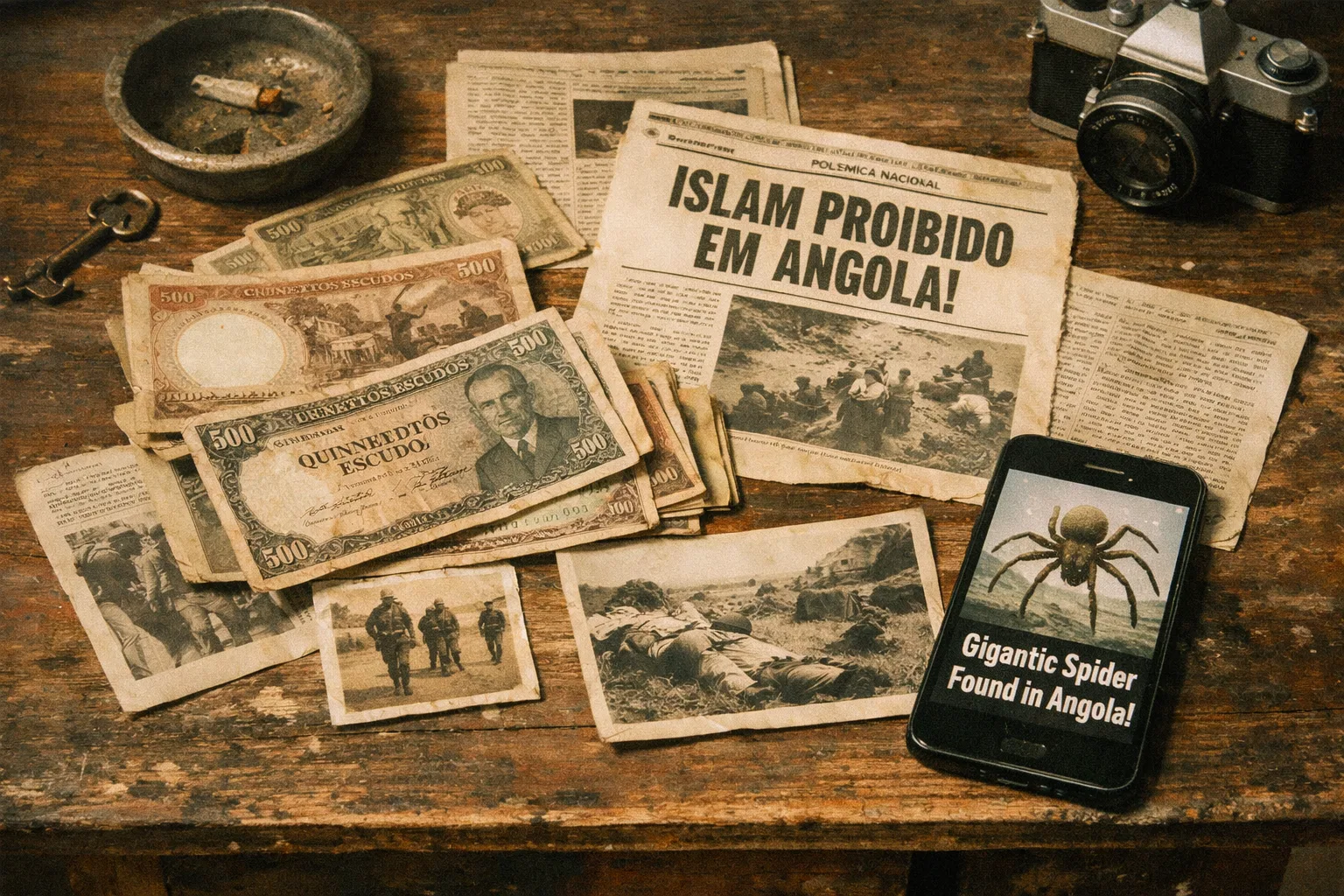
The most extraordinary fraud associated with Angola began not with counterfeit printing plates but with forged permission. In 1925, Portuguese fraudster Artur Alves Reis persuaded a respectable British security printer, Waterlow & Sons, that he was acting on a confidential mission authorised by the Bank of Portugal. His documents claimed that a special issue of banknotes was needed to finance development in colonial Angola.
Reis forged contracts and official endorsements, then exploited the deference normally shown to notarised papers, diplomatic certifications and apparently confidential state business. Waterlow printed genuine-quality 500-escudo notes using the legitimate design and machinery. The paper, ink and workmanship were authentic. What was false was the authority to order them. This distinction initially made the fraud unusually difficult to detect: the notes were not crude imitations but unauthorised duplicates of legal currency.[bhsportugal.org]bhsportugal.orgThe British Historical Society of PortugalMarch 24, 2020 — At last Alves Reis' run of luck had ended and the whole enormous fraud began to unravel, with great consequences for Por…
Angola was central to the story Reis told. He claimed the money would be overprinted for colonial circulation and used to support an international development loan. The supposed secrecy of colonial finance helped explain why ordinary procedures could not be followed. “Angola” was therefore more than a geographical label: it was the plot device that made irregularity appear official.
The conspirators established the Bank of Angola and Metropole, issued cheap loans and invested in property and commercial ventures. Reis had earlier used fraudulent cheques to gain control of the troubled Ambaca railway company in Angola, and in 1925 he travelled through the colony presenting himself as an energetic financier with ambitious development plans. His apparent wealth and generosity helped create the reputation required to keep the larger deception moving.[Wikipedia]WikipediaAlves dos ReisAlves dos Reis
The scheme collapsed after journalists and bankers became suspicious of a new institution that lent lavishly without an obvious deposit base. Investigators eventually found notes bearing duplicate serial numbers. Once the Bank of Portugal contacted Waterlow, the bewildering truth emerged: both sets of notes had been printed by an authorised contractor, but only one had been lawfully ordered. Reis was arrested in December 1925 and later sentenced to 20 years’ imprisonment.[Wikipedia]WikipediaAlves dos ReisAlves dos Reis
The fraud succeeded because every participant checked only a portion of the chain. Printers saw certified documents. Diplomats authenticated signatures rather than the underlying transaction. Investors saw visible wealth. Borrowers saw easy credit. Colonial development provided a plausible explanation for secrecy and exceptional treatment. The case remains a powerful example of institutional fraud: the deception did not defeat bureaucracy by avoiding it, but by feeding each institution the paperwork it expected to see.
It is sometimes described simply as a Portuguese counterfeiting scandal. That understates Angola’s role. The colony supplied the alleged purpose of the currency, the name of Reis’s bank, part of his personal business history and the promise of profits that made the fiction persuasive. Angola was not merely where the money was supposedly going; it was the respectable imperial project behind which the entire operation hid.

Cassinga and the battle over what photographs proved
On 4 May 1978, South African forces attacked Cassinga in southern Angola, where the South West Africa People’s Organisation, or SWAPO, maintained a camp during the Namibian independence struggle. Hundreds were killed. Almost immediately, opposing sides presented sharply different accounts. South Africa described an important military headquarters and logistical base. SWAPO and the Angolan government presented Cassinga primarily as a refugee camp and the attack as a massacre of civilians.
This is not a case in which historians uncovered one simple fabricated event. Cassinga contained military personnel, installations and weapons, but it also housed civilians, dependants, recent arrivals and people performing administrative or support roles. The precise division between combatants and non-combatants remains disputed. The deception history lies in how evidence was managed, selected and framed rather than in a wholly invented battle.[scielo.org.za]scielo.org.zaOpen source on scielo.org.za.
South African military planners prepared a media strategy intended to defend the operation and counter anticipated accusations of civilian killing. Accounts of that strategy describe soldiers being instructed to photograph evidence useful to the South African case, including bodies shown near weapons, while avoiding images of suffering that might undermine it. Such selective photography does not necessarily make an individual image fake. It can nevertheless create a deceptive record by controlling what the audience is allowed to see.[SciELO]scielo.org.zaOpen source on scielo.org.za.
SWAPO and its supporters circulated photographs of mass graves and presented those killed as refugees and civilians. These images became central to international memory of Cassinga and to Namibia’s later national commemorations. Yet photographs of bodies could not, by themselves, establish the former status of every victim or settle whether the site was a civilian camp, a military base or both. Historian Christian Williams’s research into the photographs and the camp’s administration shows why Cassinga resists a tidy binary description.[SciELO]scielo.org.zaOpen source on scielo.org.za.
The responsible conclusion is not that “both sides lied” in equal measure or that the deaths were somehow unreal. South Africa had invaded Angola, and the United Nations Security Council condemned the attack. Large numbers of people were killed, including civilians. The narrower lesson is that wartime images often arrive already packaged with a claim about who is visible, what happened immediately before the photograph and what the picture should prove.[SciELO]scielo.org.zaOpen source on scielo.org.za.
Cassinga still circulates through rival labels such as “battle”, “raid” and “massacre”. Each term directs attention towards a different part of the event. The case demonstrates how propaganda can operate without fabricating every fact: it may instead isolate genuine details, suppress inconvenient ones and turn a complicated place into a single politically useful category.
The persistent claim that Angola banned Islam
In November 2013, reports spread internationally that Angola had become the first country to ban Islam and was demolishing every mosque. The claim generated outrage and was repeatedly revived on blogs and social media, often alongside photographs said to show destroyed Angolan mosques.
The sweeping version was false. Angola’s government denied banning Islam, and later fact-checks found that viral images used as proof came from other countries or unrelated incidents. AFP documented recycled photographs of damaged buildings and protests that did not establish an Angolan prohibition. The claim continued circulating years after the original denials because each new post presented the pictures as fresh confirmation.[reuters.com]reuters.comAngola defends barring Islamic groups, denies persecutionAngola defends barring Islamic groups, denies persecution
Yet the story did not arise from nothing. At the time, no Islamic organisation had obtained formal legal recognition under Angola’s restrictive registration system. Authorities had closed some mosques or prevented construction, usually citing registration, planning or land issues. A 2013 United States religious-freedom report recorded the destruction of a mosque in Luanda’s Zango neighbourhood and presented conflicting accounts of whether the community had lawfully acquired the site. Christian organisations also faced closures under the same regulatory framework, although Muslim communities argued that the rules effectively made recognition impossible for a small minority faith.[Reuters]reuters.comAngola defends barring Islamic groups, denies persecutionAngola defends barring Islamic groups, denies persecution
The misinformation worked by collapsing three different propositions into one:
- Muslim organisations lacked formal recognition.
- Authorities had closed or demolished particular places of worship.
- Islam itself had been nationally outlawed.[Wikipedia]WikipediaIslam in AngolaIslam in Angola
The first two had factual support, though their fairness and legal justification were disputed. The third was the dramatic but unsupported leap. That leap made the story easier to share because “country bans religion” is simpler and more emotionally powerful than an account of registration thresholds, planning disputes and uneven enforcement.
The case also shows why an official denial does not automatically settle every underlying issue. Angola had not enacted a blanket ban on Islamic belief, but Muslim communities faced genuine restrictions. A good debunking therefore has to correct the false headline without erasing the circumstances that made it seem believable. Saying merely “nothing happened” would be as misleading as repeating the ban story.
The hoax persists because old pictures are easily detached from their origins, while the qualifying evidence is cumbersome. A photograph of a ruined building appears self-explanatory; a legal distinction between prohibition, non-recognition and administrative closure does not. The result is a recurring internet legend built around real discrimination concerns but inflated into a claim the evidence cannot sustain.

Fake voices in Angola’s elections
Political deception in Angola increasingly takes the form of manipulated quotations, sockpuppet accounts and coordinated amplification rather than a single famous forged document. During the 2022 general election, political parties and supporters circulated false or altered statements attributed to leading candidates. Observers also reported suspicious accounts that boosted engagement with official ruling-party material, creating the appearance of spontaneous popularity.[Freedom House]freedomhouse.orgfreedom netfreedom net
A sockpuppet is an account that conceals the identity or organisational connection of the person controlling it. Several such accounts acting together can manufacture an illusion of consensus: the same argument appears to come from many ordinary citizens, even when a campaign team, contractor or activist network is coordinating it. The deception is not only in the content of a post but in the false identity of the speaker and the false impression of how widely a view is held.
The 2022 contest was particularly vulnerable to these methods. It was Angola’s closest election since the introduction of multiparty voting, with the governing Popular Movement for the Liberation of Angola facing a strengthened opposition led by the National Union for the Total Independence of Angola. High political stakes, unequal access to traditional media and extensive use of Facebook and messaging platforms created strong incentives to control the online narrative.[Time]time.comAngola Is Bracing for Its Most Competitive Election EverMPLA's domination began post-independence from Portugal and was cemented after winning the civil war against UNITA, which ended in 2002…
Some misleading posts worked by altering or inventing quotations from candidates. Others used memes, clipped video and ridicule to compress political claims into material that could be understood and forwarded in seconds. This “meme-fication” blurs the line between joke, partisan commentary and factual assertion. A false quotation can be dismissed as humour when challenged but continue influencing readers who encounter it without the correction.
The important distinction is between normal political persuasion and deceptive representation. Parties are entitled to promote themselves and criticise opponents. The line is crossed when an actor invents an opponent’s words, disguises campaign material as independent opinion or uses fake identities to simulate public support.
Angola’s response has introduced another contested question: who gets to decide what counts as false information? In May 2026, parliament approved a law against false information on the internet, supported by the governing party and opposed by the main opposition. Critics argued that broad definitions and enforcement powers could be used against legitimate criticism rather than narrowly targeted at demonstrable fraud.[VerAngola]verangola.netLaw against “fake news” passed in a final vote with UNITA voting against itLaw against “fake news” passed in a final vote with UNITA voting against it
This tension is central to modern hoax history. Disinformation can damage elections, but laws written to suppress it can also grant authorities power to label inconvenient reporting “fake”. The most reliable safeguards are therefore not simply criminal penalties. They include transparent evidence, independent journalism, disclosed political advertising, scrutiny of coordinated accounts and corrections that remain accessible after the excitement of an election has passed.
The “Angolan witch spider” that never lived in Angola
One of the internet’s most memorable alleged Angolan creatures was a spider supposedly large enough to cover the side of a house and eat cats and dogs. The photograph circulated under names including the “Angolan witch spider”, “giant Hawaiian cane spider” and “Australian cattle spider”. Its location and species changed according to the audience.
The image was a digital composite. Artist and musician Paul Santa Maria had photographed an ordinary wolf spider in Florida and enlarged it against the exterior of a house as a joke. After the picture was copied from his social-media page, unknown users added invented zoological details and alarming stories about pets, migration and gunshots.[hoaxes.org]hoaxes.orgOpen source on hoaxes.org.
Nothing in the original prank connected the spider to Angola. The country was attached later, apparently because a distant location and an ominous invented name made the story sound like a report about an exotic species rather than an obvious photographic joke. The same picture’s ability to become Hawaiian, Australian, Colombian or Angolan shows how little the caption depended on the image itself.
The manipulation was also visually efficient. A real spider and a real house were combined with a crude change of scale. Viewers did not need to understand specialist zoology to feel that the result was frightening. Once the image had attracted attention, fabricated details supplied the missing narrative: where it came from, what it ate and how it was killed.
Calling it an “Angolan” hoax requires care. It was not created in Angola, did not depict an Angolan animal and appears to have been named by unidentified internet users abroad. It belongs on an Angola page because the country’s identity was used as part of the deception. The case reveals a recurring feature of online monster stories: unfamiliar countries are treated as blank spaces onto which impossible wildlife can be projected.
What Angola’s deception stories have in common
These episodes differ in scale and seriousness. Reis’s scheme destabilised a banking system. Cassinga concerned the representation of mass death. The Islam-ban claim distorted a real dispute over religious rights. Electoral sockpuppets interfered with democratic debate. The giant spider was a joke that escaped its original setting.
They nevertheless share several mechanisms.
Authority can be forged. Reis did not need to manufacture convincing money by hand; he manufactured the documents that persuaded an authorised printer to do the work.
A partial truth can support a much larger falsehood. Mosque closures and legal restrictions helped the false “total ban” claim appear credible.
Selection can deceive without altering the object. A genuine wartime photograph may still mislead when its caption, timing or surrounding images are controlled.
Identity is part of the evidence. Fake political accounts deceive readers about who is speaking and how much support a message possesses.
Distance encourages invention. The spider story depended on audiences accepting “Angola” as a place where an impossible creature might plausibly remain unknown.
The strongest lesson is that exposure rarely consists of spotting one obvious fake. It requires checking the full chain: who produced the material, who supplied the caption, what part of the claim is documented, what has been omitted and which institution benefits from the preferred version. In Angola’s most durable deception stories, the false element often survives precisely because it is attached to something real—an official printer, an actual photograph, a demolished building, a genuine political conflict or an ordinary spider.
Amazon book picks
Further Reading
Books and field guides related to How False Stories Took Hold in Angola. Use these as the next step if you want deeper reading beyond the article.
The Demon-Haunted World
Rating: 4.5/5 from 43 Google Books ratings
Provides tools for evaluating extraordinary claims and false stories.
King Leopold's Ghost
Provides colonial African context relevant to regional narratives and power structures.
eBay marketplace picks
Marketplace Samples
Live-tested eBay searches with available results related to this page.
Endnotes
1.
Source: bhsportugal.org
Title: The British Historical Society of Portugal
Link:https://www.bhsportugal.org/uploads/fotos_artigos/files/AlvesReisBanknoteScandal.pdf
Source snippet
March 24, 2020 — At last Alves Reis' run of luck had ended and the whole enormous fraud began to unravel, with great consequences for Por...
Published: March 24, 2020
2.
Source: Wikipedia
Title: Alves dos Reis
Link:https://en.wikipedia.org/wiki/Alves_dos_Reis
3.
Source: scielo.org.za
Link:https://www.scielo.org.za/scielo.php?pid=S0259-01902010000100011&script=sci_arttext
4.
Source: journals.ufs.ac.za
Link:https://journals.ufs.ac.za/index.php/jch/article/download/3936/3579/7513
Source snippet
THE EFFECT OF THE 1978 CASSINGA RAID ON...Abstract. The article analyses the importance of the South African. Defence Force's attack on...
5.
Source: Wikipedia
Title: Battle of Cassinga
Link:https://en.wikipedia.org/wiki/Battle_of_Cassinga
6.
Source: reuters.com
Title: Angola defends barring Islamic groups, denies persecution
Link:https://www.reuters.com/article/lifestyle/angola-defends-barring-islamic-groups-denies-persecution-idUSBRE9AS0JP/
7.
Source: factcheck.afp.com
Title: no these pictures are not evidence angola banning islam
Link:https://factcheck.afp.com/no-these-pictures-are-not-evidence-angola-banning-islam
8.
Source: time.com
Title: Angola Is Bracing for Its Most Competitive Election Ever
Link:https://time.com/6207676/angola-elections-2022/
Source snippet
MPLA's domination began post-independence from Portugal and was cemented after winning the civil war against UNITA, which ended in 2002...
9.
Source: verangola.net
Title: Law against “fake news” passed in a final vote with UNITA voting against it
Link:https://www.verangola.net/va/en/052026/Politics/48891/Law-against-%E2%80%9Cfake-news%E2%80%9D-passed-in-a-final-vote-with-UNITA-voting-against-it.htm
10.
Source: hoaxes.org
Link:https://hoaxes.org/photo_database/image/angolan_witch_spider
11.
Source: snopes.com
Title: false giant hawaiian cane spider
Link:https://www.snopes.com/fact-check/false-giant-hawaiian-cane-spider/
12.
Source: snopes.com
Link:https://www.snopes.com/
13.
Source: journals.ufs.ac.za
Link:https://journals.ufs.ac.za/index.php/jch/article/view/3936
14.
Source: facebook.com
Link:https://www.facebook.com/groups/239499183293331/posts/592476324662280/
15.
Source: facebook.com
Link:https://www.facebook.com/WaltonNYLibrary/posts/the-cardiff-giant-was-a-10-foot-tall-gypsum-statue-that-became-one-of-the-most-f/1384003660431294/
16.
Source: facebook.com
Link:https://www.facebook.com/groups/320499045629956/posts/1631693584510489/
17.
Source: facebook.com
Title: statement by floyd shivambu on the alleged links to vbs13 october 2018ever since
Link:https://www.facebook.com/paballo.tsotsotso.5/posts/statement-by-floyd-shivambu-on-the-alleged-links-to-vbs13-october-2018ever-since/2246005499010803/
18.
Source: facebook.com
Link:https://www.facebook.com/AfricaCheck/posts/-thats-a-wrapover-the-past-few-months-africa-check-has-joined-the-iec-sanef-mdda/1451544723665918/
19.
Source: facebook.com
Link:https://www.facebook.com/BeAmazedMedia/posts/fake-internet-photos-you-thought-were-realtheres-lots-of-fake-news-and-fake-info/1745864618908070/
20.
Source: facebook.com
Link:https://www.facebook.com/snopes/photos/false-giant-hawaiian-cane-spidera-photograph-purportedly-showing-a-giant-hawaiia/792086600935861/
21.
Source: facebook.com
Link:https://www.facebook.com/BeAmazedMedia/videos/fake-internet-photos-you-thought-were-real/187505003161301/
22.
Source: facebook.com
Link:https://www.facebook.com/nicky/posts/it-was-only-during-this-expedition-to-angola-that-i-discovered-the-uv-fluorescen/10162504233856441/
23.
Source: facebook.com
Link:https://www.facebook.com/WKRCTV/posts/scientists-exploring-a-remote-region-of-angola-have-discovered-dozens-of-species/1444119651095579/
24.
Source: facebook.com
Title: today in 1978 we remember about 600 namibian women men and children killed in ca
Link:https://www.facebook.com/MinistryofIT/posts/today-in-1978-we-remember-about-600-namibian-women-men-and-children-killed-in-ca/4174056739312338/
25.
Source: Wikipedia
Title: Islam in Angola
Link:https://en.wikipedia.org/wiki/Islam_in_Angola
26.
Source: Wikipedia
Title: Unusual articles
Link:https://en.wikipedia.org/wiki/Wikipedia%3AUnusual_articles
27.
Source: hoaxes.org
Link:https://hoaxes.org/photo_database
28.
Source: hoaxes.org
Link:https://hoaxes.org/photo_database/fulltext/P120
29.
Source: portugal.com
Title: the portuguese scandal that changed the country forever
Link:https://www.portugal.com/history-and-culture/the-portuguese-scandal-that-changed-the-country-forever/
30.
Source: pmgnotes.com
Title: the portuguese bank note crisis of 1925
Link:https://www.pmgnotes.com/news/article/7138/the-portuguese-bank-note-crisis-of-1925/
Source snippet
PMG NotesThe Portuguese Bank Note Crisis of 192529 Jan 2019 — Spurious reprints by Artur Virgilio Alves dos Reis... Confidential mission...
31.
Source: freedomhouse.org
Title: freedom net
Link:https://freedomhouse.org/country/angola/freedom-net/2023
32.
Source: freedomhouse.org
Title: FOTN 2023 data for essay and graphics.xlsx
Link:https://freedomhouse.org/sites/default/files/2023-10/FOTN%202023%20data%20for%20essay%20and%20graphics.xlsx
33.
Source: epubs.ac.za
Link:https://epubs.ac.za/index.php/kronos/article/view/1048
Additional References
34.
Source: essential-business.pt
Title: Essential Business Artur Alves dos Reis
Link:https://www.essential-business.pt/2025/12/31/artur-alves-dos-reis-the-man-who-almost-broke-the-bank-of-portugal/
Source snippet
Essential BusinessArtur Alves dos Reis - the man who almost broke the Bank...31 Dec 2025 — With control of the bank, the entire counterf...
35.
Source: onlinelibrary.wiley.com
Link:https://onlinelibrary.wiley.com/doi/pdf/10.1002/9781119039020.ch16
Source snippet
Wiley Online LibraryAlves Dos ReisIn May 1930, Reis (then aged 32) was tried for masterminding the fraud, being convicted and duly senten...
Published: May 1930
36.
Source: youtube.com
Title: The Man Who Found a Loophole to Print $3 Million in REAL Money
Link:https://www.youtube.com/watch?v=66XFmNUwoLM
Source snippet
Bank of Portugal Archives: The Alves Reis Case...
37.
Source: mg.co.za
Link:https://mg.co.za/thought-leader/2025-06-19-does-africa-s-supposed-digital-disadvantage-protect-it-from-election-interference/
38.
Source: instagram.com
Link:https://www.instagram.com/p/DZnuK6nE131/?hl=en
39.
Source: thomasnumismatics.com
Link:https://thomasnumismatics.com/en/blog/alves-dos-reis/?srsltid=AfmBOopRG9VrwsdeveL9kEmNlAF4nJHIXIaJhHUI2FJEtlMTCU-dy8XW
40.
Source: ispionline.it
Link:https://www.ispionline.it/en/publication/angolas-political-earthquake-aftermath-august-2022-elections-36067
41.
Source: intelwatch.org.za
Link:https://intelwatch.org.za/wp-content/uploads/2025/10/IntelWatch-Disinformation-Guide.pdf
42.
Source: cipesa.org
Link:https://cipesa.org/wp-content/files/briefs/report/Disinformation-Pathways-and-Effects-Case-Studies-from-Five-African-Countries-Report-2.pdf
43.
Source: stimson.org
Link:https://www.stimson.org/2022/disinformation-and-democratic-transition-a-kenyan-case-study/
Topic Tree
Follow this branch
Related pages 192
- Albanian Hoaxes
- Algerian Hoaxes
- Antigua Deceptions
- Argentina Hoaxes
- Armenian Hoaxes
- +187 more in sidebar