Within Ukraine Hoaxes
Were Potemkin's Famous Fake Villages Ever Real?
The famous tale of portable fake villages may reveal more about political mythmaking than about what Potemkin actually built.
On this page
- Catherine's Journey Through the South
- What Potemkin Actually Staged
- How a Doubtful Story Became a Global Metaphor
Page outline Jump by section
Introduction
Few historical legends have had a more successful afterlife than the story of the “Potemkin village”. According to the famous tale, Prince Grigory Potemkin built elaborate fake settlements along the route of Empress Catherine II’s 1787 journey through territories that now include much of southern Ukraine, then moved the scenery from place to place to create the illusion of prosperity. The phrase has since entered many languages as a shorthand for any deceptive façade. Yet the striking irony is that the original story appears to be greatly exaggerated and may never have happened in the form usually described. Modern historians generally agree that while Potemkin staged spectacles, decorated settlements and carefully managed what the Empress saw, the image of portable cardboard villages populated by travelling peasants belongs more to political mythmaking than to established fact.[jstor.org]jstor.orgCatherine II Discovers the Crimeaby DM Griffiths · 2008 · Cited by 10 — that the Empress, Potemkin, and Russians in general, were ca…
The legend matters because it shows how a doubtful story can become more influential than the historical events that inspired it. In the lands of present-day Ukraine, where Catherine’s tour took place, the boundary between genuine development, political theatre and later propaganda became blurred. The result was one of history’s most enduring metaphors for deception.
Catherine’s Journey Through the South
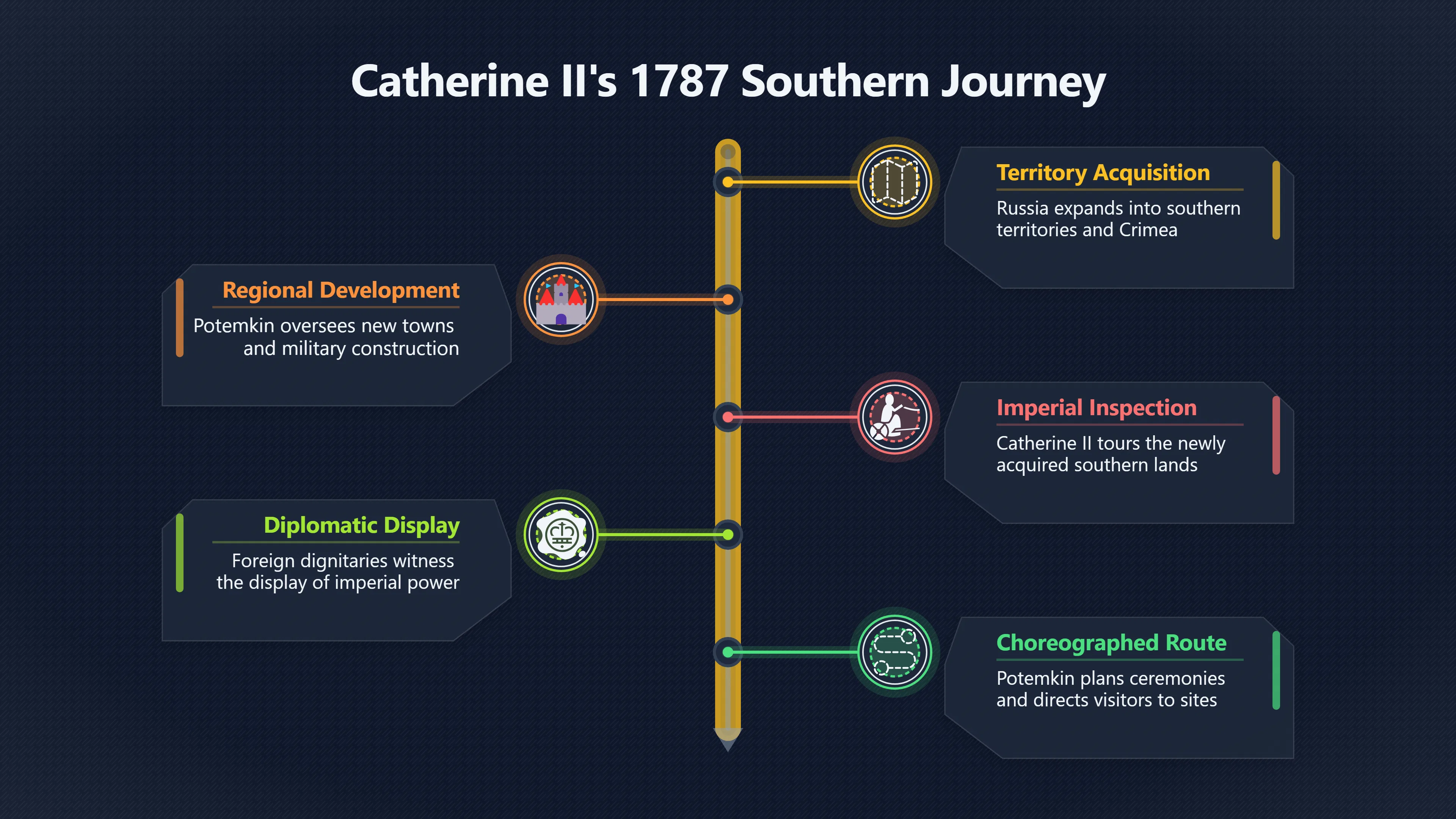
In 1787 Catherine II undertook a lengthy inspection tour of the recently acquired southern territories of her empire, including Crimea and the lands along the Dnieper River. The journey was organised by Potemkin, who governed the region and had overseen colonisation projects, military construction and urban development after Russia’s expansion into the Black Sea area. Foreign diplomats and dignitaries accompanied the Empress, making the voyage an important display of imperial power on the eve of another conflict with the Ottoman Empire.[Wikipedia]WikipediaCrimean journey of Catherine the GreatCrimean journey of Catherine the Great
The southern frontier was not an empty wilderness. New towns such as Kherson and Sevastopol had been founded, ports and fortifications were under construction, and settlers had been encouraged to move into the region. Potemkin had every incentive to showcase these achievements. The journey was therefore highly choreographed. Routes were planned, ceremonies organised and visitors directed towards impressive sites.[Wikipedia]WikipediaGrigory PotemkinGrigory Potemkin
This context is important because later critics often transformed ordinary courtly display into a story of outright fraud. Eighteenth-century rulers routinely arranged tours to emphasise success and conceal embarrassment. The question is not whether Potemkin staged the trip—he clearly did—but whether he fabricated entire villages that existed only as theatrical scenery.
What Potemkin Actually Staged
Most modern scholarship distinguishes between embellishment and invention. Evidence from correspondence, memoirs and contemporary accounts suggests that Potemkin decorated settlements, organised celebrations, improved appearances along the route and ensured that visitors encountered the most favourable examples of development. Historians such as Aleksandr Panchenko and Simon Sebag Montefiore have argued that the famous tale of vast portable fake villages is largely mythical.[Wikipedia]WikipediaPotemkin villagePotemkin village
There are several reasons for scepticism:
- The best-known accounts of the supposed fake villages were written after the journey rather than during it.
- The principal promoter of the story, the Saxon diplomat Georg von Helbig, did not accompany Catherine on the tour.
- Foreign visitors who actually travelled through the region did not describe the elaborate system of movable façades found in later retellings.
- Significant real construction and settlement activity had occurred in the south, making total fabrication unnecessary.[gw2ru.com]gw2ru.comThe Potemkin villages myth EXPOSEDThe myth of 'Potemkin villages' wasn't even written during Catherine's Crimea journey. Georg von H…
This does not mean the journey presented an entirely honest picture. Some historians note that unpleasant sights could be hidden, impoverished areas avoided and temporary decorative features erected. Such practices were common in royal progresses across Europe. The dispute concerns scale. The evidence supports selective presentation and showmanship far more strongly than it supports the legendary image of entire fake communities being repeatedly dismantled and rebuilt ahead of Catherine’s flotilla.[Wikipedia]WikipediaVillage PotemkineVillage Potemkine

How a Doubtful Story Became a Global Metaphor
The legend’s survival owes much to its simplicity. A single vivid image—a ruler fooled by painted scenery—proved more memorable than the complicated reality of frontier development, diplomacy and imperial politics.
The phrase “Potemkin village” emerged from writings by Georg von Helbig in the late eighteenth and early nineteenth centuries. Helbig portrayed Potemkin as a manipulative court favourite whose achievements were exaggerated. His account circulated widely and helped shape European perceptions of both Potemkin and Russia. Over time the story detached itself from the historical figure and became a reusable political metaphor.[wikipedia.org]WikipediaPotemkin villagePotemkin village
Several factors helped the legend spread:
It suited existing prejudices. Many European observers were already inclined to view the Russian Empire as a place of autocratic spectacle and deception. The story confirmed expectations rather than challenging them.[JSTOR]jstor.orgCatherine II Discovers the Crimeaby DM Griffiths · 2008 · Cited by 10 — that the Empress, Potemkin, and Russians in general, were ca…
It was visually powerful. Readers could easily imagine fake villages sliding down a river route ahead of the Empress. The image required no specialised knowledge to understand.[Wikipedia]WikipediaPotemkin villagePotemkin village
It converted a person into a concept. Once the phrase entered common language, people no longer needed to know who Potemkin was. The term survived because it described a broader human tendency: creating appearances that conceal reality.[Wikipedia]WikipediaPotemkin villagePotemkin village
The Afterlife of the Potemkin Village
Today the expression is used far beyond its Ukrainian and eighteenth-century origins. Journalists, historians, politicians and social critics employ it to describe situations where impressive appearances hide weakness, failure or emptiness.
The term has been applied to:
- Model settlements created for visiting dignitaries.
- Carefully managed political tours.
- Showcase institutions that conceal systemic problems.
- Corporate projects that prioritise presentation over substance.
- Legal or bureaucratic structures criticised as elaborate façades.[Wikipedia]WikipediaPotemkin villagePotemkin village
The metaphor became especially influential during the twentieth century, when critics frequently used it to describe propaganda displays and showcase projects in authoritarian states. Historians have even written about the “myth of the Soviet Potemkin village”, examining how the metaphor shaped Western interpretations of Soviet society. In many cases the phrase was deployed without any reference to the disputed historical origins of the story itself.[histoire.ens.fr]histoire.ens.frThe Myth of the Soviet Potemkin VillageThe Myth of the Soviet Potemkin Village
This is one reason the legend belongs in any history of famous deceptions. Even if the original fraud was overstated or imaginary, the belief in it generated a powerful cultural tool for describing other kinds of deception.
A Legend About Deception That May Be Deceptive
The most intriguing aspect of the Potemkin village story is that it resembles many other enduring historical myths. It contains a memorable villain, a dramatic act of deception and a moral lesson about appearances. Those qualities helped it survive despite weak evidence for its most famous details.
Modern historians do not generally argue that Catherine saw an unvarnished reality. Potemkin undoubtedly organised an elaborate display and sought to impress his sovereign and foreign guests. Yet the evidence increasingly suggests that the traditional image of entire fake villages populated by transported actors is a later exaggeration. What survives most clearly is not the deception itself but the story about the deception.[jstor.org]jstor.orgCatherine II Discovers the Crimeaby DM Griffiths · 2008 · Cited by 10 — that the Empress, Potemkin, and Russians in general, were ca…
In that sense, the Potemkin village legend is a fitting subject for the history of hoaxes and contested truths. The phrase remains one of the world’s favourite ways of describing a false appearance, even though the historical event that supposedly created it may itself be largely a product of rumour, rivalry and repetition.[wikipedia.org]WikipediaPotemkin villagePotemkin village
Amazon book picks
Further Reading
Books and field guides related to Were Potemkin's Famous Fake Villages Ever Real?. Use these as the next step if you want deeper reading beyond the article.
Catherine The Great
Provides essential context for Catherine's southern tour and Potemkin.
The Romanovs
Provides broader imperial context for narratives associated with Ukraine.
Russia in the Age of Catherine the Great
Examines the political environment behind the story.
eBay marketplace picks
Marketplace Samples
Live-tested eBay searches with available results related to this page.

Endnotes
1.
Source: jstor.org
Link:https://www.jstor.org/stable/41052102
Source snippet
Catherine II Discovers the Crimeaby DM Griffiths · 2008 · Cited by 10 — that the Empress, Potemkin, and Russians in general, were ca...
2.
Source: Wikipedia
Title: Potemkin village
Link:https://en.wikipedia.org/wiki/Potemkin_village
3.
Source: Wikipedia
Title: Village Potemkine
Link:https://fr.wikipedia.org/wiki/Village_Potemkine
4.
Source: Wikipedia
Title: Crimean journey of Catherine the Great
Link:https://en.wikipedia.org/wiki/Crimean_journey_of_Catherine_the_Great
5.
Source: Wikipedia
Title: Grigory Potemkin
Link:https://en.wikipedia.org/wiki/Grigory_Potemkin
6.
Source: gw2ru.com
Link:https://www.gw2ru.com/history/70034-potemkin-villages-myth-exposed
Source snippet
The Potemkin villages myth EXPOSEDThe myth of 'Potemkin villages' wasn't even written during Catherine's Crimea journey. Georg von H...
7.
Source: histoire.ens.fr
Title: The Myth of the Soviet Potemkin Village
Link:https://histoire.ens.fr/IMG/file/Coeure/David-Fox%20Potemkin%20villages.pdf
8.
Source: globalsecurity.org
Title: potemkin village
Link:https://www.globalsecurity.org/military/world/russia/potemkin-village.htm
Source snippet
Global SecurityPotemkin Village5 Dec 2018 — The myth of "Potemkin villages" is a myth, and not a reliably established fact. In 1786, Grig...
9.
Source: rbth.com
Title: 331767 potemkin villages myth exposed
Link:https://www.rbth.com/history/331767-potemkin-villages-myth-exposed
Source snippet
Russia BeyondThe Potemkin villages myth EXPOSED2 Mar 2020 — The myth of 'Potemkin villages' wasn't even written during Catherine's Crimea...
10.
Source: wordhistories.net
Title: potemkin village
Link:https://wordhistories.net/2023/05/08/potemkin-village/
Source snippet
word histories'Potemkin village': meaning and origin8 May 2023 — The expression Potemkin village refers to the sham villages said to have...
Published: May 2023
11.
Source: jaakkoj.com
Title: Potemkin village
Link:https://www.jaakkoj.com/concepts/potemkin-village
Additional References
12.
Source: youtube.com
Title: Potemkin, Catherine’s General, Advisor, and Lover
Link:https://www.youtube.com/watch?v=6Gzss-iVd1g
Source snippet
Putin's Potemkin Villages: The Truth About the “Reconstruction” of Occupied Cities | Pani Troyan...
13.
Source: youtube.com
Title: Grigory Potemkin: HOW Catherine’s Favorite Built an Empire of Illusions?
Link:https://www.youtube.com/watch?v=5-PSYOmapRk
Source snippet
POTEMKIN: How he conquered CRIMEA, married CATHERINE — and became a symbol of DECEPTION forever...
14.
Source: amusingplanet.com
Title: modern potemkin villages
Link:https://www.amusingplanet.com/2017/11/modern-potemkin-villages.html
Source snippet
Nov 27, 2017 — The term "Potemkin village" has come to signify any deceptive or false construct meant to deceive others into thinking tha...
15.
Source: youtube.com
Link:https://www.youtube.com/watch?v=cgw_bv4qdGk
Source snippet
What Is A Potemkin Village? - Europe Through the Ages...
16.
Source: youtube.com
Title: What Is A Potemkin Village?
Link:https://www.youtube.com/watch?v=J_j1JSzIGLI
Source snippet
Potemkin, Catherine's General, Advisor, and Lover - Extra History - Part 5...
17.
Source: reddit.com
Link:https://www.reddit.com/r/wikipedia/comments/1npxxwz/a_potemkin_village_is_a_construction_literal_or/
18.
Source: facebook.com
Link:https://www.facebook.com/womeninhistoryworldwide/photos/grigori-alexandrovich-potemkin-was-born-on-september-13-1739-in-chizhovo-a-villa/122135375985000646/
19.
Source: medium.com
Link:https://medium.com/create-change/stop-building-potemkin-villages-c68017f41fcd
20.
Source: medium.com
Link:https://medium.com/%40johnwelford15/what-were-the-potemkin-villages-713610ffd06
21.
Source: facebook.com
Link:https://www.facebook.com/DailyStarNews/posts/the-legend-goes-that-potemkin-would-construct-a-pasteboard-villagecomplete-with-/693841342897148/
Topic Tree