Which Algerian Stories Were Made to Mislead?
Algeria’s most revealing “hoaxes” are not a neat collection of practical jokes.
Page outline Jump by section
Introduction
These episodes matter because they show several different ways falsehood works. Some were deliberate fabrications; others began with real objects or events that were stripped of context, exaggerated or made to serve a political fantasy. In many cases, the misleading version survived because it was simpler, more vivid and more useful than the complicated truth. Algeria’s history of contested images and stories is therefore less about public gullibility than about who controlled cameras, archives, labels and channels of distribution.
The postcards that invented a colonial Algeria
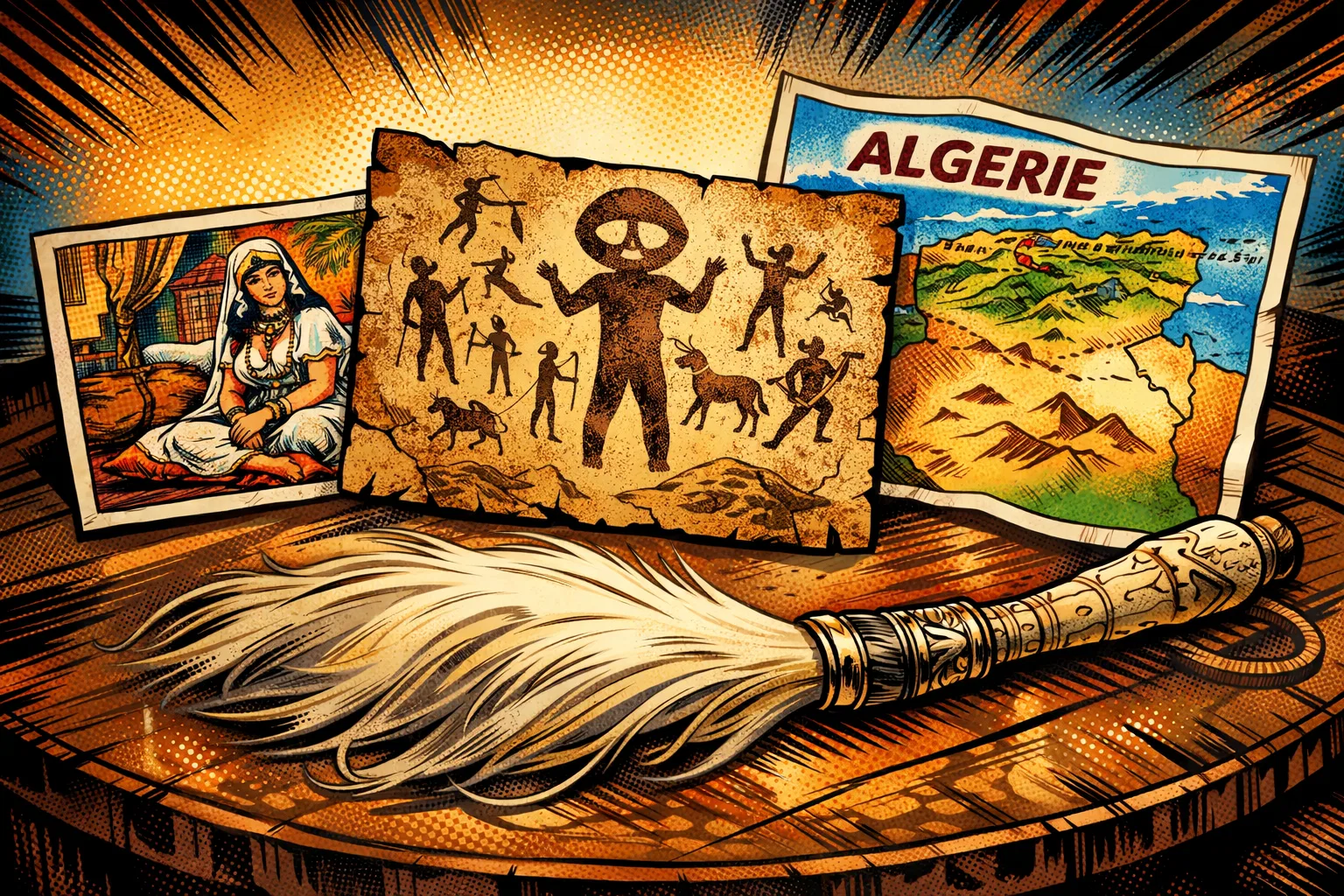
Among the clearest Algerian examples of manufactured reality are the picture postcards of women produced under French colonial rule. Sold as scenes of everyday life, many showed supposedly private interiors, unveiled women, dancers, servants or imagined harems. Their documentary appearance encouraged buyers to treat them as direct glimpses into an otherwise inaccessible society.
The photographs were often carefully staged. Because many Algerian women would not pose for colonial photographers, studios used paid models, costumes, painted backdrops and arranged interiors. The resulting images did not record a hidden social world so much as construct one for European consumers. Algerian writer Malek Alloula later analysed these cards as expressions of a colonial fantasy: women were presented as passive, available and waiting to be viewed, while the photographer’s intervention disappeared from the finished picture.[newyorker.com]newyorker.comThe New Yorker Colonial Postcards and Women as Props for War-MakingFaced with veiled and inaccessible women, photographers hired models to stage these scenes in studios, creating false and exoticized imag…
This was not a conventional hoax with a single inventor and a dramatic confession. It was an industrial form of visual misrepresentation. Publishers, photographers and postcard sellers benefited commercially, while the imagery also supported broader claims that colonial rule was entering a closed, backward or morally suspect society. The pictures looked persuasive because photography was widely treated as mechanical evidence, even when every visible detail had been selected and arranged.
Alloula’s interpretation has itself prompted debate. Scholars have questioned whether one explanatory model can account for every colonial postcard or every woman who appeared in one. Some models may have exercised agency within restrictive circumstances, and postcard conventions varied between colonies. Yet these qualifications do not restore the images as transparent records. They underline the need to ask who commissioned a photograph, how it was staged, what caption accompanied it and which audience was expected to buy it.[ORA]ora.ox.ac.ukORARecycling the 'Colonial Harem'?Women in postcards from…by J Yee · 2004 · Cited by 46 — This article analyses a selection of postcards of women from France's Indochin…
The lasting deception is not merely that particular scenes were artificial. It is that repeated studio fantasies came to stand for Algeria itself. The same problem survives online when old colonial photographs circulate without dates, production histories or warnings that they were commercial performances rather than candid ethnography.
When Tassili’s rock art became aliens and magic mushrooms
Tassili n’Ajjer, in the Algerian Sahara, contains one of the world’s greatest concentrations of prehistoric rock art. UNESCO records more than 15,000 paintings and engravings documenting changing environments, animals and human life over thousands of years. The art is real, archaeologically important and often visually extraordinary. The questionable claims arose from what later interpreters said the figures represented.[UNESCO World Heritage Centre]whc.unesco.orgUNESCO World Heritage CentreTassili n'AjjerLocated in a strange lunar landscape of great geological interest, this site has one of the mo…
French explorer Henri Lhote helped bring Tassili’s paintings to an international audience after expeditions in the 1950s. Faced with large, round-headed human figures, he used dramatic descriptions including the “great Martian god”. The language was partly playful and speculative, but popular writers detached it from archaeological caution. The figures subsequently entered ancient-astronaut literature as apparent portraits of helmeted extraterrestrials.[Wikipedia]WikipediaHenri LhoteHenri Lhote
Nothing in the paintings requires an alien explanation. Stylised heads, masks, ceremonial dress and unfamiliar artistic conventions are ordinary features of rock art. Interpreting an ancient image by asking what it resembles to a modern viewer is especially hazardous: a circle can become a space helmet only after the viewer has already introduced space travel into the story. Archaeological interpretations instead compare style, surrounding figures, animals, superimposition and environmental history.
A second claim presents some Tassili figures as the earliest evidence of psychedelic mushroom rituals. It became especially popular through late twentieth-century writing on altered states of consciousness. Certain shapes held by or surrounding human figures were identified as mushrooms, while dancing or patterned bodies were interpreted as evidence of shamanic intoxication. Alternative readings have included plants, weapons, tools, abstract signs or composite human-animal forms. There is no agreed identification, and even the dates and visual details used in popular retellings are often stated with more confidence than the evidence permits.[Wikipedia]WikipediaTassili Mushroom FigureTassili Mushroom Figure
The problem was amplified by reproduction. A widely circulated “mushroom shaman” image is not a direct photograph of an untouched wall but a modern drawing made from a published photograph, with damaged or unclear areas reconstructed. Each stage — ancient painting, field copy, photograph, redrawing and online reposting — created opportunities for ambiguous marks to become cleaner and more suggestive.[Wikipedia]WikipediaTassili Mushroom FigureTassili Mushroom Figure
There are also serious concerns about early documentation methods. Later criticism of Lhote’s work has alleged copying errors, misleading claims, damage caused during recording and even questionable additions among the material associated with the expeditions. These disputes do not make Tassili itself fake. They show how an authentic heritage site can accumulate unreliable copies and sensational interpretations around it.[Wikipedia]WikipediaHenri LhoteHenri Lhote
The alien and mushroom stories endure because they offer immediate recognition. “Ritual figure of uncertain meaning” is archaeologically responsible but less memorable than “prehistoric astronaut” or “ancient psychedelic ceremony”. Tassili demonstrates a common mechanism in pseudoarchaeology: the mystery is genuine, but certainty is manufactured.
Did a fly-whisk really cause the French invasion?
A famous account of Algeria’s colonisation says that France invaded because Hussein Dey, the ruler of Algiers, struck French consul Pierre Deval with a fly-whisk in April 1827. The incident occurred, but treating it as the true cause of the 1830 invasion turns a complicated political confrontation into a misleading national legend.
The quarrel concerned substantial unpaid French debts linked to grain supplied through merchants in Algiers, as well as diplomatic disputes, maritime conflict and contested territorial privileges. During a heated audience, Hussein Dey struck or touched Deval several times with the fly-whisk. France demanded satisfaction, broke relations and imposed a naval blockade. Three years later, French forces invaded.[encyclopedia.com]encyclopedia.comfly whisk incident 1827fly whisk incident 1827
The deceptive element lies in the compression of cause and pretext. French political leaders did not suddenly conceive a North African expedition because a consul had been insulted. The government of Charles X was dealing with domestic instability, strategic ambitions and a blockade that had failed to force Algiers into submission. The affront provided a highly communicable justification: national honour had been violated and required redress.[Cambridge University Press & Assessment]cambridge.orgOpen source on cambridge.org.
This kind of story works because a small physical gesture is easier to picture than years of debts, diplomatic manoeuvring and Mediterranean power politics. It also personalises responsibility. Instead of an invasion emerging from decisions made in Paris, the simplified version makes colonisation appear to have been provoked by one ruler losing his temper.
Calling the fly-whisk story wholly fabricated would be wrong. It is better understood as a real episode converted into a political origin myth. The event supplied the image; official rhetoric and later retelling supplied the exaggerated causal importance. Its persistence is a reminder that propaganda often does not invent an incident from nothing. It selects one true detail and makes it carry a historical weight it cannot bear.

The “Bleuite”: forged evidence that turned fighters against each other
During the Algerian War of Independence, false information was used not simply to persuade the public but to manipulate armed organisations from within. The most notorious example is commonly known as the “Bleuite”, an operation associated with French intelligence officer Paul-Alain Léger and networks of captured or turned National Liberation Front personnel.
French operatives infiltrated communication channels, circulated rumours and planted documents that appeared to identify supposed traitors inside the independence movement. The aim was to intensify existing fears of penetration. Because clandestine organisations depended on secrecy, aliases and compartmentalised information, a convincing accusation could be difficult to disprove. Suspicion itself became a weapon.[routledge.com]routledge.comOpen source on routledge.com.
The operation was effective because it did not ask its targets to believe an entirely new world. French forces really were seeking informers, arresting militants and turning some prisoners. Documents could be captured; networks could be compromised. Forged evidence therefore entered an environment in which betrayal was both possible and potentially fatal.
Purges followed in parts of the National Liberation Army. The precise scale and attribution remain debated, partly because accounts emerged from participants, military memoirs and archives produced by opposing institutions. Nevertheless, historians broadly recognise that French psychological warfare cultivated internal distrust and that forged documents and false allegations contributed to violence among nationalists.[routledge.com]routledge.comOpen source on routledge.com.
The Bleuite was not a public hoax in the manner of a forged newspaper story. It was a closed-system deception intended for selected recipients, with lethal consequences. Its central lesson is that disinformation succeeds most readily when it fits a genuine vulnerability. The forged papers did not create the possibility of infiltration; they exploited the fact that infiltration was already feared.
It also complicates the comforting idea that exposure always defeats a hoax. In wartime, discovering that some allegations were fabricated did not automatically restore trust. Once comrades had accused, tortured or killed one another, the deception had altered relationships permanently.
How Algerian images acquire false lives online
Digital misinformation involving Algeria often uses authentic material rather than sophisticated fabrication. A photograph or video is removed from its original date and place, then supplied with a new caption designed to match a breaking news event. The image appears to prove the claim because viewers are seeing a real crowd, fire or explosion-like light in the sky.
One recurring example is footage of flares and fireworks set off by supporters of Mouloudia Club d’Alger. In 2024, videos from the club’s anniversary celebrations in Algiers were falsely presented as scenes of Iranian attacks on Israel. Fact-checkers traced older uploads, matched visible landmarks and obtained confirmation from the football club. The pictures were genuine; the alleged event was not.[Reuters]reuters.comVideos of Algerian soccer club celebrations misrepresented as IsraelVideos of Algerian soccer club celebrations misrepresented as Israel
The same technique has been applied to Algerian political imagery. A large demonstration photographed in Algiers in March 2019, during protests against President Abdelaziz Bouteflika’s proposed re-election, was later shared as evidence of a mass revolt against pandemic restrictions. The claim was disproved through the photograph’s publication history and the simple chronological fact that it predated Algeria’s first confirmed coronavirus case.[Poynter]poynter.orgOpen source on poynter.org.
These cases show why “reverse image” investigation is so useful. Fact-checkers look for the earliest available upload, compare buildings and road layouts, examine weather and lighting, identify logos or banners and contact organisations visible in the footage. A clip’s emotional effect may be immediate, but its actual meaning depends on provenance: who first recorded it, where, when and for what purpose.
Algeria’s multilingual online environment adds further complications. Information moves between formal Arabic, Algerian speech, French, English and mixed forms, sometimes losing qualifications or satire in translation. Recent research datasets devoted to Algerian and North African misinformation find that emotionally charged wording and mixed-language social-media styles can help false narratives travel, while verification tends to use more literal and evidence-focused language.[arXiv]arxiv.orgOpen source on arxiv.org.
Modern miscaptioned videos resemble the colonial postcard in one important respect. Both depend on viewers mistaking an image for self-explanatory evidence. The technology has changed from printed cards to social platforms, but the basic trick remains: conceal the circumstances of production, add a persuasive label and let the audience complete the story.
What Algeria’s famous deceptions have in common
The strongest Algerian cases fall into different categories and should not be blurred together. The colonial postcards were staged commercial images with political meaning. The extraterrestrial Tassili story is largely speculative interpretation attached to authentic archaeology. The fly-whisk narrative is an oversimplified explanation built around a real incident. The Bleuite involved deliberate operational forgery. Online examples frequently use genuine footage under false captions.
Despite these differences, several recurring mechanisms connect them:
- Authority supplies credibility. A colonial photographer, explorer, military officer, newspaper or widely followed account can make a weak claim appear established.
- A true fragment anchors the false story. There was a fly-whisk confrontation, prehistoric rock art exists, the football celebrations happened and infiltration during the war was real.
- Missing context does much of the work. The deception becomes persuasive when the studio, date, location, motive or chain of custody disappears.
- The most vivid explanation beats the most careful one. Aliens, secret rituals and insult-driven invasions are easier to repeat than uncertain iconography or diplomatic history.
- Exposure cannot fully retrieve the original meaning. Staged postcards remain visually influential, copied rock-art images remain detached from their source, and corrected videos continue to circulate under new captions.
The safest approach is not to dismiss every strange Algerian story, but to classify it properly. Was something fabricated, staged, mislabelled, sincerely misinterpreted or simplified for political use? Who controlled the first version? What evidence links the surviving image or document to its claimed origin? Asking those questions preserves the genuinely extraordinary parts of Algeria’s history while separating them from the stories later imposed upon them.
Amazon book picks
Further Reading
Books and field guides related to Which Algerian Stories Were Made to Mislead?. Use these as the next step if you want deeper reading beyond the article.
The Colonial Harem
Examines how colonial postcards manufactured misleading images of Algerian women.
A Savage War of Peace
Provides context for propaganda, mythmaking and contested narratives in Algerian history.
Photography's Orientalism
Addresses how photography could create persuasive but misleading representations.
eBay marketplace picks
Marketplace Samples
Live-tested eBay searches with available results related to this page.
Endnotes
1.
Source: books.google.com
Title: Books The Colonial Harem
Link:https://books.google.com/books/about/The_Colonial_Harem.html?id=cn2yDHGWrCQC
Source snippet
Google BooksThe Colonial Harem - Malek AlloulaA collection of picture postcards of Algerian women exploited by the French, this album ill...
2.
Source: ora.ox.ac.uk
Title: ORARecycling the ‘Colonial Harem’?
Link:https://ora.ox.ac.uk/objects/uuid%3A8e261339-ae15-4330-9402-2b3658802ea6
Source snippet
Women in postcards from...by J Yee · 2004 · Cited by 46 — This article analyses a selection of postcards of women from France's Indochin...
3.
Source: whc.unesco.org
Link:https://whc.unesco.org/en/list/179/
Source snippet
UNESCO World Heritage CentreTassili n'AjjerLocated in a strange lunar landscape of great geological interest, this site has one of the mo...
4.
Source: Wikipedia
Title: Henri Lhote
Link:https://en.wikipedia.org/wiki/Henri_Lhote
5.
Source: encyclopedia.pub
Link:https://encyclopedia.pub/entry/33990
6.
Source: Wikipedia
Title: Tassili Mushroom Figure
Link:https://en.wikipedia.org/wiki/Tassili_Mushroom_Figure
7.
Source: encyclopedia.com
Title: fly whisk incident 1827
Link:https://www.encyclopedia.com/humanities/encyclopedias-almanacs-transcripts-and-maps/fly-whisk-incident-1827
8.
Source: cambridge.org
Link:https://www.cambridge.org/core/journals/historical-journal/article/congress-system-and-the-french-invasion-of-algiers-18271830/8D8850D73C82096E86F5DF097B62F5CB
9.
Source: Wikipedia
Title: French blockade of Algiers
Link:https://en.wikipedia.org/wiki/French_blockade_of_Algiers
10.
Source: routledge.com
Link:https://www.routledge.com/rsc/downloads/France_and_the_Algerian_War_Strategy%2C_Operations_and_Diplomacy.pdf
11.
Source: dokumen.pub
Link:https://dokumen.pub/download/the-algerian-war-and-the-french-army-1954-62-experiences-images-testimonies-134941638x-9781349416387.html
12.
Source: link.springer.com
Link:https://link.springer.com/content/pdf/10.1057/9780230500952.pdf
13.
Source: reuters.com
Title: Videos of Algerian soccer club celebrations misrepresented as Israel
Link:https://www.reuters.com/fact-check/videos-algerian-soccer-club-celebrations-misrepresented-israel-2024-10-21/
14.
Source: poynter.org
Link:https://www.poynter.org/?ifcn_misinformation=photo-of-a-revolution-against-covid-19-restrictions-in-algeria
15.
Source: arxiv.org
Link:https://arxiv.org/abs/2606.00193
16.
Source: Wikipedia
Link:https://en.wikipedia.org/wiki/Poltergeist
17.
Source: Wikipedia
Title: Fake news
Link:https://en.wikipedia.org/wiki/Fake_news
18.
Source: Wikipedia
Title: Pierre Deval (diplomat)
Link:https://en.wikipedia.org/wiki/Pierre_Deval_%28diplomat%29
19.
Source: Wikipedia
Title: Algerian War
Link:https://en.wikipedia.org/wiki/Algerian_War
20.
Source: Wikipedia
Title: Hussein Dey
Link:https://en.wikipedia.org/wiki/Hussein_Dey
21.
Source: unesdoc.unesco.org
Link:https://unesdoc.unesco.org/ark%3A/48223/pf0000379015
22.
Source: books.google.com
Title: The Search for the Tassili Frescoes
Link:https://books.google.com/books/about/The_Search_for_the_Tassili_Frescoes.html?id=RMZtAAAAMAAJ
23.
Source: newyorker.com
Title: The New Yorker Colonial Postcards and Women as Props for War-Making
Link:https://www.newyorker.com/books/second-read/colonial-postcards-and-women-as-props-for-war-making
Source snippet
Faced with veiled and inaccessible women, photographers hired models to stage these scenes in studios, creating false and exoticized imag...
24.
Source: ora.ox.ac.uk
Link:https://ora.ox.ac.uk/objects/uuid%3Ab0b2a4a4-2c3d-4c48-90f6-d0716691d181/files/m83c5b1e189550fa0c671bf4d0633ae86
Additional References
25.
Source: smarthistory.org
Link:https://smarthistory.org/running-horned-woman-tassili-najjer-algeria/
Source snippet
Running Horned Woman, Tassili n'Ajjer, AlgeriaLhote made African rock art famous by bringing some of the estimated 15,000 hum...
26.
Source: youtube.com
Title: Filming the Algerian Independence War: The legacy of Stevan Labudovic
Link:https://www.youtube.com/watch?v=54uSB0yckHo
Source snippet
Reels of revolution: capturing Algeria's fight for liberation...
27.
Source: ice.gov
Link:https://www.ice.gov/factsheets/cultural-artifacts
28.
Source: youtube.com
Link:https://www.youtube.com/watch?v=JoSaujqMzms
Source snippet
I INVESTIGATED ANCIENT GRAVES MADE BY ALIENS? (ALGERIA)...
29.
Source: youtube.com
Title: Operation Blue: Breaking the Invisible Trap
Link:https://www.youtube.com/watch?v=cjB5Q6H4_bk
Source snippet
Filming the Algerian Independence War: The legacy of Stevan Labudovic...
30.
Source: jstor.org
Link:https://www.jstor.org/stable/303443
Source snippet
Veiled Threats: Malek Alloula's Colonial Haremby L Rice-Sayre · 1986 · Cited by 10 — Malek Alloula's recent book about turn of the c...
31.
Source: youtube.com
Title: I INVESTIGATED ANCIENT GRAVES MADE BY ALIENS? (ALGERIA)
Link:https://www.youtube.com/watch?v=GO-pPNE6YBY
Source snippet
Operation Blue: Breaking the Invisible Trap...
32.
Source: facebook.com
Link:https://www.facebook.com/groups/580933815910224/posts/1334367937233471/
33.
Source: facebook.com
Link:https://www.facebook.com/hespresseng/posts/a-new-report-by-fact-checking-platform-misbar-has-revealed-that-morocco-was-bomb/815437674055502/
34.
Source: instagram.com
Link:https://www.instagram.com/p/DWrjblJjeyf/
Topic Tree
Follow this branch
Related pages 192
- Albanian Hoaxes
- Antigua Deceptions
- Argentina Hoaxes
- Armenian Hoaxes
- Austria Hoaxes
- +187 more in sidebar