How Somalia's Most Persuasive False Stories Spread
Somalia has no single, universally famous hoax comparable with Piltdown Man or the Loch Ness Monster. Its best-documented history of deception is more fragmented and more serious: militant propaganda, fabricated political announcements, false social-media identities, recycled war photographs, fraudulent charity appeals and rumours about disease or famine.
Page outline Jump by section
Introduction
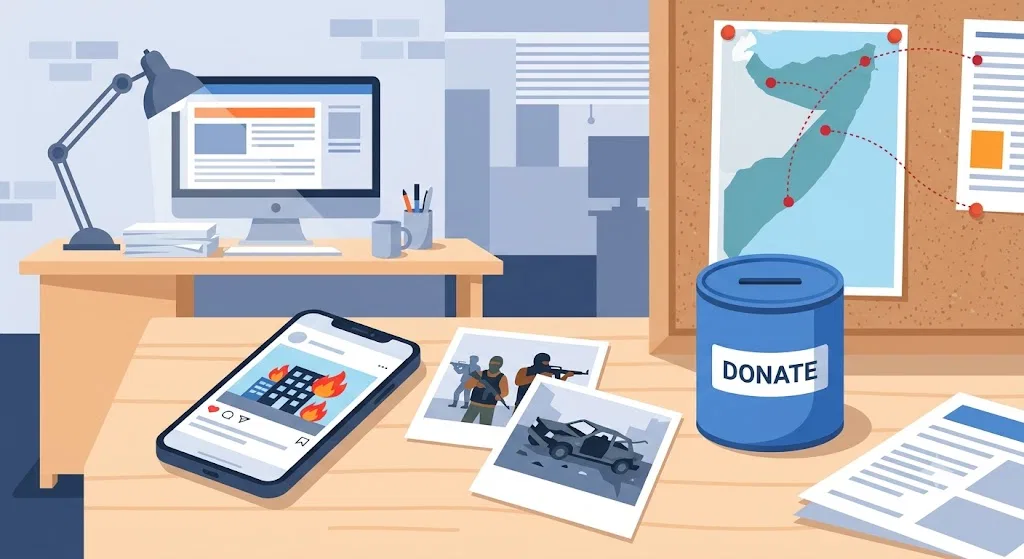
That distinction matters. Somalia has endured civil war, insurgency, drought, displacement and repeated political crises, so alarming claims often sound plausible before they have been checked. A photograph of armed men, a burning building or a starving child may be authentic while its caption is false. In other cases, a seemingly official account or journalist is an impostor. The strongest Somali examples therefore show how modern hoaxes thrive not by fabricating everything, but by mixing truth, uncertainty and urgency in proportions that discourage verification.
Why Somalia produces fewer “classic” hoaxes
The surviving public record is much richer in propaganda and misinformation than in forged antiquities, staged monsters or celebrated practical jokes. That does not mean such episodes never occurred. It means that Somalia’s recent history has left archives scattered, endangered journalists and made the verification of even ordinary events difficult. Media organisations have described an environment in which reporters face intimidation and arrest while false news circulates widely, weakening the institutions that would normally record and expose hoaxes in detail.[Free Press Unlimited]freepressunlimited.orgFree Press Unlimited SomaliaFree Press UnlimitedSomaliaMarch 30, 2021 —… journalists have only a low level of professionalism and lack a favourable working enviro…
It is also important not to label every disputed report a deliberate hoax. Some false claims begin as mistakes, mistranslations or hurried assumptions. Others are propaganda: selective or deceptive communication intended to advance a political or military cause. Still others are frauds designed to obtain money. The most useful way to understand Somalia’s deception history is therefore to ask what the claim was trying to achieve.
Three mechanisms recur:
- Borrowed evidence: an authentic photograph or video is assigned a false location, date or event.
- Borrowed authority: an unofficial account, fabricated journalist or partisan outlet imitates a trusted source.
- Borrowed suffering: genuine images of hunger, war or illness are reused to attract donations, outrage or political support.
These methods work especially well when the underlying subject is already credible. Somalia really has suffered famine, militant attacks and political violence. The deception lies in attaching real fears to the wrong evidence.
When real photographs acquire false stories
A market fire became an intelligence-service attack
In March 2024, a large fire broke out in Mogadishu’s Bakara market. Video of the blaze was soon circulated with a more dramatic claim: that al-Shabaab had attacked and set fire to the headquarters of Somalia’s National Intelligence and Security Agency. The footage was genuine, but the description was not. AFP established that it showed the market fire, while the intelligence agency confirmed that its offices had not been attacked or burned.[Fact Check AFP]factcheck.afp.comFact Check AFPVideo of market fire misrepresented as blast at Somalia…11 Apr 2024 — A fire broke out in a section of Mogadishu's Bakar…
The case illustrates why recycled or relabelled imagery is so effective. Flames and smoke provide no obvious geographical markers, and an attack on a heavily guarded state building was plausible within Somalia’s security environment. The false caption converted an urban accident into apparent proof that militants could strike the heart of the government’s security apparatus.
Who benefited is harder to establish. Posts of this kind can serve militant prestige, partisan criticism or the simpler commercial logic of online engagement. What can be demonstrated is the mechanism: dramatic footage travelled faster than the location could be checked.
Somali war images repeatedly migrate across borders
Photographs taken in Somalia have also been presented as evidence of unrelated events elsewhere in Africa. A picture of a well-drilling vehicle destroyed by al-Shabaab in southern Somalia in September 2022 was later circulated as an attack in Kenya’s Wajir County. Reverse-image searches and Somali news reports established the original location.[Fact Check AFP]factcheck.afp.comFact Check AFPPhoto of Al-Shabaab attack in Somalia falsely shared as…21 Oct 2022 — A photo shared in multiple social media posts clai…
In another case, a photograph of weapons seized during a 2014 security operation in Mogadishu was reused in Ethiopia in 2021. Posts claimed that the arsenal had recently been captured from forces in the Tigray conflict, although records from the African Union mission in Somalia showed where and when the image had actually been taken.[Fact Check AFP]factcheck.afp.comFact Check AFPThis picture has been online since 2014 and does not…15 Jul 2021 — This photograph shows weapons seized by the African U…
A photograph of the 2016 execution of former journalist Hassan Hanafi Haji in Mogadishu was similarly circulated in Nigeria as supposed evidence that Nigerian soldiers were being executed for demanding better weapons to fight Boko Haram. The picture was real, but an Associated Press caption identified an entirely different country, prisoner and judicial case.[Fact Check AFP]factcheck.afp.comFact Check AFPImage shows execution in Somalia, not a firing squad…27 Aug 2021 — In the past, Nigerian soldiers have indeed been sente…
These examples are not merely amusing caption errors. Each image was inserted into an existing political anxiety: terrorism in Kenya, the Tigray war in Ethiopia or military discontent in Nigeria. Somalia’s conflict imagery became raw material because it already looked like visual shorthand for disorder and violence.
Somalia itself can be falsely pictured
The traffic also runs in the opposite direction. In 2024, a modern city photograph was shared as a view of Mogadishu with the teasing caption that sceptics would call it fake. A fact-check found that the image actually showed Accra, Ghana.[Medium]medium.comFALSE: This image is not of Mogadishu, SomaliaFALSE: This image is not of Mogadishu, SomaliaMarch 27, 2024 — The image was posted on 10 March 2024 alongside the text, “Mogadishu…
This form of misrepresentation has a different emotional appeal. Instead of exaggerating violence, it challenges negative stereotypes by offering apparent proof of an unexpectedly polished urban landscape. The intention may be humorous, patriotic or engagement-driven rather than malicious. Yet it still demonstrates how easily a city can be replaced by another when viewers are unfamiliar with local architecture and landmarks.
Famine imagery and the commerce of compassion
Few subjects attract more dangerous miscaptioning than hunger. Somalia’s 2011 famine killed roughly a quarter of a million people, and later drought emergencies repeatedly raised fears of another catastrophe. Those realities make photographs of severely malnourished children immediately believable when attached to Somalia, even when the image comes from another year or country.[nih.gov]pubmed.ncbi.nlm.nih.govOpen source on nih.gov.
The most famous famine photograph often wrongly associated in casual retellings with Somalia is Kevin Carter’s image of a collapsed child watched by a vulture. It was taken near Ayod in Sudan, now South Sudan, in 1993—not in Somalia. The original newspaper publication and later accounts placed it within the Sudanese famine.[Wikipedia]WikipediaThe Vulture and the Little GirlThe Vulture and the Little Girl
That confusion is revealing. An iconic picture can become detached from the precise conflict it documented and turn into a generic symbol of “African famine”. Somalia’s own association with severe hunger then makes the incorrect attribution seem natural. This is less a planned hoax than a durable cultural error produced by repetition, geographical vagueness and the tendency to treat distinct African crises as interchangeable.
More deliberate deception appears in fraudulent fundraising. Africa Check documented a Facebook appeal that reused photographs of a malnourished refugee child taken in 2011 and attached them to a fabricated medical story seeking donations. The child’s suffering was real; the identity, present circumstances and appeal were not.[Africa Check]africacheck.orgscam alert malnourished refugee child photos 2011 used fakescam alert malnourished refugee child photos 2011 used fake
Such scams exploit an uncomfortable asymmetry. A donor can respond to an emotional image in seconds, while checking the photograph’s origin, the collector’s identity and the destination of the money takes much longer. Old humanitarian photographs are particularly valuable to fraudsters because they look professionally documented and are difficult for ordinary users to trace.
The safest distinction is therefore not between “real” and “fake” pictures. It is between a verified chain of context and an unverified story. A genuine image may still be functioning as the central instrument of a fraud.
Militant propaganda and the battle to define reality
Al-Shabaab has treated media activity as part of its insurgency rather than as an afterthought. Researchers describe an evolving system that moved from sermons and radio towards websites, social platforms and rapid digital distribution. Its communications seek to legitimise the movement, publicise attacks, recruit supporters and portray the Somali government and its allies as weak or illegitimate.[setav.org]setav.orgAl-Shabab's Evolving Media Strategy: Narratives, ToolsAl-Shabab's Evolving Media Strategy: Narratives, Tools
Not every al-Shabaab statement is a fabricated event. Propaganda can involve selective reporting, inflated casualty claims, carefully edited footage or the suppression of evidence that undermines the desired narrative. The deception lies in controlling what the audience sees and how it interprets an event.
This creates a recurring contest after attacks. Militants have an incentive to exaggerate their reach and government forces have an incentive to minimise losses or emphasise successful resistance. Independent confirmation may be delayed because access is dangerous, telecommunications are disrupted and witnesses fear retaliation. In that gap, the first confident narrative can become the most widely repeated one.
Somalia’s authorities have responded by pursuing militant websites and requesting the removal of extremist accounts and material. Reports describe specialised teams identifying online propaganda for action by technology companies. Yet takedowns alone cannot settle disputed facts, particularly when new accounts and channels can be created quickly.[Africa Defense Forum]adf-magazine.comAfrica Defense Forum Somalia Locked in Battle Against Digital ExtremismAfrica Defense Forum Somalia Locked in Battle Against Digital Extremism
The lasting lesson is that propaganda succeeds through speed and narrative coherence. A claim need not survive a forensic investigation if it shapes public understanding during the hours when reliable information is scarce.

Fake identities and counterfeit authority
The unofficial account that looked like a government
A striking recent example involved Somaliland, the self-declared republic that broke from Somalia in 1991 but remains internationally disputed. In March 2026, several major news organisations reported that Somaliland had called for the extradition of Somali-born US representative Ilhan Omar. The stories relied on a social-media account that presented itself as representative of Somaliland but was not an official government channel. Somaliland’s foreign ministry had already warned that the account was unauthorised, and some outlets later corrected their reports.[The Guardian]theguardian.comThe post in question was a reaction to comments by U.S. Senator JD Vance, who accused Omar of immigration fraud during an interview, spar…
The deception was effective because it copied the surface appearance of state authority. A handle, flag, formal tone and confident statement can be enough to pass as an official announcement, particularly when the message fits an existing political controversy.
This was not simply a false rumour spreading among anonymous users. Established publishers repeated it, demonstrating how newsroom haste can convert an impostor account into apparent institutional evidence. The exposure required a basic but essential check: confirmation through the government’s recognised channels.
“Fake journalists” and manufactured consensus
Somali media organisations have also alleged the use of fabricated journalistic identities and coordinated social-media campaigners to attack opponents or intimidate reporters. One 2020 investigation by Horn Observer said documents indicated that individuals posing as journalists were being used in smear and trolling operations linked to the federal government. The allegations should be treated as claims by an independent outlet rather than as a judicially established account, but they fit a wider international pattern in which fictitious personas manufacture the appearance of spontaneous support.[hornobserver.com]hornobserver.comSomalia's govt employed fake journalists to trollSomalia's govt employed fake journalists to troll
A fake journalist offers more than anonymity. The label implies investigation, access and professional judgement. It allows partisan content to arrive disguised as reporting. Networks of such identities can then cite or repeat one another, creating the illusion that numerous independent observers have reached the same conclusion.
Recent research on Somali-language social media confirms the scale of the broader problem. A 2025 study assembled human-annotated datasets of Somali fake news and toxic content and developed a language model specifically for detection. Its authors stressed that automated moderation is particularly difficult in languages with limited training data and fewer specialised digital resources.[arXiv]arxiv.orgOpen source on arxiv.org.
That technical gap has practical consequences. False material in widely resourced languages is more likely to encounter mature moderation tools, established fact-checkers and searchable archives. Somali-language deception can circulate in an environment where fewer systems are equipped to recognise its linguistic and political cues.
Election rumours and the temptation to shut the network
Political authorities sometimes respond to misinformation in ways that create a second problem. During Somaliland’s 2017 presidential election, the electoral commission ordered social-media services blocked until results were declared, saying the restriction was necessary to prevent fake news and rumour-mongering. Human-rights and digital-rights organisations criticised the shutdown as a disproportionate restriction on expression and access to information.[hrw.org]hrw.orgHuman Rights Watch Shuttering Social Media During Somaliland's ElectionsHuman Rights Watch Shuttering Social Media During Somaliland's Elections
The episode exposes a central tension in anti-hoax policy. False reports can inflame an election, particularly where margins are close and trust is fragile. But closing communication channels also obstructs journalists, observers and citizens attempting to correct those reports.
Later election research continued to identify unverified content as a significant risk in Somaliland’s media environment, while noting the importance of cooperation between election officials, information authorities and journalists.[ISIR Think Tank]isirthinktank.comSM Elections REPORT V1SM Elections REPORT V1
The shutdown did not prove that every feared rumour was part of an organised hoax campaign. Rather, it showed that the anticipation of false information can itself change public policy. Fear of deception becomes politically powerful even before the scale or authorship of the deception has been established.
Health rumours that cannot be dismissed as mere foolishness
During the COVID-19 pandemic, Somali health workers encountered rumours about the disease and vaccines in communities already coping with displacement, weak services and distrust of institutions. International organisations reported using community workers and local leaders to answer claims about vaccine safety and the reality of the virus.[IOM Germany]germany.iom.intOpen source on iom.int.
Research among health workers in Somalia found substantial vaccine hesitancy and examined concerns about safety, effectiveness and trust. Other studies found high stated demand for vaccines in some Somali populations, showing that attitudes were not uniform and should not be reduced to a claim that Somalis broadly rejected medical evidence.[PMC]pmc.ncbi.nlm.nih.govOpen source on nih.gov.
The persuasive force of these rumours came from lived experience. Where medical access is inconsistent, official communication is delayed and political institutions are mistrusted, reassurance from distant authorities may carry less weight than testimony from relatives, religious figures or familiar community networks.
Successful responses therefore did more than label claims false. They used trusted local communicators, listened to concerns and explained risks in accessible terms. Surveys of Somali opinion found substantial support for vaccination while also identifying the importance of religious and community framing.[Africa's Voices]africasvoices.orgOpen source on africasvoices.org.
This is an important boundary between hoax history and public-health history. Some vaccine falsehoods are deliberately manufactured, but many people who repeat them are expressing sincere fear. Treating all participants as fraudsters can deepen the distrust that made the rumour persuasive in the first place.

How Somali-linked hoaxes are exposed
The most successful investigations rely on ordinary verification methods rather than dramatic confessions.
Reverse-image searching finds earlier appearances of a photograph and can establish that an alleged recent event actually occurred years before. It exposed the Somali weapons image reused in Ethiopia, the destroyed vehicle relabelled as a Kenyan attack and numerous hunger photographs attached to false locations.[Fact Check AFP]factcheck.afp.comFact Check AFPPhoto of Al-Shabaab attack in Somalia falsely shared as…21 Oct 2022 — A photo shared in multiple social media posts clai…
Original captions and archives restore details lost during reposting. News-agency records identified the person and location in the Mogadishu execution photograph. Belgian archives showed that a colonial-era Congo photograph did not depict Britain’s ambassador to Somalia, despite viral claims to the contrary.[Fact Check AFP]factcheck.afp.comFact Check AFPImage shows execution in Somalia, not a firing squad…27 Aug 2021 — In the past, Nigerian soldiers have indeed been sente…
Direct institutional confirmation distinguishes official statements from impersonation. Contacting the intelligence agency disproved the claim that its headquarters had burned, while checking Somaliland’s recognised foreign-ministry channels exposed the unofficial account behind the Ilhan Omar story.[Fact Check AFP]factcheck.afp.comFact Check AFPVideo of market fire misrepresented as blast at Somalia…11 Apr 2024 — A fire broke out in a section of Mogadishu's Bakar…
Local reporting supplies geographical and political knowledge that distant audiences often lack. Somali outlets can recognise a neighbourhood, vehicle, uniform or faction that an international viewer might accept at face value. Yet those reporters themselves work under pressure, making press freedom part of the infrastructure needed to debunk falsehoods.[The Guardian]theguardian.comSalaad faces charges of "immorality, false reporting, and insulting the armed forces" after suggesting military susceptibility to al-Shab…
What these cases reveal
Somalia’s hoax history is not best understood as a cabinet of eccentric curiosities. It is a study in how evidence is manipulated under conditions of uncertainty. Its most characteristic falsehoods preserve enough reality to survive an initial glance: the fire happened, the weapon existed, the child suffered, the account looked official and the political danger was conceivable.
The people circulating these claims do not all have the same motive. Militants seek legitimacy and fear. Political operators seek advantage or the silencing of criticism. Fraudsters seek donations. Partisan users seek outrage, belonging or online attention. Some ordinary people simply share material they believe to be urgent.
What eventually changes the story is usually provenance: the recoverable history of an image, account or assertion. Where was the photograph first published? Who controls the supposed official channel? Can local witnesses confirm the event? Does the fundraising organisation exist? Has the institution named in the claim issued a statement through a recognised route?
The deeper warning is not that photographs or social media are inherently deceptive. It is that a vivid item of evidence can feel self-explanatory when it is not. Somalia’s documented cases repeatedly demonstrate that the caption, source and chain of transmission may matter more than what appears inside the frame.
eBay marketplace picks
Marketplace Samples
Live-tested eBay searches with available results related to this page.




Endnotes
1.
Source: factcheck.afp.com
Link:https://factcheck.afp.com/doc.afp.com.34P69N6
Source snippet
Fact Check AFPVideo of market fire misrepresented as blast at Somalia...11 Apr 2024 — A fire broke out in a section of Mogadishu's Bakar...
2.
Source: factcheck.afp.com
Link:https://factcheck.afp.com/doc.afp.com.32LT4GE
Source snippet
Fact Check AFPPhoto of Al-Shabaab attack in Somalia falsely shared as...21 Oct 2022 — A photo shared in multiple social media posts clai...
3.
Source: factcheck.afp.com
Link:https://factcheck.afp.com/picture-has-been-online-2014-and-does-not-show-weapons-seized-ethiopias-tigray-region
Source snippet
Fact Check AFPThis picture has been online since 2014 and does not...15 Jul 2021 — This photograph shows weapons seized by the African U...
4.
Source: factcheck.afp.com
Link:https://factcheck.afp.com/doc.afp.com.9LQ2LV
Source snippet
Fact Check AFPImage shows execution in Somalia, not a firing squad...27 Aug 2021 — In the past, Nigerian soldiers have indeed been sente...
5.
Source: medium.com
Title: FALSE: This image is not of Mogadishu, Somalia
Link:https://medium.com/pesa-check/false-this-image-is-not-of-mogadishu-somalia-5c485e3f2d3c
Source snippet
FALSE: This image is not of Mogadishu, SomaliaMarch 27, 2024 — The image was posted on 10 March 2024 alongside the text, “Mogadishu...
Published: March 27, 2024
6.
Source: reliefweb.int
Title: somalia famine 2011 2012
Link:https://reliefweb.int/report/somalia/somalia-famine
7.
Source: Wikipedia
Title: The Vulture and the Little Girl
Link:https://en.wikipedia.org/wiki/The_Vulture_and_the_Little_Girl
8.
Source: setav.org
Title: Al-Shabab’s Evolving Media Strategy: Narratives, Tools
Link:https://www.setav.org/en/al-shababs-evolving-media-strategy-narratives-tools-and-impact
9.
Source: hornobserver.com
Title: Somalia’s govt employed fake journalists to troll
Link:https://hornobserver.com/articles/449/Somalias-govt-employed-fake-journalists-to-troll-journalists-and-smear-political-opponents
10.
Source: arxiv.org
Link:https://arxiv.org/abs/2503.18117
11.
Source: germany.iom.int
Link:https://germany.iom.int/stories/covid-19-misinformation-combatting-harmful-narratives-camps-somalia
12.
Source: pmc.ncbi.nlm.nih.gov
Link:https://pmc.ncbi.nlm.nih.gov/articles/PMC10709303/
13.
Source: factcheck.afp.com
Link:https://factcheck.afp.com/doc.afp.com.32NR9HT
14.
Source: hornobserver.com
Link:https://hornobserver.com/articles/1126/Somalias-health-officials-denied-access-to-journalists-aimed-at-the-COVID19-vaccines
15.
Source: hornobserver.com
Title: Somali Parliament Dismisses anti corruption Bill Urges further Review
Link:https://hornobserver.com/articles/449/Somali-Parliament-Dismisses-anti-corruption-Bill-Urges-further-Review
16.
Source: factcheck.afp.com
Link:https://factcheck.afp.com/doc.afp.com.36KL7D4
17.
Source: factcheck.afp.com
Link:https://factcheck.afp.com/doc.afp.com.37E29T2
18.
Source: factcheck.afp.com
Link:https://factcheck.afp.com/doc.afp.com.32N44F4
19.
Source: factcheck.afp.com
Link:https://factcheck.afp.com/doc.afp.com.92ZQ6CV
20.
Source: factcheck.afp.com
Link:https://factcheck.afp.com/doc.afp.com.9LZ9ZX
21.
Source: facebook.com
Link:https://www.facebook.com/groups/827611048652074/posts/1458079665605206/
22.
Source: facebook.com
Link:https://www.facebook.com/AFPFactCheck/posts/inflammatory-posts-circulating-on-facebook-claimed-popular-music-stars-had-attac/1495043422624536/
23.
Source: facebook.com
Link:https://www.facebook.com/moisomalia/posts/press-releasefederal-government-of-somalia-issues-warning-against-disinformation/999539945628382/
24.
Source: facebook.com
Link:https://www.facebook.com/AddisstandardEng/posts/the-bbc-launches-major-new-research-into-fake-news-published-five-false-stories-/1928992490482070/
25.
Source: facebook.com
Title: certain photographs stay with youfor me one of these is kevin carters photograph
Link:https://www.facebook.com/kateholtphoto/posts/certain-photographs-stay-with-youfor-me-one-of-these-is-kevin-carters-photograph/1720961479554289/
26.
Source: facebook.com
Link:https://www.facebook.com/groups/3662574880668021/posts/4422621681330000/
27.
Source: facebook.com
Title: in 1993 photojournalist kevin carter captured one of the most disturbing images
Link:https://www.facebook.com/trtworld/videos/in-1993-photojournalist-kevin-carter-captured-one-of-the-most-disturbing-images-/2465655593868634/
28.
Source: facebook.com
Link:https://www.facebook.com/theprintindia/posts/somalia-cited-terrorism-fraud-and-impersonation-risks-as-meta-prepares-to-roll-o/1081244757839071/
29.
Source: facebook.com
Link:https://www.facebook.com/UNHCRinNigeria/posts/%EF%B8%8F-stay-alert-to-scamsfake-websites-and-apps-may-falsely-claim-to-represent-unhcr/1231426429093028/
30.
Source: facebook.com
Link:https://www.facebook.com/KOMONews/posts/a-lawmaker-is-calling-on-minnesota-gov-tim-walz-to-explain-a-new-report-involvin/1343891734438729/
31.
Source: facebook.com
Title: the head of the bbc somali services is facing the axe following scandal last mon
Link:https://www.facebook.com/kulanpost/posts/the-head-of-the-bbc-somali-services-is-facing-the-axe-following-scandal-last-mon/4926214967459133/
32.
Source: facebook.com
Link:https://www.facebook.com/ISIRINSTITUTE/posts/study-report-digital-and-social-media-in-somalilands-electoral-landscape-stakeho/1035243648705607/
33.
Source: emro.who.int
Title: somalia rolls out vaccines for covid 19
Link:https://www.emro.who.int/somalia/news/somalia-rolls-out-vaccines-for-covid-19.html
34.
Source: Wikipedia
Title: Fake news
Link:https://en.wikipedia.org/wiki/Fake_news
35.
Source: Wikipedia
Title: Archaeological forgery
Link:https://en.wikipedia.org/wiki/Archaeological_forgery
36.
Source: freepressunlimited.org
Title: Free Press Unlimited Somalia
Link:https://www.freepressunlimited.org/en/countries/somalia
Source snippet
Free Press UnlimitedSomaliaMarch 30, 2021 —... journalists have only a low level of professionalism and lack a favourable working enviro...
Published: March 30, 2021
37.
Source: theguardian.com
Link:https://www.theguardian.com/global-development/article/2024/jul/31/somalia-arrests-journalists-press-freedom-media-clampdown-intensifies
Source snippet
Salaad faces charges of "immorality, false reporting, and insulting the armed forces" after suggesting military susceptibility to al-Shab...
38.
Source: pubmed.ncbi.nlm.nih.gov
Link:https://pubmed.ncbi.nlm.nih.gov/24171715/
39.
Source: africacheck.org
Title: scam alert malnourished refugee child photos 2011 used fake
Link:https://africacheck.org/fact-checks/meta-programme-fact-checks/scam-alert-malnourished-refugee-child-photos-2011-used-fake
40.
Source: ctc.westpoint.edu
Link:https://ctc.westpoint.edu/the-online-frontline-decoding-al-shabaabs-social-media-strategy/
41.
Source: adf-magazine.com
Title: Africa Defense Forum Somalia Locked in Battle Against Digital Extremism
Link:https://adf-magazine.com/2024/06/somalia-locked-in-battle-against-digital-extremism/
42.
Source: theguardian.com
Link:https://www.theguardian.com/us-news/2026/mar/30/ilhan-omar-false-reports-somaliland
Source snippet
The post in question was a reaction to comments by U.S. Senator JD Vance, who accused Omar of immigration fraud during an interview, spar...
43.
Source: hrw.org
Title: Human Rights Watch Shuttering Social Media During Somaliland’s Elections
Link:https://www.hrw.org/news/2017/11/10/shuttering-social-media-during-somalilands-elections
44.
Source: paradigmhq.org
Title: paradigm initiative statement on social media shutdown in somaliland
Link:https://paradigmhq.org/paradigm-initiative-statement-on-social-media-shutdown-in-somaliland/
45.
Source: isirthinktank.com
Title: SM Elections REPORT V1
Link:https://isirthinktank.com/wp-content/uploads/2025/05/SM-Elections-REPORT-V1-.pdf
46.
Source: africasvoices.org
Link:https://www.africasvoices.org/case-studies/listening-to-somalis-views-on-the-covid-19-vaccine/
47.
Source: africacheck.org
Title: fact checks
Link:https://africacheck.org/fact-checks?page=1
48.
Source: africacheck.org
Link:https://africacheck.org/search?f%5B0%5D=article_type%3Afactsheets&f%5B1%5D=article_type%3Ameta-programme-fact-checks&page=158&search_api_fulltext=Lee+mwiti&sort_bef_combine=search_api_relevance_DESC&sort_by=search_api_relevance&sort_order=DESC
49.
Source: africacheck.org
Link:https://africacheck.org/search?f%5B0%5D=topic%3A155&f%5B1%5D=topic%3A181&f%5B2%5D=topic%3A216&f%5B3%5D=topic%3A269&f%5B4%5D=topic%3A336&page=6&search_api_fulltext=samia+bord&sort_bef_combine=search_api_relevance_DESC
50.
Source: africacheck.org
Link:https://africacheck.org/search?f%5B0%5D=article_type%3AMedia_literacy&f%5B1%5D=article_type%3Ablog&f%5B2%5D=article_type%3Aex_reports&f%5B3%5D=article_type%3Afactsheets&f%5B4%5D=article_type%3Aguides&f%5B5%5D=article_type%3Ameta-programme-fact-checks&page=157&search_api_fulltext=Lee+mwati&sort_bef_combine=search_api_relevance_DESC&sort_by=search_api_relevance&sort_order=DESC
51.
Source: theguardian.com
Title: somalia famine fears un call immediate massive reaction
Link:https://www.theguardian.com/global-development/2017/feb/03/somalia-famine-fears-un-call-immediate-massive-reaction
52.
Source: snopes.com
Link:https://www.snopes.com/fact-check/rating/originated_as_satire/?pagenum=4
53.
Source: transparency.meta.com
Title: inauthentic behavior
Link:https://transparency.meta.com/policies/community-standards/inauthentic-behavior/
54.
Source: transparency.meta.com
Title: Q1 2025 Adversarial threat report
Link:https://transparency.meta.com/sr/Q1-2025-Adversarial-threat-report/
55.
Source: pmc.ncbi.nlm.nih.gov
Link:https://pmc.ncbi.nlm.nih.gov/articles/PMC8224389/
56.
Source: pmc.ncbi.nlm.nih.gov
Link:https://pmc.ncbi.nlm.nih.gov/articles/PMC10060790/
Additional References
57.
Source: youtube.com
Title: Listening Post
Link:https://www.youtube.com/watch?v=LrfhShC-nZM
Source snippet
KDF rubbishes Al Shabaab account of Kulbiyow skirmish...
58.
Source: usagm.gov
Link:https://www.usagm.gov/wp-content/uploads/2021/03/USAGM-OPR-AddressingDisinformation-08-26-2020.pdf
59.
Source: youtube.com
Title: A Press Freedom Crisis: Attacks on Journalists in Somalia
Link:https://www.youtube.com/watch?v=6dQHShVcymE
Source snippet
Listening Post - Feature: Somalia: The risk of being a journalist...
60.
Source: youtube.com
Title: Somalia: Govt bans Al Shabaab ‘propaganda’ contents
Link:https://www.youtube.com/watch?v=Vean7jaorHc
Source snippet
Somalia Orders Ban On TikTok, Telegram over Content Misinformation...
61.
Source: researchgate.net
Link:https://www.researchgate.net/publication/393091016_Disinformation_Ecosystems_in_Somalia_The_Role_of_Social_Media_Platforms_in_the_Spread
62.
Source: hsdl.org
Link:https://www.hsdl.org/c/view?docid=811634
63.
Source: linkedin.com
Link:https://www.linkedin.com/posts/prashantadvait_the-photograph-that-shook-the-world-it-activity-7431910470841794560-TUq8
64.
Source: aestheticinvestigations.eu
Link:https://aestheticinvestigations.eu/article/download/12001/13563
65.
Source: u4.no
Link:https://www.u4.no/publications/aid-diversion-and-corruption-in-somalia/fullversion
66.
Source: isdglobal.org
Link:https://www.isdglobal.org/wp-content/uploads/2022/06/Undermoderated-Unhinged-and-Ubiquitous-al-shabaab-and-islamic-state-networks-on-facebook.pdf
Topic Tree
Follow this branch
Related pages 192
- Albanian Hoaxes
- Algerian Hoaxes
- Antigua Deceptions
- Argentina Hoaxes
- Armenian Hoaxes
- +187 more in sidebar