Within Egypt Hoaxes
How Fake Egyptian Artefacts Became Museum Treasures
Convincing Egyptian forgeries often succeeded because fabricated ownership histories made modern objects appear ancient.
On this page
- The Amarna Princess forgery
- How false provenance creates trust
- Tests and investigations that expose fakes
Page outline Jump by section
Introduction
Forged Egyptian antiquities are rarely convincing because of the object alone. More often, they succeed because a modern creation is wrapped in a believable story about where it came from, who owned it, and how it survived. In the antiquities market, this documented history is known as provenance. When provenance is fabricated, even experienced collectors, auction houses and museums can be persuaded that a modern object is an ancient treasure.
Egypt provides some of the most famous examples because ancient Egyptian art is instantly recognisable and highly desirable. A convincing imitation, supported by forged letters, old catalogues, inheritance stories or dealer records, can appear more trustworthy than it really is. The result is that some modern creations have entered respected collections before being exposed. These cases reveal an important lesson: authenticity depends not only on what an artefact looks like, but also on whether its history can be independently verified.[Barnes Foundation]barnesfoundation.orgBarnes Foundation Holy Cow!Uncovering an Egyptian Glass ForgeryNearly any collection of Egyptian objects could have a fake ancient artifact hidden in its midst. For…
The Amarna Princess Forgery
No modern Egyptian forgery demonstrates the power of false provenance better than the so-called Amarna Princess.
In 2003, Bolton Museum in England acquired a limestone sculpture supposedly dating from the Amarna period, the revolutionary era associated with Pharaoh Akhenaten. Experts considered it a remarkable discovery. The statue was authenticated by respected specialists and was widely celebrated as a significant addition to Egyptian art collections. Bolton Museum paid approximately £440,000 for it after grants helped fund the purchase.[wikipedia.org]WikipediaAmarna PrincessAmarna Princess
The object’s credibility rested heavily on its documented history. The sellers claimed it had been in a family collection for generations and supported this story with letters and references to nineteenth-century ownership. The provenance appeared plausible because it fitted known patterns of Victorian collecting and country-house dispersal sales.[Wikipedia]WikipediaAmarna PrincessAmarna Princess
The statue was not ancient at all.
It had been created by Shaun Greenhalgh, one member of a family responsible for a long-running forgery operation. Investigators became suspicious when similar provenance stories appeared in connection with other objects. Police searches uncovered evidence of the forgery workshop as well as additional versions of the sculpture. Greenhalgh was eventually convicted, and the Amarna Princess became one of Britain’s most famous art frauds.[wikipedia.org]WikipediaAmarna PrincessAmarna Princess
What makes the case especially instructive is that the sculpture itself was only part of the deception. The forged ownership history was equally important. Without that supporting narrative, the object would have faced much greater scrutiny. Once the provenance collapsed, confidence in the artefact collapsed with it.[The Guardian]theguardian.comThe GuardianFake art is endemic | Art theft29 Jan 2008 — The Greenhalghs made use of an 1892 auction catalogue that they claimed included…
How False Provenance Creates Trust
Many people imagine forgery as a matter of copying an ancient style. In reality, successful antiquities fraud often involves creating an entire biography for an object.
A forged Egyptian artefact may be accompanied by:
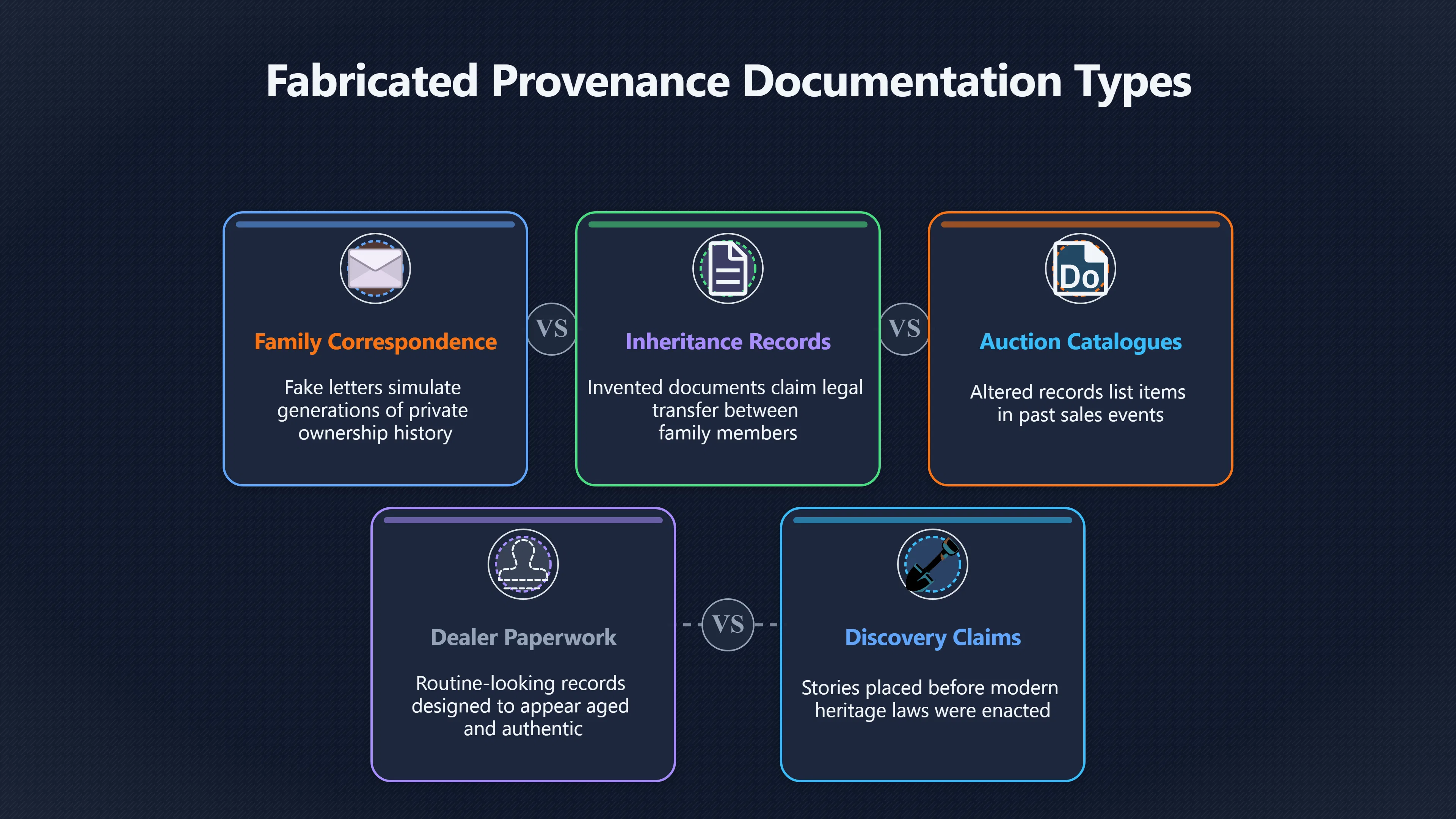
- Fake family correspondence.
- Invented inheritance records.
- Altered auction catalogues.
- Claims of discovery before modern heritage laws.
- Dealer paperwork designed to look old and routine.
- Stories linking the object to a deceased collector who can no longer be questioned.
Each element reinforces the others. The goal is not necessarily to prove authenticity beyond doubt, but to make the object seem ordinary enough that doubts fade into the background.[The Guardian]theguardian.comThe GuardianFake art is endemic | Art theft29 Jan 2008 — The Greenhalghs made use of an 1892 auction catalogue that they claimed included…
This approach exploits a practical reality of archaeology. Once an artefact has been removed from a documented excavation, much of the evidence that could establish its origin is lost. Collectors and institutions then rely more heavily on paperwork and ownership history. Forgers understand this weakness and often devote as much effort to creating documents as they do to creating the artefact itself.[Scribe House]hannahpethen.comOpen source on hannahpethen.com.
The market value of Egyptian antiquities increases the temptation. A modestly priced modern carving may become worth hundreds of thousands of pounds if it can be presented as a rare object from the age of the pharaohs. The financial incentive encourages increasingly sophisticated attempts to manufacture credibility.[The Guardian]theguardian.comThe GuardianFake art is endemic | Art theft29 Jan 2008 — The Greenhalghs made use of an 1892 auction catalogue that they claimed included…
Why Egyptian Artefacts Are Particularly Vulnerable
Ancient Egyptian objects possess characteristics that can help forgers.
Many authentic artefacts were produced in large numbers over long periods. Small statues, amulets, funerary figures and decorative items often follow established artistic conventions. A skilled craftsperson can therefore imitate familiar forms without having to reproduce a unique masterpiece.
The situation becomes more complicated when an object lacks secure archaeological context. If an artefact appears on the market with no excavation records, experts must judge it largely through style, materials and provenance. A persuasive ownership history can sometimes bridge gaps that would otherwise provoke scepticism.[Barnes Foundation]barnesfoundation.orgBarnes Foundation Holy Cow!Uncovering an Egyptian Glass ForgeryNearly any collection of Egyptian objects could have a fake ancient artifact hidden in its midst. For…
The prestige of Egyptian civilisation also plays a role. Museums, collectors and the public are naturally interested in discoveries connected to famous periods such as the reigns of Akhenaten, Tutankhamun or Ramesses II. An artefact linked to a celebrated era may receive more attention than a comparable object from a less famous culture, creating stronger incentives for forgery.[Wikipedia]WikipediaAmarna PrincessAmarna Princess
Tests and Investigations That Expose Fakes
Modern investigators rarely rely on a single method to identify forged Egyptian antiquities. Instead, they combine historical research, scientific analysis and provenance checks.
Following the Paper Trail
One of the most effective techniques is simply verifying the claimed history.
Researchers may examine auction records, shipping documents, collection inventories, exhibition catalogues and correspondence. If a supposed nineteenth-century ownership trail cannot be independently confirmed, doubts increase rapidly. In many cases, inconsistencies in paperwork provide the first warning sign. The Amarna Princess case ultimately unravelled because investigators identified problems with the provenance narrative itself.[Wikipedia]WikipediaAmarna PrincessAmarna Princess
Examining Materials and Manufacture
Scientific testing can reveal whether materials match what would be expected from ancient Egypt.
Analysts may study stone composition, pigments, tool marks, glazes and manufacturing techniques. Advanced imaging methods can examine internal structures without damaging the object. Museum researchers increasingly use non-invasive technologies to investigate ceramics, faience and other materials, helping distinguish authentic ancient production from modern imitation.[arXiv]arxiv.orgOpen source on arxiv.org.
Looking for Historical Impossibilities
Forgery investigations often focus on details that should not exist.
A supposedly ancient object might contain traces of modern tools, modern pigments, modern adhesives or stylistic combinations that would never have appeared together historically. Sometimes the object is convincing overall but includes a small error that betrays a modern creator working from books and photographs rather than ancient experience.[Barnes Foundation]barnesfoundation.orgBarnes Foundation Holy Cow!Uncovering an Egyptian Glass ForgeryNearly any collection of Egyptian objects could have a fake ancient artifact hidden in its midst. For…
Museums, Collectors and the Cost of Getting It Wrong
The exposure of a forgery can be embarrassing, but it has also changed museum practice.
Institutions now place far greater emphasis on provenance research than in previous decades. Questions about ownership history have become increasingly important not only for detecting forgeries but also for identifying looted or illegally exported antiquities. Investigations into Egyptian objects with questionable documented histories have highlighted the risks of accepting attractive stories without sufficient verification.[Artnet News]news.artnet.comNews A French Museum Agency Ignored Red Flags When ItNews A French Museum Agency Ignored Red Flags When It
Many museums have responded by becoming more cautious about acquisitions lacking clear documentation. Rather than treating provenance as a bureaucratic detail, they increasingly regard it as a core part of establishing authenticity and legality.[Artnet News]news.artnet.comNews A French Museum Agency Ignored Red Flags When ItNews A French Museum Agency Ignored Red Flags When It
Interestingly, some exposed fakes now remain on display. The Amarna Princess itself became a museum exhibit after its exposure, not as an ancient Egyptian masterpiece but as evidence of how convincing modern deception can be.[Wikipedia]WikipediaAmarna PrincessAmarna Princess
What Forged Antiquities Reveal About Belief
The most successful Egyptian forgeries exploit trust rather than ignorance. They work because museums, collectors and experts often need to make decisions with incomplete information. A plausible ownership story can fill gaps that archaeology cannot.
The lesson of cases such as the Amarna Princess is not that expertise is worthless. Rather, it shows that visual expertise alone is rarely enough. Authenticity emerges from a combination of archaeological context, documented provenance, historical consistency and scientific examination. When one of those pillars is fabricated, even a modern object can briefly become a museum treasure.[wikipedia.org]WikipediaAmarna PrincessAmarna Princess
Amazon book picks
Further Reading
Books and field guides related to How Fake Egyptian Artefacts Became Museum Treasures. Use these as the next step if you want deeper reading beyond the article.
Frauds, Myths, and Mysteries: Science and Pseudoscience in Ar...
Examines archaeological frauds and methods used to expose them.
The Rise and Fall of Ancient Egypt
Helps readers understand the historical periods often exploited by forgers.
Fake? The art of deception
Directly addresses how fakes enter collections and fool experts.
eBay marketplace picks
Marketplace Samples
Live-tested eBay searches with available results related to this page.

Endnotes
1.
Source: Wikipedia
Title: Amarna Princess
Link:https://en.wikipedia.org/wiki/Amarna_Princess
2.
Source: arxiv.org
Link:https://arxiv.org/abs/1903.10458
3.
Source: news.artnet.com
Title: News A French Museum Agency Ignored Red Flags When It
Link:https://news.artnet.com/art-world/louvre-abu-dhabi-report-egyptian-antiquities-2128348
4.
Source: barnesfoundation.org
Title: Barnes Foundation Holy Cow!
Link:https://www.barnesfoundation.org/whats-on/research-notes-december-2021
Source snippet
Uncovering an Egyptian Glass ForgeryNearly any collection of Egyptian objects could have a fake ancient artifact hidden in its midst. For...
5.
Source: theguardian.com
Link:https://www.theguardian.com/artanddesign/artblog/2008/jan/29/thecaseofthegreenhalgh
Source snippet
The GuardianFake art is endemic | Art theft29 Jan 2008 — The Greenhalghs made use of an 1892 auction catalogue that they claimed included...
6.
Source: theartnewspaper.com
Title: boltons fake egyptian princess returns to the duped museum
Link:https://www.theartnewspaper.com/2011/03/01/boltons-fake-egyptian-princess-returns-to-the-duped-museum
Source snippet
Art NewspaperBolton's fake Egyptian princess returns to the duped museumMar 1, 2011 — The Amarna Princess, the fake Egyptian sculpture cr...
7.
Source: museumsassociation.org
Link:https://www.museumsassociation.org/museums-journal/opinion/2009/11/15467-2/
Source snippet
Museums AssociationFollowing the jailing of the Bolton forger, museums and...Nov 13, 2009 — The memories are all coming flooding back no...
8.
Source: hannahpethen.com
Link:https://hannahpethen.com/2017/09/27/provenance-fakes-and-uncertainty-the-problems-with-legally-purchased-antiquities/
9.
Source: theguardian.com
Link:https://www.theguardian.com/uk/2007/nov/17/artnews.art
Additional References
10.
Source: traffickingculture.org
Link:https://traffickingculture.org/uploads/2015/06/Brodie-2014-Four-case-studies.pdf
Source snippet
Trafficking CulturePart I Case studIesWhat article 2.5 does reveal, in fact, is that the British Museum applies a less stringent test of...
11.
Source: historynewsnetwork.org
Title: amarna princess statue to return to bolton museum
Link:https://www.historynewsnetwork.org/article/amarna-princess-statue-to-return-to-bolton-museum
Source snippet
HNNAmarna Princess statue to return to Bolton MuseumNov 15, 2010 — Forger Shaun Greenhalgh made the statue in a shed in the back garden o...
12.
Source: bolton.gov.uk
Title: bolton s master forger returns to bolton museum
Link:https://www.bolton.gov.uk/news/article/549/bolton-s-master-forger-returns-to-bolton-museum
Source snippet
Bolton CouncilBolton's master forger returns to Bolton MuseumJul 19, 2019 — Among Mr Greenhalgh's forgeries was the infamous 'Amarna Prin...
13.
Source: youtube.com
Title: Egyptian Precision Vases: Legit Artifacts or Modern Forgery?
Link:https://www.youtube.com/watch?v=V58Xlq6cstI
Source snippet
A Convicted Forger Calls Nefertiti's Bust a Fake...
14.
Source: youtube.com
Title: Looted gold coffin returned to Egypt
Link:https://www.youtube.com/watch?v=2IeYB3espkc
Source snippet
The Dark Trade of Ancient History | Nefertiti: The Lonely Queen | Full Documentary...
15.
Source: youtube.com
Title: A Convicted Forger Calls Nefertiti’s Bust a Fake
Link:https://www.youtube.com/watch?v=Cckwn7jN3Ms
Source snippet
The FAKE Nefertiti Bust That Fooled The World For 100 Years...
16.
Source: researchgate.net
Link:https://www.researchgate.net/publication/347390878_Fakes_and_Forgeries_of_Written_Artefacts_from_Ancient_Mesopotamia_to_Modern_China
17.
Source: medium.com
Link:https://medium.com/%40theartfulhistorian/5-extraordinary-art-forgeries-1002fdf488fd
18.
Source: facebook.com
Link:https://www.facebook.com/knowthyselfinstitute/posts/age-of-forgeries-egyptomaina-ageofforgeries/787673714008569/
19.
Source: sarahpickering.co.uk
Link:https://www.sarahpickering.co.uk/works/art-antiquities/
Topic Tree