Within Timor Leste Deceptions
How the Balibo Declaration Staged Popular Consent
The Balibo Declaration used coercion, hidden authorship and a false setting to make Indonesian annexation appear locally requested.
On this page
- What the declaration claimed
- How its setting and authorship were concealed
- How the 1999 vote exposed the false mandate
Page outline Jump by section
Introduction
The Balibo Declaration is one of the most important examples of manufactured political consent in the history of Timor-Leste. Presented in late 1975 as a spontaneous appeal from East Timorese political leaders asking for integration with Indonesia, it was later shown to have been created under circumstances that concealed its true origins, misrepresented where it was produced, and exaggerated the freedom of those who signed it. Rather than an outright forgery, it was a carefully staged political document designed to make Indonesian intervention appear locally requested and internationally legitimate. Its significance lies not only in what it claimed, but in how the claim was constructed and sold to foreign governments, journalists and international institutions.[reliefweb.int]reliefweb.intRelief Web Chega!The report of the commission for reception, truth…28 Nov 2005 — The four other East Timorese political parties, under pressure from th…
The declaration became a central piece of Indonesia’s argument that annexation reflected the wishes of the East Timorese people. Yet later investigations, testimony from participants, and the eventual UN-supervised vote of 1999 exposed a large gap between the document’s message and the electorate’s demonstrated preferences.[participedia.net]participedia.netTimor-Leste Commission of Truth and FriendshipIndonesia officially stated that it held no territorial ambitions over East Timor, but it r…
What the declaration claimed
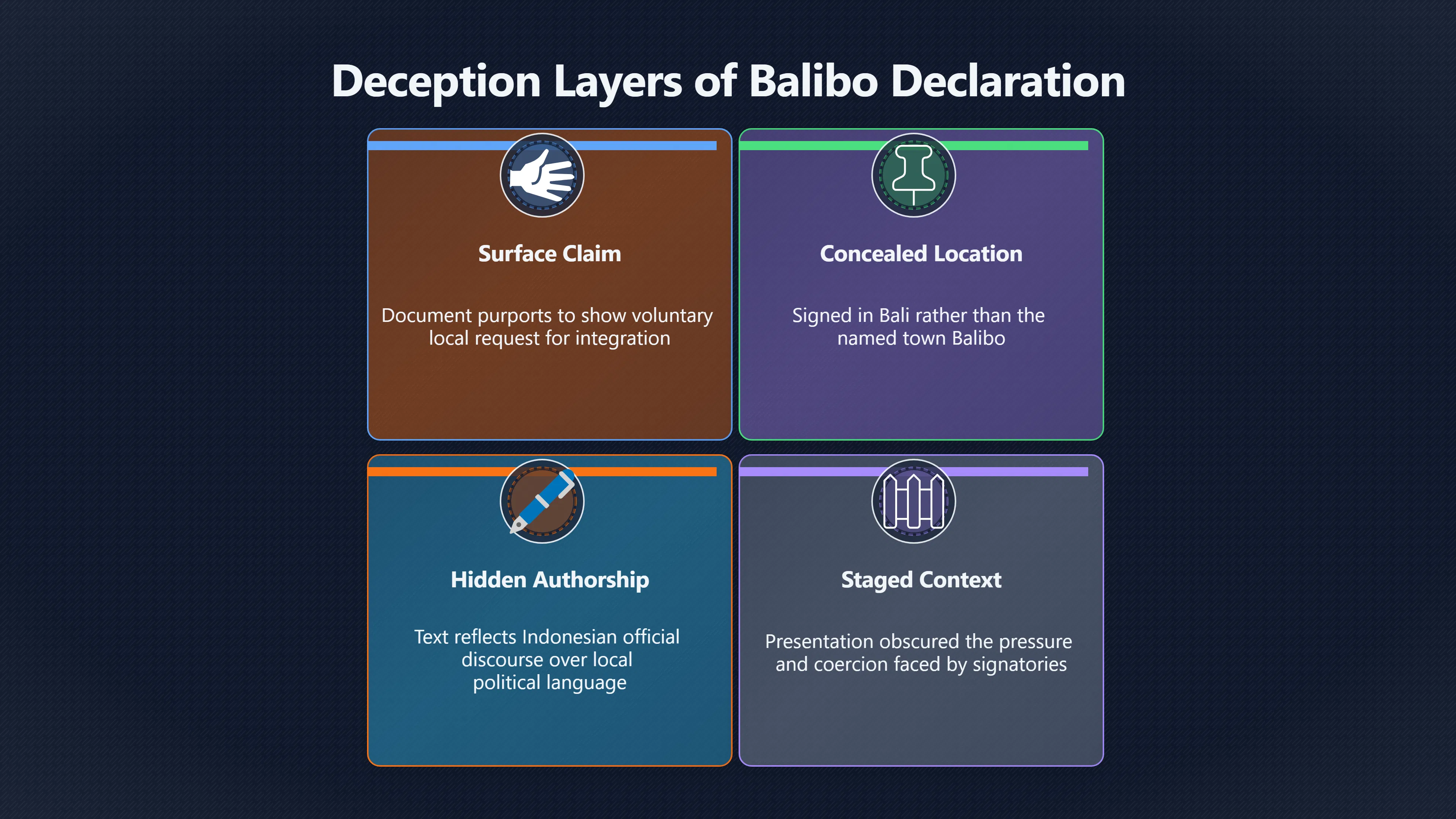
The Balibo Declaration was dated 30 November 1975 and purported to represent the position of four East Timorese political parties opposed to the pro-independence movement Fretilin. The document rejected independence and called for integration with Indonesia, creating the impression that East Timorese political leaders had voluntarily concluded that incorporation into Indonesia was the best future for the territory.[participedia.net]participedia.netTimor-Leste Commission of Truth and FriendshipIndonesia officially stated that it held no territorial ambitions over East Timor, but it r…
For Indonesian authorities, the declaration served several purposes at once:
- It framed intervention as a response to local requests rather than external aggression.
- It portrayed Fretilin as isolated rather than representative.
- It supplied a document that could be shown to foreign governments as evidence of self-determination.
- It helped fit the invasion into a Cold War narrative in which anti-communist intervention could be presented as stabilisation rather than conquest.[participedia.net]participedia.netTimor-Leste Commission of Truth and FriendshipIndonesia officially stated that it held no territorial ambitions over East Timor, but it r…
The document therefore functioned less as a neutral political statement than as a legitimising instrument. Its value lay in creating the appearance of consent.
How its setting and authorship were concealed
The most famous deception surrounding the declaration concerns its name. Although it became known as the “Balibo Declaration”, it was not signed in the East Timorese border town of Balibo. Evidence assembled by the Timor-Leste Commission for Reception, Truth and Reconciliation (CAVR) and later researchers showed that the declaration was signed in Bali, Indonesia. Witnesses and participants later described circumstances very different from the image implied by the document’s title.[reliefweb.int]reliefweb.intRelief Web Chega!The report of the commission for reception, truth…28 Nov 2005 — The four other East Timorese political parties, under pressure from th…
The location mattered. A declaration apparently issued from Balibo suggested that East Timorese leaders, operating on East Timorese soil amid local political turmoil, had independently reached their conclusions. A declaration signed in Indonesia under Indonesian supervision conveyed a very different story. By attaching Balibo’s name to the document, the organisers gave it an aura of local authenticity.[Fundasaun Mahein]fundasaunmahein.orgFundasaun MaheinIndonesia's military strategy in the invasion of East TimorAlthough said to have been proclaimed at Balibo, witnesses to…
Questions also emerged about authorship. Later analyses found indications that the text was drafted with substantial Indonesian involvement rather than originating from the East Timorese signatories themselves. Critics pointed to language and phrasing that appeared more consistent with Indonesian official discourse than with the political language then used by Timorese parties. Researchers and advocacy groups subsequently argued that the declaration reflected Indonesian strategic objectives rather than an independently drafted East Timorese political programme.[etan.org]etan.orgOpen source on etan.org.
The result was a document that used genuine signatures but concealed key facts about how the statement came into existence. The deception was not that the paper itself was imaginary. Rather, the deception lay in the presentation of the paper as the free expression of a local political consensus.

Why the declaration seemed persuasive
Manufactured consent works best when it reinforces beliefs that powerful audiences already want to accept. The Balibo Declaration emerged during a period when many Western governments viewed regional politics through the lens of the Cold War. Indonesian officials characterised Fretilin as a potentially radical or communist-aligned movement and depicted integration as a stabilising solution.[National Security Archive]nsarchive2.gwu.eduNational Security Archive Declassified British Documents Reveal U.KSupport for…These documents provide the first detailed account of British policymaking in the months leading up to and following Indon…
Foreign governments that prioritised strategic relations with Indonesia often had little incentive to scrutinise the declaration closely. Access to East Timor was limited, independent reporting was difficult, and information frequently passed through official channels. Under those conditions, a document carrying the apparent endorsement of East Timorese leaders could be used as convenient evidence that intervention reflected local wishes.[National Security Archive]nsarchive2.gwu.eduNational Security Archive Declassified British Documents Reveal U.KSupport for…These documents provide the first detailed account of British policymaking in the months leading up to and following Indon…
This helps explain why the declaration became so influential despite its weaknesses. It supplied a simple narrative at a moment when many international actors preferred simplicity to investigation.
Staged consent rather than a classic forgery
The Balibo Declaration occupies an unusual place in the history of political deception because it was neither wholly genuine nor wholly fabricated.
A traditional forgery involves invented signatures, fake documents or fabricated evidence. The Balibo Declaration contained real political figures and an actual signed text. What was misleading was the broader presentation surrounding it:
- The implied location was false.
- The degree of Indonesian involvement was concealed.
- The circumstances facing the signatories were obscured.
- The document was presented as evidence of free political choice despite allegations of pressure and coercion.[reliefweb.int]reliefweb.intRelief Web Chega!The report of the commission for reception, truth…28 Nov 2005 — The four other East Timorese political parties, under pressure from th…
For that reason, historians often view it as an example of political theatre or manufactured consent rather than a straightforward forgery. The document’s power came from controlling context as much as controlling content.
How the 1999 vote exposed the false mandate
The strongest challenge to the declaration did not come from textual analysis or historical investigation. It came from a ballot box.
For more than two decades, Indonesian authorities cited integration as the expressed desire of the East Timorese people. Yet in August 1999 the United Nations organised a direct popular consultation allowing East Timorese voters to choose between special autonomy within Indonesia and a path leading to independence. Turnout was extraordinarily high. When the votes were counted, 78.5 per cent rejected the autonomy proposal and chose separation from Indonesia. Only 21.5 per cent supported continued association under the proposed arrangement.[unvienna.org]unis.unvienna.orgThe people of East TimorPeople of East Timor Reject Proposed Special Autonomy…the result of the vote is 94,388, or 21.5 per cent in favour, and 344,580…
The result did not simply determine Timor-Leste’s future. It also served as a retrospective test of the Balibo Declaration’s central claim. If the declaration had truly reflected the settled will of the population, a very different outcome might have been expected. Instead, the consultation revealed a striking mismatch between the supposed mandate cited in 1975 and the preferences expressed in a secret, internationally supervised vote.[unvienna.org]unis.unvienna.orgThe people of East TimorPeople of East Timor Reject Proposed Special Autonomy…the result of the vote is 94,388, or 21.5 per cent in favour, and 344,580…
The contrast transformed the declaration from a contested political document into a widely cited example of how official narratives can manufacture the appearance of popular support.

How Balibo Declaration entered public memory
The Balibo Declaration remains significant because it illustrates a recurring mechanism of political deception. The document did not rely on an obviously absurd claim. It relied on selective presentation, concealed authorship, strategic naming and the authority created by apparent local endorsement. Those techniques are often more effective than outright fabrication because they mix truth with distortion.[Fundasaun Mahein]fundasaunmahein.orgFundasaun MaheinIndonesia's military strategy in the invasion of East TimorAlthough said to have been proclaimed at Balibo, witnesses to…
In the broader history of Timor-Leste, the declaration stands as a reminder that consent can be staged as well as expressed. It demonstrates how governments and political movements may attempt to manufacture legitimacy through documents, symbols and carefully managed narratives. The later exposure of its origins, combined with the democratic verdict delivered in 1999, turned the Balibo Declaration into one of the clearest examples of political consent being constructed rather than freely given.[reliefweb.int]reliefweb.intRelief Web Chega!The report of the commission for reception, truth…28 Nov 2005 — The four other East Timorese political parties, under pressure from th…
Amazon book picks
Further Reading
Books and field guides related to How the Balibo Declaration Staged Popular Consent. Use these as the next step if you want deeper reading beyond the article.
Manufacturing Consent
Useful for understanding staged political legitimacy and media framing.
A Not-so-distant Horror
Explores narratives used to justify intervention and occupation.
Political Order and Political Decay
Offers context on state legitimacy and political institutions.
East Timor: A People's History
Covers the political context of the Balibo Declaration.
eBay marketplace picks
Marketplace Samples
Live-tested eBay searches with available results related to this page.


Endnotes
1.
Source: reliefweb.int
Title: Relief Web Chega!
Link:https://reliefweb.int/report/timor-leste/chega-report-commission-reception-truth-and-reconciliation-timor-leste
Source snippet
The report of the commission for reception, truth...28 Nov 2005 — The four other East Timorese political parties, under pressure from th...
2.
Source: chegareport.org
Link:https://chegareport.org/Chega%20All%20Volumes.pdf
3.
Source: participedia.net
Link:https://participedia.net/case/timor-leste-commission-of-truth-and-friendship
Source snippet
Timor-Leste Commission of Truth and FriendshipIndonesia officially stated that it held no territorial ambitions over East Timor, but it r...
4.
Source: unis.unvienna.org
Title: The people of East Timor
Link:https://unis.unvienna.org/unis/en/pressrels/1999/sg2353.html
Source snippet
People of East Timor Reject Proposed Special Autonomy...the result of the vote is 94,388, or 21.5 per cent in favour, and 344,580...
5.
Source: reliefweb.int
Link:https://reliefweb.int/report/timor-leste/east-timor-letter-dated-3-sep-1999-secretary-general-addressed-president-security
Source snippet
East Timor: Letter dated 3 Sep 1999 from the Secretary...3 Sept 1999 — Thus, the people of East Timor have rejected the propose...
6.
Source: etan.org
Link:https://etan.org/et/1998/july/july14-21/17debunk.htm
7.
Source: cambridge.org
Title: University Press & Assessment Timor-Leste and Indonesia (Chapter 3)
Link:https://www.cambridge.org/core/books/negotiating-peace/timorleste-and-indonesia/336107A771CEBC512BF275A7C556A3ED
8.
Source: mineaction.org
Title: East Timor
Link:https://www.mineaction.org/sites/default/files/past/unmiset/background.html
9.
Source: etan.org
Title: Chega! Report Executive
Link:https://www.etan.org/etanpdf/2006/CAVR/Chega%21-Report-Executive-Summary.pdf
10.
Source: fundasaunmahein.org
Link:https://www.fundasaunmahein.org/wp-content/uploads/2011/06/Indonesias-military-strategy-in-the-invasion-of-East-Timor.pdf
Source snippet
Fundasaun MaheinIndonesia's military strategy in the invasion of East TimorAlthough said to have been proclaimed at Balibo, witnesses to...
11.
Source: nsarchive2.gwu.edu
Title: National Security Archive Declassified British Documents Reveal U.K
Link:https://nsarchive2.gwu.edu/NSAEBB/NSAEBB174/indexuk.htm
Source snippet
Support for...These documents provide the first detailed account of British policymaking in the months leading up to and following Indon...
12.
Source: parasparas.com
Title: Paras Balibo Balibohong Declaration The Balibo Declaration, dated
Link:https://parasparas.com/archive/balibo-balibohong-declaration/
13.
Source: Wikipedia
Link:https://en.wikipedia.org/wiki/Balibo
14.
Source: press.un.org
Link:https://press.un.org/en/1999/19990903.sc6721.html
Additional References
15.
Source: youtube.com
Link:https://www.youtube.com/watch?v=g8sbQJmrVjo
Source snippet
Election info changes quickly. Verify responses with official sources...
16.
Source: youtube.com
Title: How the Media Manufactured Consent for a Genocide
Link:https://www.youtube.com/watch?v=jjPc8mfbrtA
Source snippet
Five journalists brutally shot down by Indonesian soldiers | 60 Minutes Australia...
17.
Source: mdpi.com
Link:https://www.mdpi.com/2409-9252/5/4/50
Source snippet
The Limits of “Genocide”: East Timor, International Law...by S Pulley · 2025 — the leaders of UDT and APODETI signed the “Balibo Dec...
18.
Source: youtube.com
Title: Justice for the Balibo 5
Link:https://www.youtube.com/watch?v=Gj0k-82mRBk
Source snippet
50 years since the 'Balibo 5' murders and the Indonesian invasion | The Pacific | ABC NEWS...
19.
Source: Wikipedia
Link:https://en.wikipedia.org/wiki/Indonesia%E2%80%93Timor-Leste_relations
20.
Source: jstor.org
Link:https://www.jstor.org/stable/j.ctt2jbjgr.17?Search=yes&resultItemClick=true&searchText=%22S.+B.%22&searchText=au%3A&searchUri=%2Fopen%2Fsearch%2F%3Fsi%3D1%26amp%3BQuery%3Dau%253A%2522S.%2BB.%2522%26amp%3Btheme%3Dopen%26amp%3Bso%3Drel%26amp%3Bpage%3D6
21.
Source: timorarchive.ca
Link:https://timorarchive.ca/chega-the-final-report-of-the-timor-leste-commission-for-reception-truth-and-reconciliation
22.
Source: jls.apsa.us
Link:https://jls.apsa.us/index.php/jls/article/download/86/107/306
23.
Source: facebook.com
Title: remembering 25 years of being part of the birth of a nation in august 1999 timor
Link:https://www.facebook.com/NationalArmyMuseumNZ/posts/remembering-25-years-of-being-part-of-the-birth-of-a-nation-in-august-1999-timor/1052787850186427/
Published: august 1999
24.
Source: youtube.com
Link:https://www.youtube.com/watch?v=J9SfCgJRppY
Source snippet
Justice for the Balibo 5...
Topic Tree