Which Mongolian Mysteries Survive the Evidence?
Mongolia has no single, universally recognised “great hoax” comparable with Piltdown Man or the Loch Ness Monster photograph. Its most revealing stories instead sit along the border between folklore, commercial fraud, wishful thinking and modern disinformation.
Page outline Jump by section
Introduction
These episodes matter because they show several different ways falsehood works. Some stories are not deliberate deceptions at all, but legends intensified by explorers and entertainment media. Others are calculated frauds whose purpose is to turn protected heritage into saleable property. More recent fabrications exploit the authority of photographs, museums and famous historical names. The common thread is not national credulity, but the power of a compelling story when reliable evidence is distant, inaccessible or slower to travel.
The death worm: folklore turned into a monster hunt
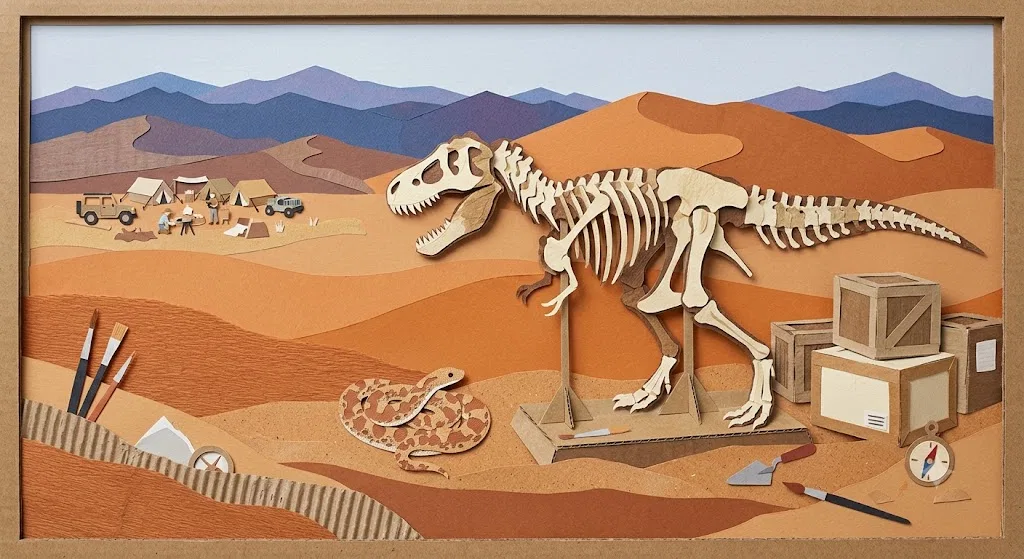
The creature usually called the Mongolian death worm is said to inhabit the Gobi Desert. Accounts describe a thick, reddish animal resembling a length of intestine, sometimes credited with spraying poison or killing at a distance through an electrical discharge. No body, skin, bone, verified photograph or biological sample has ever established that such an animal exists. It is therefore better understood as a legendary creature or cryptid than as an exposed, deliberately manufactured hoax.[Wikipedia]WikipediaMongolian death wormMarch 31, 2004 — Investigations into the legendary creature have been pursued by amateur cryptozoologists and credentialed academics alik…
The story entered Western popular culture largely through the American explorer Roy Chapman Andrews, who led American Museum of Natural History expeditions into the Gobi during the 1920s. In his 1926 book On the Trail of Ancient Man, Andrews recalled Mongolian officials describing the animal in detail. His most important observation was also the most sceptical: none of those present claimed to have seen it personally. Andrews repeated the tale in later writing but did not accept the creature’s existence.[wikipedia.org]WikipediaMongolian death wormMarch 31, 2004 — Investigations into the legendary creature have been pursued by amateur cryptozoologists and credentialed academics alik…
That combination was unusually effective. Andrews was associated with spectacular genuine discoveries, including major dinosaur finds, so a monster story preserved in his expedition literature acquired a scientific aura even though he presented it as hearsay. The Gobi itself supplied the ideal setting: vast, difficult to search and unfamiliar to most foreign readers. A claim that would have seemed weak in a well-studied landscape could remain tantalising when placed in a remote desert.
Later retellings enlarged the creature’s powers and shifted attention away from the original evidential weakness. Expeditions in the 1990s used vibration devices and even small explosions in attempts to draw it from the sand. A British cryptozoological team searched in 2005, while television crews and other visitors mounted further hunts. None produced physical evidence. Even sympathetic investigators increasingly treated the supposed poison and electrical attack as embellishments, suggesting that sightings might involve an ordinary or unidentified burrowing reptile.[wikipedia.org]WikipediaMongolian death wormMarch 31, 2004 — Investigations into the legendary creature have been pursued by amateur cryptozoologists and credentialed academics alik…
One proposed explanation is the Tartar sand boa, a stout-bodied snake whose appearance could fit less extravagant descriptions. A published account reports that, when such a boa was shown to people who said they knew the legendary animal, they identified it as the same creature. That does not prove every story arose from snake sightings, but it offers a far more economical explanation than an undocumented animal capable of remote killing.[Wikipedia]WikipediaMongolian death wormMarch 31, 2004 — Investigations into the legendary creature have been pursued by amateur cryptozoologists and credentialed academics alik…
The death worm survives because the legend is flexible. Failed searches can be blamed on the desert’s size, the animal’s supposed rarity or its habit of remaining underground. Each unsuccessful expedition then becomes new material for books, documentaries and travel writing. The case illustrates how folklore can be converted into a continuing media mystery without any individual needing to invent the entire story.
How a Mongolian dinosaur became “British”
The most consequential deception associated with Mongolia’s natural heritage did not concern a fake fossil. The bones were genuine; the story of their lawful origin was not.
In May 2012, a nearly complete Tarbosaurus bataar skeleton was offered at auction in New York and attracted a bid of more than US$1 million. Mongolian officials and palaeontologists objected that the animal was characteristic of the country’s Gobi deposits and that Mongolian fossils could not lawfully have been privately exported. A judge halted completion of the sale while ownership and provenance were investigated.[WIRED]wired.comStop the Tarbosaurus Auction!Fossil theft, especially of dinosaurs, is an ongoing issue in Mongolia and China, where specimens are often sold illegally to private col…
The fossil dealer Eric Prokopi had imported the skeleton through Britain and caused customs documentation to describe its country of origin as Great Britain. That assertion was not merely implausible in a scientific sense: palaeontologists examining the specimen concluded that its geology, preservation and colouring pointed to the Gobi Desert. Prokopi later pleaded guilty to participating in a scheme involving illegally removed fossils, false statements and smuggling.[Department of Justice]justice.govDepartment of Justice USDOJ: US Attorney's OfficeDepartment of Justice USDOJ: US Attorney's Office
This was provenance fraud: the manipulation of an object’s ownership and export history to make it appear legally marketable. In the antiquities and fossil trades, provenance can be as important as authenticity. A real object without a lawful history may be stolen property; a vague statement that it came from an “old European collection” or a country through which it merely passed can create a veneer of legitimacy.
The auction skeleton also demonstrated how spectacular displays can obscure uncertainty. It had been assembled and restored from numerous fossil components, a common practice in mounting dinosaur skeletons, but one that complicates questions about exactly which bones came from where. To a buyer or auction audience, the finished animal appeared singular and complete. Investigators instead had to separate the theatrical object from the shipments, declarations and individual fossil pieces behind it.[The New Yorker]newyorker.comThe New Yorker The Black Market for DinosaursThe New Yorker The Black Market for Dinosaurs
The United States returned the skeleton to Mongolia in 2013. Information supplied during the criminal investigation helped authorities pursue further specimens, and more than a dozen dinosaur skeletons were subsequently repatriated. Prokopi received a three-month prison sentence after cooperating with investigators. The affair exposed a much wider trade in fossils removed from Mongolia and sold through international dealers.[newyorker.com]newyorker.comThe New Yorker The Black Market for DinosaursThe New Yorker The Black Market for Dinosaurs
A later celebrity episode revealed how convincingly such objects could circulate. Actor Nicolas Cage had bought a Tarbosaurus skull at auction in 2007 for US$276,000. After investigators determined that it had probably been taken illegally from Mongolia, Cage agreed to surrender it for repatriation; there was no allegation that he had knowingly purchased stolen property. The fame of the buyer made the story memorable, but the important point was structural: impressive catalogues, reputable venues and high prices had failed to guarantee lawful origin.[Vanity Fair]vanityfair.comOpen source on vanityfair.com.
Unlike the death worm, this was deliberate deception with identifiable financial beneficiaries. False or obscured provenance allowed dealers to transform protected scientific material into luxury merchandise. Collectors obtained dramatic trophies, auction businesses earned fees, and middlemen profited from the distance between an excavation site in the Gobi and a showroom in New York. Mongolia, meanwhile, lost not only valuable objects but also archaeological context—the exact location and rock layer that make a fossil scientifically useful.
The repeatedly “discovered” tomb of Genghis Khan
Few archaeological announcements would attract more attention than the discovery of Genghis Khan’s burial place. Historical tradition places the tomb somewhere in Mongolia but provides no securely identified site, and the uncertainty has encouraged repeated rumours, speculative expeditions and false headlines.
In February 2018, Mongolian news outlet News.mn explicitly warned readers about a circulating report claiming that the tomb had been found. The story was presented as a discovery by an international team but lacked the institutional announcements, excavation records and peer-reviewed evidence that would accompany an authentic find of such importance.[news.mn]news.mnOpen source on news.mn.
The rumour’s appeal is obvious. Genghis Khan is globally famous, the location of his grave remains unresolved, and stories about elaborate secrecy surrounding the burial have circulated for centuries. An invented discovery therefore begins with a genuine historical mystery. It does not need to persuade readers that the tomb exists—only that someone has finally located it.
False tomb announcements also benefit from the public’s limited ability to verify archaeology. Real discoveries are normally established slowly through excavation permits, stratigraphy, artefact analysis, dating, specialist review and publication. Online fabrications compress that process into a photograph and a dramatic headline. By the time experts point out the missing evidence, the supposed revelation has already travelled.
The responsible conclusion is not that the tomb can never be found. It is that any future claim should be judged by its evidence rather than the fame of its subject. A credible announcement would identify the excavating institution, legal authority, archaeological context, dating methods and basis for connecting the burial to Genghis Khan. An unnamed “team of scientists” and images of an impressive excavation are not enough.

When genuine Mongolian images acquire false stories
Modern misinformation frequently uses material from Mongolia without making a false claim about Mongolia itself. The photograph is authentic, but its caption is replaced.
In 2026, Reuters examined an image circulating as evidence of a mass grave in Gaza. The photograph actually showed an ancient burial pit in Mongolia, documented in 2009 and associated with the Han dynasty period. The false post removed the image from its archaeological setting and reassigned it to a current conflict, relying on the emotional force of visible human remains.[Reuters]reuters.comFact Check: Mongolia burial ground dating to Han dynastyFact Check: Mongolia burial ground dating to Han dynasty
Miscaptioning works because people tend to treat photographs as direct evidence. Yet an image usually cannot establish where or when it was taken without supporting information. Landscape, clothing, architecture and metadata may offer clues, but many excavation or disaster scenes are visually ambiguous. A false caption supplies the missing context before the viewer thinks to ask who made the photograph or where it first appeared.
Mongolian journalists and fact-checkers have described a broader environment in which social-media rumours can spread rapidly through personal networks. One fabrication reported during a journalism training programme claimed that China had transmitted HIV/AIDS to Mongolia through contaminated bananas. The allegation combined health fear, distrust of a powerful neighbour and an everyday consumer product, giving users several emotional reasons to share it despite the biological implausibility.[USAGM]usagm.govmongolia ethics investigative journalism fake newsmongolia ethics investigative journalism fake news
The Mongolian Fact Checking Center has also highlighted practical obstacles to correction, including strong reliance on word of mouth and difficulties establishing widely understood terminology for different forms of false information. These are not uniquely Mongolian problems, but they can make the distinction between error, manipulated content and intentional disinformation harder to communicate.[Poynter]poynter.orgOpen source on poynter.org.
Political narratives can similarly appropriate Mongolian landmarks. In 2024, fact-checkers challenged a Belarusian state-media claim that “Westerners” had built a large Genghis Khan museum in central Ulaanbaatar as a geopolitical provocation against Russia and China. The museum was real; the asserted foreign plot and purpose were not supported by its actual history. The technique resembled the miscaptioned burial photograph: begin with something visible and genuine, then attach an invented explanation.[Investigate Belarus]investigatebel.orglazutkin chingiskhan muzei mongoliyalazutkin chingiskhan muzei mongoliya
What these cases reveal
Mongolia’s best-documented deception stories fall into three distinct categories, and confusing them weakens rather than strengthens sceptical analysis.
Folklore amplified by media. The death worm is not known to have been invented by a single fraudster. It is a traditional story that foreign explorers, cryptozoologists and television producers converted into an enduring monster hunt. The lack of evidence counts strongly against the extraordinary claims, but calling the whole tradition a calculated hoax would misrepresent how folklore develops.
Commercial fraud involving genuine objects. The dinosaur-smuggling cases concerned real fossils paired with false declarations, concealed origins or misleading ownership histories. Here deception had a clear purpose: to bypass Mongolian law and make objects saleable. Scientific authentication alone could not solve the problem because the question was not simply “Is this fossil real?” but “Where was it removed, and who had the right to sell it?”
Digital misinformation built from authentic fragments. False tomb reports, repurposed archaeological photographs and invented political explanations exploit genuine mysteries or real images. Their persuasive power comes from partial truth. Genghis Khan’s tomb is genuinely undiscovered; the burial pit genuinely exists; the museum genuinely stands in Ulaanbaatar. The falsehood lies in the added claim.
These distinctions also suggest practical tests for future stories. A monster claim needs physical evidence that independent zoologists can examine. An antiquities or fossil sale needs a documented chain of ownership and lawful export, not simply expert assurance that the object is genuine. An archaeological announcement needs named institutions, methods and excavation context. A viral photograph needs its earliest traceable publication and original caption.
Mongolia’s strange-history cases ultimately show that the most successful false stories rarely consist of pure invention. They attach themselves to something already powerful: the remoteness of the Gobi, the prestige of a dinosaur skeleton, the unresolved grave of a world conqueror or the apparent immediacy of a photograph. Exposure begins by separating that authentic core from the unsupported story built around it.
Amazon book picks
Further Reading
Books and field guides related to Which Mongolian Mysteries Survive the Evidence?. Use these as the next step if you want deeper reading beyond the article.
Genghis Khan and the Making of the Modern World
Provides broad context for many Mongolian mysteries and legends.
The Demon-Haunted World
Rating: 4.5/5 from 43 Google Books ratings
Explains how extraordinary claims persist without strong evidence.
The Secret History of the Mongol Queens
Expands understanding of Mongolian history often overshadowed by myth.
The dinosaur hunters
Connects to fossil discoveries and controversies linked to Mongolia.
eBay marketplace picks
Marketplace Samples
Live-tested eBay searches with available results related to this page.



Endnotes
1.
Source: Wikipedia
Title: Mongolian death worm
Link:https://en.wikipedia.org/wiki/Mongolian_death_worm
Source snippet
March 31, 2004 — Investigations into the legendary creature have been pursued by amateur cryptozoologists and credentialed academics alik...
Published: March 31, 2004
2.
Source: wired.com
Link:https://www.wired.com/2007/01/beware-the-conq
Source snippet
This fearsome worm, measuring two to four feet in length, is notable for its reddish color, ability to eject yellow poison, and purported...
3.
Source: wired.com
Title: Stop the Tarbosaurus Auction!
Link:https://www.wired.com/2012/05/stop-the-tarbosaurus-auction
Source snippet
Fossil theft, especially of dinosaurs, is an ongoing issue in Mongolia and China, where specimens are often sold illegally to private col...
4.
Source: justice.gov
Title: Department of Justice USDOJ: US Attorney’s Office
Link:https://www.justice.gov/archive/usao/nys/pressreleases/December12/ProkopiEricPleaPR.html
5.
Source: justice.gov
Link:https://www.justice.gov/archive/usao/nys/pressreleases/October12/ProkopiArrestPR/Prokopi%2C%20Eric%20Complaint.pdf
6.
Source: Wikipedia
Title: United States v. One Tyrannosaurus Bataar Skeleton
Link:https://en.wikipedia.org/wiki/United_States_v._One_Tyrannosaurus_Bataar_Skeleton
7.
Source: news.mn
Link:https://news.mn/en/772255/
8.
Source: reuters.com
Title: Fact Check: Mongolia burial ground dating to Han dynasty
Link:https://www.reuters.com/fact-check/mongolia-burial-ground-dating-han-dynasty-miscaptioned-gaza-grave-2026-04-01/
9.
Source: usagm.gov
Title: mongolia ethics investigative journalism fake news
Link:https://www.usagm.gov/2017/12/01/mongolia-ethics-investigative-journalism-fake-news/
10.
Source: poynter.org
Link:https://www.poynter.org/fact-checking/2021/the-mongolian-fact-check-center-fights-misinformation-in-a-country-where-the-word-doesnt-exist/
11.
Source: Wikipedia
Title: Tartarian Empire
Link:https://en.wikipedia.org/wiki/Tartarian_Empire
12.
Source: Wikipedia
Title: Unusual articles
Link:https://en.wikipedia.org/wiki/Wikipedia%3AUnusual_articles
13.
Source: Wikipedia
Title: Roy Chapman Andrews
Link:https://en.wikipedia.org/wiki/Roy_Chapman_Andrews
14.
Source: youtube.com
Title: The Mystery of the Gobi Desert Monster
Link:https://www.youtube.com/watch?v=oegPOIS3HR4
Source snippet
The Mongolian Death Worm...
15.
Source: youtube.com
Title: The Mongolian Death Worm
Link:https://www.youtube.com/watch?v=pUHx_JRInYo
Source snippet
The Million-Dollar Dinosaur Fossil Heist: From Mongolia To New York Auction...
16.
Source: atlasobscura.com
Title: mongolian death worm
Link:https://www.atlasobscura.com/articles/mongolian-death-worm
Source snippet
Atlas ObscuraIs the Mongolian Death Worm Real?30 Apr 2024 — In May 2005, cryptozoologist Richard Freeman (far left) and others from the C...
Published: May 2005
17.
Source: amnh.org
Link:https://www.amnh.org/explore/ology/ology-cards/023-roy-chapman-andrews
Source snippet
This bold explorer and real-life "Indiana Jones" inspired many people to...Read more...
18.
Source: amnh.org
Title: roy chapman andrews legacy
Link:https://www.amnh.org/explore/news-blogs/roy-chapman-andrews-legacy
Source snippet
American Museum of Natural HistoryCelebrating Roy Chapman Andrews' Legacy26 Jan 2014 — Honoring the adventurous life of Roy Chapman Andre...
19.
Source: newyorker.com
Link:https://www.newyorker.com/magazine/2013/01/28/bones-of-contention-paige-williams
20.
Source: newyorker.com
Title: The New Yorker The Black Market for Dinosaurs
Link:https://www.newyorker.com/tech/annals-of-technology/the-black-market-for-dinosaurs
21.
Source: vanityfair.com
Link:https://www.vanityfair.com/hollywood/2015/12/nicolas-cage-stolen-dinosaur-skull
22.
Source: investigatebel.org
Title: lazutkin chingiskhan muzei mongoliya
Link:https://investigatebel.org/en/fakenews/lazutkin-chingiskhan-muzei-mongoliya
23.
Source: a-z-animals.com
Title: the mongolian death worm
Link:https://a-z-animals.com/articles/the-mongolian-death-worm/
24.
Source: paranormalarabia.com
Title: the mongolian death worm
Link:https://www.paranormalarabia.com/en/investigations/2025/10/the-mongolian-death-worm
25.
Source: critter.science
Title: the mongolian death worm
Link:https://critter.science/the-mongolian-death-worm/
26.
Source: cryptidz.fandom.com
Title: Mongolian Death Worm
Link:https://cryptidz.fandom.com/wiki/Mongolian_Death_Worm
27.
Source: coo.fieldofscience.com
Title: the mongolian death worm
Link:https://coo.fieldofscience.com/2017/03/the-mongolian-death-worm.html
28.
Source: science.howstuffworks.com
Title: mongolian death worm
Link:https://science.howstuffworks.com/science-vs-myth/strange-creatures/mongolian-death-worm.htm
29.
Source: skeptoid.com
Link:https://skeptoid.com/episodes/344
30.
Source: roychapmanandrewssociety.org
Title: roy chapman andrews
Link:https://roychapmanandrewssociety.org/roy-chapman-andrews/
Additional References
31.
Source: discoveryuk.com
Title: desert legend the truth behind the mongolian death worm
Link:https://www.discoveryuk.com/mysteries/desert-legend-the-truth-behind-the-mongolian-death-worm/
Source snippet
Discovery UKDesert Legend: The Truth Behind the Mongolian Death Worm3 Feb 2025 — Several theories suggest the Mongolian worm might actual...
32.
Source: youtube.com
Title: The Million-Dollar Dinosaur Fossil Heist: From Mongolia To New York Auction
Link:https://www.youtube.com/watch?v=lLrxmQ23Qrw
Source snippet
US Returns Looted Dinosaur Fossils to Mongolia...
33.
Source: facebook.com
Link:https://www.facebook.com/groups/149844915349213/posts/537395939927440/
34.
Source: reddit.com
Link:https://www.reddit.com/r/Cryptozoology/comments/1mclpth/is_the_mongolian_death_worm_real/
35.
Source: restitutionmatters.org
Link:https://restitutionmatters.org/news-item/mongolia-mulls-restitution-claims-after-identifying-objects-abroad/
36.
Source: pbs.org
Link:https://www.pbs.org/wgbh/nova/lochness/legend3.html
37.
Source: reddit.com
Link:https://www.reddit.com/r/badhistory/comments/ieg2k0/tartaria_the_supposed_megaempire_of_inner_eurasia/
38.
Source: facebook.com
Link:https://www.facebook.com/HistoryExtra/posts/there-were-tales-of-the-hairy-man-we-know-as-bigfoot-or-sasquatch-in-a-number-of/906144671546303/
39.
Source: shh.mpg.de
Link:https://www.shh.mpg.de/1439414/mongolia-vessels-and-silks-ventresca-miller
40.
Source: videos.factly.in
Link:https://www.videos.factly.in/playlist/UUpi2S8wW4xLlUCVryhyBtsA/?v=uNhc1INjIjs
Topic Tree
Follow this branch
Related pages 192
- Albanian Hoaxes
- Algerian Hoaxes
- Antigua Deceptions
- Argentina Hoaxes
- Armenian Hoaxes
- +187 more in sidebar