When False Claims Gained Power in Gambia
The Gambia does not have a well-documented catalogue of forged monsters, fake antiquities or celebrated newspaper hoaxes comparable with those of some larger countries.
Page outline Jump by section
Introduction
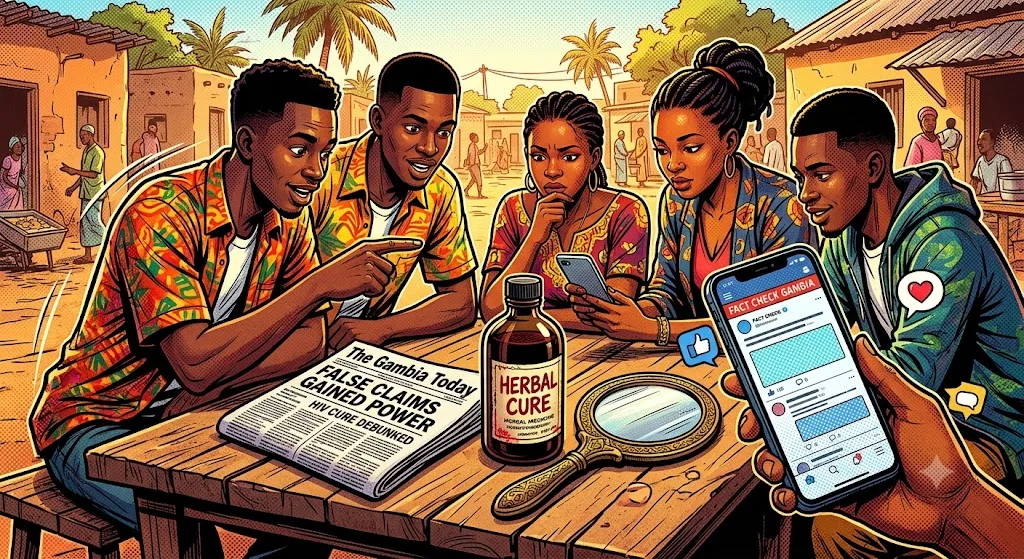
Three episodes stand out. Former president Yahya Jammeh promoted an unproven herbal treatment as a cure for HIV/AIDS; his government later organised “witch-hunting” operations in which people were falsely identified through ritual performances and forced to undergo dangerous “cleansing”; and, after his fall, election campaigns became testing grounds for viral misinformation and organised fact-checking. These cases differ sharply. The HIV treatment was pseudoscience promoted as medical fact, the witch accusations were coercive claims embedded in supernatural belief and political power, and modern election falsehoods range from careless rumours to deliberate propaganda. Together they show that deception becomes most dangerous when authority, fear and restricted access to independent evidence reinforce one another.
The president who claimed to cure HIV
In January 2007, President Yahya Jammeh announced that he had perfected a herbal treatment capable of curing HIV/AIDS, reportedly within days. Patients were enrolled in what became known as the Presidential Alternative Treatment Programme, where Jammeh personally administered herbal preparations and religious rituals. The precise ingredients were not disclosed, independently tested or subjected to a controlled clinical trial. Nevertheless, the programme was presented through state institutions and publicised as a medical success rather than as an experimental or traditional remedy.[thenewhumanitarian.org]thenewhumanitarian.orgThe New Humanitarian President's AIDS cure raising more questions than answersThe New HumanitarianPresident's AIDS cure raising more questions than answersFebruary 12, 2007 — 12 Feb 2007 — An unsubstantiated but wel…
The claim was persuasive partly because it came from the country’s head of state, not an obscure travelling healer. Jammeh appeared alongside patients, health workers and government officials, while state media gave the programme an official stage. In a country where political dissent could carry serious consequences, the normal safeguards of scientific argument—independent scrutiny, open data and public criticism—were badly weakened. The treatment also drew on the familiar authority of herbal medicine and religious healing, making it culturally legible even though the specific claim of an HIV cure lacked reliable evidence.[thenewhumanitarian.org]thenewhumanitarian.orgThe New Humanitarian President's AIDS cure raising more questions than answersThe New HumanitarianPresident's AIDS cure raising more questions than answersFebruary 12, 2007 — 12 Feb 2007 — An unsubstantiated but wel…
Medical specialists quickly challenged the announcement. HIV can be suppressed by antiretroviral therapy, allowing people to live long and healthy lives, but a fall in symptoms or a temporary change in a laboratory result does not establish that the virus has been eliminated. Researchers examining information presented in support of Jammeh’s programme said that no cure had been demonstrated and that some of the supporting data were false or misleading. They also warned that interrupting antiretroviral medication could allow the virus to rebound, damage patients’ health and increase the risk of transmission.[reuters.com]reuters.comGambian herbal AIDS cure no such thing -scientistsGambian herbal AIDS cure no such thing -scientistsApril 25, 2007 — 9 Aug 2007 — WASHINGTON, April 24 (Reuters) - Gambian President…
The government did not respond by opening the treatment to independent testing. Instead, it expelled Fadzai Gwaradzimba, the United Nations Development Programme’s senior representative in The Gambia, after she questioned the claim and warned about its possible consequences. This converted a medical dispute into a demonstration of political power: criticism of the “cure” could be treated as hostility to the presidency.[Reuters]reuters.comgambia expels un official for aids quotcurequot criticism idUSL23436011Reuters) - Gambia has ordered the expulsion of the top U.N. official in the country after she criticised assertions by President Yahya J…
Nor was the announcement a brief eccentricity. In 2012 Jammeh said that dozens of patients had been cured, and in 2013 he announced plans for a 1,111-bed hospital where the herbal treatment would be offered. These later claims repeated the appearance of success without supplying the evidence needed to verify it: transparent diagnostic records, long-term follow-up, independent laboratories and reproducible treatment protocols.[Reuters]reuters.comgambia says cures more hiv patients with herbs idUSBRE8970U3Gambia says cures more HIV patients with herbs8 Oct 2012 — Gambian President Yahya Jammeh said that dozens of HIV/AIDS patients in…

Hoax, fraud or sincere pseudoscience?
It is tempting to call the HIV cure a straightforward hoax, but the surviving evidence does not conclusively establish what Jammeh privately believed. He may have believed in his own powers, knowingly exaggerated an uncertain remedy, or used the programme primarily to cultivate an image of supernatural and national leadership. Those possibilities involve different degrees of conscious deception.
What can be established is that an extraordinary medical claim was promoted as fact without adequate evidence, that contrary expertise was suppressed, and that vulnerable patients bore the risk. A later academic assessment concluded that the programme compromised HIV services and violated the rights of people living with the virus. In practical terms, the absence of proof about Jammeh’s private intentions does not soften the public-health danger of presenting an untested preparation as a cure.[PMC]pmc.ncbi.nlm.nih.govThe Impact of the Presidential Alternative Treatment Program…by SL Bosha · 2019 · Cited by 4 — This paper argues that PATP and the…
How ritual accusation became state power
The 2008–09 witch-hunting campaign was not a stage illusion or harmless supernatural tale. It was a system of false identification backed by soldiers, police and political authority. The Gambia’s Truth, Reconciliation and Reparations Commission later found that operations were conducted on Jammeh’s orders in numerous communities and involved armed security personnel, government supporters and visiting “witch hunters”.[Moj]moj.gmOpen source on moj.gm.
According to testimony gathered by the commission, the witch hunters used mirrors, horns, chanting and ritual searches to designate supposed witches and wizards. Their pronouncements were treated as discoveries, although no reliable test could establish the alleged offence. Those selected were rounded up, transported to guarded locations and forced to drink a hallucinogenic or toxic concoction. Some were compelled to confess after becoming confused, weak or unconscious—the effects of coercion and intoxication being recast as confirmation of guilt.[moj.gm]moj.gmOpen source on moj.gm.
This is an important mechanism in the history of deceptive claims. The ritual did not merely persuade observers; it helped manufacture its own evidence. A designated person’s distress, illness or forced statement could be interpreted as proof that the designation had been correct. Armed escorts and official participation made refusal dangerous, while the social stigma surrounding witchcraft made later denial difficult. Victims could therefore be made to appear to confirm the accusation imposed upon them.
Amnesty International reported in March 2009 that as many as 1,000 people had been abducted during the campaign. Later truth-commission findings attributed approximately 41 deaths to the treatment and recorded lasting physical illness, psychological harm, ostracism and discrimination. The commission found that elderly people were frequent targets, though pregnant women, nursing mothers, children and a 16-year-old boy were also caught in the operations.[amnesty.org]amnesty.orgOpen source on amnesty.org.
The commission also found evidence that witchcraft allegations could serve political or personal purposes. Jambur, regarded as an opposition area, was among the communities targeted, and testimony suggested that accusations were sometimes used to pursue local rivalries or punish perceived enemies. This does not mean that every participant regarded witchcraft as fictional. Some may have held the belief sincerely. The deception lay in presenting arbitrary ritual selections as dependable findings—and in allowing officials or local actors to exploit those findings without evidence or due process.[Moj]moj.gmOpen source on moj.gm.
Attempts to expose the campaign were themselves suppressed. The commission recorded that opposition politician and journalist Halifa Sallah was arrested while investigating the events and that his recorder was destroyed. It interpreted this as evidence of an effort to conceal the scale and consequences of the operation. The episode therefore combined supernatural accusation with a recognisably political pattern: manufacture an allegation, enforce it through state power, silence witnesses and make independent checking hazardous.[Moj]moj.gmOpen source on moj.gm.
The distinction between belief and fraud matters here. Witchcraft beliefs were not invented by the Jammeh government, and it would be misleading to treat Gambian society as uniformly credulous. The truth commission instead described an existing belief becoming a source of stigma and abuse when mobilised by a coercive state. The central lesson is not that folklore caused the violence by itself, but that unchecked authority turned an unverifiable claim into an official verdict.[Moj]moj.gmOpen source on moj.gm.
Why these claims worked
The HIV “cure” and the witch hunts were different in form, yet both relied on the same imbalance between assertion and verification. Jammeh occupied several roles at once: president, chief promoter, supposed healer and ultimate source of institutional approval. A claim carrying his endorsement could move through hospitals, police units, government media and local administration without passing an independent test.
Several conditions made resistance harder:
- Authority replaced evidence. The president’s involvement gave uncertain claims the appearance of official confirmation.
- The method remained opaque. Secret herbal ingredients and ritual techniques could not be independently reproduced or properly challenged.
- Contradiction carried personal risk. A United Nations official was expelled after questioning the HIV treatment, while people investigating the witch hunts faced arrest or intimidation.
- Visible performances created credibility. Public treatment sessions, official entourages, mirrors, chanting and forced confessions produced persuasive theatre.
- The claims answered fears that science or law could not quickly resolve. HIV was a life-threatening illness without a routine cure, while sudden death, misfortune and political insecurity could be given a supernatural culprit.
- Victims were used as evidence. Selected patients were displayed as cured; coerced or intoxicated villagers were made to appear to confess.
None of these mechanisms depends on a population being unusually gullible. Similar patterns recur wherever a trusted or feared authority controls the stage, defines what counts as proof and penalises dissent.
From state-controlled claims to viral rumours
Jammeh’s defeat in the 2016 presidential election transformed The Gambia’s media environment, but it did not end deceptive politics. The spread of smartphones, Facebook and WhatsApp made it easier for rumours, doctored material and unsupported electoral claims to move outside conventional newsrooms. Information became more open and more difficult for any government to monopolise, yet falsehood could also circulate before journalists or election officials had time to respond.
The 2021 presidential election was the first post-Jammeh presidential contest and a major test of this new environment. Local fact-checkers warned that campaign accusations, false endorsements, manipulated images and invented electoral information could spread rapidly. The European Union’s election observation mission consequently included social-media monitoring in its assessment, while independent organisations examined campaign claims and explained how voters could check suspicious material.[europa.eu]europarl.europa.euGambia 2021 EOM final reportGambia 2021 EOM final report
This period also produced an institutional change. A United Nations Peacebuilding account says that before 2021 no formal fact-check had been published in Gambian news media, although journalists had long carried out ordinary verification. Training and newsroom partnerships helped establish a more visible culture of claim-by-claim checking, and FactCheck Gambia became an independent local platform devoted to misinformation and public claims.[United Nations]un.orgfighting falsehoods gambia new era verified journalismfighting falsehoods gambia new era verified journalism
Modern political falsehoods are harder to classify than the presidential cure. Some are deliberately fabricated to damage an opponent. Others are partisan interpretations, premature reports or genuine mistakes repeated without checking. A responsible history must avoid calling every inaccurate statement a hoax. The useful questions are whether a claim was knowingly invented, whether its promoters corrected it after contrary evidence emerged, whether anonymous or impersonating accounts were involved, and whether the material was designed to provoke action before verification was possible.
The rise of fact-checking therefore marks more than a technical response to social media. It reverses the older structure in which the most powerful speaker could act as both claimant and judge. A published fact-check separates the claim from the evidence, identifies sources and leaves a record that readers can examine. That process is imperfect, but it makes deception more contestable.
The danger of fighting falsehood with censorship
The Gambia’s history also creates a difficulty for any official campaign against “fake news”. Under an authoritarian government, labels such as false, subversive or irresponsible can be used against accurate reporting. The suppression surrounding the witch hunts and the expulsion of a critic of Jammeh’s HIV treatment show why governments should not have unrestricted power to decide truth by decree.[Moj]moj.gmOpen source on moj.gm.
International freedom-of-expression guidance distinguishes targeted responses to demonstrably harmful deception from broad laws criminalising vaguely defined “false news”. Overbroad prohibitions can deter reporters from investigating officials, particularly when guilt depends on proving that a disputed publication was objectively true at the moment it appeared. Independent correction, access to public records, transparent election communication and media literacy generally provide safer answers than allowing political authorities to punish loosely defined falsehood.[Media Defence]mediadefence.orgOpen source on mediadefence.org.
This tension remains relevant as Gambian institutions develop formal responses to misinformation. State agencies can provide useful data and rapid corrections, but official fact-checking will command confidence only when its evidence is open to inspection and independent media remain free to challenge the government itself. A truth system that cannot be questioned risks reproducing the very structure that allowed earlier false claims to flourish.
What the Gambian cases reveal
The best-known Gambian examples are not amusing practical jokes. They are stories about the consequences of unequal power over evidence.
Jammeh’s HIV programme demonstrates how pseudoscience can acquire the force of public policy when a charismatic leader presents personal conviction as clinical proof. The witch hunts show how a ritual claim can become self-confirming when accused people are drugged, frightened or forced to confess. Election misinformation shows a newer problem: authority has become more dispersed, allowing false claims to arise from parties, influencers, anonymous accounts and ordinary users as well as from the state.
The exposures also came through different routes. Medical researchers compared cure claims with established standards of diagnosis and treatment. Human-rights organisations documented victims while the abuses were occurring. Years later, the truth commission assembled testimony, official responsibility and patterns of concealment into a public record. More recently, Gambian fact-checkers have tried to intervene while dubious claims are still circulating rather than waiting for a historical inquiry.
What connects these episodes is the need to keep the claimant separate from the verifier. Secret remedies, supernatural tests and viral political posts all become less persuasive when readers can ask the same basic questions: Who produced the claim? What evidence would prove it wrong? Can independent people inspect the method? Are witnesses speaking freely? Who gains if the audience accepts the story before checking it?
In The Gambia, those questions are not merely tools for spotting internet rumours. They are lessons drawn from episodes in which false or untestable assertions shaped medical decisions, destroyed reputations, justified violence and protected political power.

Amazon book picks
Further Reading
Books and field guides related to When False Claims Gained Power in Gambia. Use these as the next step if you want deeper reading beyond the article.
The Demon-Haunted World
Rating: 4.5/5 from 43 Google Books ratings
Connects to pseudoscience, rumours and contested truths.
eBay marketplace picks
Marketplace Samples
Live-tested eBay searches with available results related to this page.
Endnotes
1.
Source: reuters.com
Title: gambia says cures more hiv patients with herbs idUSBRE8970U3
Link:https://www.reuters.com/article/lifestyle/gambia-says-cures-more-hiv-patients-with-herbs-idUSBRE8970U3/
Source snippet
Gambia says cures more HIV patients with herbs8 Oct 2012 — Gambian President Yahya Jammeh said that dozens of HIV/AIDS patients in...
2.
Source: pmc.ncbi.nlm.nih.gov
Link:https://pmc.ncbi.nlm.nih.gov/articles/PMC6586965/
Source snippet
The Impact of the Presidential Alternative Treatment Program...by SL Bosha · 2019 · Cited by 4 — This paper argues that PATP and the...
3.
Source: pmc.ncbi.nlm.nih.gov
Title: At the same time,
Link:https://pmc.ncbi.nlm.nih.gov/articles/PMC2291042/
Source snippet
Dangerous medicines: Unproven AIDS cures and counterfeit...by JJ Amon · 2008 · Cited by 73 — Increasing access to antiretroviral ther...
4.
Source: reuters.com
Title: gambia expels un official for aids quotcurequot criticism idUSL23436011
Link:https://www.reuters.com/article/economy/gambia-expels-un-official-for-aids-quotcurequot-criticism-idUSL23436011/
Source snippet
(Reuters) - Gambia has ordered the expulsion of the top U.N. official in the country after she criticised assertions by President Yahya J...
5.
Source: reuters.com
Title: Gambian herbal AIDS cure no such thing -scientists
Link:https://www.reuters.com/article/economy/gambian-herbal-aids-cure-no-such-thing-scientists-idUSN24201413/
Source snippet
Gambian herbal AIDS cure no such thing -scientistsApril 25, 2007 — 9 Aug 2007 — WASHINGTON, April 24 (Reuters) - Gambian President...
Published: April 25, 2007
6.
Source: reuters.com
Title: gambian leader says to build herbal aids cure hospital idUSBRE9000BE
Link:https://www.reuters.com/article/lifestyle/gambian-leader-says-to-build-herbal-aids-cure-hospital-idUSBRE9000BE/
Source snippet
Gambian leader says to build herbal AIDS-cure hospital2 Jan 2013 — AIDS patients would be offered an herbal cure at a 1111-bed hos...
7.
Source: moj.gm
Link:https://www.moj.gm/download-file/12945cad-6447-11ec-8f4f-025103a708b7
8.
Source: amnesty.org
Link:https://www.amnesty.org/en/latest/press-release/2009/03/gambia-hundreds-accused-e2809cwitchcrafte2809d-and-poisoned-government-campaign-20/
9.
Source: factcheckgambia.org
Title: explainer seven ways to spot fake news in gambia presidential election 2021
Link:https://factcheckgambia.org/2021/11/27/explainer-seven-ways-to-spot-fake-news-in-gambia-presidential-election-2021/
10.
Source: factcheckgambia.org
Link:https://factcheckgambia.org/tag/misinformation/
11.
Source: facebook.com
Link:https://www.facebook.com/WhatsOnGambia/posts/just-a-reminder-there-are-many-fake-whats-on-gambia-pages-on-facebook-and-tiktok/1437203391785322/
12.
Source: facebook.com
Title: todays papers monday 11th september 2017
Link:https://www.facebook.com/SmartEaglesZambia/posts/todays-papers-monday-11th-september-2017/1853360598310695/
Published: september 2017
13.
Source: facebook.com
Link:https://www.facebook.com/100086199859155/posts/the-gambia-is-launching-the-national-misinformation-and-disinformation-response-/947070611509592/
14.
Source: facebook.com
Link:https://www.facebook.com/groups/ProfessorLumumba/posts/4179691308829967/
15.
Source: facebook.com
Link:https://www.facebook.com/PresidencyGambia/posts/the-gambia-launches-national-misinformation-and-disinformation-centre/1296301775945239/
16.
Source: apps.who.int
Link:https://apps.who.int/gb/ebwha/pdf_files/WHA61-REC2/A61_VR5-en.pdf
17.
Source: apps.who.int
Link:https://apps.who.int/gb/ebwha/pdf_files/WHASSA_WHA60-Rec2/WHASS1-REC2_en.pdf
18.
Source: apps.who.int
Link:https://apps.who.int/gb/ebwha/pdf_files/WHA62-REC2/WHA62_REC2-en.pdf
19.
Source: afro.who.int
Link:https://www.afro.who.int/sites/default/files/sessions/final-reports/afr-rc55-20-rc-report.pdf
20.
Source: iris.who.int
Title: int Untitled
Link:https://iris.who.int/bitstreams/6f10ec5c-572a-4602-b2d5-2dbd1618b354/download
21.
Source: extranet.who.int
Link:https://extranet.who.int/countryplanningcycles/sites/default/files/planning_cycle_repository/gambia/national_health_policy.pdf
22.
Source: apps.who.int
Link:https://apps.who.int/gb/ebwha/pdf_files/WHA62-REC2/WHA62_VR3-en.pdf
23.
Source: afro.who.int
Title: 9789241549127 eng
Link:https://www.afro.who.int/sites/default/files/2017-06/9789241549127_eng.pdf
24.
Source: apps.who.int
Title: A61 REC2
Link:https://apps.who.int/gb/ebwha/pdf_files/WHA61-REC2/A61_REC2.pdf
25.
Source: reuters.com
Title: victims of fake aids treatment sue gambias ex ruler id INL5N1T05TT
Link:https://www.reuters.com/article/gambia-hiv-justice/victims-of-fake-aids-treatment-sue-gambias-ex-ruler-idINL5N1T05TT/
26.
Source: thenewhumanitarian.org
Title: The New Humanitarian President’s AIDS cure raising more questions than answers
Link:https://www.thenewhumanitarian.org/report/70115/gambia-president%E2%80%99s-aids-cure-raising-more-questions-answers
Source snippet
The New HumanitarianPresident's AIDS cure raising more questions than answersFebruary 12, 2007 — 12 Feb 2007 — An unsubstantiated but wel...
Published: February 12, 2007
27.
Source: un.org
Link:https://www.un.org/peacebuilding/fr/content/gambia-story
28.
Source: europarl.europa.eu
Title: Gambia 2021 EOM final report
Link:https://www.europarl.europa.eu/cmsdata/245269/Gambia_2021_EOM-final_report.pdf
29.
Source: un.org
Title: fighting falsehoods gambia new era verified journalism
Link:https://www.un.org/peacebuilding/content/fighting-falsehoods-gambia-new-era-verified-journalism
30.
Source: mediadefence.org
Link:https://www.mediadefence.org/resource-hub/misinformation-propaganda-sub-saharan-africa/
31.
Source: cps.gov.uk
Title: fake passport gang leader jailed ps1 million immigration scam
Link:https://www.cps.gov.uk/national-news/news/fake-passport-gang-leader-jailed-ps1-million-immigration-scam
32.
Source: un.org
Link:https://www.un.org/peacebuilding/fr/content/fighting-falsehoods-gambia-new-era-verified-journalism
Additional References
33.
Source: youtube.com
Title: TRRC begins hearing on jammeh’s witch Hunting
Link:https://www.youtube.com/watch?v=MizpXc6OHQg
Source snippet
Yahya Jammeh HIV cure "YAHYA JAMMEH" The first Person who Cure HIV/AIDS THE GAMBIA 24...
34.
Source: youtube.com
Title: The Gambia: HIV patients recount herbal treatment under Jammeh
Link:https://www.youtube.com/watch?v=3y2vQLzdTbs
Source snippet
President of Gambia Yahya Jammeh says he can cure AIDS...
35.
Source: askanwi.com
Link:https://www.askanwi.com/factchecks
36.
Source: factspace.org
Link:https://factspace.org/west-africa/gambia/
37.
Source: dokumen.pub
Link:https://dokumen.pub/impostors-literary-hoaxes-and-cultural-authenticity-e-booknbsped-022659100x-9780226591001-022659095x-9780226590950-022659114x-9780226591148.html
38.
Source: interpol.int
Link:https://www.interpol.int/en/News-and-Events/News/2026/Major-operation-in-Africa-targeting-online-scams-nets-651-arrests-recovers-USD-4.3-million
39.
Source: instagram.com
Link:https://www.instagram.com/p/DTyM7B-gfhx/
40.
Source: reddit.com
Link:https://www.reddit.com/r/Scams/comments/1m4fa8o/us_potential_scam_on_twitter_about_situation_in/
41.
Source: waeon.org
Link:https://www.waeon.org/assets/downloadables/WAEON-toolkit-ENGLISH-full-WB-1-1.pdf
42.
Source: alkambatimes.com
Link:https://alkambatimes.com/op-ed-fake-news-and-elections-the-impact-of-disinformation-on-electoral-integrity-in-the-gambias-2021-presidential-election/
Topic Tree
Follow this branch
Related pages 192
- Albanian Hoaxes
- Algerian Hoaxes
- Antigua Deceptions
- Argentina Hoaxes
- Armenian Hoaxes
- +187 more in sidebar