Within Mongolia Hoaxes
How Did a Mongolian Dinosaur Become British?
A genuine Mongolian dinosaur became saleable only after false paperwork disguised where it had been excavated and exported.
On this page
- The million dollar auction that triggered objections
- How false provenance made stolen fossils marketable
- Repatriation, prosecutions and the wider fossil trade
Page outline Jump by section
Introduction
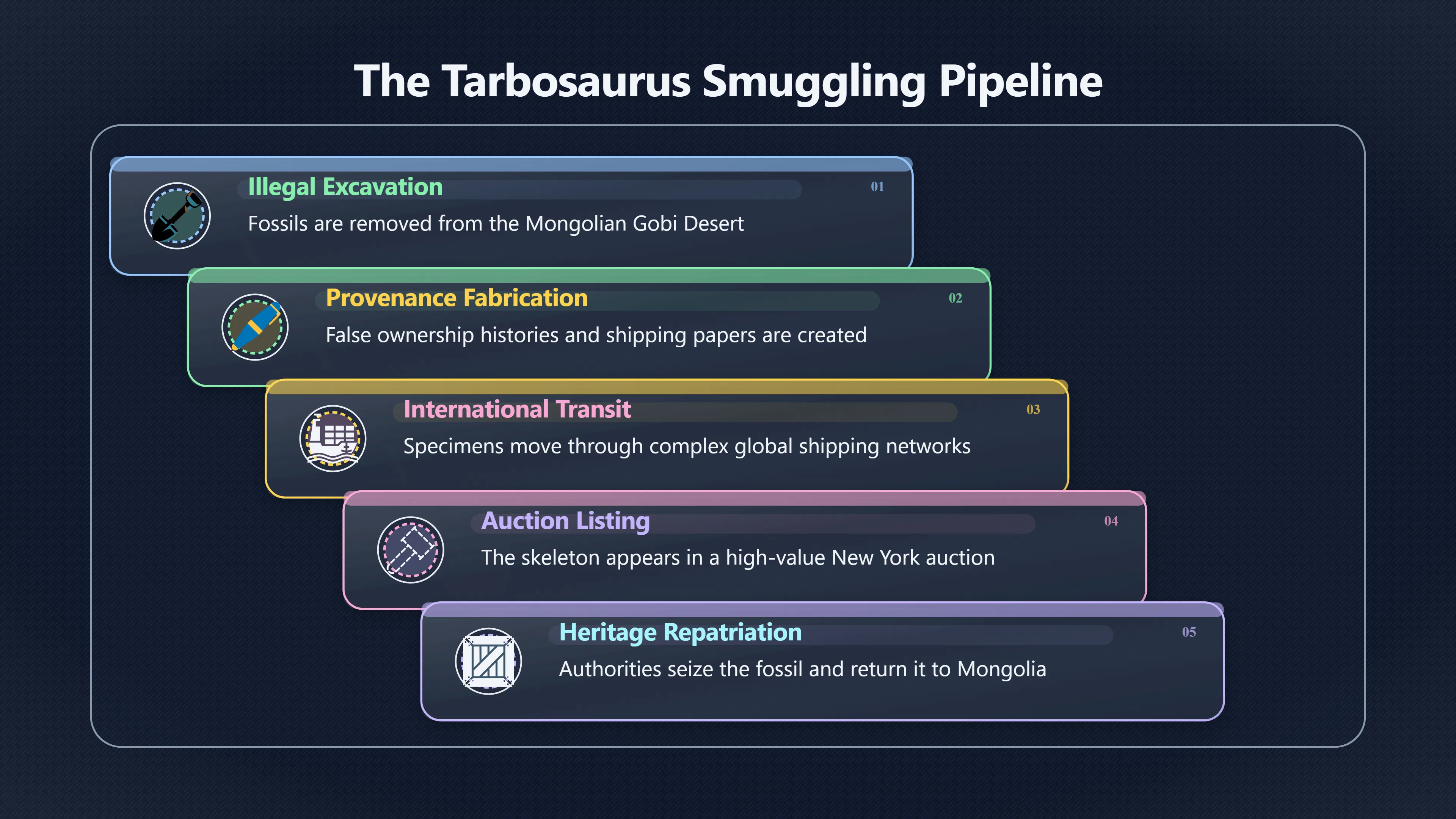
The Tarbosaurus smuggling case was not a fake dinosaur. The fossil itself was genuine, one of the most famous predatory dinosaurs ever discovered in Mongolia’s Gobi Desert. The deception lay in the paperwork. A skeleton that could not legally be exported from Mongolia became a million-dollar auction item only after its origins were disguised through misleading ownership histories, false customs declarations and invented provenance claims. When the fossil appeared for sale in New York in 2012, the resulting dispute exposed a wider international trade in illegally exported dinosaur remains and turned a commercial transaction into one of the most important heritage-repatriation cases in palaeontology.[Department of Justice]justice.govDepartment of Justice U.S. v. Eric Prokopi ComplaintDepartment of JusticeU.S. v. Eric Prokopi ComplaintOctober 17, 2012 — A Tyrannosaurus bataar skeleton stolen from Mongolia and sold at au…

For Mongolia, the episode became a powerful example of how cultural and scientific treasures can be transformed into marketable commodities through provenance fraud. The case also demonstrated how scientists, customs investigators and governments can reconstruct the true history of an object even when sellers attempt to obscure where it came from.[Department of Justice]justice.govDepartment of Justice Manhattan U.SAttorney Announces Return To Mongolia…Jul 10, 2014 — As part of his plea agreement, Prokopi consented to the forfeiture of the First B…
The million-dollar auction that triggered objections
In May 2012, Heritage Auctions in New York offered a nearly complete skeleton identified as Tyrannosaurus bataar, now more commonly known as Tarbosaurus bataar. The specimen sold for more than US$1 million, a remarkable price for a dinosaur fossil and one that attracted international attention.[Department of Justice]justice.govDepartment of Justice U.S. v. Eric Prokopi ComplaintDepartment of JusticeU.S. v. Eric Prokopi ComplaintOctober 17, 2012 — A Tyrannosaurus bataar skeleton stolen from Mongolia and sold at au…
The problem emerged almost immediately. Mongolian officials and palaeontologists recognised that Tarbosaurus bataar is overwhelmingly associated with the Gobi Desert and that Mongolia treats such fossils as protected national heritage. President Tsakhiagiin Elbegdorj publicly objected to the sale, while scientists questioned how a specimen of such obvious Mongolian origin could legally have reached an American auction house.[Wikipedia]WikipediaUnited States v. One Tyrannosaurus Bataar SkeletonUnited States v. One Tyrannosaurus Bataar Skeleton
What made the case unusual was that the challenge came before the buyer could take possession. Investigators began examining import records, ownership claims and shipping documents. Rather than being a dispute about scientific identification, it quickly became a dispute about provenance: the documented history used to establish where an object came from and whether it was legally obtained.[Center for Art Law]itsartlaw.orgCenter for Art Law Fossils Dealer Wants his Dinosaur Skeleton BackCenter for Art LawFossils Dealer Wants his Dinosaur Skeleton BackAugust 29, 2012 — 29 Aug 2012 — A New York judge ordered seizure of the…
How false provenance made stolen fossils marketable
The fossil market relies heavily on provenance. A collector buying a valuable specimen typically wants evidence showing where it was found, who owned it and whether it was legally exported. If those records appear legitimate, a fossil can enter prestigious auctions and private collections with relatively little scrutiny.
According to U.S. court documents and later investigations, the Tarbosaurus skeleton was linked to fossil dealer Eric Prokopi. Authorities alleged that fossils originating in Mongolia were moved through a chain of transactions and shipments that concealed their true source. Import documents stated that the skeleton originated in Great Britain rather than Mongolia, creating a paper trail that obscured the specimen’s actual history.[justice.gov]justice.govDepartment of Justice U.S. v. Eric Prokopi ComplaintDepartment of JusticeU.S. v. Eric Prokopi ComplaintOctober 17, 2012 — A Tyrannosaurus bataar skeleton stolen from Mongolia and sold at au…
This was the crucial act of deception. The fossil itself did not need to be forged. Instead, its biography was altered.
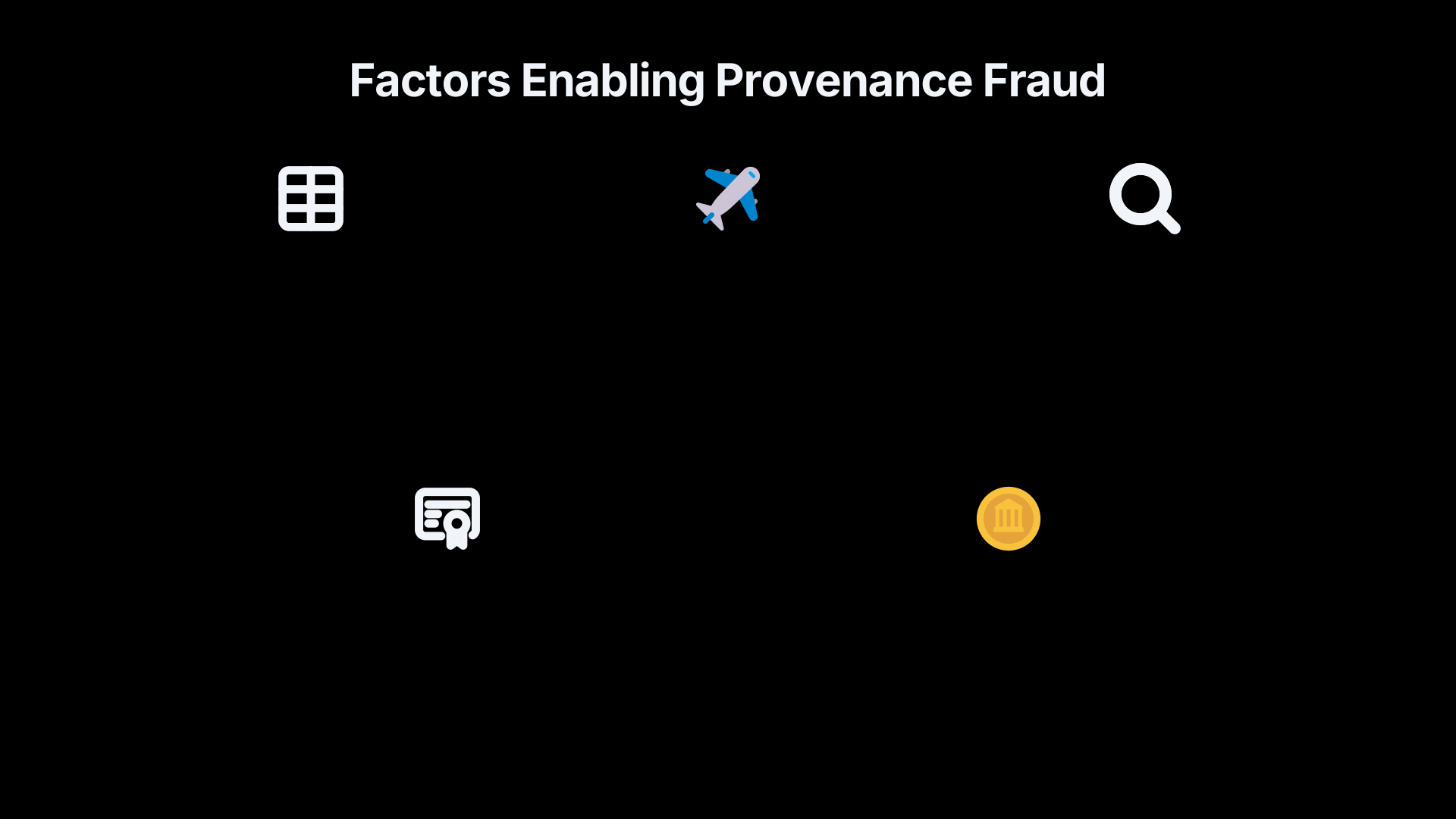
Several features made the false provenance plausible:
- Fossils are often assembled from multiple recovered bones and prepared in specialised workshops, making ownership histories complex.
- International fossil trading networks routinely involve dealers, preparators, shippers and collectors in several countries.
- Many buyers focus on whether documents exist rather than independently verifying every stage of an object’s journey.
- A specimen arriving from a country with an established commercial fossil trade can appear less legally problematic than one originating in a nation with strict heritage protections.[justice.gov]justice.govDepartment of Justice U.S. v. Eric Prokopi ComplaintDepartment of JusticeU.S. v. Eric Prokopi ComplaintOctober 17, 2012 — A Tyrannosaurus bataar skeleton stolen from Mongolia and sold at au…
Investigators later argued that the paperwork did not reflect the fossil’s true origin. Scientific evidence became important here. Experts examined the specimen and concluded that its characteristics, preservation and geological context were consistent with fossils from Mongolia’s Gobi Desert rather than the alternative histories presented in the import records.[Wikipedia]WikipediaUnited States v. One Tyrannosaurus Bataar SkeletonUnited States v. One Tyrannosaurus Bataar Skeleton
How investigators reconstructed the fossil’s real history
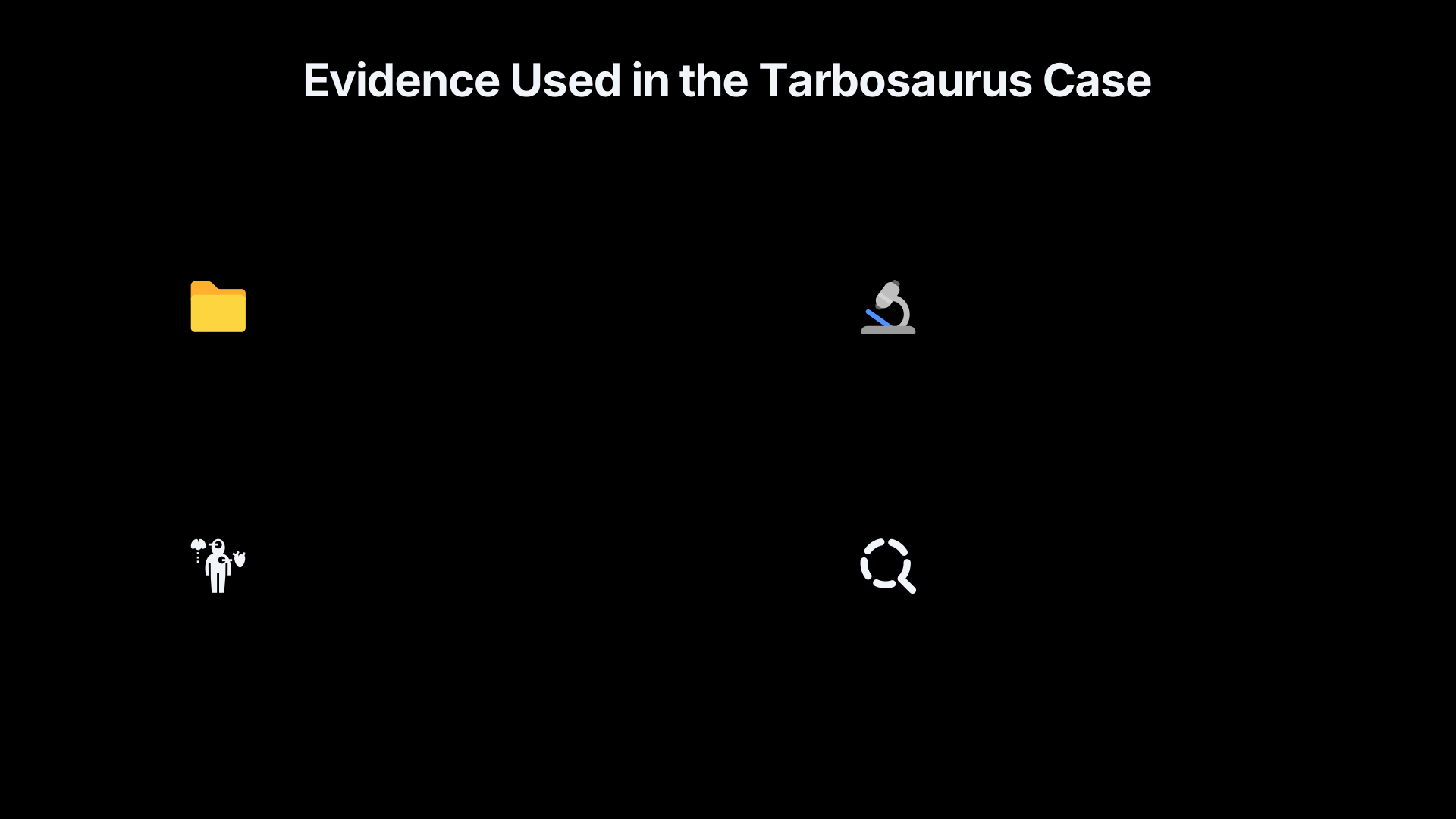
One reason the case became so influential is that it showed how provenance fraud can be challenged through multiple forms of evidence.
Customs records provided one line of inquiry. Authorities compared declarations, shipping information and descriptions supplied during importation. Investigators alleged that fossils had been described in ways that concealed their actual nature and value.[Department of Justice]justice.govDepartment of Justice U.S. v. Eric Prokopi ComplaintDepartment of JusticeU.S. v. Eric Prokopi ComplaintOctober 17, 2012 — A Tyrannosaurus bataar skeleton stolen from Mongolia and sold at au…
Palaeontological expertise provided another. Scientists noted that Tarbosaurus bataar is strongly associated with Late Cretaceous deposits in the Gobi region. Specialists argued that the specimen’s geological and anatomical characteristics pointed toward Mongolia.[Wikipedia]WikipediaUnited States v. One Tyrannosaurus Bataar SkeletonUnited States v. One Tyrannosaurus Bataar Skeleton
The case therefore combined two different kinds of investigation:
- Documentary evidence showing inconsistencies in import and ownership records.
- Scientific evidence indicating where the fossil had most likely been excavated.
Together, these strands undermined the claim that the specimen had entered the market through a legitimate chain of custody.[Department of Justice]justice.govDepartment of Justice U.S. v. Eric Prokopi ComplaintDepartment of JusticeU.S. v. Eric Prokopi ComplaintOctober 17, 2012 — A Tyrannosaurus bataar skeleton stolen from Mongolia and sold at au…
Repatriation, prosecutions and the wider fossil trade
The legal consequences extended far beyond a single skeleton. In 2012, Eric Prokopi pleaded guilty to charges connected to the illegal importation and smuggling of dinosaur fossils. As part of the case, he agreed to forfeit claims to the Tarbosaurus specimen and other Mongolian fossils recovered during the investigation.[Department of Justice]justice.govDepartment of Justice Manhattan U.SAttorney Announces Return To Mongolia…Jul 10, 2014 — As part of his plea agreement, Prokopi consented to the forfeiture of the First B…
The recovered Tarbosaurus was returned to Mongolia, where it became a public symbol of successful heritage repatriation. Subsequent actions led to the return of additional Mongolian dinosaur fossils, including other major specimens that had entered foreign collections through questionable channels.[Department of Justice]justice.govDepartment of Justice Manhattan U.SAttorney Announces Return To Mongolia…Jul 10, 2014 — As part of his plea agreement, Prokopi consented to the forfeiture of the First B…
The affair also exposed how lucrative the fossil trade had become. Rare dinosaur remains could command prices ranging from hundreds of thousands to millions of dollars. Such values created incentives for illicit excavation, smuggling and the manufacture of misleading provenance records. The Tarbosaurus case demonstrated that the most profitable part of the fraud was often not the fossil itself but the creation of a marketable legal identity for it.[justice.gov]justice.govDepartment of Justice U.S. v. Eric Prokopi ComplaintDepartment of JusticeU.S. v. Eric Prokopi ComplaintOctober 17, 2012 — A Tyrannosaurus bataar skeleton stolen from Mongolia and sold at au…
The investigation had ripple effects. Museums, auction houses and collectors faced greater pressure to scrutinise ownership histories. The case became a frequently cited example in debates over fossil ownership, repatriation and the responsibilities of commercial dealers.[Wikipedia]WikipediaUnited States v. One Tyrannosaurus Bataar SkeletonUnited States v. One Tyrannosaurus Bataar Skeleton
Why claims about Dinosaur Fraud remained persuasive
Among Mongolia’s most important episodes involving deception and heritage, the Tarbosaurus affair stands out because it was neither a mythical creature nor a forged artefact. The dinosaur was real. The fraud lay in the story attached to it.
The case illustrates a recurring pattern in the illicit antiquities and fossil trades: objects gain access to legitimate markets when their histories are rewritten. A false provenance can transform protected heritage into apparently lawful property, allowing buyers, sellers and intermediaries to treat it as an ordinary commercial asset.[Center for Art Law]itsartlaw.orgCenter for Art Law Fossils Dealer Wants his Dinosaur Skeleton BackCenter for Art LawFossils Dealer Wants his Dinosaur Skeleton BackAugust 29, 2012 — 29 Aug 2012 — A New York judge ordered seizure of the…
The exposure of the Tarbosaurus scheme showed that provenance is not merely administrative paperwork. It is evidence. When that evidence is manipulated, museums, collectors and auction houses can unknowingly become participants in a deception. The million-dollar dinosaur became famous not because it was fake, but because its supposed journey from the Gobi Desert to the auction room turned out to be a carefully constructed fiction.[justice.gov]justice.govDepartment of Justice U.S. v. Eric Prokopi ComplaintDepartment of JusticeU.S. v. Eric Prokopi ComplaintOctober 17, 2012 — A Tyrannosaurus bataar skeleton stolen from Mongolia and sold at au…
Amazon book picks
Further Reading
Books and field guides related to How Did a Mongolian Dinosaur Become British?. Use these as the next step if you want deeper reading beyond the article.
Genghis Khan and the Making of the Modern World
Keeps the reading lane anchored in Mongolian heritage and history.
The First Fossil Hunters
Explores how fossil discoveries acquire stories and interpretations.
Tyrannosaurus Sue
First published 1900. Subjects: Tyrannosaurus rex, Paleontology, Paleozoölogie, Tyrannosaurussen, History.
The dinosaur hunters
Strong gateway title for readers interested in dinosaur provenance.
eBay marketplace picks
Marketplace Samples
Live-tested eBay searches with available results related to this page.
Endnotes
1.
Source: justice.gov
Title: Department of Justice U.S. v. Eric Prokopi Complaint
Link:https://www.justice.gov/archive/usao/nys/pressreleases/October12/ProkopiArrestPR/Prokopi%2C%20Eric%20Complaint.pdf
Source snippet
Department of JusticeU.S. v. Eric Prokopi ComplaintOctober 17, 2012 — A Tyrannosaurus bataar skeleton stolen from Mongolia and sold at au...
Published: October 17, 2012
2.
Source: justice.gov
Title: Department of Justice Manhattan U.S
Link:https://www.justice.gov/usao-sdny/pr/manhattan-us-attorney-announces-return-mongolia-fossils-over-18-dinosaur-skeletons
Source snippet
Attorney Announces Return To Mongolia...Jul 10, 2014 — As part of his plea agreement, Prokopi consented to the forfeiture of the First B...
3.
Source: Wikipedia
Title: United States v. One Tyrannosaurus Bataar Skeleton
Link:https://en.wikipedia.org/wiki/United_States_v._One_Tyrannosaurus_Bataar_Skeleton
4.
Source: Wikipedia
Title: Tarbosaurus bataar
Link:https://es.wikipedia.org/wiki/Tarbosaurus_bataar
5.
Source: Wikipedia
Link:https://en.wikipedia.org/wiki/Tarbosaurus
6.
Source: Wikipedia
Title: Fossil trade
Link:https://en.wikipedia.org/wiki/Fossil_trade
7.
Source: justice.gov
Link:https://www.justice.gov/
8.
Source: Wikipedia
Title: United States Department of Justice
Link:https://en.wikipedia.org/wiki/United_States_Department_of_Justice
9.
Source: smithsonianmag.com
Title: release the tarbosaurus 125868582
Link:https://www.smithsonianmag.com/science-nature/release-the-tarbosaurus-125868582/
Source snippet
Smithsonian MagazineRelease the Tarbosaurus!19 Jun 2012 — the specimen was illegally collected from Mongolia's Gobi Desert. Official docu...
10.
Source: itsartlaw.org
Title: Center for Art Law Fossils Dealer Wants his Dinosaur Skeleton Back
Link:https://itsartlaw.org/al-clippings/fossils-dealer-wants-his-dinosaur-skeleton-back/
Source snippet
Center for Art LawFossils Dealer Wants his Dinosaur Skeleton BackAugust 29, 2012 — 29 Aug 2012 — A New York judge ordered seizure of the...
Published: August 29, 2012
11.
Source: doj.gov.ph
Title: Index:: Department of Justice
Link:https://www.doj.gov.ph/
12.
Source: doj.gov.hk
Title: Department of Justice
Link:https://www.doj.gov.hk/
13.
Source: doj.gov.in
Link:https://doj.gov.in/
Additional References
14.
Source: cbsnews.com
Title: dinosaur dealer pleads guilty to smuggling tyrannosaurus bones
Link:https://www.cbsnews.com/news/dinosaur-dealer-pleads-guilty-to-smuggling-tyrannosaurus-bones/
Source snippet
CBS News"Dinosaur dealer" pleads guilty to smuggling...Jan 3, 2013 — Eric Prokopi, 38, said he would surrender the 70 million-year-old T...
15.
Source: youtube.com
Title: U.S. Returns Fossils Of Over 18 Dinosaur Skeletons To Mongolia
Link:https://www.youtube.com/watch?v=ZZ2oBXsqJQ4
Source snippet
The Million-Dollar Dinosaur Fossil Heist: From Mongolia To New York Auction...
16.
Source: youtube.com
Title: The Million-Dollar Dinosaur Fossil Heist: From Mongolia To New York Auction
Link:https://www.youtube.com/watch?v=lLrxmQ23Qrw
Source snippet
Repatriation of a Tyrannosaurus Bataar to Mongolia...
17.
Source: youtube.com
Title: Repatriation of a Tyrannosaurus Bataar to Mongolia
Link:https://www.youtube.com/watch?v=_B2QQLZo_wk
Source snippet
U.S. Customs Returns Looted Tyrannosaurus Bataar Skeleton to Mongolia...
18.
Source: blog.everythingdinosaur.com
Link:https://blog.everythingdinosaur.com/blog/_archives/2013/01/06
Source snippet
Hunting for a Tarbosaurus – in the United KingdomFeb 11, 2023 — Last week, Floridian Eric Prokopi pleaded guilty to falsifying importatio...
19.
Source: merriam-webster.com
Link:https://www.merriam-webster.com/dictionary/DOJ
20.
Source: facebook.com
Link:https://www.facebook.com/100089649976722/posts/france-has-returned-a-stolen-70-million-year-old-tarbosaurus-bataar-skeleton-to-/841985998799725/
21.
Source: facebook.com
Link:https://www.facebook.com/WIONews/posts/france-returns-a-dinosaur-skeleton-to-mongoliathe-70-million-year-old-skeleton-w/1212596824312823/
22.
Source: facebook.com
Link:https://www.facebook.com/DOJ/
23.
Source: x.com
Link:https://x.com/TheJusticeDept
Topic Tree