Within Cape Verde Hoaxes
When Real Footage Became Political Deception
Cape Verde's 2016 presidential race showed how real footage, personal support and disaster memories could be edited into misleading political narratives.
On this page
- The 2016 presidential campaign
- Borrowed endorsements and changed context
- Contested claims after the Vicente disaster
Page outline Jump by section
Introduction
Cape Verde’s most notable documented cases of political deception are not grand conspiracies or entirely fabricated stories. Instead, they involve a subtler tactic: taking real people, real footage and real events and presenting them in a misleading context. During the 2016 presidential election, incumbent president Jorge Carlos Fonseca and independent challenger Albertino Graça competed in a campaign that produced some of the country’s clearest examples of disputed endorsements and contested political messaging. Researchers examining the election later argued that these episodes demonstrated how authentic material can be repackaged to create a false impression without requiring outright invention. The result was a form of political deception that relied on borrowed credibility rather than fabricated evidence.[Wikipedia]Wikipedia2016 Cape Verdean presidential election2016 Cape Verdean presidential election
The 2016 Presidential Campaign
The 2016 presidential election took place after a dramatic political year. The Movement for Democracy (MpD) had returned to power in parliamentary elections, while the main opposition party, the African Party for the Independence of Cape Verde (PAICV), chose not to field a presidential candidate. This left Jorge Carlos Fonseca facing two independent challengers, including Albertino Graça. Fonseca was widely regarded as the favourite and ultimately won re-election with more than 74 per cent of the vote.[Wikipedia]Wikipedia2016 Cape Verdean parliamentary election2016 Cape Verdean parliamentary election
Because the race lacked a strong party-backed challenger, much of the controversy focused less on policy differences and more on campaign communication. Subsequent academic analysis described several incidents in which endorsements, speeches and historical events were presented in ways critics argued distorted their original meaning. Rather than anonymous online rumours, many of these claims appeared through conventional campaign broadcasts and public political communication.
This distinction is important. The controversy was not primarily about forged documents or fake social-media accounts. It was about whether genuine material had been edited, framed or selectively presented to create impressions that were not supported by the full context.
Borrowed Endorsements and Changed Context
One of the most frequently discussed episodes involved António Monteiro, leader of the Democratic and Independent Cape Verdean Union (UCID), a smaller political party that occupied an important position in Cape Verde’s multiparty landscape. UCID had not formally entered the presidential race, and its members were not bound to support a single candidate.[Wikipedia]WikipediaDemocratic and Independent Cape Verdean UnionDemocratic and Independent Cape Verdean Union
According to later analyses of campaign broadcasts, footage showing Monteiro expressing support for Fonseca was presented in a way that critics said encouraged viewers to interpret the endorsement as representing UCID as a whole rather than Monteiro’s personal position. The distinction mattered politically. An endorsement from an individual politician carries a different meaning from official backing by an entire party organisation.
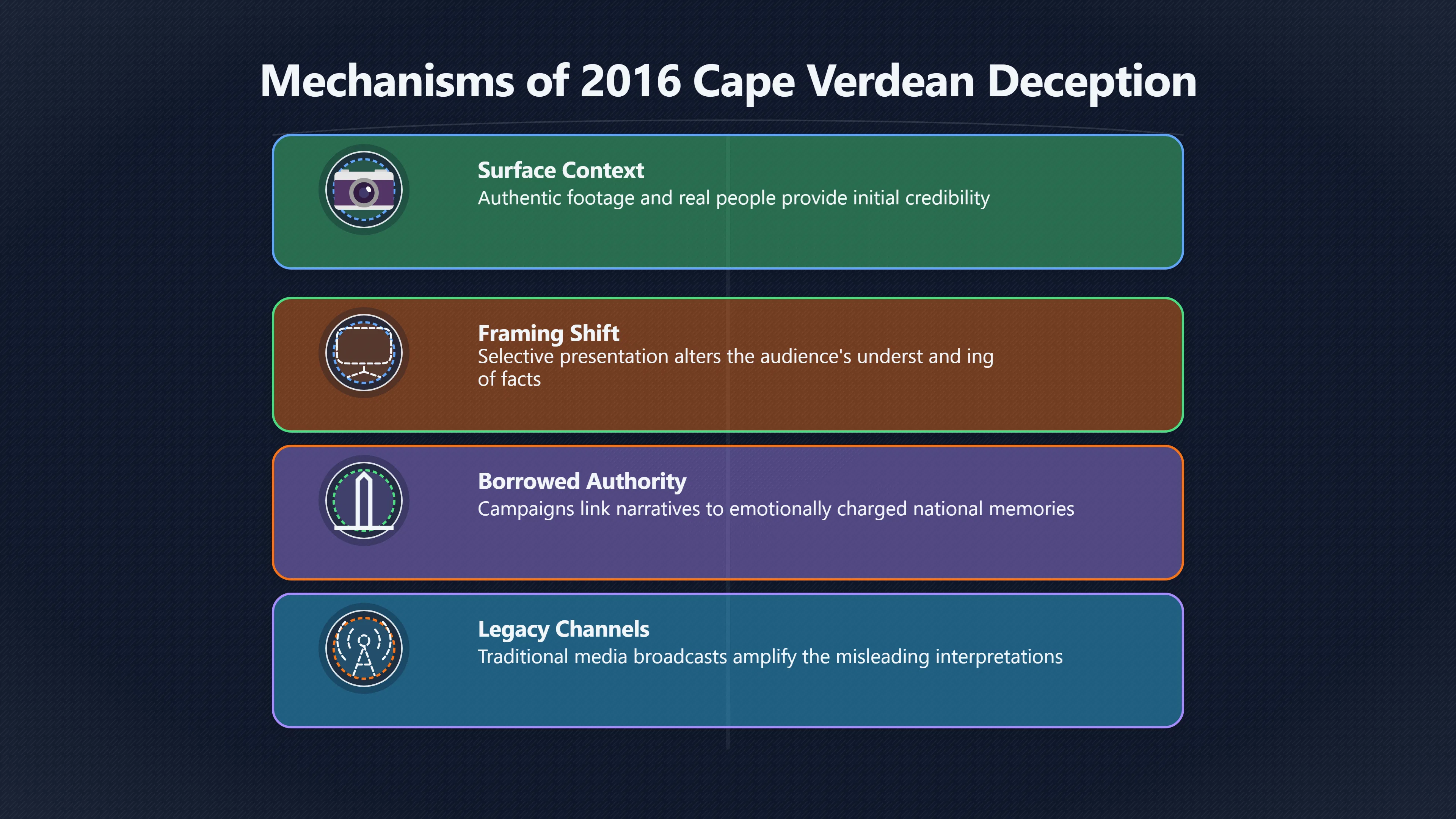
The controversy illustrates a recurring feature of modern political deception. Nothing in the footage itself needed to be fabricated. The persuasive effect came from altering the audience’s understanding of what the footage represented. Viewers were shown a real politician making real remarks, but the surrounding presentation allegedly encouraged conclusions that went beyond the facts available.
Researchers examining the election later described this as a form of “legacy disinformation” because it relied on established campaign channels and traditional political communication rather than anonymous online manipulation. The misleading element, if present, lay in context and interpretation rather than invention.
Contested Claims After the Vicente Disaster
Another disputed area concerned references to the 2015 eruption of Pico do Fogo, one of Cape Verde’s most significant natural disasters in recent decades. The eruption devastated communities, displaced residents and became a powerful national memory. Political campaigns therefore had strong incentives to associate themselves with recovery efforts and public solidarity.
During the presidential campaign, rival camps exchanged claims concerning responses to the disaster and the conduct of political figures during the recovery period. Critics argued that some campaign messages selectively highlighted events or statements in ways that exaggerated political credit or responsibility.
As with the endorsement disputes, the controversy was not primarily about fabricated evidence. Instead, it centred on how emotionally charged historical events could be repurposed for electoral advantage. The memory of a national crisis provided a persuasive backdrop because many voters already possessed strong feelings about what had happened. By linking campaign narratives to those memories, politicians could borrow the emotional authority of the disaster itself.
This mechanism helps explain why misleading political claims can be effective even when the underlying facts are genuine. Voters often evaluate messages through existing memories and loyalties. A campaign does not always need to invent a story; it may only need to emphasise selected parts of one.
The wider consequences of Campaign Claims
The 2016 election stands out in Cape Verde’s history of misinformation because it demonstrates how deception can emerge from authentic material. Unlike classic hoaxes involving forged photographs, invented identities or fabricated documents, these disputes revolved around interpretation.
Several features made the claims persuasive:
- Real people were involved. Endorsements came from identifiable public figures rather than anonymous sources.
- Authentic footage was used. The controversy concerned framing and context rather than fabricated recordings.
- Recognisable events provided credibility. References to national disasters and well-known political figures carried emotional weight.
- Traditional media channels amplified the message. The claims circulated through campaign broadcasts and public political communication, not only through informal online networks.
These characteristics make the cases particularly useful for understanding modern political deception. They show that misleading narratives often succeed by borrowing trust from genuine sources rather than by constructing entirely false stories.

A Different Kind of Political Hoax
Cape Verde’s 2016 presidential campaign occupies an unusual place in the country’s history of misinformation. It was not defined by forged evidence, fabricated scandals or spectacular conspiracy theories. Instead, it revealed how easily political communication can blur the boundary between accurate information and misleading presentation.
The disputes over endorsements and disaster-related claims demonstrate a broader lesson. In democratic politics, the most influential deception is not always a complete falsehood. Sometimes it is a real image, a real statement or a real event placed into a new setting that changes what audiences believe they are seeing. In Cape Verde, the 2016 election became one of the clearest documented examples of that process in action.[Wikipedia]Wikipedia2016 Cape Verdean presidential election2016 Cape Verdean presidential election
Amazon book picks
Further Reading
Books and field guides related to When Real Footage Became Political Deception. Use these as the next step if you want deeper reading beyond the article.
Thinking, Fast and Slow
Explains why voters and audiences can be persuaded by misleading framing.
Network Propaganda
Examines political information ecosystems and misleading narratives.
eBay marketplace picks
Marketplace Samples
Live-tested eBay searches with available results related to this page.
Endnotes
1.
Source: Wikipedia
Title: 2016 Cape Verdean presidential election
Link:https://en.wikipedia.org/wiki/2016_Cape_Verdean_presidential_election
2.
Source: Wikipedia
Title: 2016 Cape Verdean parliamentary election
Link:https://en.wikipedia.org/wiki/2016_Cape_Verdean_parliamentary_election
3.
Source: Wikipedia
Title: Democratic and Independent Cape Verdean Union
Link:https://en.wikipedia.org/wiki/Democratic_and_Independent_Cape_Verdean_Union
4.
Source: lume.ufrgs.br
Title: br Brazilian History
Link:https://lume.ufrgs.br/bitstream/10183/195627/1/001095724.pdf
Source snippet
History: - Culture, Society, Politics 1500- 2010Besides the contradictions and disputes between Brazil and its neighbors, the chapter wil...
Additional References
5.
Source: cambridge.org
Link:https://www.cambridge.org/core/services/aop-cambridge-core/content/view/955B9230244551DFFB0DC4C59153687B/9781009281843AR.pdf/Peopling_for_Profit_in_Imperial_Brazil.pdf?event-type=FTLA
Source snippet
Peopling for Profit in Imperial BrazilPeopling for Profit provides a comprehensive history of migration to nineteenth-century imperial Br...
6.
Source: rtc.cv
Link:https://www.rtc.cv/rcv/audio-details/caso-do-jovem-dario-pode-ser-discutido-com-serenidade-sem-por-em-causa-o-sistema-nacional-da-saude-11551
Source snippet
Convidado: Ex-Presidente da República, Jorge Carlos Fonseca, analisa o processo eleitoral no...
7.
Source: inlibra.com
Link:https://www.inlibra.com/10.5771/9781538111239-19.pdf
Source snippet
nment corruption, intimidation of political activists, transparency...
8.
Source: escholarship.org
Link:https://escholarship.org/content/qt8d06x1qp/qt8d06x1qp_noSplash_a07466a656645a84dd6d4f948e407bf6.pdf?t=p8rla0
Source snippet
The Crude Urban Revolution: Land Markets, Planning...This dissertation examines the relationship between petro-capitalism and urban deve...
9.
Source: youtube.com
Link:https://www.youtube.com/watch?v=p-8mxf_zQPo
Source snippet
Jorge Carlos Fonseca and José Maria Neves concerned about impasse in the election of External Bodies...
10.
Source: degro.org
Title: 16 09 Final Programme UEGweek web
Link:https://www.degro.org/wp-content/uploads/2016/10/16_09_FinalProgramme_UEGweek_web.pdf
Source snippet
Final Programme16 Oct 2016 — I warmly welcome you in Vienna for UEG Week 2016 which I am certain will be another resounding success. Mich...
11.
Source: youtube.com
Link:https://www.youtube.com/watch?v=DUcUheg-_8A
Source snippet
Cap-Vert: bilan de la gouvernance du président Jorge Carlos Fonseca...
12.
Source: portalciencia.ull.es
Link:https://portalciencia.ull.es/documentos/698b00e99e41074a91302e0f/f/698b00e99e41074a91302e10.pdf
Source snippet
ull.es25th WONCA World Conference21 Sept 2025 —... Carlos. APMGF Representative. Adam Windak. WONCA Europe, EURACT Representative. Alexa...
13.
Source: youtube.com
Title: MIT X TAU Series: Africa’s E-Governance, feat. President José Maria Neves
Link:https://www.youtube.com/watch?v=00keMxaIDNw
Source snippet
Cape Verde Elections 2026: Is democracy on the line...
14.
Source: youtube.com
Link:https://www.youtube.com/watch?v=_G71uYBp9rI
Source snippet
2026 Legislative Elections: Cape Verde hosts CPLP election observation mission...
Topic Tree