Within Ethiopia
Was Ethiopia's Famous Philosopher Invented?
The Hatata may be a landmark of Ethiopian philosophy or a missionary forgery, and the evidence still supports a serious unresolved debate.
On this page
- How the manuscript entered modern scholarship
- The case for missionary authorship
- Why scholars reopened the question
Page outline Jump by section
Introduction
Was Ethiopia’s most famous philosopher a real seventeenth-century thinker, or the invention of a nineteenth-century missionary? That question lies at the heart of the Hatata authorship dispute, one of the most unusual controversies in African intellectual history. The text known as the Hatata (“Inquiry”) is traditionally attributed to Zera Yacob, an Ethiopian philosopher who supposedly wrote it in the 1600s. Its arguments about reason, religion, morality and human equality have led some readers to compare it with major European Enlightenment thinkers. Yet for more than a century, scholars have argued over whether the work is genuinely Ethiopian or a later fabrication created by an Italian missionary.[Taylor & Francis Online]tandfonline.comTaylor & Francis Online An Ethiopian Descartes?A French Zera Yacob? Comparison…Even more than his philosophical genius, Zera Yacob is known for his potentially having never existed…

Unlike many famous hoaxes, this is not a case in which a forged object was exposed and discarded. The surviving manuscript tradition is real. The dispute concerns authorship, provenance and historical credibility. The result is a rare intellectual mystery in which evidence has accumulated on both sides, and where debates about colonial assumptions, textual scholarship and African philosophy have become almost as important as the manuscript itself.[OpenEdition Journals]journals.openedition.orgIntroduction: Investigating an Investigation. Aïssatou…Read more…
How the Manuscript Entered Modern Scholarship
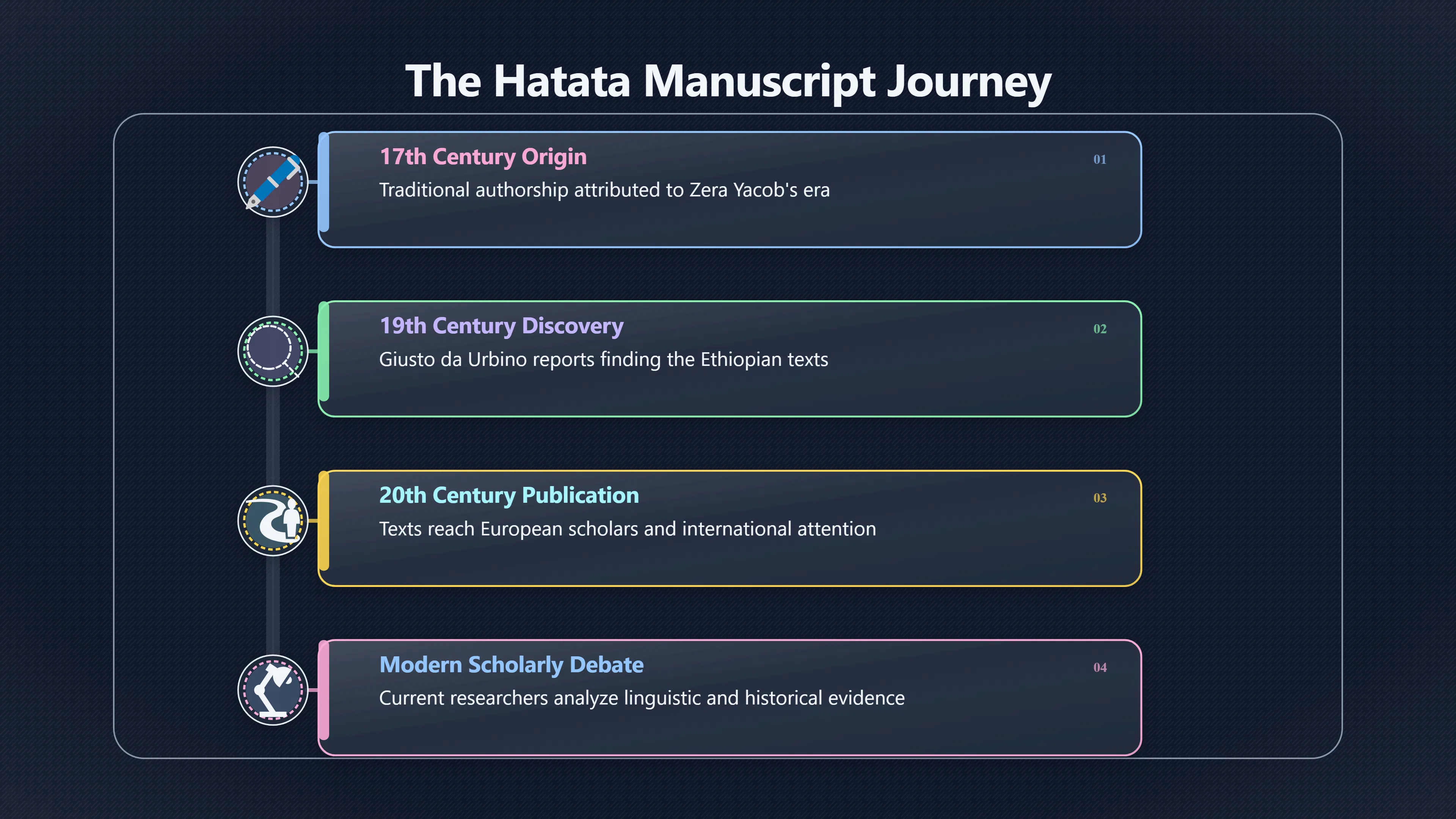
The Hatata became known to European scholars through the Capuchin missionary Giusto da Urbino, who worked in Ethiopia during the nineteenth century. He reported discovering manuscripts attributed to Zera Yacob and his follower Walda Heywat. These texts eventually reached scholars and were published in the early twentieth century, bringing an apparently unknown Ethiopian philosophical tradition to international attention.[Wikipedia]WikipediaZera Yacob (philosopherZera Yacob (philosopher
The work immediately attracted notice because its contents seemed remarkable. Rather than presenting theology in the usual style of religious commentary, the author described using reason to test religious claims, criticised sectarian disputes and argued that truth should be judged through rational examination rather than inherited authority. Such themes appeared unexpectedly similar to ideas associated with early modern European philosophy.[intellectualhistory.web.ox.ac.uk]intellectualhistory.web.ox.ac.ukin search of zera yacob philosophy in early modern ethiopiaIn Search of Zera Yacob: Philosophy in Early Modern Ethiopia9 Apr 2022 — The philosopher constructed arguments for the existence of God…
For supporters of the text’s authenticity, this was evidence that sophisticated philosophical reasoning emerged independently within Ethiopia’s own intellectual traditions. For sceptics, the resemblance to European rationalism seemed suspicious from the beginning.[Cambridge University Press & Assessment]cambridge.orgOpen source on cambridge.org.
Why Some Scholars Suspected a Forgery
The forgery theory emerged most prominently with the Italian orientalist Carlo Conti Rossini in the 1920s. He argued that the Hatata had probably been composed not by a seventeenth-century Ethiopian philosopher but by Giusto da Urbino himself. Later, the German scholar Eugen Mittwoch supported aspects of this sceptical interpretation.[Wikipedia]WikipediaZera Yacob (philosopherZera Yacob (philosopher
Several points fuelled suspicion:
- The manuscripts surfaced late. No known manuscript could be securely dated to Zera Yacob’s lifetime. The texts entered scholarly circulation through a nineteenth-century intermediary rather than through a long documented manuscript tradition.[Wikipedia]WikipediaZera Yacob (philosopherZera Yacob (philosopher
- The discoverer had the necessary skills. Giusto da Urbino knew Ethiopian languages and religious literature, meaning he possessed the technical ability to compose such a work if he wished.[Wikipedia]WikipediaZera Yacob (philosopherZera Yacob (philosopher
- The philosophy appeared unusually modern. Some early scholars doubted that a text expressing such strong rationalist themes could have emerged from seventeenth-century Ethiopia. Their scepticism often rested on broader assumptions about what kinds of intellectual traditions were thought possible in Africa.[Cambridge University Press & Assessment]cambridge.orgOpen source on cambridge.org.
- Questions about literary form. Critics argued that aspects of the autobiography and philosophical presentation looked unusual when compared with better-known Ethiopian religious writing.[OpenEdition Journals]journals.openedition.orgIntroduction: Investigating an Investigation. Aïssatou…Read more…
These arguments never produced a definitive proof of forgery. Instead, they created a climate of doubt that reduced scholarly interest in the text for decades.[Wikipedia]WikipediaZera Yacob (philosopherZera Yacob (philosopher
Why Scholars Reopened the Question
The debate changed significantly during the second half of the twentieth century. The most influential defence of authenticity came from the Canadian philosopher and Jesuit scholar Claude Sumner, who devoted years to studying Ethiopian philosophy and the Hatata manuscripts.[Wikipedia]WikipediaZera Yacob (philosopherZera Yacob (philosopher
Sumner challenged the forgery theory on several fronts. He examined archival material relating to Giusto da Urbino and argued that the missionary’s known writings, linguistic habits and theological outlook differed substantially from those found in the Hatata. He also questioned whether a missionary would have had a convincing motive for carrying out such an elaborate deception and then keeping it hidden.[Wikipedia]WikipediaZera Yacob (philosopherZera Yacob (philosopher
Subsequent scholars revisited the language of the text itself. Some argued that its style reflected Ethiopian literary traditions and forms of expression that would have been difficult for a foreign missionary to imitate convincingly. Others pointed to features associated with local intellectual culture rather than imported European philosophy.[insightsjournal.org]insightsjournal.orgOpen source on insightsjournal.org.
The result was not a simple victory for one side. Instead, the dispute evolved from broad suspicion into a more detailed investigation of manuscripts, language, historical context and intellectual history.[OpenEdition Journals]journals.openedition.orgIntroduction: Investigating an Investigation. Aïssatou…Read more…
The New Evidence and the Modern Debate
In recent years the controversy has been revived rather than settled. Historians and philologists have re-examined the manuscript history and the circumstances under which the texts became known. Among the most influential recent contributions are studies by Anaïs Wion and collaborators, who reconstructed the complicated journey of the manuscripts through missionary and scholarly networks.[OpenEdition Journals]journals.openedition.orgIntroduction: Investigating an Investigation. Aïssatou…Read more…
This newer research does not simply repeat the old forgery claim. Instead, it highlights genuine puzzles:
- The manuscript trail remains incomplete.
- The relationship between the surviving copies and any original text is uncertain.
- Some aspects of the narrative surrounding discovery and transmission raise historical questions.
- The intellectual uniqueness of the work still demands explanation.[OpenEdition Journals]journals.openedition.orgIntroduction: Investigating an Investigation. Aïssatou…Read more…
At the same time, other specialists continue to defend Ethiopian authorship. Recent editors and translators who have worked closely with the texts argue that prolonged linguistic and textual analysis supports the conclusion that they were composed by Ethiopian authors rather than by a European missionary.[Wikipedia]WikipediaOpen source on wikipedia.org.
The modern dispute therefore differs from the older one. The strongest contemporary scholars rarely present the issue as a simple choice between obvious authenticity and obvious fraud. Instead, they debate how manuscript evidence, literary style, historical context and colonial-era assumptions should be weighed against one another.[tandfonline.com]tandfonline.comTaylor & Francis Online An Ethiopian Descartes?A French Zera Yacob? Comparison…Even more than his philosophical genius, Zera Yacob is known for his potentially having never existed…

Was This a Hoax, a Misattribution, or an Unresolved Mystery?
The Hatata controversy occupies an unusual place in Ethiopia’s history of contested truths because the central object is not fake. The manuscripts exist, and the philosophical work itself is genuine as a historical text. The question is whether the traditional attribution is correct.[OpenEdition Journals]journals.openedition.orgIntroduction: Investigating an Investigation. Aïssatou…Read more…
If the sceptical position were ultimately proven, the case would resemble a literary forgery or pseudonymous work rather than a conventional hoax. If the traditional attribution is correct, then the controversy would instead represent a long episode in which African intellectual achievement was doubted because it did not fit prevailing assumptions about the history of philosophy.[Cambridge University Press & Assessment]cambridge.orgOpen source on cambridge.org.
What makes the case enduringly fascinating is that both interpretations carry major implications. One would reveal an extraordinarily ambitious nineteenth-century intellectual deception. The other would confirm the existence of a major early modern Ethiopian philosopher whose work survived despite centuries of neglect and scepticism.[Taylor & Francis Online]tandfonline.comTaylor & Francis Online An Ethiopian Descartes?A French Zera Yacob? Comparison…Even more than his philosophical genius, Zera Yacob is known for his potentially having never existed…
Why the Debate Still Matters
The Hatata dispute survives because it is about more than authorship. It touches on wider questions about how knowledge is authenticated, whose intellectual traditions are considered credible, and how colonial-era scholarship shaped the study of Africa. Even scholars who disagree about the text’s origins often agree that the controversy itself has become historically significant.[Cambridge University Press & Assessment]cambridge.orgOpen source on cambridge.org.
Today the dominant position among many specialists is more cautious than either the old scepticism or the strongest claims of certainty. The forgery hypothesis remains part of the discussion, but so do substantial arguments for Ethiopian authorship. Rather than a solved scandal, the Hatata remains one of the most intriguing unresolved authorship disputes in African history—a case where the evidence continues to be examined, and where the investigation itself has become part of the story.[oapen.org]library.oapen.orgLibrary[PDF] In Search of Zär'a Ya‛ǝqobLibrary[PDF] In Search of Zär'a Ya‛ǝqob
Amazon book picks
Further Reading
Books and field guides related to Was Ethiopia's Famous Philosopher Invented?. Use these as the next step if you want deeper reading beyond the article.
A History of Ethiopia
Supplies context for the intellectual and religious environment.
African Philosophy
First published 1991. Subjects: African Philosophy, Philosophy, Aufsatzsammlung, Afrikaanse filosofie, Philosophie.
eBay marketplace picks
Marketplace Samples
Live-tested eBay searches with available results related to this page.




Endnotes
1.
Source: intellectualhistory.web.ox.ac.uk
Title: in search of zera yacob philosophy in early modern ethiopia
Link:https://intellectualhistory.web.ox.ac.uk/article/in-search-of-zera-yacob-philosophy-in-early-modern-ethiopia
Source snippet
In Search of Zera Yacob: Philosophy in Early Modern Ethiopia9 Apr 2022 — The philosopher constructed arguments for the existence of God...
2.
Source: journals.openedition.org
Link:https://journals.openedition.org/afriques/3154
Source snippet
Introduction: Investigating an Investigation. Aïssatou...Read more...
3.
Source: journals.openedition.org
Link:https://journals.openedition.org/afriques/3178?lang=en
Source snippet
OpenEdition JournalsThe History of a Genuine Fake Philosophical Treatise...18 Oct 2021 — The present article is the first in a series de...
4.
Source: Wikipedia
Title: Zera Yacob (philosopher)
Link:https://en.wikipedia.org/wiki/Zera_Yacob_%28philosopher%29
5.
Source: Wikipedia
Link:https://en.wikipedia.org/wiki/Hatata
6.
Source: Wikipedia
Title: Ethiopian philosophy
Link:https://en.wikipedia.org/wiki/Ethiopian_philosophy
7.
Source: cambridge.org
Link:https://www.cambridge.org/core/journals/hegel-bulletin/article/hegel-and-the-hatata-zara-yaeqob-africa-in-the-philosophy-of-history-and-the-history-of-philosophy/84406A55A4A91EA580F022985A3862CB
8.
Source: aeon.co
Title: from the pseudo to the forger the value of faked philosophy
Link:https://aeon.co/essays/from-the-pseudo-to-the-forger-the-value-of-faked-philosophy
Source snippet
A 17th-century classic of Ethiopian philosophy might be a fake. Does it matter, or is that just how philosophy works? by...Read more...
9.
Source: library.oapen.org
Title: Library[PDF] In Search of Zär’a Ya‛ǝqob
Link:https://library.oapen.org/bitstream/handle/20.500.12657/94328/9783110725810.pdf?isAllowed=y&sequence=1
10.
Source: insightsjournal.org
Link:https://insightsjournal.org/reason-knowledge-and-prayer-the-philosophy-of-xera-yaaqob/
11.
Source: tandfonline.com
Title: Taylor & Francis Online An Ethiopian Descartes?
Link:https://www.tandfonline.com/doi/abs/10.1080/09608788.2025.2611833
Source snippet
A French Zera Yacob? Comparison...Even more than his philosophical genius, Zera Yacob is known for his potentially having never existed...
Additional References
12.
Source: youtube.com
Title: African Philosophy & the Enlightenment
Link:https://www.youtube.com/watch?v=KUicQL-Vz8c
Source snippet
In Search of Zera Yacob: On an Early Modern Ethiopian Philosopher & Whether He Existed...
13.
Source: youtube.com
Title: The Forgotten African philosopher: Zer’a Yaqob
Link:https://www.youtube.com/watch?v=y3fKvCnW024
Source snippet
Ethiopian Philosophy: The Life and Legacy of Zera Yacob...
14.
Source: jopafl.com
Link:https://www.jopafl.com/uploads/issue32/TESHOME_ETHIOPIAN_PHILOSOPHICAL_WORK_HATATA_HISTORICAL_SOCIAL_REALITY.pdf
15.
Source: researchgate.net
Link:https://www.researchgate.net/publication/375478195_The_Authorship_of_the_Hatata_Inquiries
16.
Source: blog.degruyter.com
Link:https://blog.degruyter.com/the-enduring-influence-of-ethiopian-philosophys-most-enigmatic-texts/
17.
Source: reddit.com
Link:https://www.reddit.com/r/Africa/comments/1c9l647/the_radical_philosophy_of_the_hatata_a_17th/
18.
Source: academia.edu
Link:https://www.academia.edu/143652921/Z%C3%A4r_a_Ya_%C7%9Dqob_and_W%C3%A4ld%C3%A4%E1%B8%A4%C7%9Dyw%C3%A4t_Exceptionality_and_Situatedness_of_the%E1%B8%A4at%C3%A4tas_in_the_Ethiopian_Intellectual_Tradition
19.
Source: researchgate.net
Link:https://www.researchgate.net/publication/328929105_Zera_Yacob%27s_Hatata_and_the_vitality_of_an_Indigenous_Ethiopian_Philosophy
20.
Source: youtube.com
Title: What is Ethiopian Philosophy?
Link:https://www.youtube.com/watch?v=R1SuB-cKJDY
Source snippet
The Forgotten African philosopher: Zer'a Yaqob...
21.
Source: jonathanegid.com
Link:https://www.jonathanegid.com/in-search-of-zera-yacob
Topic Tree