Within Guinea Bissau
Why False Claims Spread So Fast
Political instability, private messaging and weak verification networks let reused images, partisan claims and false health advice travel quickly.
On this page
- The political actors and channels behind misleading material
- Why private messages and reused images feel convincing
- How journalists and public agencies can verify claims
Page outline Jump by section
Introduction
In Guinea-Bissau, rumours rarely spread through a single channel. They move through overlapping networks of conversation, local radio broadcasts, Facebook posts and, increasingly, WhatsApp groups. This does not mean that false claims are uniquely common in the country. Rather, the combination of political uncertainty, limited professional media resources, strong interpersonal trust networks and widespread mobile-phone use creates conditions in which unverified information can travel faster than corrections. Studies of Guinea-Bissau’s misinformation environment consistently identify political actors, activists and supporters as important distributors of misleading content, especially during periods of political tension.[CDD]cddwestafrica.orgl media platforms and blogs, to…Read more…

For readers interested in Guinea-Bissau’s history of contested truth, the key question is not simply what false claims were made. It is how they moved. Radio and WhatsApp form a particularly important combination because one provides public legitimacy while the other provides rapid, private circulation. Together they can turn a local rumour into a national talking point within hours.
Why False Claims Spread So Fast
Guinea-Bissau has long relied on oral communication networks. In many communities, information is trusted because it comes from relatives, neighbours, religious figures, local leaders or familiar radio presenters rather than from anonymous institutions. As mobile-phone access expanded, WhatsApp became an extension of these existing trust networks rather than a replacement for them.[Google Books]books.google.comGoogle BooksWhatsApp and Everyday Life in West Africa: Beyond Fake…WhatsApp is the most popular messaging platform in over 80% of coun…
Several features make rumours especially resilient:
- Information gaps during crises. Political disputes, military interventions and contested elections often create periods when official information is incomplete or contradictory. Rumours flourish when people are seeking answers that institutions cannot immediately provide.[CDD]cddwestafrica.orgl media platforms and blogs, to…Read more…
- High trust in personal contacts. A message forwarded by a family member or community figure may appear more credible than a correction issued by a distant authority.[Google Books]books.google.comGoogle BooksWhatsApp and Everyday Life in West Africa: Beyond Fake…WhatsApp is the most popular messaging platform in over 80% of coun…
- Limited verification resources. Guinea-Bissau has a relatively small media sector, meaning there are fewer organisations able to rapidly investigate and debunk viral claims.[CDD]cddwestafrica.orgl media platforms and blogs, to…Read more…
- Speed of mobile messaging. WhatsApp allows the same claim, image or voice note to be forwarded repeatedly across dozens of groups before fact-checkers become aware of it. Research from multiple countries shows that private messaging systems can accelerate the circulation of misinformation because outsiders cannot easily monitor or challenge what is being shared.[arXiv]arxiv.orgA Dataset of Fact-Checked Images Shared on WhatsApp During the Brazilian and Indian ElectionsMay 5, 2020…
The result is not a population that believes everything it hears. Rather, it is an environment where verification often arrives later than the original story.
The Political Actors and Channels Behind Misleading Material
Research by the Centre for Democracy and Development (CDD-West Africa) found that political misinformation in Guinea-Bissau is frequently connected to party activists, supporters, bloggers and politically engaged social-media users. During periods of political competition, misleading claims can be used to attack rivals, mobilise supporters or create confusion about unfolding events.[CDD]cddwestafrica.orgl media platforms and blogs, to…Read more…
Radio remains important because it reaches audiences that may have limited internet access. Community and local stations often serve as primary news sources, especially outside the capital. Even when a rumour originates online, discussion on radio programmes can dramatically increase its visibility. Conversely, statements heard on radio can be recorded, clipped and redistributed through WhatsApp groups, giving them a second life far beyond the original broadcast.[Wikipedia]WikipediaTelecommunications in Guinea-BissauTelecommunications in Guinea-Bissau
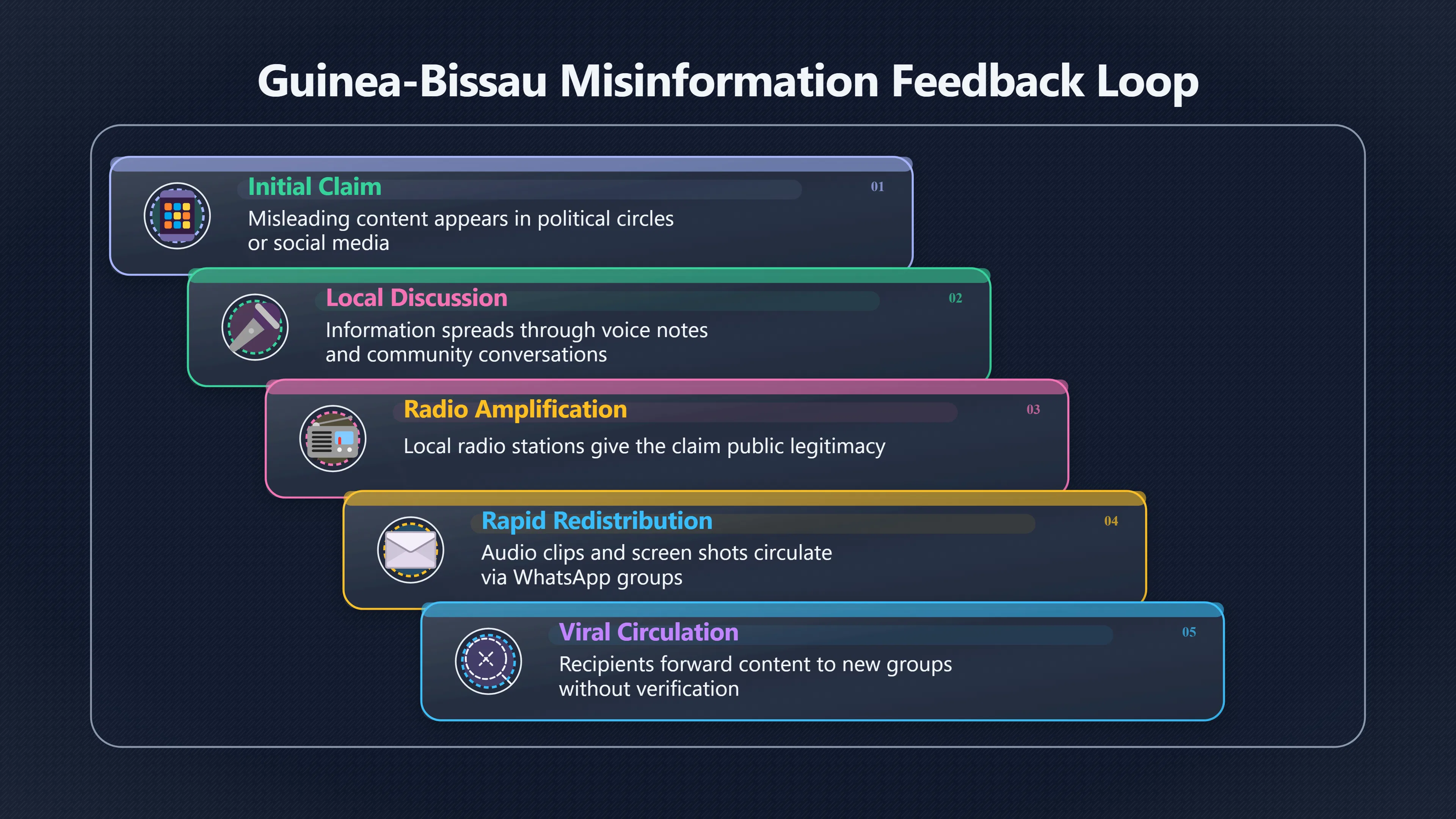
This interaction creates a feedback loop:
- A claim appears on social media or in political circles.
- It is discussed in conversations, voice notes or local networks.
- Radio coverage, commentary or mention gives the claim greater visibility.
- Audio clips, screenshots or summaries are shared through WhatsApp.
- Recipients forward the material to new groups, often without checking its origin.
By the time journalists investigate, many people may already have encountered multiple versions of the same story.
Why Private Messages and Reused Images Feel Convincing
One of the most effective forms of misinformation in Guinea-Bissau has involved images or videos taken from unrelated events and presented as evidence of something happening locally. The CDD-West Africa study identified images as particularly powerful because they can cross literacy barriers and create an immediate sense of authenticity.[CDD]cddwestafrica.orgl media platforms and blogs, to…Read more…
A photograph does not need to be altered to mislead. An old image from another country can be attached to a new caption and transformed into apparent proof of a political allegation, public disorder or government action. Once detached from its original context, the image gains persuasive power because recipients feel they are seeing evidence rather than hearing a claim.[cddwestafrica.org]cddwestafrica.orgl media platforms and blogs, to…Read more…
WhatsApp voice notes have a similar effect. Unlike text messages, they sound personal and urgent. A speaker may claim to possess insider knowledge, present themselves as a health worker or government employee, or describe events as though they witnessed them directly. Recipients often evaluate the confidence of the speaker rather than the quality of the evidence.
This helps explain why rumours can spread rapidly even when they are later shown to be inaccurate. The emotional impact of a familiar voice or dramatic image often arrives before careful scrutiny.

Health Rumours During the COVID-19 Pandemic
The COVID-19 pandemic provided one of the clearest examples of how misinformation moved through WhatsApp networks in Guinea-Bissau. In 2020, UNICEF publicly warned about false messages circulating online that promoted incorrect health advice and unsupported claims about preventing infection.[UNICEF]unicef.orgOpen source on unicef.org.
Health misinformation was particularly dangerous because it often appeared practical and reassuring. Messages frequently offered simple remedies, prevention methods or explanations that seemed easier to understand than evolving scientific guidance. During a period of uncertainty, these claims could spread quickly through family and community groups.[UNICEF]unicef.orgOpen source on unicef.org.
Public-health agencies responded by using many of the same communication channels. Radio broadcasts, community outreach programmes, social-media campaigns and fact-checking initiatives were deployed to counter rumours and distribute verified information. International organisations and local partners recognised that combating misinformation required more than issuing corrections; it required reaching the same trusted networks through which rumours were travelling.[unmissions.org]uniogbis.unmissions.orgun guinea bissau helps combating fake news advance covid 19 responseun guinea bissau helps combating fake news advance covid 19 response
The pandemic illustrated a broader lesson: rumours thrive when fear, uncertainty and limited information coincide.
How Journalists and Public Agencies Can Verify Claims
Because many rumours circulate in private messaging spaces, debunking them is often more difficult than correcting a false newspaper article or public speech. Journalists may not even know a claim is spreading until it has already reached large audiences.[arXiv]arxiv.orgOpen source on arxiv.org.
Several verification approaches have become increasingly important in Guinea-Bissau:[Wikipedia]WikipediaTelecommunications in Guinea-BissauTelecommunications in Guinea-Bissau
Checking Images and Videos
Journalists can use reverse-image search tools and archive searches to determine whether a photograph first appeared elsewhere. This is particularly effective against recycled images attached to false local claims.[Media Foundation for West Africa]mfwa.orgfake news and mis-disinformation in Guinea Bissau. Peace journalism training for 30 social media influencers. The training is aimed at en…
Verifying Through Multiple Sources
Claims that originate in a single WhatsApp message should be compared with official statements, independent reporting and eyewitness accounts before being repeated publicly. This is especially important during elections, security incidents and political crises.[CDD]cddwestafrica.orgl media platforms and blogs, to…Read more…
Building Fact-Checking Networks
Guinea-Bissau has seen efforts to strengthen local fact-checking capacity, including initiatives that train journalists and social-media communicators to identify misinformation and verify digital content. Fact-checking projects created during the COVID-19 period were designed specifically to challenge viral rumours before they became widely accepted.[unmissions.org]uniogbis.unmissions.orgun guinea bissau helps combating fake news advance covid 19 responseun guinea bissau helps combating fake news advance covid 19 response

Using Trusted Community Channels
Corrections are often most effective when delivered through the same networks that spread the original rumour. Community radio, local leaders, health workers and respected journalists can sometimes reach audiences more effectively than formal government announcements.[who.int]cdn.who.intOpen source on who.int.
What Rumour Networks Reveal About Guinea-Bissau
The spread of rumours through radio and WhatsApp in Guinea-Bissau is less a story about technology than about trust. False claims travel successfully when they appear to come from familiar people, trusted institutions or convincing evidence. Radio lends public visibility; WhatsApp supplies speed, privacy and personal endorsement.
The most important lesson is that misinformation rarely succeeds because of a single fabricated message. It succeeds when political uncertainty, social trust and communication technology reinforce one another. In Guinea-Bissau, understanding those networks helps explain why some rumours fade quickly while others continue circulating long after the original claim has been challenged.
Amazon book picks
Further Reading
Books and field guides related to Why False Claims Spread So Fast. Use these as the next step if you want deeper reading beyond the article.
The Misinformation Age
Directly addresses how false claims spread through social networks.
eBay marketplace picks
Marketplace Samples
Example marketplace items related to this page. Use the search link to explore similar finds on eBay.



Endnotes
1.
Source: cddwestafrica.org
Title: guinea bissau s fake news ecosystem an overview
Link:https://www.cddwestafrica.org/reports/guinea-bissau-s-fake-news-ecosystem-an-overview/
Source snippet
CDDGuinea Bissau's Fake News Ecosystem: An Overview1 Feb 2022 — Guinea Bissau's Fake News Ecosystem: An Overview. Misinformation involves...
2.
Source: books.google.com
Link:https://books.google.com/books/about/WhatsApp_and_Everyday_Life_in_West_Afric.html?id=GLxeEAAAQBAJ
Source snippet
Google BooksWhatsApp and Everyday Life in West Africa: Beyond Fake...WhatsApp is the most popular messaging platform in over 80% of coun...
3.
Source: arxiv.org
Link:https://arxiv.org/abs/2005.02443
Source snippet
A Dataset of Fact-Checked Images Shared on WhatsApp During the Brazilian and Indian ElectionsMay 5, 2020...
Published: May 5, 2020
4.
Source: arxiv.org
Link:https://arxiv.org/abs/2005.09784
5.
Source: arxiv.org
Link:https://arxiv.org/abs/2308.14782
6.
Source: Wikipedia
Title: Telecommunications in Guinea-Bissau
Link:https://en.wikipedia.org/wiki/Telecommunications_in_Guinea-Bissau
7.
Source: Wikipedia
Title: COVID-19 pandemic in Guinea-Bissau
Link:https://en.wikipedia.org/wiki/COVID-19_pandemic_in_Guinea-Bissau
8.
Source: unicef.org
Link:https://www.unicef.org/guineabissau/press-releases/unicef-alerts-spreading-false-messages-increase-risk-misinformation-about-corona
9.
Source: uniogbis.unmissions.org
Title: un guinea bissau helps combating fake news advance covid 19 response
Link:https://uniogbis.unmissions.org/en/news/un-guinea-bissau-helps-combating-fake-news-advance-covid-19-response
10.
Source: facebook.com
Title: Social Media, Fake news & Elections in Africa
Link:https://www.facebook.com/themfwa/posts/wameca-2019-social-media-fake-news-elections-in-africa/2241206892614834/
11.
Source: facebook.com
Link:https://www.facebook.com/Ecowas.Cedeao/posts/the-gambia-and-ecowas-launch-west-africas-first-strategic-national-response-cent/1277844014521222/
12.
Source: cddwestafrica.org
Link:https://www.cddwestafrica.org/uploads/reports/file/A-Report-on-Fake-News-in-Guinea-Bissau-1.pdf
Source snippet
l media platforms and blogs, to...Read more...
13.
Source: mfwa.org
Link:https://mfwa.org/issues-in-focus/140-journalists-media-managers-and-social-media-influencers-in-guinea-bissau-to-benefit-from-fact-checking-peace-journalism-training/
Source snippet
fake news and mis-disinformation in Guinea Bissau. Peace journalism training for 30 social media influencers. The training is aimed at en...
14.
Source: cdn.who.int
Link:https://cdn.who.int/media/docs/default-source/evaluation-office/collective_service_evaluation_case_studies.pdf?download=true&sfvrsn=aacc612b_3
Additional References
15.
Source: cigionline.org
Title: disinformation is undermining democracy in west africa
Link:https://www.cigionline.org/articles/disinformation-is-undermining-democracy-in-west-africa/
Source snippet
CIGIDisinformation Is Undermining Democracy in West Africa4 Jul 2022 — Political actors and supporters of political parties use cloned, f...
16.
Source: youtube.com
Title: Coronavirus in Africa: Debunking fake news and myths around Covid-19
Link:https://www.youtube.com/watch?v=yDowVv6zVTo
Source snippet
WhatsApp launches first TV campaign to fight misinformation in India...
17.
Source: idrc-crdi.ca
Title: disinformation africa lessons west
Link:https://idrc-crdi.ca/en/stories/disinformation-africa-lessons-west
Source snippet
To combat this phenomenon effectively, local realities must be taken into account.Read more...
18.
Source: youtube.com
Title: Tackling Misinformation in West Africa
Link:https://www.youtube.com/watch?v=2Frvqy1BEq8
Source snippet
CheckPoint Podcast | Fake news understood WhatsApp first...
19.
Source: youtube.com
Title: Misinformation deepens divides in Burkina Faso
Link:https://www.youtube.com/watch?v=Xi7RXWC7liA
Source snippet
Coronavirus in Africa: Debunking fake news and myths around Covid-19...
20.
Source: youtube.com
Title: Check Point Podcast | Fake news understood Whats App first
Link:https://www.youtube.com/watch?v=PqDAtqm5W-4
Source snippet
Misinformation deepens divides in Burkina Faso...
21.
Source: academia.edu
Link:https://www.academia.edu/43624427/Whatsapp_Fake_News_And_African_Elections_Between_Political_Turmoil_And_Liberation_Technology_
22.
Source: researchgate.net
Link:https://www.researchgate.net/publication/392505422_From_Fake_News_to_Real_Protests_WhatsApp%27s_Role_in_Brazilian_Political_Coordination
23.
Source: adonis-abbey.com
Link:https://www.adonis-abbey.com/pdf/3982_article.pdf
24.
Source: africtivistes.com
Link:https://africtivistes.com/en/news/our-releases/
Topic Tree