How the Netherlands Learned to Spot a Fake
The Netherlands has produced some of Europe’s most revealing stories of forged history, fabricated evidence and carefully staged deception.
Page outline Jump by section
Introduction
These episodes matter because they show that successful deceptions rarely depend on technical brilliance alone. They work by giving audiences something they already expect or want: a lost national past, a newly discovered masterpiece, a dramatic scientific result, a moral warning or an emotionally irresistible television spectacle. Exposure usually comes only when investigators examine the physical evidence, the chain of ownership, the original data or the incentives behind the story.
Falsehood in the Dutch Republic
Long before social media, the Dutch Republic possessed a highly developed information market. Printers, pamphleteers and engravers could distribute political allegations, forged documents and misleading images rapidly across a literate, commercially connected society. Research at Leiden University has identified fabricated publications from the sixteenth to the eighteenth centuries that were presented not as jokes but as authentic texts, sometimes under invented names or false publishing details.[Universiteit Leiden]universiteitleiden.nlthe dutch were masters of forgeries and fake news in the seventeenth centurymore…
The political crisis of 1672 offers a particularly grim example of what misinformation could do. During the “Disaster Year”, the Republic was invaded by France, England and two German states. Johan de Witt, the dominant statesman of the preceding period, became a target for pamphlets and rumours blaming him for military failure and portraying him as a traitor. Leiden researchers working with De Witt’s correspondence have compared the circulation of such material through taverns and public spaces with the rapid spread of hostile claims through modern social networks.[Leiden University Staff]staff.universiteitleiden.nlLeiden University StaffLetters of Johan de Witt give a glimpse behind the scenes…31 Oct 2022 — Louis XIV Entering the Netherlands at L…
Johan and his brother Cornelis were murdered by a mob in The Hague in August 1672. It would be too simple to say that fake news alone caused the killings: war, political rivalry, Orangist agitation, fear and institutional breakdown all mattered. Yet fabricated accusations helped turn a political dispute into a story of treachery demanding punishment. The episode demonstrates an enduring feature of propaganda: a false claim becomes especially dangerous when it supplies a clear villain during a confusing emergency.[University of Waikato]waikato.ac.nzfake news and real cannibalism a cautionary tale from the dutch golden ageUniversity of WaikatoFake news and real cannibalism: a cautionary tale from the…10 Jun 2025 — In 1672, enraged by a fake news campaign…
The ancient book that was not ancient
The Oera Linda Book appeared in Friesland in the nineteenth century as an alleged chronicle of an extraordinarily ancient civilisation. Cornelis Over de Linden brought the manuscript to public attention in 1867, claiming that it had been preserved in his family. Its story stretched back thousands of years and described a freedom-loving Frisian people, female religious leaders, migrations, disasters and a lost land associated with Atlantis.[Wikipedia]WikipediaOera Linda BookOera Linda Book
The book arrived at a persuasive moment. Across nineteenth-century Europe, scholars and enthusiasts were searching for ancient epics, national origins and supposedly pure ancestral cultures. A manuscript that placed the Frisians near the centre of world history could therefore appeal simultaneously to regional pride, romantic nationalism and interest in lost civilisations. Jan Gerhardus Ottema, a respected member of the Frisian historical establishment, translated and published it in 1872 as a genuine ancient text. His authority gave the manuscript a legitimacy its contents alone could not have supplied.[Wikipedia]WikipediaOera Linda BookOera Linda Book
Linguists soon identified problems. The language was not authentic Old Frisian but an artificial mixture containing anachronisms, puns and forms suggestive of modern composition. Its history also drew on nineteenth-century ideas rather than evidence from antiquity. By the late 1870s, scholars generally regarded it as a recent forgery or literary hoax.[Groningen Research Portal]research.rug.nlGemaskeerde GodGemaskeerde God
The precise authorship and original intention remain less certain than the verdict on its age. Historian Goffe Jensma has argued that the clergyman and poet François Haverschmidt probably played a central role, with Cornelis Over de Linden and librarian Eelco Verwijs also involved. In this interpretation, the work may have begun as a sophisticated parody intended to expose literal readings of sacred and national histories. Once Ottema and others accepted it, revealing the joke became socially difficult.[Groningen Research Portal]research.rug.nlGemaskeerde GodGemaskeerde God
That ambiguity explains part of the book’s afterlife. A satire can become a forgery when it is allowed to circulate as authentic, and a discredited forgery can later become scripture for a new audience. The Oera Linda Book was revived by racial mystics and was promoted in Germany by Herman Wirth, who treated it as evidence of an ancient northern civilisation. It still appears in occult, Atlantis and alternative-history literature. Its survival does not reflect strong evidence; it reflects the power of a text that offers believers a grander ancestry than conventional history permits.[Wikipedia]WikipediaOera Linda BookOera Linda Book
Tulip mania: a real crash wrapped in a myth
The Dutch tulip trade of the 1630s was real. Rare bulbs became fashionable luxury goods, contracts changed hands at rising prices, and the market abruptly weakened in early 1637. What is doubtful is the familiar story in which the entire Dutch population abandoned ordinary work, traded houses for flowers and was ruined when the bubble burst.
Historian Anne Goldgar’s examination of contracts, legal records and the social networks of traders found a much narrower episode. Participation was concentrated among interconnected merchants and skilled craftspeople rather than encompassing every social class. Some rare bulbs commanded remarkable prices, and broken agreements damaged reputations and relationships, but the crash did not wreck the Dutch economy or impoverish the country on a mass scale.[uchicago.edu]press.uchicago.eduOpen source on uchicago.edu.
Much of the dramatic imagery came from contemporary moralising pamphlets. Writers hostile to speculation portrayed bulb traders as fools corrupted by greed, using comic tales and exaggerated scenes rather than neutral economic reporting. In 1841, Scottish journalist Charles Mackay repeated and amplified many of these stories in Extraordinary Popular Delusions and the Madness of Crowds. His entertaining account became more influential than the incomplete archival evidence.[The Guardian]theguardian.comThe Guardian Tulipmania: Money, Honor, and Knowledge in the DutchThe Guardian Tulipmania: Money, Honor, and Knowledge in the Dutch
Tulip mania is therefore best described as a debunked national legend built around a genuine event, not as an entirely invented hoax. Prices rose and fell, contracts failed and contemporaries experienced a crisis of trust. The distortion lies in converting a limited and culturally charged market dispute into a tale of nationwide insanity.
The legend persists because it is useful. Journalists, investors and politicians can invoke “tulip mania” whenever they need a ready-made comparison for an unfamiliar asset. A complicated episode involving luxury collecting, credit, honour and contract law becomes a simple fable: foolish crowds chase worthless objects and are punished. That moral clarity helps the story survive even after historians have dismantled its most colourful claims.[Twente Research Info System]ris.utwente.nlTwente Research Info System Tulipmania: Money, Honor, and Knowledge in the DutchTwente Research Info System Tulipmania: Money, Honor, and Knowledge in the Dutch
Han van Meegeren and the Vermeers experts wanted to see
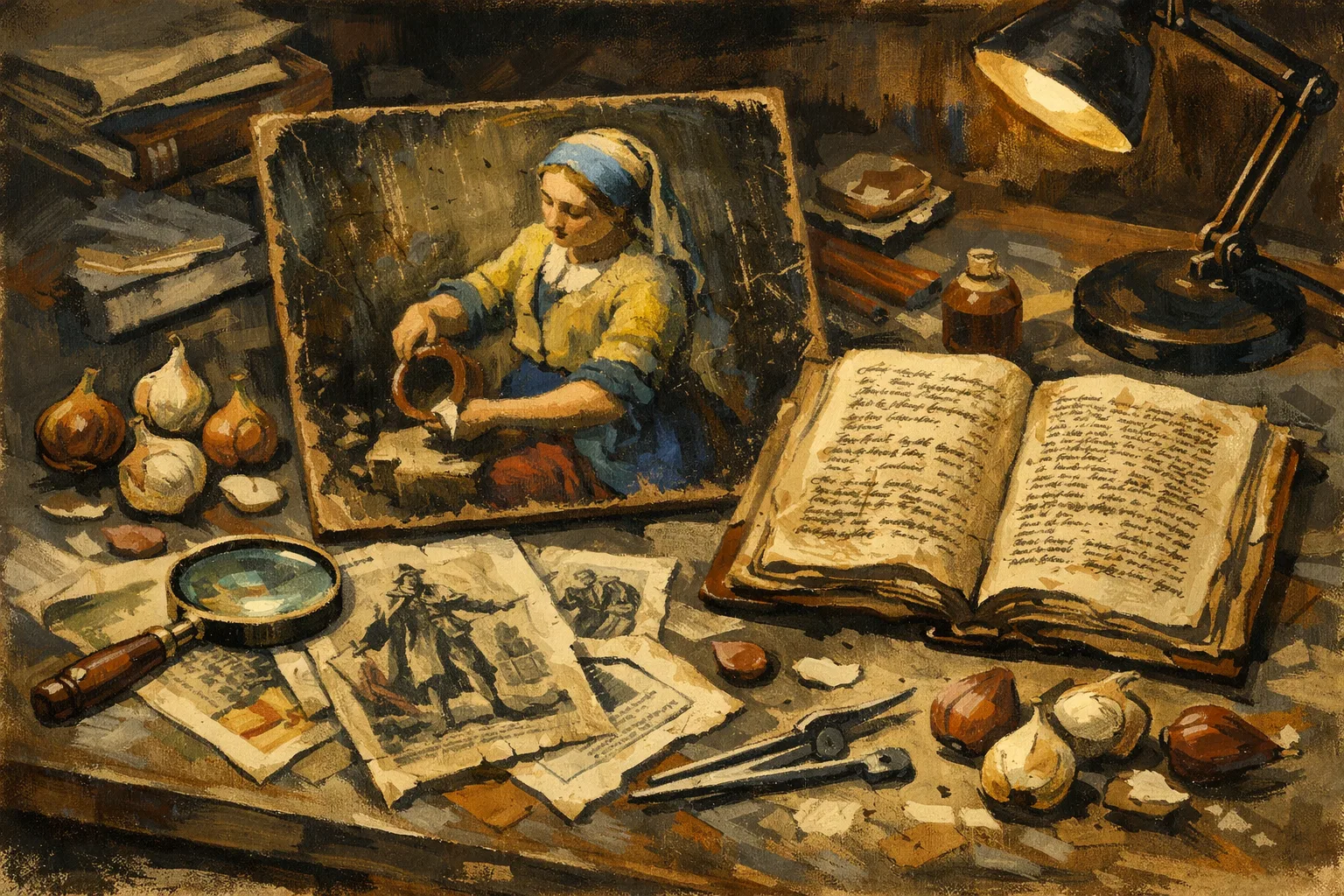
Han van Meegeren’s forged Vermeers remain the most famous art deception associated with the Netherlands. His achievement was not to copy an existing Vermeer perfectly. Instead, he created paintings that appeared to fill a gap in the artist’s career: large religious scenes supposedly produced during an early, poorly documented period.
That strategy exploited uncertainty. Only a small number of accepted Vermeer paintings existed, and scholars believed that missing works might transform understanding of his development. Van Meegeren gave experts not the familiar domestic interiors they knew, but the discovery they hoped might exist.
His most celebrated forgery, The Supper at Emmaus, was authenticated by the prominent art historian Abraham Bredius and acquired in 1937 by Museum Boijmans in Rotterdam as an extraordinary Vermeer. The museum now identifies it openly as Van Meegeren’s work and calls it the most famous forgery in Dutch art history.[Museum Boijmans Van Beuningen]boijmans.nlOpen source on boijmans.nl.
Van Meegeren improved his chances by working on old canvases and using materials designed to withstand examination. More importantly, he understood connoisseurship. The painting looked convincing partly because an influential expert had already developed theories about a biblical phase in Vermeer’s career. Authentication became circular: the new painting appeared to confirm the theory, while the theory made the painting seem plausible.[Essential Vermeer]essentialvermeer.comOpen source on essentialvermeer.com.
The fraud unravelled after the Second World War. Investigators discovered that a supposed Vermeer had reached Hermann Göring, raising the possibility that Van Meegeren had sold a Dutch national treasure to a senior Nazi. Facing a potentially grave collaboration case, he confessed that the painting was his own forgery. Because the claim seemed almost unbelievable, he demonstrated his technique by producing another imitation under observation. He was ultimately convicted of forgery and fraud rather than treason.[Le Monde.fr]lemonde.frLe Monde.fr Faux et faussaires. 2|6: le vieil homme et VermeerVan Meegeren vend ses faux à prix d'or, y compris à Hermann Göring pendant la Seconde Guerre mondiale, ce qui entraîne son arrestation à…
Popular retellings often transform him into a patriotic trickster who humiliated Göring. That version is satisfying but incomplete. Van Meegeren had been enriching himself by deceiving museums, collectors and scholars before the Göring transaction, and later research has complicated the image of an apolitical avenger. The Nazi buyer became part of the forger’s defence and legend, not the original purpose of the scheme.[The New Yorker]newyorker.comOpen source on newyorker.com.
The case changed art authentication by showing how easily prestige can reinforce error. Scientific examination is important, but provenance—the documented history of ownership—can be even more revealing. A masterpiece that appears suddenly, conveniently confirms a scholar’s theory and lacks a reliable chain of custody should provoke more questions, not fewer.
Stone tools, courtroom doubt and the Vermaning affair
Tjerk Vermaning was an amateur archaeologist who reported important Stone Age discoveries in the northern Netherlands. His finds appeared to establish a substantial Neanderthal presence in Drenthe and brought him public recognition, including a provincial cultural award. For a self-taught collector working outside the academic establishment, the discoveries represented both personal vindication and a major contribution to regional prehistory.[Drents Museum]drentsmuseum.nlthe vermaning affairthe vermaning affair
Specialists later concluded that some of the objects showed signs inconsistent with genuine ancient tools. Questions concerned their surfaces, weathering, manufacturing traces and archaeological circumstances. The objects had not emerged from securely documented excavations in the way archaeologists would normally require for exceptional claims. Vermaning was arrested in 1975 and convicted of fraud at his first trial.[Wikipedia]WikipediaTjerk VermaningTjerk Vermaning
On appeal in 1978, however, he was acquitted because the court did not consider it proved that he personally had forged the pieces. That legal result is crucial. An acquittal establishes that criminal responsibility was not proved to the necessary standard; it does not establish that the artefacts were archaeologically authentic. Professional opinion continued to reject the disputed finds, while supporters treated the court decision as evidence that Vermaning had been persecuted by an academic elite.[Wikipedia]WikipediaTjerk VermaningTjerk Vermaning
The affair became larger than the stones themselves. It opened a lasting divide between professional archaeologists, who emphasised context and laboratory analysis, and some amateur collectors, who saw institutional arrogance and exclusion. The Drents Museum’s later exhibition treated the episode as both a forgery controversy and a human conflict rather than reducing it to a simple villain-and-detective story.[Drents Museum]drentsmuseum.nlthe vermaning affairthe vermaning affair
Vermaning’s case illustrates why forged antiquities can be unusually divisive. A painting may be evaluated partly as an isolated object, but an archaeological artefact derives much of its meaning from exactly where and how it was found. Once that context is missing or unreliable, even a plausible-looking object loses much of its evidential value.
Diederik Stapel and data that were too good
Scientific fraud can appear less theatrical than a forged manuscript or painting, but it exploits many of the same weaknesses. Diederik Stapel, a prominent Dutch social psychologist, fabricated or manipulated data across a long series of studies conducted while he worked at universities in Amsterdam, Groningen and Tilburg.
The fraud was exposed in 2011 after junior researchers at Tilburg University became suspicious. Stapel often claimed that he had personally arranged data collection through schools or other institutions, then supplied collaborators with neat datasets ready for analysis. By controlling access to the supposed participants and raw collection process, he prevented colleagues from checking whether the experiments had occurred as described.[Tilburg University]tilburguniversity.eduTilburg University Flawed science: The fraudulent research practices of socialTilburg University Flawed science: The fraudulent research practices of social
The joint university investigation found fraudulent data in 55 published papers and in work connected with ten doctoral theses. Its report concluded that co-authors and doctoral researchers were not complicit, although some had failed to question improbable results or inadequate documentation.[Tilburg University]tilburguniversity.eduTilburg University Flawed science: The fraudulent research practices of socialTilburg University Flawed science: The fraudulent research practices of social
Why did the deception last? Stapel supplied findings that were orderly, striking and easy to publish. Messy real-world data had been replaced by patterns shaped to fit attractive hypotheses. He also occupied a position of authority, while the division of labour in large research projects allowed co-authors to analyse datasets they had not collected themselves.
The official report did not treat the affair solely as the wrongdoing of one unusually dishonest individual. It also criticised a research culture that rewarded surprising results, tolerated poor data management and offered too few incentives for replication. Subsequent policy discussions in Dutch psychology called for better archiving, openness and supervision.[Tilburg University]tilburguniversity.eduTilburg University Flawed science: The fraudulent research practices of socialTilburg University Flawed science: The fraudulent research practices of social
Stapel’s fraud is a useful counterweight to the idea that expertise automatically protects a community from deception. Experts can be fooled precisely through professional trust. Science corrects errors most effectively when evidence can be inspected independently rather than accepted because of a researcher’s reputation.
The kidney show that weaponised outrage
On 1 June 2007, Dutch broadcaster BNN aired The Big Donor Show. Its premise appeared grotesque: a terminally ill woman would choose which of three patients should receive one of her kidneys. Viewers were invited to participate, and the programme generated international condemnation before it was broadcast.[The Guardian]theguardian.comThe Guardian TV kidney donor show revealed as hoax to provoke debateThe Guardian TV kidney donor show revealed as hoax to provoke debate
At the end, presenter Patrick Lodiers revealed that the supposed donor was an actress. The three prospective recipients were real patients who knew about the deception, and no kidney was being awarded. BNN and producer Endemol said the stunt was intended to draw attention to the shortage of organ donors and pressure the Dutch government to reform donation policy.[The Guardian]theguardian.comThe Guardian TV kidney donor show revealed as hoax to provoke debateThe Guardian TV kidney donor show revealed as hoax to provoke debate
Unlike Van Meegeren’s fraud, the programme was designed to be exposed. Its creators needed journalists, politicians and viewers to believe the premise temporarily so that their outrage would amplify the issue. The deception was therefore closer to an activist media stunt than a conventional scam: its immediate beneficiaries sought publicity and political impact rather than secret financial profit.
The ethical problem did not disappear when the truth was revealed. Medical ethicists questioned whether a good cause justified manipulating patients’ suffering and public trust. The programme succeeded as publicity partly because it resembled the most exploitative possibilities of reality television. Viewers believed it because television had already normalised increasingly intimate competitions, public voting and personal crisis as entertainment.[PMC]pmc.ncbi.nlm.nih.govPMCThe dangers of triage by televisionPMCThe dangers of triage by television
The episode demonstrates a central tension in benevolent hoaxes. Exposure may produce relief and discussion, but it can also reward institutions for making future claims less trustworthy. A stunt that says “we deceived you for a worthy reason” still asks audiences to accept that the deceiver should decide when dishonesty is justified.
The false claim that Anne Frank’s diary was forged
The allegation that Anne Frank’s diary is a forgery is not an unresolved authenticity debate. It is a repeatedly disproved claim promoted chiefly by Holocaust deniers. The distinction matters because presenting the issue as two equally plausible positions reproduces the propagandists’ preferred framing.
After Anne’s death, her father Otto Frank prepared a published edition using the surviving diary, notebooks and revised pages. Editing and combining versions did not mean inventing the underlying text. Anne herself had begun revising her diary after hearing a radio appeal for wartime documents that might eventually be published.[Anne Frank Website]annefrank.orgOpen source on annefrank.org.
Following Otto Frank’s death, the Netherlands Institute for War Documentation commissioned extensive forensic research. Examiners compared the handwriting with known examples and analysed the paper, glue and ink. The materials were consistent with those available during the period in which Anne wrote, and the handwriting was identified as hers.[Full Fact]fullfact.orgFull Fact Diary of Anne Frank not written by American novelist afterFull Fact Diary of Anne Frank not written by American novelist after
One recurring allegation concerns ballpoint pen marks, supposedly impossible during the wartime period. The claim distorts the evidence. The diary itself was written mainly in fountain-pen ink and pencil. Limited ballpoint annotations came from later examination notes and were not part of Anne’s text.[Anne Frank Website]annefrank.orgOpen source on annefrank.org.
The forgery story survives because it serves an ideological purpose. If a famous personal record of persecution can be made to seem manufactured, deniers can encourage broader doubt about documentary evidence from the Holocaust. Repetition is part of the method: a technical-sounding allegation about ink or handwriting may reach people who do not know that it was investigated decades ago.
The persistence of the claim has had consequences in the Netherlands. In 2023, an antisemitic slogan referring to the ballpoint myth was projected onto the Anne Frank House in Amsterdam. The stunt showed how a long-debunked fabrication can be repackaged for new media while retaining its original political function.[AP News]apnews.comAP News Amsterdam Anne Frank museum targeted with antisemitic textAP News Amsterdam Anne Frank museum targeted with antisemitic text
Why these deceptions worked
The Dutch cases differ in motive and seriousness, but several recurring mechanisms connect them.
They filled a desired gap. The Oera Linda Book supplied an ancient Frisian civilisation; Van Meegeren supplied a missing phase in Vermeer’s career; Vermaning’s tools supplied dramatic evidence of Neanderthals in the northern Netherlands. A discovery can be most seductive when it completes a story experts or communities already hope is true.
Authority carried the claim. Ottema’s scholarship, Bredius’s connoisseurship, Stapel’s professorship and television’s apparent access to real patients all reduced the perceived need for independent verification. Prestige did not create the false evidence, but it helped circulate and protect it.
The evidence was difficult to inspect. Van Meegeren controlled his paintings’ provenance, Stapel controlled his supposed data collection, and the creators of The Big Donor Show controlled what viewers could see. Deception thrives when audiences receive a finished result but cannot examine how it was produced.
Emotion accelerated belief. National pride, wartime anger, reverence for masterpieces, sympathy for patients and fear of moral decline made detached checking harder. The emotional direction varied, but the mechanism was similar: audiences reacted before they had access to the full evidence.
Exposure did not end the story. Van Meegeren became a folk hero, the Oera Linda Book entered occult literature, tulip mania remained a financial parable and Anne Frank forgery claims continued in denial networks. A correction competes not merely with an incorrect fact but with a memorable narrative that fulfils a social or political need.
The most reliable defence is therefore not general cynicism. It is disciplined attention to provenance, original records, physical testing, reproducible methods and the difference between legal, historical and scientific conclusions. The history of Dutch hoaxes shows that falsehood is most persuasive when it resembles the truth a particular audience is already prepared to welcome.
Amazon book picks
Further Reading
Books and field guides related to How the Netherlands Learned to Spot a Fake. Use these as the next step if you want deeper reading beyond the article.
Extraordinary Popular Delusions and the Madness of Crowds
Rating: 4.0/5 from 5 Google Books ratings
Includes the famous traditional tulip mania narrative.
The Demon-Haunted World
Rating: 4.5/5 from 43 Google Books ratings
Provides a broad framework for spotting deception.
eBay marketplace picks
Marketplace Samples
Live-tested eBay searches with available results related to this page.

Endnotes
1.
Source: Wikipedia
Title: Oera Linda Book
Link:https://en.wikipedia.org/wiki/Oera_Linda_Book
2.
Source: reviews.history.ac.uk
Link:https://reviews.history.ac.uk/review/666/print/
3.
Source: Wikipedia
Title: Tulip mania
Link:https://en.wikipedia.org/wiki/Tulip_mania
4.
Source: boijmans.nl
Link:https://www.boijmans.nl/collectie/kunstwerken/101464/de-emmauesgangers
5.
Source: Wikipedia
Title: Tjerk Vermaning
Link:https://en.wikipedia.org/wiki/Tjerk_Vermaning
6.
Source: pmc.ncbi.nlm.nih.gov
Title: PMCThe dangers of triage by television
Link:https://pmc.ncbi.nlm.nih.gov/articles/PMC1889948/
7.
Source: Wikipedia
Title: The Diary of a Young Girl
Link:https://en.wikipedia.org/wiki/The_Diary_of_a_Young_Girl
8.
Source: boijmans.nl
Title: the men at emmaus
Link:https://www.boijmans.nl/en/collection/artworks/101464/the-men-at-emmaus
9.
Source: storage.boijmans.nl
Title: Xw Wx Gnihb MOn Js ZA2yf HJKIrs Dvs Qhw CZx BBVJm7
Link:https://storage.boijmans.nl/uploads/2017/06/26/XwWxGnihbMOnJsZA2yfHJKIrsDvsQhwCZxBBVJm7.pdf
10.
Source: hoaxes.org
Link:https://hoaxes.org/weblog/comments/tulipmania
11.
Source: hoaxes.org
Link:https://hoaxes.org/af_database/display/category/benelux
12.
Source: Wikipedia
Title: Fake news
Link:https://en.wikipedia.org/wiki/Fake_news
13.
Source: Wikipedia
Title: Diederik Stapel
Link:https://en.wikipedia.org/wiki/Diederik_Stapel
14.
Source: Wikipedia
Title: Han van Meegeren
Link:https://en.wikipedia.org/wiki/Han_van_Meegeren
15.
Source: Wikipedia
Title: De Grote Donorshow
Link:https://en.wikipedia.org/wiki/De_Grote_Donorshow
16.
Source: Wikipedia
Title: List of hoaxes
Link:https://en.wikipedia.org/wiki/List_of_hoaxes
17.
Source: universiteitleiden.nl
Title: the dutch were masters of forgeries and fake news in the seventeenth century
Link:https://www.universiteitleiden.nl/en/news/2024/03/the-dutch-were-masters-of-forgeries-and-fake-news-in-the-seventeenth-century
Source snippet
more...
18.
Source: staff.universiteitleiden.nl
Link:https://www.staff.universiteitleiden.nl/news/2022/10/letters-of-johan-de-witt-give-a-glimpse-into-the-disaster-year-of-1672
Source snippet
Leiden University StaffLetters of Johan de Witt give a glimpse behind the scenes...31 Oct 2022 — Louis XIV Entering the Netherlands at L...
19.
Source: waikato.ac.nz
Title: fake news and real cannibalism a cautionary tale from the dutch golden age
Link:https://www.waikato.ac.nz/int/news-events/news/fake-news-and-real-cannibalism-a-cautionary-tale-from-the-dutch-golden-age/
Source snippet
University of WaikatoFake news and real cannibalism: a cautionary tale from the...10 Jun 2025 — In 1672, enraged by a fake news campaign...
20.
Source: historicmysteries.com
Title: oera linda
Link:https://www.historicmysteries.com/history/oera-linda/24821/
21.
Source: research.rug.nl
Title: Gemaskeerde God
Link:https://research.rug.nl/files/14673054/GemaskeerdeGod.PDF
22.
Source: press.uchicago.edu
Link:https://press.uchicago.edu/Misc/Chicago/301259.html
23.
Source: theguardian.com
Title: The Guardian Tulipmania: Money, Honor, and Knowledge in the Dutch
Link:https://www.theguardian.com/books/2008/oct/11/anne-goldgar
24.
Source: ris.utwente.nl
Title: Twente Research Info System Tulipmania: Money, Honor, and Knowledge in the Dutch
Link:https://ris.utwente.nl/ws/files/268792103/Article.pdf
25.
Source: newyorker.com
Link:https://www.newyorker.com/magazine/2008/10/27/dutch-master
26.
Source: essentialvermeer.com
Link:https://www.essentialvermeer.com/misc/van_meegeren.html
27.
Source: lemonde.fr
Title: Le Monde.fr Faux et faussaires. 2|6: le vieil homme et Vermeer
Link:https://www.lemonde.fr/idees/article/2016/07/20/faux-et-faussaires-2-6-le-vieil-homme-et-vermeer_4972266_3232.html
Source snippet
Van Meegeren vend ses faux à prix d'or, y compris à Hermann Göring pendant la Seconde Guerre mondiale, ce qui entraîne son arrestation à...
28.
Source: drentsmuseum.nl
Title: the vermaning affair
Link:https://drentsmuseum.nl/en/exhibitions/the-vermaning-affair
29.
Source: tilburguniversity.edu
Title: Tilburg University Flawed science: The fraudulent research practices of social
Link:https://www.tilburguniversity.edu/sites/default/files/download/Final%20report%20Flawed%20Science_2.pdf
30.
Source: theguardian.com
Title: The Guardian TV kidney donor show revealed as hoax to provoke debate
Link:https://www.theguardian.com/media/2007/jun/02/realitytv.independentproductioncompanies
31.
Source: annefrank.org
Link:https://www.annefrank.org/en/anne-frank/diary/
32.
Source: fullfact.org
Title: Full Fact Diary of Anne Frank not written by American novelist after
Link:https://fullfact.org/online/anne-frank-diary-ballpoint-pen-meyer-levin-false-claim/
33.
Source: annefrank.org
Link:https://www.annefrank.org/en/anne-frank/go-in-depth/authenticity-diary-anne-frank/
34.
Source: apnews.com
Title: AP News Amsterdam Anne Frank museum targeted with antisemitic text
Link:https://apnews.com/article/46cf331985e60bfef5a7525c21e0132f
35.
Source: theguardian.com
Title: cannibalism tv stunt eating flesh
Link:https://www.theguardian.com/world/2011/dec/20/cannibalism-tv-stunt-eating-flesh
36.
Source: research.annefrank.org
Link:https://research.annefrank.org/en/onderwerpen/42405377-f044-4d4a-a988-f085228f8455/
37.
Source: rug.nl
Link:https://www.rug.nl/news/2011/10/stapel31okt?lang=en
38.
Source: rug.nl
Title: stapel eindrapport eng
Link:https://www.rug.nl/about-ug/latest-news/news/archief2012/nieuwsberichten/stapel-eindrapport-eng.pdf
39.
Source: rug.nl
Title: promoties 2019
Link:https://www.rug.nl/about-ug/latest-news/events/promoties/promoties-2019?hfId=122279&lang=en
40.
Source: pmc.ncbi.nlm.nih.gov
Link:https://pmc.ncbi.nlm.nih.gov/articles/PMC4143312/
41.
Source: scholarlypublications.universiteitleiden.nl
Link:https://scholarlypublications.universiteitleiden.nl/access/item%3A3139903/view
42.
Source: scholarlypublications.universiteitleiden.nl
Link:https://scholarlypublications.universiteitleiden.nl/access/item%3A4175680/view
Additional References
43.
Source: dutchnews.nl
Link:https://www.dutchnews.nl/2022/10/fake-news-cannibalism-and-a-human-tongue-the-disaster-year-of-1672/
Source snippet
Fake news, cannibalism and a human tongue: the disaster...9 Oct 2022 — Fake news, cannibalism and a human tongue: the disaster year of 1672...
44.
Source: kam.illinois.edu
Title: Citizens’ Justice or Horrific Crimes?
Link:https://kam.illinois.edu/event/citizens-justice-or-horrific-crimes-conspiracy-murder-and-printed-images-dutch-republic
Source snippet
Conspiracy, Murder, and...This lecture will take a closer look at several broadsides on view this Fall at Krannert Art Museum in the exh...
45.
Source: investopedia.com
Title: dutch tulip bulb market bubble.asp
Link:https://www.investopedia.com/terms/d/dutch_tulip_bulb_market_bubble.asp
Source snippet
By 1637, the market collapsed when prices suddenly dropped, and buyers defaulted on payments. Although widely remembered as a financial d...
46.
Source: youtube.com
Link:https://www.youtube.com/watch?v=-u6taIXYQo8
Source snippet
The Story of (Fake News & Lying Pictures) Political Prints in the Dutch Republic...
47.
Source: science.org
Title: final report stapel affair points bigger problems social psychology
Link:https://www.science.org/content/article/final-report-stapel-affair-points-bigger-problems-social-psychology
48.
Source: academia.edu
Link:https://www.academia.edu/34250288/Dance_and_suspence_Reassessing_Dutch_Mesolithic_anthropomorphic_engravings
49.
Source: reddit.com
Link:https://www.reddit.com/r/badhistory/comments/5jzl95/anne_franks_diary_is_a_fraud_a_look_at_anne_frank/
50.
Source: academia.edu
Link:https://www.academia.edu/40968762/Fakes_Hoaxes_Counterfeits_and_Deception_in_Early_Modern_Science
51.
Source: freemanart.ca
Link:https://www.freemanart.ca/greatest_art_forgers_fakers.htm
52.
Source: reddit.com
Link:https://www.reddit.com/r/wikipedia/comments/1ozv6ip/han_van_meegeren_was_a_dutch_painter_who_was/
Topic Tree
Follow this branch
Related pages 192
- Albanian Hoaxes
- Algerian Hoaxes
- Antigua Deceptions
- Argentina Hoaxes
- Armenian Hoaxes
- +187 more in sidebar