How Spain's Most Famous Hoaxes Took Hold
Spain’s history of hoaxes is not a tale of national gullibility. It is a history of persuasive objects, trusted authorities and stories designed to satisfy needs that were already present: a sacred past for a divided society, archaeological proof of cultural antiquity, contact with technologically superior beings, or visible evidence of life after death.
Page outline Jump by section
Introduction
The most revealing Spanish cases range from the forged Lead Books of Granada to the modern fabrication of Roman inscriptions at Iruña-Veleia. Others, such as the faces said to appear in a concrete floor at Bélmez or the elaborate Ummo extraterrestrial correspondence, survived because newspapers, broadcasters, enthusiasts and commercial interests kept adding new layers to the original claim. There are also important borderline cases, such as the supposed “Orce Man”, where premature publicity and scientific disagreement created the atmosphere of a hoax without clear evidence of deliberate fraud.
Taken together, these episodes show that successful deception rarely depends on one perfect fake. It usually works by combining an emotionally satisfying claim with incomplete expertise, publicity, institutional authority and an audience willing to postpone doubt.
Sacred history forged in lead
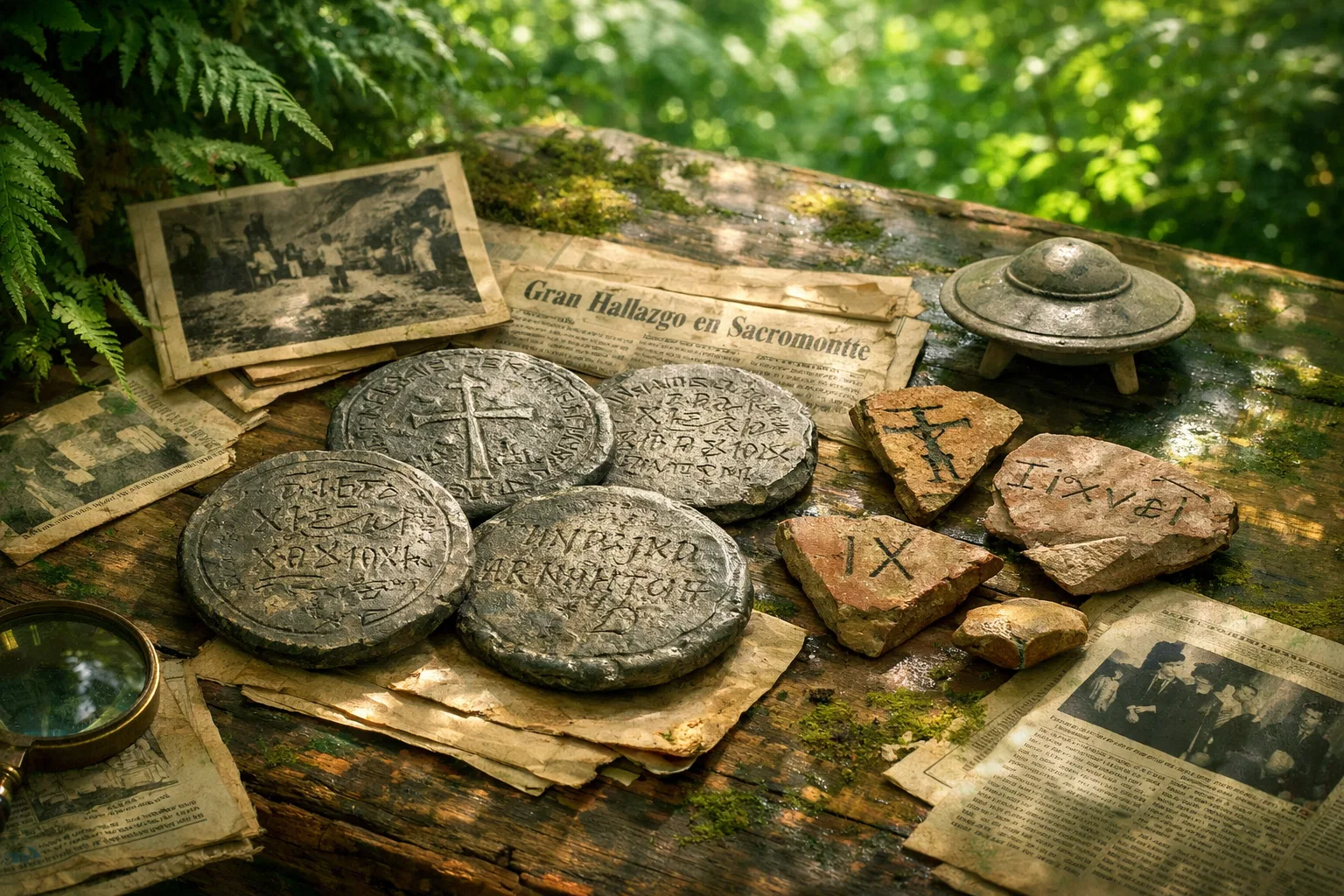
One of Spain’s most consequential historical forgeries began in Granada after the Christian conquest of the last Muslim-ruled kingdom on the Iberian Peninsula. In 1588, workers demolishing the former minaret of Granada’s main mosque reportedly found a parchment in a lead box. Between 1595 and 1606, further discoveries followed in caves on the hill later known as Sacromonte: relics, ashes and a series of circular lead tablets bearing mysterious inscriptions.[uva.nl]uva.nlUniversiteit van AmsterdamNieuw boek: The Lead Books of the Sacromonte and…January 22, 2024 — 22 Jan 2024 — A parchment containing a p…
The Lead Books claimed to preserve teachings connected with early Christian figures, including followers of Saint James. Their language and imagery offered an extraordinary solution to a dangerous political problem. They presented Arabic as part of Spain’s earliest Christian heritage and described a form of Christianity that appeared unusually compatible with Islamic traditions. For Moriscos—Muslims or descendants of Muslims compelled to convert to Christianity—such a discovery could be read as evidence that Arabic language and customs were not foreign intrusions but elements of an ancient Spanish faith.[degruyterbrill.com]degruyterbrill.comDe Gruyter BrillLa invención del Sacromonte: How and Why Scholars…How and Why Scholars Debated about the Lead Books of Granada for Two…
The deception was powerful because the objects seemed to authenticate one another. Inscribed plates explained the remains; the remains gave physical weight to the texts; unfamiliar lettering allowed translators to claim privileged access to the message. Archbishop Pedro de Castro became a determined defender of the discoveries, and the site developed into a centre of pilgrimage and ecclesiastical prestige.
Doubts appeared early. Scholars questioned the language, theology and supposed antiquity of the inscriptions. The Vatican eventually obtained the materials, examined them over several decades and condemned the parchment and Lead Books as forgeries in 1682. Modern scholarship broadly agrees that they were produced in late-sixteenth-century Granada, probably within learned Morisco circles, although the precise division of responsibility remains uncertain.[wikipedia.org]WikipediaLead Books of SacromonteLead Books of Sacromonte
The Lead Books were therefore more than crude counterfeit relics. They were an attempt to rewrite sacred history in material form. Their likely purpose was defensive: to construct a Christian past in which Arabic-speaking communities belonged securely within Spain. That political aim failed. The Moriscos were expelled in the early seventeenth century, while the forged objects acquired an afterlife as evidence of how threatened groups may use invented antiquity to negotiate survival.[Wikipedia]WikipediaLead Books of SacromonteLead Books of Sacromonte

The Roman finds that promised to rewrite Basque history
The Iruña-Veleia scandal demonstrates how the same basic mechanism can operate in modern archaeology. In 2006, excavators working at the Roman site of Veleia, near Vitoria-Gasteiz, announced an astonishing collection of inscribed pottery fragments. The markings appeared to include early Basque words, Egyptian-style signs and an exceptionally ancient representation of the crucifixion. If authentic, some inscriptions would have pushed the written history of the Basque language back by centuries.[Dialnet]dialnet.unirioja.esDialnet The 'exceptional finds' of Iruña-Veleia (Álava): syntaxJuly 14, 2017 — by IR Temiño · 2017 · Cited by 6 — The 'Iruña-Veleia case', as it has come to be known, has been the subject of se…
The finds were persuasive partly because they offered several sensational discoveries at once. They seemed to illuminate language, religion, education and cultural exchange in Roman Spain. The excavation context also gave them an appearance of scientific legitimacy that an unprovenanced object on the antiquities market would not have possessed.
Yet the collection contained glaring anachronisms. Critics identified modern letter forms, improbable Latin, a reference resembling the name of René Descartes, and a crucifixion inscription using “RIP” in a context that made little historical or theological sense. Investigators also reported modern materials and incisions on ancient pottery fragments. An expert committee established by the provincial authorities concluded in 2008 that the exceptional inscriptions were false.[academia.edu]academia.eduOpen source on academia.edu.
In 2020, a court found excavation director Eliseo Gil and collaborator Rubén Cerdán guilty of fraud-related offences. The ruling stated that old artefacts had been altered with contemporary incisions to make them appear historically significant. Gil received a sentence totalling two years and three months, while Cerdán received 15 months; both were also ordered to compensate the Álava authorities that had helped fund the work.[Artnet News]news.artnet.comNews An Archaeologist Who 'Discovered' One of the EarliestNews An Archaeologist Who 'Discovered' One of the Earliest
The case matters because it exposes a weakness that is not confined to archaeology: exciting claims often receive public attention before specialists have completed slow, adversarial checking. The promise of transforming Basque history gave the objects cultural importance immediately. Once that significance had been announced, criticism could be interpreted not simply as technical scrutiny but as an attack on identity, institutions or regional prestige.
Iruña-Veleia also shows why forged artefacts can be harder to challenge than forged documents. The pottery itself was genuinely ancient. The deception lay in adding modern marks to authentic material, allowing the age of the object to lend credibility to the age of the inscription.
Ummo and the manufacture of extraterrestrial authority
The Ummo affair began in the Madrid UFO culture of the 1960s and developed into one of Europe’s most elaborate contact stories. Typed letters, telephone calls, reports, symbols and photographs purported to come from visitors from a planet called Ummo. The documents described alien science, government, religion and social organisation in a serious technical style.[El País]elpais.comEl País Ummo: el mayor caso de ovnis en España que acabóEl País Ummo: el mayor caso de ovnis en España que acabó
The operation did not rely on a single spectacular sighting. It created an expanding archive. Recipients could compare letters, decode recurring terminology and discuss the supposed civilisation in UFO groups. In 1966, a claimed landing in the Madrid district of Aluche drew press attention. The following year, photographs supposedly showed an Ummo craft over San José de Valderas, bearing the same distinctive symbol used in the correspondence.[El País]elpais.comEl País Ummo: el mayor caso de ovnis en España que acabóEl País Ummo: el mayor caso de ovnis en España que acabó
Several features made the story persuasive. The letters were long, technical and only partly comprehensible, which gave them the appearance of expertise. Some information was obscure in Spain at the time but available in foreign scientific publications, allowing familiar knowledge to be repackaged as advanced revelation. The correspondence also offered an appealing vision of an orderly and technologically sophisticated society during the Franco dictatorship, when public debate and access to information were restricted.[El País]elpais.comEl País Ummo: el mayor caso de ovnis en España que acabóEl País Ummo: el mayor caso de ovnis en España que acabó
Sceptics raised doubts about the photographs and scientific content from an early stage. The negatives had suspicious gaps, while the documents often transformed existing terrestrial ideas into alien terminology. In 1997, journalist Manuel Carballal recreated the famous spacecraft photographs with a small model and fishing equipment. José Luis Jordán Peña, a prominent participant and claimed witness, also admitted that he had invented Ummo as an experiment in human credulity, although his later explanations included contradictory claims about assistance from intelligence agencies.[El País]elpais.comEl País Ummo: el mayor caso de ovnis en España que acabóEl País Ummo: el mayor caso de ovnis en España que acabó
Those contradictions gave committed believers room to reject the confession. Some argued that one man could not have generated such a large body of material. New “Ummo” messages continued after Jordán Peña’s death, demonstrating how a hoax can detach itself from its original author once readers, imitators and later promoters begin producing their own additions.[El País]elpais.comEl País Ummo: el mayor caso de ovnis en España que acabóEl País Ummo: el mayor caso de ovnis en España que acabó
The affair also had consequences beyond harmless UFO speculation. The Ummo mythology was appropriated by groups with more coercive practices, most notoriously the Edelweiss organisation, whose leader presented himself as an extraterrestrial prince and exploited minors. The original creator did not necessarily intend those abuses, but the case illustrates a recurring danger: a fictional system that offers secret knowledge and superior authority can become a tool for manipulation in other hands.[El País]elpais.comEl País Ummo: el mayor caso de ovnis en España que acabóEl País Ummo: el mayor caso de ovnis en España que acabó
The faces in the floor at Bélmez
In August 1971, María Gómez Cámara reported that a human face had appeared in the concrete floor of her home in Bélmez de la Moraleda, a village in Jaén. The image was destroyed and the floor replaced, but further faces were said to have formed. Photographs circulated in newspapers, visitors arrived and the house became a paranormal attraction.[Wikipedia]WikipediaBélmez FacesBélmez Faces
The claim benefited from the physical setting. Visitors were not merely being shown a photograph: they could enter an ordinary family home and inspect images apparently embedded in its fabric. Variations in damp concrete, stains and irregular outlines encouraged pareidolia, the human tendency to recognise faces in ambiguous patterns. Once observers had been told what to see, suggestive marks could acquire eyes, mouths and expressions.
Sceptical investigators have argued that at least some faces were deliberately produced with colouring agents, chemicals or other surface treatments. Others have noted that the images were surprisingly pictorial and that the household benefited from tourism. Yet the case has never produced a single universally accepted reconstruction covering every image made or reported over several decades. That gap has allowed paranormal promoters to present the absence of one comprehensive explanation as evidence for the supernatural.[Wikipedia]WikipediaBélmez FacesBélmez Faces
The distinction between the original faces and later revivals is especially important. After Gómez Cámara died in 2004, new images were promoted, but Spanish reporting alleged that these had been fabricated with the involvement of paranormal enthusiasts and local interests. Later technical demonstrations and television investigations produced conflicting claims, ranging from attempted chemical explanations to declarations that particular samples showed no obvious added paint.[Wikipedia]WikipediaBélmez FacesBélmez Faces
Bélmez persists because it occupies an ideal zone of uncertainty. The weakest version of the supernatural claim—that no ordinary process could make face-like marks in concrete—is easy to reject. The stronger historical question—who made which image, by what method and at what date—is much harder to settle after repeated alterations, incomplete documentation and decades of publicity. Every unresolved detail can therefore be recycled as a new mystery.
When a scientific mistake starts to resemble a hoax
Not every famous false claim is a fraud. The controversy over the “Orce Man” shows how sincere scientific error, institutional rivalry and exaggerated headlines can create a public story with many of the features of a hoax.
In 1982, researchers found a cranial fragment at Venta Micena near Orce in Granada. It was announced in 1983 as evidence of an extremely early human presence in Europe. The claim attracted enormous attention because it promised to transform the prehistory of the continent. Subsequent examination suggested that the fragment belonged not to a human ancestor but to an equid, probably a young member of the horse family. Newspapers turned the reversal into the mocking label “Orce Donkey”.[researchgate.net]researchgate.netOpen source on researchgate.net.
The original researchers did not simply admit a settled error. Josep Gibert continued to defend a hominin identification, while other specialists supported an animal origin. The dispute involved anatomy, protein analysis, access to specimens and deep professional disagreements. Historical studies of the controversy emphasise that the argument unfolded as much through newspapers, conferences and institutional manoeuvring as through the normal accumulation of scientific evidence.[researchgate.net]researchgate.netOpen source on researchgate.net.
Calling the episode a hoax would therefore be misleading: there is no established evidence that the fossil was planted or knowingly misrepresented. Its relevance lies in showing how publicity can outrun verification. Once a tentative identification becomes a national or regional “first”, later correction may look like exposure of deceit even when the real causes are overconfidence, rivalry or an honest mistake.
Orce itself remains archaeologically important. Subsequent work has produced strong evidence of very early human activity in the area, including stone tools and animal bones with cut marks. The failure of one celebrated fossil identification did not make the wider site fraudulent.[NASA Science]science.nasa.govScience Orce's Archaeological WonderlandScience Orce's Archaeological Wonderland
From newspaper spectacle to networked misinformation
Older Spanish hoaxes depended on relics, photographs, exhibitions or broadcasters. Digital misinformation can reproduce the same mechanisms almost instantly: false attribution supplies authority, manipulated or unrelated images provide apparent proof, and emotional relevance encourages circulation before verification.
Research examining science and health hoaxes checked in Spain during the COVID-19 pandemic found several recurring forms. Some items were wholly invented; others distorted genuine scientific claims, removed statements from context or falsely attributed messages to doctors and institutions. Social platforms and private messaging services made such material especially difficult to trace because a copied message could circulate without its original source.[PLOS]journals.plos.orgOpen source on plos.org.
This is not entirely new. The Lead Books borrowed the authority of saints, Iruña-Veleia borrowed the age of Roman pottery, and Ummo borrowed the language of technical expertise. Digital hoaxes use screenshots, logos, voice notes and recycled footage in much the same way. The aim is to make the claim feel as though it has already passed through a trusted institution.
Satire creates a separate boundary problem. Spain’s satirical outlets deliberately imitate news conventions, but their purpose is comic or political rather than deceptive. Stories from the website El Mundo Today have nevertheless been repeated as real reporting, including by media organisations outside Spain. In another case, the editor of the magazine El Jueves was called to court over an article whose absurd claim about riot police was intended as satire. These episodes show why intention, presentation and audience interpretation must be considered separately: material can be clearly comic to its creators yet misleading once stripped of its original setting.[Wikipedia]WikipediaEl Mundo TodayEl Mundo Today
Why the stories survive exposure
The best-known Spanish hoaxes did not succeed because nobody noticed their flaws. In most cases, sceptics appeared early. They failed to end the stories because exposure had to compete with forces that made belief socially or emotionally useful.
The claim answered an existing need. The Lead Books offered reconciliation between Arabic heritage and Christian authority. Iruña-Veleia offered dramatic proof of the antiquity of Basque writing. Ummo offered superior knowledge and an imagined alternative society. Bélmez turned an ordinary house into a gateway to the supernatural.
Real objects carried false meanings. Ancient pottery, lead plates, concrete floors and photographic negatives gave abstract stories a physical anchor. In several cases, the base material was genuine even when the interpretation or inscription was not.
Authority was distributed. Clergy, archaeologists, journalists, broadcasters and self-described experts did not need to conspire. Each could lend a small amount of credibility while relying on the judgement of others.
Publicity changed the burden of proof. Once a claim became famous, sceptics were expected to explain every detail. Promoters needed only to identify one disputed test, unexplained stain or inconsistency in a confession to argue that the mystery remained open.
The story acquired new owners. Later believers, tourism promoters, writers and online communities could continue a narrative after its original evidence had collapsed. Ummo messages survived their confessed creator; Bélmez gained new faces; the Sacromonte forgeries became historically valuable even after losing their claimed antiquity.
Spain’s most memorable deceptions therefore reveal less about credulity than about the social life of evidence. A fake becomes durable when it is attached to identity, hope, fear, commerce or institutional prestige. Exposure may settle the age of an inscription or reveal the model used in a photograph, but it cannot automatically remove the reasons people wanted the story to be true.
Amazon book picks
Further Reading
Books and field guides related to How Spain's Most Famous Hoaxes Took Hold. Use these as the next step if you want deeper reading beyond the article.
Frauds, Myths, and Mysteries: Science and Pseudoscience in Ar...
Covers archaeological hoaxes, pseudohistory and disputed discoveries.
Mistakes Were Made (but Not by Me)
Explains why people continue believing false claims and hoaxes.
Extraordinary Popular Delusions and the Madness of Crowds
Rating: 4.0/5 from 5 Google Books ratings
Explores how collective belief and sensational claims spread.
The Demon-Haunted World
Rating: 4.5/5 from 43 Google Books ratings
Provides tools for evaluating remarkable stories and alleged evidence.
eBay marketplace picks
Marketplace Samples
Live-tested eBay searches with available results related to this page.


Endnotes
1.
Source: library.oapen.org
Link:https://library.oapen.org/handle/20.500.12657/87962
Source snippet
The Lead Books of the Sacromonte and the Parchment...by GA Wiegers · 2023 · Cited by 2 — The Archive of the Sacromonte Abbey in Gra...
2.
Source: Wikipedia
Title: Lead Books of Sacromonte
Link:https://en.wikipedia.org/wiki/Lead_Books_of_Sacromonte
3.
Source: academia.edu
Link:https://www.academia.edu/33594081/THE_EXCEPTIONAL_FINDS_OF_IRU%C3%91A_VELEIA_%C3%81LAVA_SYNTAX_OF_AN_ARCHAEOLOGICAL_FORGERY
4.
Source: news.artnet.com
Title: News An Archaeologist Who ‘Discovered’ One of the Earliest
Link:https://news.artnet.com/art-world/spanish-archaeologists-fake-discoveries-1885953
5.
Source: Wikipedia
Title: Planetary objects proposed in religion, astrology, ufology and pseudoscience
Link:https://en.wikipedia.org/wiki/Planetary_objects_proposed_in_religion%2C_astrology%2C_ufology_and_pseudoscience
6.
Source: Wikipedia
Title: Bélmez Faces
Link:https://en.wikipedia.org/wiki/B%C3%A9lmez_Faces
7.
Source: researchgate.net
Link:https://www.researchgate.net/publication/287446008_Hominids_doubts_and_big_headlines_The_Orce_Man_controversy_in_the_Spanish_press
8.
Source: Wikipedia
Link:https://en.wikipedia.org/wiki/Orce_Man
9.
Source: academia.edu
Link:https://www.academia.edu/83767445/Orce_man_A_Public_Controversy_in_Spanish_Human_Origins_Research
10.
Source: science.nasa.gov
Title: Science Orce’s Archaeological Wonderland
Link:https://science.nasa.gov/earth/earth-observatory/orces-archaeological-wonderland-152584/
11.
Source: journals.plos.org
Link:https://journals.plos.org/plosone/article?id=10.1371%2Fjournal.pone.0265995
12.
Source: Wikipedia
Title: El Mundo Today
Link:https://en.wikipedia.org/wiki/El_Mundo_Today
13.
Source: researchgate.net
Link:https://www.researchgate.net/publication/376950905_Patterns_and_Actors_of_Disinformation_Analysis_of_Debunked_Hoaxes_in_Spain_in_2022
14.
Source: researchgate.net
Link:https://www.researchgate.net/publication/317866079Los%27hallazgos_excepcionales%27_de_Iruna-Veleia_Alava_sintaxis_de_una_falsificacion_arqueologica
15.
Source: researchgate.net
Link:https://www.researchgate.net/publication/347390625_La_invencion_del_Sacromonte_How_and_Why_Scholars_Debated_about_the_Lead_Books_of_Granada_for_Two_Hundred_Years
16.
Source: Wikipedia
Title: List of fake news websites
Link:https://en.wikipedia.org/wiki/List_of_fake_news_websites
17.
Source: Wikipedia
Title: Iruña Veleia
Link:https://en.wikipedia.org/wiki/Iru%C3%B1a-Veleia
18.
Source: Wikipedia
Title: List of satirical fake news websites
Link:https://en.wikipedia.org/wiki/List_of_satirical_fake_news_websites
19.
Source: academia.edu
Link:https://www.academia.edu/108920708/Patterns_and_Actors_of_Disinformation_Analysis_of_Debunked_Hoaxes_in_Spain_in
20.
Source: uva.nl
Link:https://www.uva.nl/en/shared-content/faculteiten/en/faculteit-der-geesteswetenschappen/news/2024/01/nieuw-boek-the-lead-books-of-the-sacromonte-and-the-parchment-of-the-torre-turpiana-granada-1588-1606.html
Source snippet
Universiteit van AmsterdamNieuw boek: The Lead Books of the Sacromonte and...January 22, 2024 — 22 Jan 2024 — A parchment containing a p...
Published: January 22, 2024
21.
Source: degruyterbrill.com
Link:https://www.degruyterbrill.com/document/doi/10.1515/9783110714333-011/html?srsltid=AfmBOooRNL07zxHk1tYsynUlY4Nzwt9Q_P2p-6WbNiEIyK6l3irQKTCd
Source snippet
De Gruyter BrillLa invención del Sacromonte: How and Why Scholars...How and Why Scholars Debated about the Lead Books of Granada for Two...
22.
Source: dialnet.unirioja.es
Title: Dialnet The ‘exceptional finds’ of Iruña-Veleia (Álava): syntax
Link:https://dialnet.unirioja.es/servlet/articulo?codigo=6224471
Source snippet
July 14, 2017 — by IR Temiño · 2017 · Cited by 6 — The 'Iruña-Veleia case', as it has come to be known, has been the subject of se...
Published: July 14, 2017
23.
Source: elpais.com
Title: El País Ummo: el mayor caso de ovnis en España que acabó
Link:https://elpais.com/elpais/2019/08/29/icon/1567087063_903049.html
24.
Source: dialnet.unirioja.es
Link:https://dialnet.unirioja.es/servlet/tesis?codigo=117377
25.
Source: doi.org
Link:https://doi.org/10.1163/9789004431508_008
26.
Source: facebook.com
Link:https://www.facebook.com/groups/1572893699951268/posts/1833718200535482/
27.
Source: facebook.com
Link:https://www.facebook.com/groups/883153099972134/posts/1207996664154441/
28.
Source: english.elpais.com
Link:https://english.elpais.com/elpais/2013/02/18/inenglish/1361201892_286250.html
29.
Source: reddit.com
Title: El Mundo Today
Link:https://www.reddit.com/r/Spanish/comments/1m8tfy/el_mundo_today_a_spanish_counterpart_to_the_onion/
Additional References
30.
Source: theguardian.com
Title: spanish archaeologist sentenced for faking basque finds
Link:https://www.theguardian.com/science/2020/jun/11/spanish-archaeologist-sentenced-for-faking-basque-finds
Source snippet
The GuardianSpanish archaeologist sentenced for faking Basque finds11 Jun 2020 — It ruled that the finds had been manipulated “with conte...
31.
Source: youtube.com
Title: Al-Shabaab exploits Kenya’s divisions to wage war
Link:https://www.youtube.com/watch?v=j13wvZND5zk
Source snippet
Election info changes quickly. Verify responses with official sources...
32.
Source: youtube.com
Title: Inside Al Shabaab: The extremist group trying to seize Somalia
Link:https://www.youtube.com/watch?v=KVSw0E9Y1RI
Source snippet
How Al-Shabab is recruiting young men from Kenya...
33.
Source: science.org
Title: study reveals culprit behind piltdown man one science s most famous hoaxes
Link:https://www.science.org/content/article/study-reveals-culprit-behind-piltdown-man-one-science-s-most-famous-hoaxes
34.
Source: youtube.com
Title: Somalia: Govt bans Al Shabaab ‘propaganda’ contents
Link:https://www.youtube.com/watch?v=Vean7jaorHc
Source snippet
Inside Al Shabaab: The extremist group trying to seize Somalia...
35.
Source: jstor.org
Link:https://www.jstor.org/stable/2544606
Source snippet
Forging History: The Plomos of the Sacromonte of Granada...by AK Harris · 1999 · Cited by 37 — In the late sixteenth century, treas...
36.
Source: youtube.com
Link:https://www.youtube.com/watch?v=5hKAyQIc5rk
Source snippet
Al-Shabaab exploits Kenya's divisions to wage war...
37.
Source: youtube.com
Title: How Al-Shabab is recruiting young men from Kenya
Link:https://www.youtube.com/watch?v=xc6wfF9sV90
Source snippet
Inside Al Shabaab (2017): Terror group tackles drought...
38.
Source: sciencemediacentre.es
Link:https://sciencemediacentre.es/en/515-cent-spanish-population-feel-capable-spotting-misinformation-about-science-only-181-cent
39.
Source: ddd.uab.cat
Link:https://ddd.uab.cat/pub/tesis/2015/hdl_10803_313233/mcb1de1.pdf?fbclid=IwAR3Sib-An9-Aq4VJpDq4bMwjOm-5BqPltFN6T0CdUaDveEiAnOGlTZMJJ6I
Topic Tree
Follow this branch
Related pages 192
- Albanian Hoaxes
- Algerian Hoaxes
- Antigua Deceptions
- Argentina Hoaxes
- Armenian Hoaxes
- +187 more in sidebar