Within Spain's Great Hoaxes
Why Granada's Forged Relics Seemed So Convincing
The Lead Books offered persecuted Moriscos a persuasive ancient history in which Arabic culture belonged inside Spanish Christianity.
On this page
- What the Lead Books claimed
- Why church authority strengthened the deception
- How scholars and the Vatican exposed the forgery
Page outline Jump by section
Introduction
The Lead Books of Sacromonte are among the most remarkable religious forgeries in Spanish history, not because they were crude fakes, but because they addressed a real social and political crisis. Discovered in Granada between 1588 and 1606, the texts and relics appeared to reveal a forgotten chapter of early Christianity in Spain. They claimed that Arabic-speaking believers had helped establish the faith in the Iberian Peninsula and that Granada occupied a privileged place in sacred history. At a time when Spain’s Moriscos—Muslims and their descendants who had been forced to convert to Christianity—faced increasing suspicion and repression, the discoveries offered a powerful argument that Arabic language and culture belonged within Spanish Christianity rather than outside it. The story convinced church leaders, attracted pilgrims and reshaped Granada’s identity for decades before scholars and the Vatican concluded that the relics and texts were forged.[Wikipedia]WikipediaLead Books of SacromonteLead Books of Sacromonte

What the Lead Books Claimed
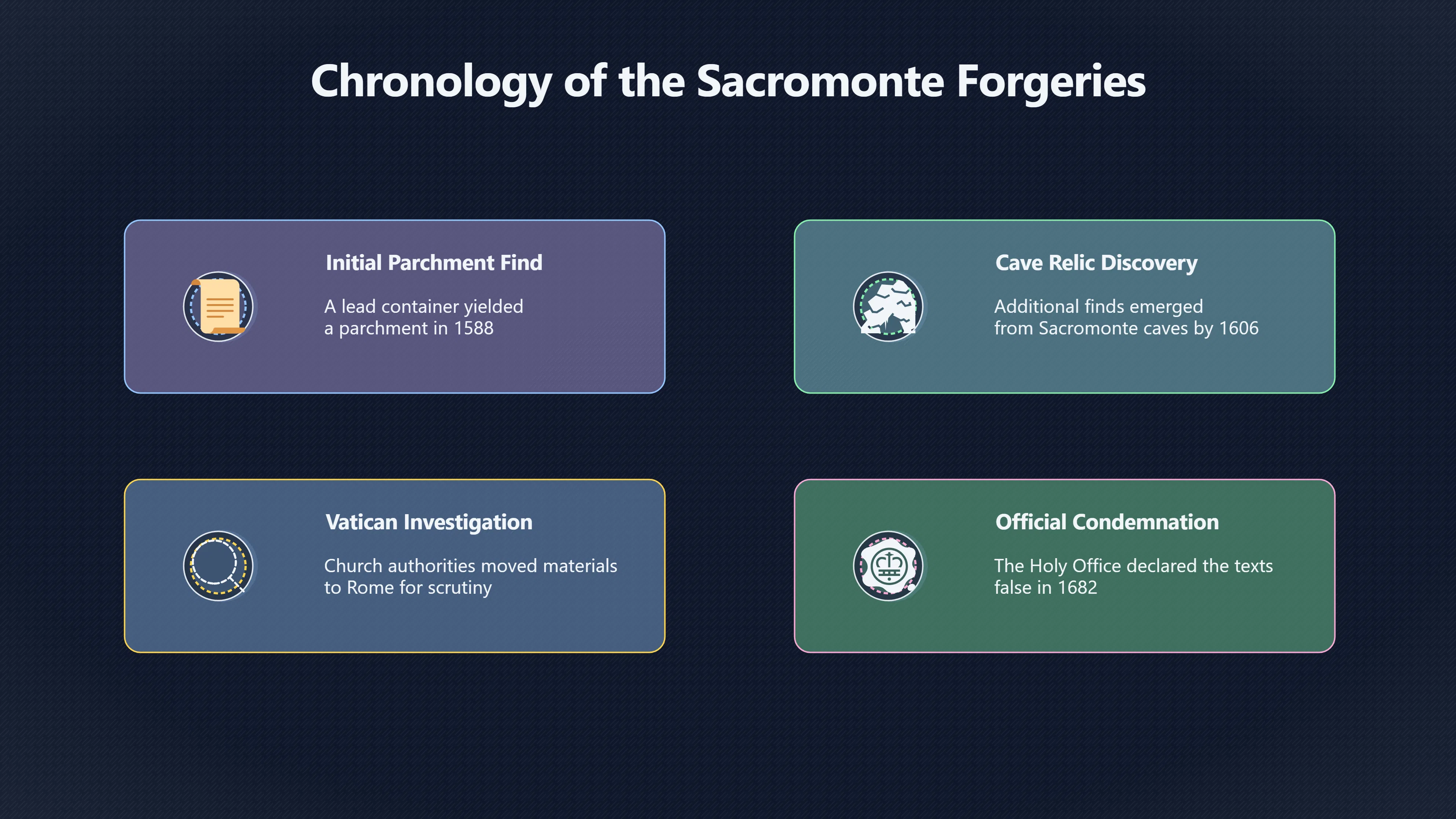
The affair began with a sequence of dramatic discoveries. In 1588 a parchment was reportedly found in a lead container during work at Granada Cathedral, which stood on the site of the former Great Mosque. Between 1595 and 1606 additional finds emerged from caves on the nearby hill later known as Sacromonte. These included ashes, bones identified as those of early Christian martyrs, and a collection of circular lead tablets inscribed with mysterious texts.[wikipedia.org]WikipediaLead Books of SacromonteLead Books of Sacromonte
The texts presented themselves as ancient writings connected to the first centuries of Christianity. According to their narrative, disciples linked to Saint James had evangelised Spain, while Arabic-speaking Christians preserved sacred teachings that had later been hidden with martyrs’ relics. The books elevated Granada’s importance in Christian history and portrayed Arabic as a language favoured by early believers.[Wikipedia]WikipediaLead Books of SacromonteLead Books of Sacromonte
What made the message especially striking was its blend of Christian and Islamic elements. The texts honoured the Virgin Mary, supported Catholic devotion to saints and relics, and reinforced Granada’s Christian prestige. Yet they also used language and concepts that echoed Islamic religious traditions. The result was a version of sacred history in which Christianity and Arabic culture appeared deeply interconnected. Modern scholarship generally interprets this as an attempt to create a historical foundation for Morisco identity within Christian Spain.[wikipedia.org]WikipediaLead Books of SacromonteLead Books of Sacromonte
For many Moriscos, such claims would have been emotionally and politically attractive. If Arabic had been part of Spain’s earliest Christianity, then contemporary Arabic-speaking converts could argue that their language and customs were not foreign survivals but remnants of an authentic Spanish religious heritage.[Wikipedia]WikipediaLead Books of SacromonteLead Books of Sacromonte
Why Church Authority Strengthened the Deception
The Lead Books succeeded because they arrived wrapped in institutional authority. The discoveries were not presented as isolated manuscripts bought from a dealer or found by a private collector. They emerged alongside relics, ashes and inscriptions that appeared to confirm one another. Physical objects gave credibility to the texts, while the texts explained the significance of the objects.[Wikipedia]WikipediaLead Books of SacromonteLead Books of Sacromonte
Equally important was the support of powerful church figures. Archbishop Pedro de Castro became an enthusiastic defender of the discoveries and promoted their significance. Under his patronage, the supposed relics enhanced Granada’s standing as a sacred city. Pilgrimage activity increased, devotion developed around the site, and the discoveries became tied to local religious prestige.[Wikipedia]WikipediaLead Books of SacromonteLead Books of Sacromonte
The unusual writing system also helped sustain belief. The texts were said to be written in an ancient form of Arabic mixed with other elements. Because few people could interpret them, authority shifted to a small group of translators and specialists. Their claims were difficult for ordinary clergy or believers to verify independently. The obscurity of the inscriptions therefore became an advantage rather than a weakness.[Wikipedia]WikipediaLead Books of SacromonteLead Books of Sacromonte
The timing mattered as well. Late sixteenth-century Spain was deeply concerned with religious unity after the Reconquista and during the Counter-Reformation. Discoveries that appeared to confirm ancient Christian roots in Granada were politically useful. Even people who doubted parts of the story could see benefits in a narrative that strengthened the city’s Christian legitimacy.[JSTOR]jstor.orgIn 1682 Pope Innocent XI condemned them as "mere human fictions" and attributed their authorship to.Read more…
Why the Forgery Seemed Plausible
Modern readers sometimes wonder how such elaborate claims gained acceptance. The answer lies partly in how skilfully the forgers adapted their story to existing beliefs.
Rather than inventing an entirely new religion, the Lead Books attached themselves to respected traditions already circulating in Spain. Saint James was already central to Spanish Christian identity. The cult of relics was widely accepted. Claims about forgotten martyrs or lost writings had precedents elsewhere in Europe. The books therefore felt like discoveries that completed an existing story rather than replacing it.[Wikipedia]WikipediaLead Books of SacromonteLead Books of Sacromonte
The forgers also understood the emotional needs of their audience. For Moriscos facing pressure to abandon their language and customs, the books offered reassurance that Arabic culture possessed sacred legitimacy. For church leaders in Granada, the discoveries elevated the city’s status. Different groups could therefore find different reasons to support the same narrative.[Wikipedia]WikipediaLead Books of SacromonteLead Books of Sacromonte
This combination of religious hope, civic pride and political utility explains why the affair lasted for decades despite persistent criticism.
How Scholars and the Vatican Exposed the Forgery
Doubts appeared almost immediately. Critics questioned the language, theology and historical claims found in the texts. Some scholars argued that supposedly ancient writings contained ideas and expressions that belonged to much later periods. Others noticed doctrinal formulations that seemed suspiciously suited to contemporary debates rather than the early Christian era.[Wikipedia]WikipediaLead Books of SacromonteLead Books of Sacromonte
The strongest objections came from experts who examined the texts in detail. The books claimed great antiquity, yet their language and religious concepts did not fit comfortably with the historical periods they purported to represent. The mixture of Christian and Islamic elements appeared less like evidence of ancient origins than a product of sixteenth-century Granada, where those traditions interacted daily.[Wikipedia]WikipediaLead Books of SacromonteLead Books of Sacromonte
The Vatican remained sceptical throughout much of the controversy. After years of investigation, church authorities transferred the materials to Rome for closer examination. The inquiry stretched over decades, reflecting both the complexity of the case and its political sensitivity. Finally, in 1682, the Holy Office concluded that the parchment and Lead Books were forgeries and condemned them as false religious inventions.[wikipedia.org]WikipediaLead Books of SacromonteLead Books of Sacromonte
Although no definitive judicial verdict identified every individual responsible, scholarly consensus has long centred on learned Morisco circles in Granada, with particular suspicion falling on translators connected to the discoveries. The exact division of responsibility remains debated, but few modern historians accept the books as authentic ancient documents.[Wikipedia]WikipediaLead Books of SacromonteLead Books of Sacromonte

The Strange Afterlife of a Failed Sacred History
The exposure of the forgery did not erase its influence. For generations, arguments over the books shaped scholarship, local identity and debates about Spain’s Islamic and Christian heritage. The controversy helped stimulate the study of Arabic texts and contributed to broader European interest in the languages and history of the Islamic world.[moriscostunez.blogspot.com]moriscostunez.blogspot.comthe orient in spain converted muslimsThe Orient in Spain, Converted Muslims, the Forged Lead…26 Apr 2013 — Taking as its main subject a series of notorious forgeries by Mu…
Ironically, the central political aim that many historians attribute to the forgers was unsuccessful. The Moriscos were expelled from Spain in the early seventeenth century despite the appearance of the books. Yet the texts survived as historical evidence of how vulnerable communities sometimes use invented antiquity to argue for belonging and legitimacy.[Wikipedia]WikipediaLead Books of SacromonteLead Books of Sacromonte
The physical setting of the discoveries also endured. The Sacromonte hill became permanently associated with the relics and the legend surrounding them. Even after the Vatican’s condemnation, the episode remained embedded in Granada’s cultural memory, demonstrating how forged artefacts can continue shaping identity long after their authenticity has collapsed.[Wikipedia]WikipediaOpen source on wikipedia.org.
What the Lead Books Reveal About Hoaxes in Spain
The Lead Books were not a simple fraud designed for money. They were a sophisticated attempt to rewrite the past through objects that appeared ancient, sacred and authoritative. Their creators understood that successful deception often requires more than fabricated evidence. It requires a story that answers a pressing social need.
In this respect, the Sacromonte affair stands as one of Spain’s most revealing cases of forged history. The books persuaded many people because they offered a solution to a genuine conflict over identity, religion and belonging. Their eventual exposure showed the growing power of linguistic, historical and theological criticism. Yet their enduring fascination lies in the fact that they were not merely counterfeit relics. They were an ambitious effort to create an alternative sacred past for Granada and for a community struggling to survive within early modern Spain.[wikipedia.org]WikipediaLead Books of SacromonteLead Books of Sacromonte
Amazon book picks
Further Reading
Books and field guides related to Why Granada's Forged Relics Seemed So Convincing. Use these as the next step if you want deeper reading beyond the article.
Frauds, Myths, and Mysteries: Science and Pseudoscience in Ar...
Examines how false historical claims gain authority.
Extraordinary Popular Delusions and the Madness of Crowds
Rating: 4.0/5 from 5 Google Books ratings
Shows how influential institutions can reinforce mistaken beliefs.
The Demon-Haunted World
Rating: 4.5/5 from 43 Google Books ratings
Addresses evidence, authority and belief.
The Forge and the Crucible
Provides context for sacred objects, relics and religious symbolism.
eBay marketplace picks
Marketplace Samples
Live-tested eBay searches with available results related to this page.
Endnotes
1.
Source: Wikipedia
Title: Lead Books of Sacromonte
Link:https://en.wikipedia.org/wiki/Lead_Books_of_Sacromonte
2.
Source: library.oapen.org
Link:https://library.oapen.org/handle/20.500.12657/87962
Source snippet
The Lead Books of the Sacromonte and the Parchment...by GA Wiegers · 2023 · Cited by 2 — The Archive of the Sacromonte Abbey in Gra...
3.
Source: moriscostunez.blogspot.com
Title: the orient in spain converted muslims
Link:https://moriscostunez.blogspot.com/2013/04/the-orient-in-spain-converted-muslims.html
Source snippet
The Orient in Spain, Converted Muslims, the Forged Lead...26 Apr 2013 — Taking as its main subject a series of notorious forgeries by Mu...
4.
Source: jstor.org
Link:https://www.jstor.org/stable/2544606
Source snippet
In 1682 Pope Innocent XI condemned them as "mere human fictions" and attributed their authorship to.Read more...
5.
Source: Wikipedia
Link:https://en.wikipedia.org/wiki/Sacromonte
6.
Source: Wikipedia
Link:https://en.wikipedia.org/wiki/Lead
7.
Source: natlib.govt.nz
Link:https://natlib.govt.nz/records/54388726
Source snippet
They became the object of heated discussions in Europe and were condemned by the Pope in...
8.
Source: pure.uva.nl
Link:https://pure.uva.nl/ws/files/243024474/9789004730885-BP000021.pdf
Source snippet
Research ExplorerUvA-DARE (Digital Academic Repository)Our recent edition and study of the Lead Books shows that we are indeed dealing wi...
9.
Source: academia.edu
Title: The Lead Books of Sacromonte
Link:https://www.academia.edu/104100431/The_Lead_Books_of_Sacromonte
10.
Source: voynich.fandom.com
Title: Lead Books of Sacromonte
Link:https://voynich.fandom.com/wiki/Lead_Books_of_Sacromonte
11.
Source: kids.kiddle.co
Title: Lead Books of Sacromonte
Link:https://kids.kiddle.co/Lead_Books_of_Sacromonte
Additional References
12.
Source: researchgate.net
Link:https://www.researchgate.net/publication/347390625_La_invencion_del_Sacromonte_How_and_Why_Scholars_Debated_about_the_Lead_Books_of_Granada_for_Two_Hundred_Years
13.
Source: legadoandalusi.es
Title: ignacio de las casas 2
Link:https://www.legadoandalusi.es/magazine/ignacio-de-las-casas-2/?lang=en
Source snippet
El legado andalusiIgnacio de las Casas 2Up to his death in 1608, De las Casas, as well as another evangelist of the Moriscos in their own...
14.
Source: youtube.com
Title: Al-Shabaab exploits Kenya’s divisions to wage war
Link:https://www.youtube.com/watch?v=j13wvZND5zk
Source snippet
Election info changes quickly. Verify responses with official sources...
15.
Source: youtube.com
Title: Inside Al Shabaab: The extremist group trying to seize Somalia
Link:https://www.youtube.com/watch?v=KVSw0E9Y1RI
Source snippet
How Al-Shabab is recruiting young men from Kenya...
16.
Source: youtube.com
Title: Somalia: Govt bans Al Shabaab ‘propaganda’ contents
Link:https://www.youtube.com/watch?v=Vean7jaorHc
Source snippet
Inside Al Shabaab: The extremist group trying to seize Somalia...
17.
Source: youtube.com
Link:https://www.youtube.com/watch?v=5hKAyQIc5rk
Source snippet
Al-Shabaab exploits Kenya's divisions to wage war...
18.
Source: youtube.com
Title: How Al-Shabab is recruiting young men from Kenya
Link:https://www.youtube.com/watch?v=xc6wfF9sV90
Source snippet
Inside Al Shabaab (2017): Terror group tackles drought...
19.
Source: ricksteves.com
Link:https://www.ricksteves.com/watch-read-listen/read/articles/granadas-sacromonte-district
20.
Source: ebay.com
Link:https://www.ebay.com/itm/389341948747?mkevt=1&mkcid=1&mkrid=710-53481-19255-0&campid=5339151051&customid=endnote-source&toolid=10001
21.
Source: researchgate.net
Link:https://www.researchgate.net/publication/393788194_Contested_Heritage_The_Case_of_the_Abbey_of_the_Sacromonte_in_Granada_and_the_Lead_Books
Topic Tree