How China's Most Famous Hoaxes Fooled the Public
China’s best-known hoaxes are not one continuous tradition of national credulity.
Page outline Jump by section
Introduction
The most revealing cases share a pattern. A claim arrives with something people already want: scientific prestige, local investment, patriotic pride, commercial profit or a marvellous story. Institutions then lend it authority before verification has caught up. Exposure usually comes from less glamorous work — matching photographs, examining provenance, scanning fossils, demanding controlled tests or asking whether the chronology makes sense. China’s hoax history is therefore less about exotic beliefs than about familiar pressures: markets reward spectacle, officials dislike embarrassment, media compete for attention and convincing objects can outrun cautious explanations.
When a fossil became a “missing link”
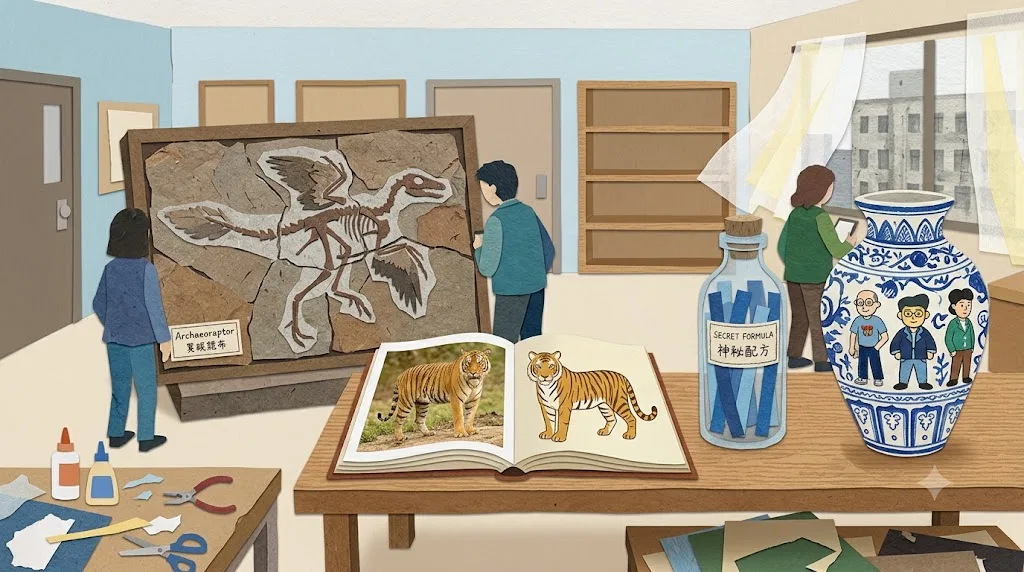
The fossil informally called “Archaeoraptor” is one of the clearest examples of a real scientific treasure being converted into a fraudulent spectacle. Announced by National Geographic in 1999, it appeared to combine the body of a primitive bird with the long tail of a small dinosaur. That made it seem like a dramatic transitional form linking birds and non-avian dinosaurs.
The specimen did contain genuine fossils from China’s exceptionally rich deposits in Liaoning province. The deception lay in their arrangement. Pieces from unrelated animals had been joined into a single slab, apparently to create a more complete, unusual and valuable object. Later forensic examination identified the upper portion as a primitive bird and the tail as belonging to a small non-flying dinosaur; additional sections may have come from still more specimens.[PubMed]pubmed.ncbi.nlm.nih.govForensic palaeontology: The Archaeoraptor forgeryby T Rowe · 2001 · Cited by 91 — Archaeoraptor was revealed to be a forgery in whi…
Several warning signs existed before the public announcement. The fossil had passed through commercial dealers, had reportedly left China illegally and lacked the secure excavation record that allows scientists to reconstruct exactly where an object came from. Journals considering a technical paper also raised concerns about its condition and provenance. Nevertheless, a visually irresistible story reached the public before the normal process of peer review and authentication had been completed.[Nature]nature.comFake bird fossil highlights the problem of illegal tradingby D REX · 2000 — A panel of palaeontologists last week confirmed that a…
The exposure did not disprove the evolutionary relationship between dinosaurs and birds. Quite the opposite: genuine feathered dinosaurs from China have supplied powerful evidence for it. The scandal instead showed how a thriving market could damage science by encouraging excavators and dealers to assemble incomplete fossils into apparently spectacular ones. Poor rural collectors, commercial middlemen, wealthy buyers and prestige-seeking institutions all operated within a system that rewarded completeness and novelty more than documented provenance.[National Geographic]nationalgeographic.comduck dinosaur amphibious halszkaraptor fossil mongolia scienceNational GeographicDuck-Like Dinosaur Is Among Oddest Fossils Yet Found6 Dec 2017 — In 1999, National Geographic magazine unveiled the fo…
“Archaeoraptor” remains memorable because it was not a crude object made entirely from plaster. Its components were largely authentic. The forgery worked by making true pieces tell a false story.
The paper tiger that embarrassed officials
In 2007, farmer Zhou Zhenglong released photographs that he said showed a wild South China tiger in the mountains of Shaanxi province. The subspecies was feared to have disappeared from the wild, so the images promised a conservation sensation. Provincial forestry officials endorsed them as evidence that the tiger survived and reportedly rewarded Zhou.
Online sceptics quickly challenged the pictures. The animal’s posture looked strangely consistent across different frames, its scale and focus appeared wrong, and vegetation seemed to overlap it unnaturally. The decisive clue was not an advanced laboratory discovery but an ordinary printed image: internet users found a decorative tiger poster whose animal closely matched the supposed wild specimen.
Authorities eventually acknowledged that Zhou had photographed a tiger image rather than a living animal. Police said they found the borrowed picture used to produce the photographs, and thirteen officials were dismissed or disciplined over the endorsement. Zhou was convicted of fraud, although he later continued to insist publicly that the photographs were genuine.[Reuters]reuters.comChina admits controversial tiger photos fakedChina admits controversial tiger photos fakedJune 29, 2008 — 28 Jun 2008 — Zhou Zhenglong, the farmer who claimed to have taken th…
The case spread because nearly every participant had something to gain. Zhou could receive money and recognition. Local officials could announce an ecological triumph and strengthen the case for conservation funding or tourism. News organisations obtained an uplifting national wildlife story. Members of the public wanted to believe that an iconic animal had escaped extinction.
Its exposure also marked a change in Chinese media culture. Rather than waiting for a formal scientific institution to settle the question, dispersed online investigators compared images, analysed details and kept pressure on officials. Chinese commentary at the time treated the affair as evidence that internet scrutiny was becoming a significant check on official announcements.[Reuters]reuters.comChina officials say sorry in "paper tiger" sagaChina officials say sorry in "paper tiger" saga
The “paper tiger” was therefore more than a fake photograph. It demonstrated how bureaucratic endorsement can turn a small fraud into a public scandal — and how a network of ordinary sceptics can sometimes investigate faster than the authorities responsible for verification.

Impossible inventions and the price of scientific prestige
During the 1980s and 1990s, Wang Hongcheng claimed that a small quantity of his secret liquid could transform ordinary water into a fuel comparable to petrol. He presented the substance as a revolutionary invention and attracted backing from officials, government-linked bodies and commercial supporters. Accounts of the affair state that his enterprise raised hundreds of millions of yuan, yet no viable fuel product emerged.[Wikipedia]WikipediaHongcheng Magic LiquidHongcheng Magic Liquid
The claim flourished in an environment hungry for rapid modernisation. China was investing heavily in science and technology, while newspapers and officials were eager to celebrate home-grown breakthroughs. A simple additive that produced abundant cheap fuel promised industrial prestige, energy security and immense profits. Demonstrations could impress non-specialists, while secrecy around the supposed formula made independent checking difficult.
Scientists asked Wang to submit the liquid to controlled evaluation. He declined a proposed formal appraisal in Beijing, and a group of researchers urged an official investigation. The claim collapsed under sustained criticism, and Wang was convicted of fraud in 1998 and sentenced to ten years in prison.[Wikipedia]WikipediaHongcheng Magic LiquidHongcheng Magic Liquid
This was not merely a case of one persuasive salesman misleading an innocent public. Support from officials and institutions helped sustain the enterprise. Journalists had incentives to publish a technological wonder, while some backers appeared reluctant to admit that earlier endorsements might have been mistaken. The affair became part of a broader debate about pseudoscience, weak technical appraisal and the influence of personal connections over evidence.
China’s enthusiasm for paranormal demonstrations during roughly the same period followed a related pattern, although not every performer or participant can be shown to have acted fraudulently. Individuals said to possess exceptional mental or bodily powers appeared before scientists, officials and large audiences. Claims associated with the celebrity performer Zhang Baosheng included moving objects through sealed containers and reading hidden messages. Sceptical investigators argued that demonstrations failed when tighter controls blocked ordinary methods of trickery.[Wikipedia]WikipediaZhang BaoshengZhang Baosheng
The important distinction is between deliberate fraud, loose experimental design and sincere belief. Some researchers genuinely hoped to discover unknown human abilities. Others may have been impressed by skilled conjuring without understanding how easily an uncontrolled demonstration can be manipulated. The lesson is not that unusual claims must be dismissed automatically, but that secrecy, prestige and theatrical demonstrations are poor substitutes for repeatable tests.
When the museum label creates the illusion
Antiquities are unusually vulnerable to forgery because their value depends on stories that most buyers cannot independently verify. A bronze, ceramic vessel or manuscript may look old, yet its meaning comes from an asserted excavation site, ownership history, date and cultural setting. Once an expert, dealer or museum supplies those details, the label can become almost as persuasive as the object.
The Jibaozhai Museum in Hebei province became an extreme illustration. The privately established institution reportedly held tens of thousands of objects, many presented as important antiquities. In 2013, it was closed after public ridicule and official scrutiny of exhibits alleged to be modern fakes. One widely mocked object was described as an ancient vase despite decoration that included modern cartoon-like figures.[The Guardian]theguardian.comjibaozhai museum closed fakes chinajibaozhai museum closed fakes china
The episode was comic at the surface, but the underlying system was serious. A museum building, glass cases, formal captions and the language of heritage gave doubtful objects institutional authority. Visitors were not simply assessing clay and metal; they were responding to the setting’s promise that authentication had already been done.
Chinese antiquities also circulate through a large international market in which forgery, illicit excavation and poorly documented ownership can overlap. Modern workshops can copy ancient forms, artificially age surfaces and invent histories of ownership. Scholars consequently emphasise provenance — the documented chain connecting an artefact to a lawful excavation or reliable collection — rather than relying only on appearance or stylistic judgement.[Academia]academia.eduOpen source on academia.edu.
This does not mean that an object without a known excavation history is automatically false. Many genuine objects entered collections before modern documentation standards existed. Nor does it mean every restored or reconstructed item is fraudulent. Museums openly display replicas and restored works for legitimate educational reasons. Deception begins when a modern production, composite or heavily altered object is represented as an untouched ancient original.
Purchased manuscripts present an especially difficult boundary. Bamboo strips and other texts can be historically important even when they come from the market, but the absence of an excavated context makes authentication more demanding. Researchers may compare handwriting, vocabulary, physical structure, carbon dates and relationships among strips, yet disagreements can remain. The argument over such material is therefore not always a story of obvious fakes defeating gullible experts; it is often a continuing contest over how much confidence incomplete evidence can support.[Cambridge University Press & Assessment]cambridge.orgUniversity Press & AssessmentUniversity Press & Assessment
Monsters, viral pictures and commercial theatre
The social-media era accelerated an older form of hoax: a photograph with just enough ambiguity to invite its own story. In 2014, pictures from the Huairou area near Beijing appeared to show a thin, hairless humanoid creature crouching among rocks. Online comparisons with fantasy monsters helped the images spread rapidly.
The explanation was much more ordinary. Reports traced the figure to an actor or model involved in promotional filming, described as advertising connected with a video game. A staged image detached from its original setting had been reinterpreted as evidence of an unknown creature.[Kotaku]kotaku.comChinese Monster Hoax Wasn't Really Gollum, But a VideoChinese Monster Hoax Wasn't Really Gollum, But a Video
Such episodes occupy an uncertain territory between hoax and misreading. The people producing an advertising image may not intend to convince the public that a monster exists. The deceptive story can arise later, when photographs are reposted without their commercial context and users add invented eyewitness details. A publicity stunt becomes a monster report because the image travels more easily than its explanation.
Modern attractions create similar ambiguity. Dyed dogs exhibited or promoted as panda-like animals have repeatedly produced outrage and mockery. In some cases, operators have acknowledged that the animals were dogs styled to resemble pandas rather than genuine pandas. The ethical issue is not simply whether a visitor could eventually recognise the substitution; it is whether advertising, ticket sales and exhibition design encouraged a false impression, and whether cosmetic treatment harmed the animals.[The Sun]thesun.co.ukOpen source on thesun.co.uk.
These stories spread internationally partly because they fit a ready-made stereotype of the “fake Chinese attraction”. That framing can be misleading. Tourist deception, staged animals and misleading promotions occur worldwide. Treating every odd Chinese zoo video as proof of a national habit makes audiences more vulnerable to the next miscaptioned clip. The appropriate questions remain specific: who operated the attraction, what exactly was advertised, what did visitors encounter, and is the circulating footage complete and accurately located?
Great Wall myths made outside China
Some of the most persistent false stories about China were created abroad. In June 1899, four newspaper reporters in Denver fabricated a report that American engineers were travelling to China to demolish the Great Wall and build a road in its place. The tale was printed by several local newspapers and then copied elsewhere, acquiring supposed confirmations and extra details as it travelled.[Denver Public Library]history.denverlibrary.orgfake news 1899 editionfake news 1899 edition
Decades later, a second story claimed that the newspaper hoax had reached China and helped provoke the Boxer uprising. That dramatic moral — careless journalism causing a major war — circulated widely, but the chronology and evidence do not support it. Boxer activity and anti-foreign conflict had roots preceding the Denver story, and there is no established evidence that the movement responded to the fabricated report.[Wikipedia]WikipediaGreat Wall of China hoaxGreat Wall of China hoax
The case is valuable because it shows a hoax acquiring a false history of its own. The original fabrication was plausible to American readers because China was distant, verification was slow and Western powers really were imposing projects and territorial demands on the weakened Qing state. The later version was persuasive because it offered a neat lesson about the dangerous power of the press. Both stories benefited from China serving as a remote stage on which outsiders could project fears about modernisation, imperialism and mass media.
The equally durable claim that the Great Wall can be seen clearly from the Moon is better described as a myth than a deliberate hoax. It circulated before human spaceflight made direct testing possible. NASA states that the wall is not visible from the Moon and is difficult or impossible to distinguish unaided even from low Earth orbit because it is narrow and blends with the surrounding landscape.[NASA]nasa.govgreat wallgreat wall
That distinction matters. A hoax normally involves an intention to deceive; a myth may persist through repetition, faulty intuition and copied educational material. The Great Wall’s length makes the space claim feel reasonable, but visibility depends on width, contrast and atmospheric conditions, not length alone. Its survival illustrates how an impressive fact — the enormous total extent of the wall system — can attract an even more impressive false addition.
Why these stories were believed
China’s famous hoaxes differ in subject and seriousness, but several mechanisms recur.
They attached themselves to genuine wonders. Liaoning really does contain extraordinary feathered fossils. The South China tiger really was critically endangered. China really was seeking rapid technological development. The Great Wall really is monumental. Fraudulent or mistaken claims were persuasive because they extended realities that audiences already accepted.
They offered benefits before proof. Local authorities could gain prestige and investment from a surviving tiger. Dealers could raise the value of a fossil by making it complete. A museum could attract visitors through spectacular antiquities. An inventor could secure finance by promising an energy revolution. Once reputations and money were committed, admitting uncertainty became costly.
Authority travelled faster than verification. A forestry bureau, museum caption, prominent magazine or scientific supporter could make a disputed claim feel settled. Later corrections rarely possessed the same emotional force as the original revelation.
Objects seemed more trustworthy than words. A fossil slab, photograph, sealed bottle or bronze vessel appears to be physical evidence. Yet objects can be assembled, staged, relabelled or removed from the context needed to interpret them.
Exposure depended on reconstructing provenance. Investigators asked where the fossil pieces came from, where the photograph’s tiger image had appeared before, how an alleged antique entered a collection and whether a demonstration could be repeated under controlled conditions. Provenance turns an impressive thing into a testable claim.
Online circulation has made these dynamics faster but not fundamentally new. Research comparing false and genuine stories on China’s Weibo platform has found that their reposting patterns can diverge early in the life of a rumour, suggesting that the structure of circulation itself may help identify misinformation. Detection, however, is not the same as persuasion: people often retain stories that fit existing hopes, identities or suspicions even after corrections appear.[arXiv]arxiv.orgOpen source on arxiv.org.
What a careful reader should look for
The strongest safeguard is not blanket disbelief. It is disciplined attention to how a claim became public.
A spectacular Chinese discovery deserves caution when its precise find location is hidden, its ownership history is unclear or it passed through commercial hands before scientific examination. A wildlife photograph needs more than official enthusiasm: investigators should seek original files, independent sightings, physical traces and ecological evidence. An invention that supposedly overturns basic chemistry should be repeatable by independent experts without secret interventions. An antiquity should be judged through documented provenance, material analysis and comparison, not merely through a persuasive label.
It is also worth asking whether “hoax” is the correct category. “Archaeoraptor” was a constructed composite sold as something it was not. The tiger photographs were staged evidence used for fraud. The water-to-fuel enterprise involved an impossible commercial claim sustained against demands for testing. By contrast, the Great Wall’s supposed visibility from the Moon is mainly a repeated misconception, while an advertising creature mistaken for a monster may become deceptive only after others strip away its context.
Those differences reveal the larger value of hoax history. It is not a catalogue of foolish people. It is a study of how evidence acquires authority, how institutions can amplify error and how desire influences judgement. China’s most memorable cases endure because their mechanisms remain current: astonishing images still outrun their captions, markets still reward remarkable objects, officials still face pressure to announce success, and corrections still struggle to compete with a story people wanted to be true.
Amazon book picks
Further Reading
Books and field guides related to How China's Most Famous Hoaxes Fooled the Public. Use these as the next step if you want deeper reading beyond the article.
The Demon-Haunted World
Rating: 4.5/5 from 43 Google Books ratings
Fits a wide survey of famous hoaxes and debunked claims.
eBay marketplace picks
Marketplace Samples
Live-tested eBay searches with available results related to this page.


Endnotes
1.
Source: nature.com
Link:https://www.nature.com/articles/35008237
Source snippet
Fake bird fossil highlights the problem of illegal tradingby D REX · 2000 — A panel of palaeontologists last week confirmed that a...
2.
Source: Wikipedia
Link:https://en.wikipedia.org/wiki/Archaeoraptor
3.
Source: reuters.com
Title: China admits controversial tiger photos faked
Link:https://www.reuters.com/article/economy/china-admits-controversial-tiger-photos-faked-idUSPEK264929/
Source snippet
China admits controversial tiger photos fakedJune 29, 2008 — 28 Jun 2008 — Zhou Zhenglong, the farmer who claimed to have taken th...
Published: June 29, 2008
4.
Source: reuters.com
Link:https://www.reuters.com/article/economy/saga-of-fake-tiger-photos-rears-head-again-in-china-idUSPEK182190/
Source snippet
Saga of fake tiger photos rears head again in China20 Dec 2008 — "I solemnly declare that the tiger picture was real, and was not...
5.
Source: reuters.com
Title: China officials say sorry in "paper tiger" saga
Link:https://www.reuters.com/article/economy/china-officials-say-sorry-in-quotpaper-tigerquot-saga-idUSPEK99507/
6.
Source: Wikipedia
Title: Hongcheng Magic Liquid
Link:https://en.wikipedia.org/wiki/Hongcheng_Magic_Liquid
7.
Source: Wikipedia
Title: Zhang Baosheng
Link:https://en.wikipedia.org/wiki/Zhang_Baosheng
8.
Source: academia.edu
Link:https://www.academia.edu/14521481/Forge_and_Export_The_Trade_in_Fake_Antiquities_from_China
9.
Source: cambridge.org
Link:https://www.cambridge.org/core/journals/international-journal-of-cultural-property/article/modern-antiquities-the-looted-and-the-faked/847CCB50D0D4936B009F22FB32312551
10.
Source: cambridge.org
Title: University Press & Assessment
Link:https://www.cambridge.org/core/journals/early-china/article/introduction-to-the-peking-university-han-bamboo-strips-on-the-authentication-and-study-of-purchased-manuscripts/0CFFFE9DCB366886481848438E895431
11.
Source: kotaku.com
Title: Chinese Monster Hoax Wasn’t Really Gollum, But a Video
Link:https://kotaku.com/chinese-monster-hoax-wasnt-really-gollum-but-a-video-g-1596907179
12.
Source: hoaxes.org
Title: the great wall of china hoax
Link:https://hoaxes.org/archive/permalink/the_great_wall_of_china_hoax
13.
Source: Wikipedia
Title: Great Wall of China hoax
Link:https://en.wikipedia.org/wiki/Great_Wall_of_China_hoax
14.
Source: nasa.gov
Title: great wall
Link:https://www.nasa.gov/image-article/great-wall/
15.
Source: arxiv.org
Link:https://arxiv.org/abs/1803.03443
16.
Source: arxiv.org
Title: arXiv Debunking in a World of Tribes
Link:https://arxiv.org/abs/1510.04267
17.
Source: cambridge.org
Link:https://www.cambridge.org/core/journals/international-journal-of-cultural-property/article/forgers-tale-an-insiders-account-of-corrupting-the-corpus-of-cycladic-figures/CAF576762F401CC6336C5FFD2EA34935
18.
Source: cambridge.org
Link:https://www.cambridge.org/core/journals/antiquity/article/duanfangs-egyptian-rubbings-the-first-egyptian-collection-in-late-imperial-china/D2F62CDBC21A5697CAB1EF82425E801F
19.
Source: cambridge.org
Title: duanfangs egyptian rubbings the first egyptian collection in late imperial china
Link:https://www.cambridge.org/core/services/aop-cambridge-core/content/view/D2F62CDBC21A5697CAB1EF82425E801F/S0003598X25100987a.pdf/duanfangs_egyptian_rubbings_the_first_egyptian_collection_in_late_imperial_china.pdf
20.
Source: resolve.cambridge.org
Title: fakes forgeries and money laundering
Link:https://resolve.cambridge.org/core/services/aop-cambridge-core/content/view/1958A75B77B2DB00DFE3E1D8A4D8EA6A/9781782045373c10_p141-152_CBO.pdf/fakes-forgeries-and-money-laundering.pdf
21.
Source: cambridge.org
Link:https://www.cambridge.org/core/books/curating-revolution/antiquity-in-revolution-the-shanghai-museum/56D593ECBD2D0C240588F6921EEF1CEF
22.
Source: cambridge.org
Link:https://www.cambridge.org/core/elements/egyptian-archaeology-and-the-twentyfirst-century-museum/3B72BC9555F99BDD724005DC6F3B65CC
23.
Source: cambridge.org
Link:https://www.cambridge.org/core/journals/early-china/article/beginning-of-cultural-memory-production-in-china-and-the-memory-policy-of-the-zhou-royal-house-during-the-western-zhou-period/F63EFDF78EAE29A923ADA7D597B85F43
24.
Source: resolve.cambridge.org
Title: headquarters the databank and operative department in rome
Link:https://resolve.cambridge.org/core/services/aop-cambridge-core/content/view/89C66A6D7EAE8EE34B990C2800397A66/9781782045373c2_p15-36_CBO.pdf/headquarters-the-databank-and-operative-department-in-rome.pdf
25.
Source: Wikipedia
Link:https://en.wikipedia.org/wiki/China
26.
Source: Wikipedia
Title: Piltdown Man
Link:https://en.wikipedia.org/wiki/Piltdown_Man
27.
Source: Wikipedia
Title: List of pseudoscience topics
Link:https://en.wikipedia.org/wiki/List_of_pseudoscience_topics
28.
Source: Wikipedia
Title: Artificial structures visible from space
Link:https://en.wikipedia.org/wiki/Artificial_structures_visible_from_space
29.
Source: reuters.com
Link:https://www.reuters.com/world/china/
30.
Source: reuters.com
Title: chinese farmer imprisoned for fake tiger photos idUSTRE6441P5
Link:https://www.reuters.com/article/lifestyle/chinese-farmer-imprisoned-for-fake-tiger-photos-idUSTRE6441P5/
31.
Source: hoaxes.org
Link:https://hoaxes.org/archive/display/P288
32.
Source: history.com
Title: 7 historical hoaxes
Link:https://www.history.com/articles/7-historical-hoaxes
33.
Source: academia.edu
Link:https://www.academia.edu/26180496/Fossil_fakes_and_their_recognition
34.
Source: pubmed.ncbi.nlm.nih.gov
Link:https://pubmed.ncbi.nlm.nih.gov/11279483/
Source snippet
Forensic palaeontology: The Archaeoraptor forgeryby T Rowe · 2001 · Cited by 91 — Archaeoraptor was revealed to be a forgery in whi...
35.
Source: nationalgeographic.com
Title: duck dinosaur amphibious halszkaraptor fossil mongolia science
Link:https://www.nationalgeographic.com/science/article/duck-dinosaur-amphibious-halszkaraptor-fossil-mongolia-science
Source snippet
National GeographicDuck-Like Dinosaur Is Among Oddest Fossils Yet Found6 Dec 2017 — In 1999, National Geographic magazine unveiled the fo...
36.
Source: theguardian.com
Title: jibaozhai museum closed fakes china
Link:https://www.theguardian.com/culture/2013/jul/17/jibaozhai-museum-closed-fakes-china
37.
Source: thesun.co.uk
Link:https://www.thesun.co.uk/news/31479581/china-fake-zoos-barking-pandas-robot-sharks/
38.
Source: history.denverlibrary.org
Title: fake news 1899 edition
Link:https://history.denverlibrary.org/news/fake-news-1899-edition
39.
Source: english.gov.cn
Link:https://english.www.gov.cn/
40.
Source: worldbank.org
Link:https://www.worldbank.org/ext/en/country/china
41.
Source: dinopedia.fandom.com
Link:https://dinopedia.fandom.com/wiki/Archaeoraptor
42.
Source: pmc.ncbi.nlm.nih.gov
Link:https://pmc.ncbi.nlm.nih.gov/articles/PMC11813807/
43.
Source: pmc.ncbi.nlm.nih.gov
Link:https://pmc.ncbi.nlm.nih.gov/articles/PMC3972694/
44.
Source: openfactbook.org
Link:https://openfactbook.org/countries/china/
Additional References
45.
Source: youtube.com
Link:https://www.youtube.com/watch?v=4P20H6F5slE
Source snippet
Archaeoraptor fossil hoax Archaeoraptor (1999, China) – The Fossil Hoax That Fooled National Geographic WW View...
46.
Source: scientificamerican.com
Title: how fake fossils pervert paleontology excerpt
Link:https://www.scientificamerican.com/article/how-fake-fossils-pervert-paleontology-excerpt/
Source snippet
It is exacerbated by the fact that most of the fossils are pulled from the ground by desperately...Read more...
47.
Source: youtube.com
Title: Archaeoraptor: The Greatest Fossil Fraud in History EXPOSED
Link:https://www.youtube.com/watch?v=9ajsyZPtNDI
Source snippet
This chip expert defrauded China of 1.1 billion yuan and made China Chip stagnate for 13 years?...
48.
Source: youtube.com
Link:https://www.youtube.com/watch?v=4emGmixVI80
Source snippet
Archaeoraptor: The Dinosaur Fossil Hoax That Fooled Scientists...
49.
Source: cia.gov
Link:https://www.cia.gov/readingroom/docs/CIA-RDP96-00792R000300400002-9.pdf
50.
Source: researchgate.net
Link:https://www.researchgate.net/publication/12053009_Forensic_palaeontology_The_Archaeoraptor_forgery
51.
Source: historysnob.com
Link:https://www.historysnob.com/eras/20-archaeological-hoaxes-that-fooled-people-for-way-too-long
52.
Source: instagram.com
Link:https://www.instagram.com/reel/DQfA5xmlD4q/
53.
Source: en-academic.com
Link:https://en-academic.com/dic.nsf/enwiki/11516011
54.
Source: smithsonianmag.com
Link:https://www.smithsonianmag.com/air-space-magazine/alone-and-unarmed-1006333/
Topic Tree
Follow this branch
Related pages 192
- Albanian Hoaxes
- Algerian Hoaxes
- Antigua Deceptions
- Argentina Hoaxes
- Armenian Hoaxes
- +187 more in sidebar