Which Oman Stories Survived Their Debunking?
Oman has no single, world-famous national hoax comparable with Piltdown Man or the Cottingley Fairies. Its more revealing stories sit along the border between deception, exaggeration, folklore and sincere error.
Page outline Jump by section
Introduction
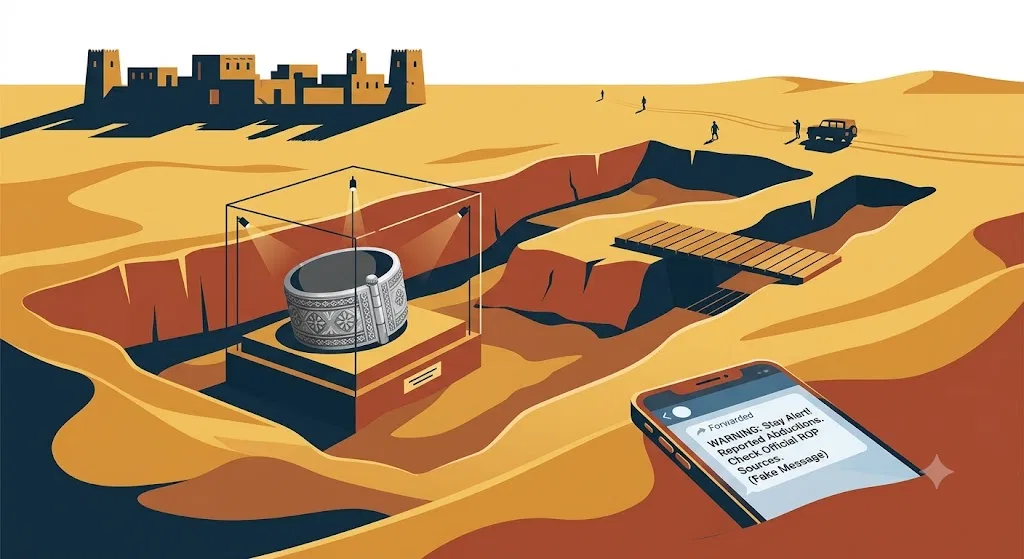
These cases matter because they show several different ways an untrue story can acquire authority. Satellite technology can make a romantic archaeological interpretation sound proven. A genuine museum object can be stripped of its cultural identity by a false caption. A warning can borrow the appearance of an official notice, while a dramatic video can circulate faster than its commercial origin. Oman’s history of contested truth is therefore less a catalogue of master criminals than a study of how familiar fears, prestigious institutions and impressive images make doubtful claims persuasive.
Was Ubar really Oman’s lost city?
The best-known contested story associated with Oman is the supposed discovery of Ubar, often advertised as the “Atlantis of the Sands”. Unlike a straightforward fraud, this was not a fabricated archaeological site. The ruins at Shisr in Dhofar are real, ancient caravan routes did converge there, and satellite imagery genuinely helped investigators locate traces of travel and settlement beneath the desert landscape. The questionable part was the leap from those discoveries to the announcement that a magnificent legendary city had been found.
Stories of a wealthy settlement swallowed by the sands had circulated among travellers for decades. In 1930, the explorer Bertram Thomas was shown an old desert track said to lead towards Ubar, described in local tradition as a rich city buried in the Empty Quarter. The tale offered everything an expedition narrative needed: vanished wealth, dangerous terrain, fragments of oral testimony and an apparently recoverable destination.[Archaeology Magazine]archive.archaeology.orgArchaeology MagazineAtlantis of the Sands - Archaeology Magazine ArchiveIt was a great city, rich in treasure, with date gardens and a fo…
During the late twentieth century, Nicholas Clapp, archaeologist Juris Zarins, explorer Ranulph Fiennes and others used historical maps, remote-sensing data and field investigation to trace old frankincense routes. Excavation at Shisr uncovered a fortified oasis site whose walls had partly collapsed into a sinkhole. In February 1992, NASA’s Jet Propulsion Laboratory announced that satellite and shuttle-radar technology had played a key role in the discovery of the “legendary lost city of Ubar”, presenting the place as a major frankincense centre with extremely ancient origins.[NASA Jet Propulsion Laboratory (JPL)]jpl.nasa.govNASA Jet Propulsion Laboratory (JPL)JPL Technology and Expertise Key Role in Lost City…February 5, 1992 — 5 Feb 1992 — A team of scien…
The technology was real, but the headline was more certain than the archaeology. Even Clapp later acknowledged that there was no definitive inscription or other “100 per cent proof” identifying Shisr as Ubar. The imagery revealed old tracks converging on a site; it could not read the site’s ancient name or establish that it was the great city of legend.[NASA Science]science.nasa.gov“There was never any 100NASA ScienceSearching for the Origins of Space ArchaeologyAugust 7, 2017 — 7 Aug 2017 — More than a decade of research, a few space shutt…
Later interpretation became more cautious. Shisr appears to have been an important fortified watering place or caravan station connected with the frankincense trade. Its partial collapse into a sinkhole may have contributed to its abandonment, but there is no good evidence that a vast metropolis disappeared beneath a catastrophic sandstorm. Zarins himself argued that “Ubar” may have referred to a wider region rather than a single city. The identification of Ubar with Iram, the people of ‘Ad or a specific scriptural city is also disputed.[Wikipedia]WikipediaAtlantis of the SandsAtlantis of the Sands
The episode is best understood as archaeological overstatement rather than a planned hoax. Several forces encouraged it:
- The romance of exploration: “Fortified desert trading post” was accurate but less marketable than “Arabian Atlantis”.
- Technological prestige: References to NASA, radar and satellites gave an interpretive claim the aura of a scientific measurement.
- Several legends were merged: Ubar, Iram, scriptural punishment narratives and later travellers’ stories were often treated as descriptions of the same place.
- A genuine discovery supported a larger story: Because Shisr and the caravan tracks were real, readers had less reason to question the name attached to them.
The story still circulates because the correction is less memorable than the original announcement. Modern retellings commonly say that satellites “confirmed” the lost city, even though the evidence supports a more modest conclusion: remote sensing helped find and interpret a significant oasis site, while its identity as legendary Ubar remains unproven. NASA’s own later material has continued to use the Ubar label, demonstrating how an attractive identification can persist inside otherwise reliable scientific communication.[NASA Science]science.nasa.govNASA ScienceSecrets Beneath the SandAugust 29, 2017 — Such images once aided early pioneers of space archaeology as they searched for the…

How an Omani anklet became a giant’s ring
One of the clearest Oman-related internet hoaxes begins with a real piece of jewellery. Photographs of a very large metal ornament have repeatedly circulated with captions claiming that archaeologists discovered an enormous ring belonging to a giant or to an impossibly large ancient human. The object is actually a type of heavy Omani silver anklet.
The false caption works because the photograph often removes all useful scale and cultural context. A circular ornament lying in a display case can look ring-shaped, while its unusually heavy construction encourages fantasies about gigantic owners. Once the image is reposted without museum information, viewers are invited to explain its size rather than to ask whether it was ever a finger ring.
Museum collections provide a straightforward correction. The British Museum holds heavy, hollow, hinged Omani anklets decorated with chased geometric, floral and vegetal patterns. The front section opens and is secured with a silver pin, a construction designed for wearing around the ankle rather than slipping over a finger. The museum identifies comparable examples as Omani jewellery, including pieces associated with the Nizwa tradition.[British Museum]britishmuseum.orgOpen source on britishmuseum.org.
Such anklets could be visually imposing and were sometimes made in substantial weights. Their size reflects their function, design and the importance of silver ornament in Oman, not evidence for a forgotten race of giants. Specialist descriptions of Omani silver also note that heavy hinged anklets were among the country’s distinctive jewellery forms.[omanisilver.com]omanisilver.comd367 Antique Omani silver Ankletd367 Antique Omani silver Anklet
This is a particularly instructive form of historical misinformation because the object itself is authentic. No one needs to manufacture a fake artefact; the deception is performed entirely by the caption. It also erases the object’s real history. A piece of women’s adornment and Omani craft becomes a prop in a generic pseudohistorical claim, usually detached from its maker, wearer, date and regional style.
The giant-ring tale survives because visual resemblance often outruns documentary evidence. A photograph can be copied thousands of times, while a museum catalogue entry remains attached to one institutional page. Each repost strips away provenance until the image appears to be an unexplained discovery. The lesson is simple: with supposed anomalous artefacts, checking the collection record is usually more valuable than debating the dramatic caption.
Fear spread in the form of official warnings
Many of Oman’s best-documented falsehoods are not elaborate hoaxes but alarming messages circulated through WhatsApp and other social platforms. They commonly concern kidnapping, murder, policing or personal safety. Their persuasive strength comes from urgency and borrowed authority: the message appears to be issued by the police, written by an informed witness or shared “for awareness”.
In 2017, drawings said to depict two female child abductors were circulated as though they had been issued by the Royal Oman Police. The police said that neither the sketches nor the accompanying story had come from them. A separate message that year alleged that a seven-year-old girl had been abducted and later found dead near a shopping centre. It too was false, despite presenting itself as a public-safety warning.[Times of Oman]cdn.timesofoman.com27424 fake news child abduction sketches and story untrue says oman police27424 fake news child abduction sketches and story untrue says oman police
These stories used an effective moral defence against scepticism. Recipients were encouraged to share them for the protection of children, so withholding the message could feel irresponsible. Yet that same emotional pressure allowed an unsupported claim to bypass ordinary questions: Where did the incident occur? Was there a police reference number? Had any local news organisation confirmed it? Did the supposed official notice appear on an official channel?
The pattern continued during the COVID-19 period. In June 2020, a circulated notice claimed that the Royal Oman Police had warned residents about criminals offering free government masks, drugging householders during a fitting and then robbing their homes. Oman’s Government Communications Centre said that the alleged police warning was fake, while still advising people to exercise normal caution around strangers.[Times of Oman]timesofoman.comgovernment quashes rumours of police warning being issued in omangovernment quashes rumours of police warning being issued in oman
That rumour combined a real crisis, an unfamiliar public-health object and an old urban-legend structure. Similar tales around the world feature criminals using perfume, business cards, injections or contaminated objects to incapacitate victims. Replacing the device with a face mask made the story feel current and locally urgent. The fake police attribution then supplied the authority that the story itself lacked.
Other false claims have been more directly political or socially disruptive. In May 2021, police denied online reports that a citizen had died during gatherings in Sohar. Earlier that year, they also rejected a message claiming that officers were stopping vehicles containing more than one occupant and demanding proof that passengers belonged to the same family.[Times of Oman]timesofoman.com101738 royal oman police denies false news circulated on social media101738 royal oman police denies false news circulated on social media
These cases should not all be treated as calculated disinformation campaigns. Some may have begun as misunderstanding, speculation or careless repetition. Others were plainly designed to alarm. What they share is a distribution system in which private forwarding can make a claim appear socially confirmed before public institutions have had time to respond.
When advertising looked like breaking news
A more playful but still revealing episode occurred in Muscat in 2023, when a video appeared to show a cheetah running beside a car on Sultan Qaboos Street and racing through the Muttrah area. The startling clip generated theories about an escaped wild animal before being identified as a digitally created advertising campaign. No cheetah was loose in the city.[Times of Oman]timesofoman.com128334 dont believe everything you see on social media128334 dont believe everything you see on social media
This was not a traditional criminal deception. The aim was attention, not permanent belief, and the commercial origin was eventually clarified. Nevertheless, it briefly occupied the same information space as eyewitness footage and local news. The campaign depended on viewers encountering the spectacle before the explanation.
A second video discussed at the same time showed a dramatic vehicle stunt filmed in Muscat for an Indian production. Detached from its production context, the clip caused concern about the driver’s fate. Authorities had been informed about the filming and the stunt performer was safe, but the short, context-free version travelled faster than the reassuring explanation.[Times of Oman]timesofoman.com128334 dont believe everything you see on social media128334 dont believe everything you see on social media
These examples show that the boundary between hoax, publicity stunt and misunderstood entertainment is increasingly unstable. A creator may regard a clip as obvious visual fiction, yet viewers receive it through feeds where fictional advertising, news footage, film production and eyewitness video have almost identical presentation. The first caption encountered can determine the whole interpretation.
The cheetah campaign also anticipated a broader difficulty created by synthetic media. Once a realistic but impossible event can be produced cheaply, local familiarity becomes an asset to the deception. A recognisable road, building or waterfront makes a fabricated scene feel verifiable: residents know the place, so they may instinctively trust the image before checking the event.
Fraud by borrowed identity
Recent digital fraud in Oman often follows the same principle as the fake police notices: credibility is stolen rather than built. Scammers imitate newspapers, government bodies, employers, banks, insurers or other recognised organisations, then direct victims towards fraudulent websites or payment pages.
In 2024, the Times of Oman warned that fake social-media accounts were copying its logo and branding. The imitation posts were intended to look like material from the real newspaper and could lead users towards dangerous links capable of compromising personal information.[Zawya]zawya.comTimes of Oman' warns its readers on fake social media postsTimes of Oman' warns its readers on fake social media posts
Traffic-fine scams use an equally effective combination of authority and urgency. Messages claim that a fine remains unpaid and threaten a higher penalty unless the recipient follows a link or pays quickly. The believable part is not necessarily the website itself but the emotional situation: few people want to risk additional punishment from the police. Fraudsters benefit when fear of delay suppresses inspection of the sender, domain name and payment method.
The same architecture appears in fake employment offers and impersonation schemes. The victim is presented with something desirable or threatening, given a narrow window to act, and directed away from the organisation’s genuine communication channel. The fraud succeeds not by creating a wholly invented institution but by attaching itself to an institution that people already recognise.
Omani authorities and consumer-protection bodies have repeatedly advised users to verify web addresses, ignore unsolicited payment links and consult official channels. The Royal Oman Police also provides a dedicated number for reporting cyber extortion, reflecting how impersonation, blackmail and account fraud have become continuing law-enforcement concerns rather than isolated internet pranks.[ROP]rop.gov.omOpen source on rop.gov.om.
Propaganda and exaggeration in the Dhofar War
The Dhofar War, which ran from the 1960s until the mid-1970s, belongs in this history only with careful qualification. Propaganda is not automatically a hoax, and competing political claims cannot be dismissed merely because they were intended to persuade. Yet the conflict shows how selective truth, exaggerated reporting and control of information can operate during war.
The rebellion developed in southern Oman against the Sultan’s government and British influence. After Sultan Qaboos took power in 1970, the government combined military operations with development programmes, medical and veterinary assistance, intelligence work and a “hearts and minds” campaign. Radio and other communications were central because both sides needed to shape how residents understood the war and its likely outcome.[RAF Museum]rafmuseum.org.ukthe dhofar warthe dhofar war
Government messaging presented the insurgency through the wider Cold War struggle against communism, while the rebels described themselves as fighting foreign domination and an unjust political order. Neither framework was wholly invented, but each selected facts that served its cause. Rebel broadcasts from neighbouring South Yemen were sometimes regarded by listeners as exaggerated, while government information benefited from improved access to radios and from visible development projects that reinforced its claims of practical progress.[Wikipedia]WikipediaGuerra del DhofarGuerra del Dhofar
The important distinction is between propaganda and provable fabrication. Wartime persuasion may use emotional language, omit inconvenient facts or magnify success without producing a specific forged event. For a history of hoaxes, the Dhofar case is therefore most useful as context: it shows that credibility is often won not by telling the most dramatic story, but by matching claims with what an audience can observe.
What Oman’s hoax stories have in common
The surviving cases differ greatly, but several recurring mechanisms connect them.
A true object or event supplies the foundation. Shisr is a genuine archaeological site. The “giant’s ring” is genuine Omani jewellery. The Muscat stunt footage recorded a real production. The misleading story begins when interpretation is detached from context.
Authority is borrowed. NASA’s involvement made the Ubar identification sound conclusive. Fake warnings copied the voice of the Royal Oman Police. Fraudulent accounts reproduced newspaper logos and institutional branding.
Fear and wonder reduce hesitation. A lost city, an escaped cheetah, a child abductor and an unpaid police fine trigger very different emotions, but each encourages immediate reaction rather than patient verification.
Corrections travel at a disadvantage. The false claim is usually compact, vivid and easy to forward. The correction requires provenance, archaeological caution, official records or an explanation of how the media was produced.
Not every false story has a single deceiver. Ubar became overstated through exploration culture, publicity and repeated simplification. A film stunt became alarming when separated from its production context. These are different from phishing campaigns or forged police notices, where misleading the audience is central to the scheme.
The most useful test is therefore not simply “Is this a hoax?” but “Where did the claim change?” A real site may acquire a legendary name. A real artefact may receive a false function. A fictional advertisement may be reposted as news. An ordinary safety concern may be rewritten as an official warning. Following that change—from evidence to caption, or from uncertainty to certainty—usually reveals who benefited and why the story spread.

Why the stories endure
Oman’s hoax history is shaped by the country’s distinctive mixture of ancient trade, desert exploration, strong oral traditions, rapid modernisation and highly connected digital life. Romantic stories flourish around remote landscapes and archaeological remains, while modern rumours move through the intimate trust networks of messaging applications.
The persistence of the “Atlantis of the Sands” illustrates the attraction of a grand conclusion. The evidence for caravan trade and settlement is historically valuable, yet the legendary city remains the part most likely to appear in headlines and tourism narratives. The giant-ring image shows the reverse process: an object with a rich cultural identity becomes famous only after that identity is removed.
Modern false warnings reveal another tension. People share them because they believe they are protecting relatives and neighbours, but the act of forwarding can itself create fear and confusion. Scammers exploit the same instinct by presenting fraudulent links as urgent instructions from trusted bodies.
Taken together, the cases do not suggest unusual gullibility in Oman. They demonstrate mechanisms found everywhere: confidence inspired by technology, trust in official-looking communication, the emotional force of endangered children, and the tendency of spectacular images to outrun careful explanation. Oman’s examples are valuable precisely because they show how deception often succeeds without inventing everything. A fragment of truth, placed beneath the right headline, is frequently enough.
Amazon book picks
Further Reading
Books and field guides related to Which Oman Stories Survived Their Debunking?. Use these as the next step if you want deeper reading beyond the article.
The Demon-Haunted World
Rating: 4.5/5 from 43 Google Books ratings
Focuses on evaluating extraordinary claims and public misconceptions.
Suspicious Minds
Examines why doubtful stories gain credibility and survive debunking.
Frauds, Myths, and Mysteries: Science and Pseudoscience in Ar...
Covers how archaeological myths and exaggerated discoveries spread.
eBay marketplace picks
Marketplace Samples
Live-tested eBay searches with available results related to this page.
Endnotes
1.
Source: archive.archaeology.org
Link:https://archive.archaeology.org/9705/abstracts/ubar.html
Source snippet
Archaeology MagazineAtlantis of the Sands - Archaeology Magazine ArchiveIt was a great city, rich in treasure, with date gardens and a fo...
2.
Source: jpl.nasa.gov
Link:https://www.jpl.nasa.gov/news/jpl-technology-and-expertise-key-role-in-lost-city-discovery/
Source snippet
NASA Jet Propulsion Laboratory (JPL)JPL Technology and Expertise Key Role in Lost City...February 5, 1992 — 5 Feb 1992 — A team of scien...
Published: February 5, 1992
3.
Source: science.nasa.gov
Title: “There was never any 100
Link:https://science.nasa.gov/earth/earth-observatory/searching-for-the-origins-of-space-archaeology/
Source snippet
NASA ScienceSearching for the Origins of Space ArchaeologyAugust 7, 2017 — 7 Aug 2017 — More than a decade of research, a few space shutt...
Published: August 7, 2017
4.
Source: Wikipedia
Title: Atlantis of the Sands
Link:https://en.wikipedia.org/wiki/Atlantis_of_the_Sands
5.
Source: science.nasa.gov
Title: following the frankincense trail 90992
Link:https://science.nasa.gov/earth/earth-observatory/following-the-frankincense-trail-90992/
Source snippet
NASA ScienceFollowing the Frankincense Trail25 Sept 2017 — In the 1990s, a team of explorers and archaeologists discovered several new si...
6.
Source: science.nasa.gov
Link:https://science.nasa.gov/earth/earth-observatory/secrets-beneath-the-sand-90847/
Source snippet
NASA ScienceSecrets Beneath the SandAugust 29, 2017 — Such images once aided early pioneers of space archaeology as they searched for the...
Published: August 29, 2017
7.
Source: nasa.gov
Title: 40 Years Ago: STS-41G – A Flight of Many Firsts
Link:https://www.nasa.gov/history/40-years-ago-sts-41g-a-flight-of-many-firsts-and-records/
Source snippet
7 Oct 2024 — The discovery of the 3,000-year-old lost city of Ubar in the desert of Oman resulted from SIR-B data, one of many intere...
8.
Source: omanisilver.com
Title: d367 Antique Omani silver Anklet
Link:https://omanisilver.com/contents/en-us/d367_Antique_Omani_silver_Anklet.html
9.
Source: zawya.com
Title: ‘Times of Oman’ warns its readers on fake social media posts
Link:https://www.zawya.com/en/world/middle-east/times-of-oman-warns-its-readers-on-fake-social-media-posts-xj7fnomm
10.
Source: rop.gov.om
Link:https://www.rop.gov.om/english/contactus.aspx
11.
Source: Wikipedia
Title: Dhofar rebellion
Link:https://en.wikipedia.org/wiki/Dhofar_rebellion
12.
Source: Wikipedia
Title: Guerra del Dhofar
Link:https://it.wikipedia.org/wiki/Guerra_del_Dhofar
13.
Source: Wikipedia
Title: Psychological warfare
Link:https://en.wikipedia.org/wiki/Psychological_warfare
14.
Source: assets.science.nasa.gov
Title: EOKids Space Archaeology508
Link:https://assets.science.nasa.gov/content/dam/science/esd/eo/eokids/wp-content/uploads/sites/6/2018/08/EOKids_SpaceArchaeology508.pdf
15.
Source: nasa.gov
Link:https://www.nasa.gov/wp-content/uploads/static/history/rg_finding_aids/rg_5_international_march2020.xlsx
16.
Source: history.com
Title: brilliant psyops psychological warfare
Link:https://www.history.com/articles/brilliant-psyops-psychological-warfare
17.
Source: omanisilver.com
Link:https://omanisilver.com/contents/en-us/d24_Omani_silver_rings.html
18.
Source: britishmuseum.org
Link:https://www.britishmuseum.org/collection/object/W
19.
Source: cdn.timesofoman.com
Title: 27424 fake news child abduction sketches and story untrue says oman police
Link:https://cdn.timesofoman.com/article/27424-fake-news-child-abduction-sketches-and-story-untrue-says-oman-police
20.
Source: timesofoman.com
Link:https://timesofoman.com/article/108943/Oman/WhatsApp-rumour-girl-kidnapped-and-killed-is-fake-news-says-Royal-Oman-Policedisqussion-0
21.
Source: timesofoman.com
Title: government quashes rumours of police warning being issued in oman
Link:https://timesofoman.com/article/3015523/oman/government/government-quashes-rumours-of-police-warning-being-issued-in-oman
22.
Source: timesofoman.com
Title: 101738 royal oman police denies false news circulated on social media
Link:https://timesofoman.com/article/101738-royal-oman-police-denies-false-news-circulated-on-social-media
23.
Source: timesofoman.com
Title: 98805 rop quashes rumours on checking of vehicles
Link:https://timesofoman.com/article/98805-rop-quashes-rumours-on-checking-of-vehicles
24.
Source: timesofoman.com
Title: 128334 dont believe everything you see on social media
Link:https://timesofoman.com/article/128334-dont-believe-everything-you-see-on-social-media
25.
Source: rafmuseum.org.uk
Title: the dhofar war
Link:https://www.rafmuseum.org.uk/research/online-exhibitions/an-enduring-relationship-a-history/the-dhofar-war/
26.
Source: facebook.com
Link:https://www.facebook.com/timesofoman/posts/times-of-oman-warns-readers-of-fake-social-media-posts/928607492635737/
27.
Source: cdn-4.timesofoman.com
Title: 160571 trump requests release of documents related to epstein case
Link:https://cdn-4.timesofoman.com/article/160571-trump-requests-release-of-documents-related-to-epstein-case
28.
Source: cdn-5.timesofoman.com
Title: 161922 citizens and residents targeted by online fraud rop advises caution
Link:https://cdn-5.timesofoman.com/article/161922-citizens-and-residents-targeted-by-online-fraud-rop-advises-caution
29.
Source: rssfeeds.timesofoman.com
Title: 45385 fake news royal oman police deny sohar murder rumours
Link:https://rssfeeds.timesofoman.com/article/45385-fake-news-royal-oman-police-deny-sohar-murder-rumours
30.
Source: timesofoman.com
Title: 103154 rop reviews video clip circulating on social media
Link:https://timesofoman.com/article/103154-rop-reviews-video-clip-circulating-on-social-media
31.
Source: cdn-4.timesofoman.com
Title: 170989 rop issues statement to debunk misleading reports of school trip incident
Link:https://cdn-4.timesofoman.com/article/170989-rop-issues-statement-to-debunk-misleading-reports-of-school-trip-incident
32.
Source: timesofoman.com
Link:https://timesofoman.com/article/1151560/Oman?page=0
33.
Source: ia902808.us.archive.org
Title: bub gb La Un Oztbk P4C
Link:https://ia902808.us.archive.org/24/items/bub_gb_LaUnOztbkP4C/bub_gb_LaUnOztbkP4C.pdf
34.
Source: britishmuseum.org
Link:https://www.britishmuseum.org/collection/object/W
35.
Source: britishmuseum.org
Link:https://www.britishmuseum.org/sites/default/files/2023-10/Making-their-mark-women-silversmiths-from-Oman-large-print-guide.pdf
36.
Source: GOV.UK
Title: information on child abduction in oman
Link:https://www.gov.uk/government/publications/oman-child-abduction/information-on-child-abduction-in-oman
Additional References
37.
Source: youtube.com
Title: The Lost City of Ubar: Arabia’s Atlantis Beneath the Sands
Link:https://www.youtube.com/watch?v=xKQ0_AHzSAc
Source snippet
The Lost City That Was Never Meant to Be Found...
38.
Source: youtube.com
Title: Ubar — The City Swallowed by Sand: Myth, Satellites & Sinkholes
Link:https://www.youtube.com/watch?v=XLdZh31rsDA
Source snippet
UBAR: The search for the LOST CITY, the ATLANTIS OF THE SANDS...
39.
Source: youtube.com
Title: The Lost City That Was Never Meant to Be Found
Link:https://www.youtube.com/watch?v=7SBqPt83jB4
Source snippet
The City the Quran Said Existed That Scientists Called a Myth...
40.
Source: researchgate.net
Link:https://www.researchgate.net/publication/353551801_Atlantis_of_the_Sands_Evidence_of_a_Previous_Civilization_in_Arabia
41.
Source: researchgate.net
Link:https://www.researchgate.net/publication/347390878_Fakes_and_Forgeries_of_Written_Artefacts_from_Ancient_Mesopotamia_to_Modern_China
42.
Source: datajournalism.com
Link:https://datajournalism.com/read/handbook/verification-1/verifying-images/4-verifying-images/4-2-verifying-two-suspicious-street-sharks-dur-ing-hurricane-sandy
43.
Source: universityofleeds.github.io
Link:https://universityofleeds.github.io/philtaylorpapers/vp01a6a8-2.html
44.
Source: acams.org
Link:https://www.acams.org/en/opinion/cyber-security-fake-news-bots-botnets-and-click-fraud
45.
Source: facebook.com
Link:https://www.facebook.com/groups/149844915349213/posts/2223496457984038/
46.
Source: facebook.com
Link:https://www.facebook.com/meteorologistryan.wichman/posts/dont-fall-for-it-this-is-a-fake-photo-circulating-claiming-to-be-from-houston-of/1662169150480463/
Topic Tree
Follow this branch
Related pages 192
- Albanian Hoaxes
- Algerian Hoaxes
- Antigua Deceptions
- Argentina Hoaxes
- Armenian Hoaxes
- +187 more in sidebar