Within Russian Hoaxes
Why Russia Kept Believing in Lost Heirs
From False Dmitry to Anna Anderson, disputed heirs succeeded when political crisis or grief made miraculous survival believable.
On this page
- False Dmitry and the Time of Troubles
- Anna Anderson and the Anastasia legend
- Why survival stories outlived their evidence
Page outline Jump by section
Introduction
Few Russian stories show the power of wishful thinking more clearly than the recurring belief that a dead royal heir had somehow survived. From the Time of Troubles in the early seventeenth century to the Romanov mysteries of the twentieth, claimants repeatedly emerged claiming to be princes, tsareviches or grand duchesses thought to have been killed. Some attracted armies, foreign sponsors and political movements; others won sympathy from people unable to accept a tragic ending. In Russia, royal imposture was rarely just a personal fraud. It flourished when war, dynastic uncertainty, censorship, poor information or collective grief left room for alternative narratives. The result was a succession of famous pretenders whose stories often survived long after the evidence against them had become overwhelming.[Wikipedia]WikipediaTime of TroublesTime of Troubles

False Dmitry and the Time of Troubles
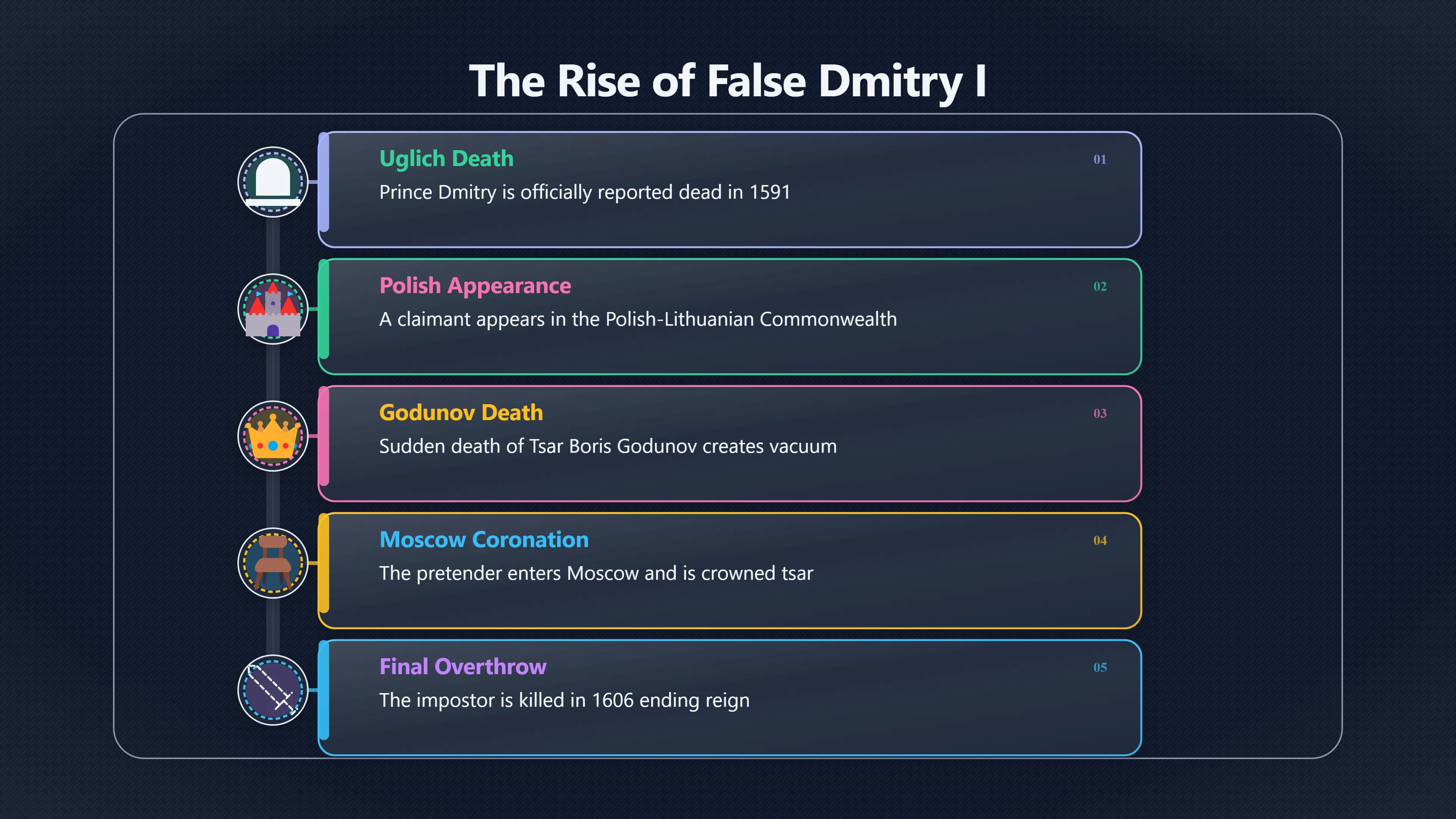
The most successful royal impostor in Russian history was the man known as False Dmitry I. He claimed to be Dmitry Ivanovich, the youngest son of Ivan the Terrible, who was officially reported dead in 1591 at the town of Uglich. Rumours about the boy’s death had circulated almost immediately. Some suspected murder, others believed he had escaped. When a claimant appeared in the Polish–Lithuanian Commonwealth around 1603 insisting that he was the miraculously rescued heir, he entered a political environment already primed to believe him.[Wikipedia]WikipediaDmitry of UglichDmitry of Uglich
The timing mattered as much as the claim itself. Russia was facing dynastic crisis, famine and growing dissatisfaction with Tsar Boris Godunov. The pretender gained support from powerful nobles, military backers and foreign interests who saw advantages in backing an alternative ruler. After Godunov’s sudden death in 1605, the claimant entered Moscow and was crowned tsar. Whatever his true identity, he achieved something extraordinary: he became the recognised ruler of Russia.[Wikipedia]WikipediaFalse Dmitry IFalse Dmitry I
His success demonstrates an important feature of royal imposture. The claim did not triumph because conclusive proof existed. It triumphed because enough influential people found it useful or plausible. Dmitry’s supposed survival offered a legal and emotional answer to a political crisis. Even his acceptance by Dmitry’s mother, Maria Nagaya, strengthened the story despite obvious political pressures surrounding such recognition.[Wikipedia]WikipediaFalse Dmitry IFalse Dmitry I
When False Dmitry I was overthrown and killed in 1606, the story might have ended. Instead, it became even more flexible. New claimants appeared claiming either to be the same Dmitry or another miraculous survivor. False Dmitry II attracted substantial support, and further pretenders emerged during the continuing chaos of the Time of Troubles. Once a survival narrative became established, every reported death could be reinterpreted as another escape.[wikipedia.org]WikipediaTime of TroublesTime of Troubles
Why people believed the Dmitry story
Several factors made the claim unusually persuasive:
- Uncertainty surrounding the original death. Many people never saw the young prince’s body and relied on official accounts that were widely distrusted.[Wikipedia]WikipediaDmitry of UglichDmitry of Uglich
- Political need. Opponents of Boris Godunov needed a legitimate alternative claimant to the throne.[Wikipedia]WikipediaTime of TroublesTime of Troubles
- Limited communications. In an age without rapid information networks, identity could be contested for years.[Wikipedia]WikipediaTime of TroublesTime of Troubles
- Religious and folkloric expectations. Stories of hidden heirs and providential returns already existed in European and Russian political culture, making miraculous survival easier to imagine.[Wikipedia]WikipediaTime of TroublesTime of Troubles
The False Dmitry phenomenon became a template for later Russian survival legends: an apparently dead royal, uncertainty surrounding the death, political turmoil, and a claimant who offered hope that history could be reversed.

Anna Anderson and the Anastasia legend
More than three centuries later, another lost-heir story captured the world’s imagination. Following the execution of Tsar Nicholas II, his wife Alexandra and their children by the Bolsheviks in 1918, confusion surrounded the fate of the Romanov family. The Soviet government concealed details of the killings, physical evidence remained inaccessible for decades, and rumours quickly spread that one or more children had escaped.[Wikipedia]WikipediaAnna AndersonAnna Anderson
The most famous claimant was Anna Anderson, a woman who emerged in Germany during the 1920s claiming to be Grand Duchess Anastasia, the youngest daughter of the last tsar. Her supporters pointed to perceived physical similarities, personal memories and the emotional conviction of some who met her. Critics argued that her story contained inconsistencies and that she was actually a Polish factory worker named Franziska Schanzkowska. The dispute lasted for decades and generated books, court cases, films and endless media attention.[Wikipedia]WikipediaAnna AndersonAnna Anderson
Unlike the False Dmitry episode, Anderson never gained political power. Her appeal rested instead on psychology and emotion. The Romanovs’ murder was shocking even to many who opposed monarchy. The possibility that a young princess had escaped a revolutionary massacre provided a more hopeful ending than the historical reality. As the years passed, uncertainty itself became part of the legend.[Wikipedia]WikipediaAnna AndersonAnna Anderson
The mystery persisted until advances in forensic science transformed the debate. After the discovery and examination of Romanov remains, researchers used DNA testing to compare the bones with living relatives of the imperial family. Separate tests on preserved tissue and hair associated with Anderson showed that she was not related to the Romanovs. Instead, the genetic evidence matched relatives of Franziska Schanzkowska. Subsequent discoveries of the remaining Romanov children and additional DNA analyses reinforced the conclusion that none of Nicholas II’s daughters survived the execution.[wikipedia.org]WikipediaAnna AndersonAnna Anderson
Why the Anastasia story endured
The Anastasia legend lasted far longer than many other impostor claims because it drew strength from several overlapping factors:
- Secrecy surrounding the executions. Soviet authorities did not immediately provide a clear public account of what happened.[The Times]thetimes.comThe request, supported by Count Nikolai Tolstoy of the Monarchist League, followed the identification of the Romanov remains using Prince…
- A powerful emotional narrative. The image of a lone princess escaping revolution was dramatically appealing.[Wikipedia]WikipediaAnna AndersonAnna Anderson
- Celebrity and media attention. Court battles, memoirs and films kept the mystery alive for generations.[Wikipedia]WikipediaAnna AndersonAnna Anderson
- Scientific delay. Definitive DNA evidence became available only decades after the original events.[Wikipedia]WikipediaAnna AndersonAnna Anderson
The case illustrates how a claim can survive not because evidence supports it, but because the evidence needed to refute it arrives slowly.

Why survival stories outlived their evidence
The False Dmitrys and the Anastasia claimants belonged to very different eras, yet they followed remarkably similar patterns. Both emerged after violent political upheaval. Both centred on a supposedly dead heir whose fate remained uncertain in the public mind. Both offered a version of history in which catastrophe could be undone.[Wikipedia]WikipediaTime of TroublesTime of Troubles
Survival legends also benefit from an unusual logical advantage. Every failed prediction can be explained away. If a claimant dies, supporters can argue that another survivor remains hidden. If evidence appears, believers can question its authenticity. The story therefore becomes difficult to extinguish completely, especially when it serves emotional or political needs.[Reddit]reddit.comThe False Dmitries: r/historyTIL that Russia was once ruled by an impostor who claimed to be Ivan the Terrible's son. He is now kn…
In Russia’s history of deception and contested truth, royal impostors occupy a special place because they were not merely individual frauds. They reflected broader social conditions: uncertainty after a succession crisis, distrust of official accounts, the trauma of revolution, and the enduring human attraction of lost heirs who might one day return. Even when evidence eventually settled the historical record, the legends proved harder to bury than the people whose identities they borrowed.[wikipedia.org]WikipediaTime of TroublesTime of Troubles
Amazon book picks
Further Reading
Books and field guides related to Why Russia Kept Believing in Lost Heirs. Use these as the next step if you want deeper reading beyond the article.
A People's Tragedy
Provides context for upheaval, legitimacy crises and belief in claimants.
Ivan the Terrible
Explains the dynasty and succession issues behind the impostor phenomenon.
eBay marketplace picks
Marketplace Samples
Live-tested eBay searches with available results related to this page.



Endnotes
1.
Source: Wikipedia
Title: Time of Troubles
Link:https://en.wikipedia.org/wiki/Time_of_Troubles
2.
Source: Wikipedia
Title: False Dmitry I
Link:https://en.wikipedia.org/wiki/False_Dmitry_I
3.
Source: Wikipedia
Title: Dmitry of Uglich
Link:https://en.wikipedia.org/wiki/Dmitry_of_Uglich
4.
Source: ebsco.com
Title: Known in Russian history as the Time of Troubles, this period saw pretenders
Link:https://www.ebsco.com/research-starters/history/reign-false-dmitry-i
Source snippet
Reign of False Dmitry I | History | Research Starters - EBSCORussia's pretender to the throne, the False Dmitry, reigned briefly during...
5.
Source: reddit.com
Link:https://www.reddit.com/r/history/comments/dmp7qr/the_false_dmitries/
Source snippet
The False Dmitries: r/historyTIL that Russia was once ruled by an impostor who claimed to be Ivan the Terrible's son. He is now kn...
6.
Source: Wikipedia
Title: Anna Anderson
Link:https://en.wikipedia.org/wiki/Anna_Anderson
7.
Source: Wikipedia
Title: Grand Duchess Anastasia Nikolaevna of Russia
Link:https://en.wikipedia.org/wiki/Grand_Duchess_Anastasia_Nikolaevna_of_Russia
Source snippet
Anderson's body was cremated upon her death in 1984; DNA testing in 1994 on pieces of Anderson's tissue and hair showed no relation to th...
8.
Source: ebsco.com
Link:https://www.ebsco.com/research-starters/applied-sciences/identification-anastasia-romanovs-remains
Source snippet
Identification of Anastasia Romanov's remainsBoth American and German authorities tested the DNA of Anna Anderson, the DNA was not a...
9.
Source: tsarnicholas.org
Title: the ghost of anna anderson continues to haunt us
Link:https://tsarnicholas.org/2024/02/12/the-ghost-of-anna-anderson-continues-to-haunt-us/
10.
Source: Wikipedia
Link:https://en.wikipedia.org/wiki/False
11.
Source: Wikipedia
Title: Murder of the Romanov family
Link:https://en.wikipedia.org/wiki/Murder_of_the_Romanov_family
12.
Source: reddit.com
Link:https://www.reddit.com/r/todayilearned/comments/sxtp9g/til_of_anna_anderson_an_impostor_who_claimed_to/
13.
Source: reddit.com
Link:https://www.reddit.com/r/wikipedia/comments/jb1h7q/anna_anderson_a_woman_who_claimed_to_be_be_the/
14.
Source: reddit.com
Link:https://www.reddit.com/r/todayilearned/comments/1jznn1n/til_about_the_strange_death_of_dmitry_of_uglich_a/
15.
Source: reddit.com
Link:https://www.reddit.com/r/EnglishLearning/comments/178pc3x/difference_between_fake_and_false/
16.
Source: reddit.com
Link:https://www.reddit.com/r/AskHistorians/comments/10yc1qm/why_did_various_women_claim_to_be_anastasiya/
17.
Source: history.com
Link:https://www.history.com/this-day-in-history/february-6/anastasia-arrives-in-the-united-states
18.
Source: history.com
Title: romanov family bodies discovery coverup
Link:https://www.history.com/articles/romanov-family-bodies-discovery-coverup
19.
Source: content.time.com
Link:https://content.time.com/time/specials/packages/article/0%2C28804%2C1900621_1900618_1900620%2C00.html
20.
Source: thetimes.com
Link:https://www.thetimes.com/uk/scotland/article/britain-rejected-plea-to-return-tsar-familys-remains-with-dignity-3djxhcw8v
Source snippet
The request, supported by Count Nikolai Tolstoy of the Monarchist League, followed the identification of the Romanov remains using Prince...
21.
Source: dictionary.cambridge.org
Link:https://dictionary.cambridge.org/us/dictionary/english/false
22.
Source: psu.edu
Title: anastasia story
Link:https://www.psu.edu/news/research/story/anastasia-story
Additional References
23.
Source: youtube.com
Title: The Rise of Russia’s Impostor Tsar (The Story of the First False Dmitry, Part 1)
Link:https://www.youtube.com/watch?v=28HE1cya8iM
Source snippet
The largest uprising in Russia before the 20th century and the worst punishment. E.Pugachev. 1762...
24.
Source: order-of-the-jackalope.com
Link:https://order-of-the-jackalope.com/samozvantsy/
Source snippet
Dmitry II seemed to embolden other would-be pretenders...
25.
Source: youtube.com
Link:https://www.youtube.com/watch?v=EmuKHaR0W1k
Source snippet
The Rise of Russia's Impostor Tsar (The Story of the First False Dmitry, Part 1)...
Published: June 1605
26.
Source: youtube.com
Link:https://www.youtube.com/watch?v=72eItcnOj2Y
Source snippet
Yemelyan Pugachev's Rebellion: The Russian Peasants' War of 1773...
27.
Source: youtube.com
Link:https://www.youtube.com/watch?v=-4tJC-txreI
Source snippet
Anna Anderson: The Anastasia Romanov Impostor | After Dark...
28.
Source: facebook.com
Link:https://www.facebook.com/61551355978606/posts/dna-breakthrough-shatters-the-romanov-survival-myth-the-tragic-truth-revealeddna/122228576030045199/
29.
Source: merriam-webster.com
Link:https://www.merriam-webster.com/dictionary/false
30.
Source: dictionary.com
Link:https://www.dictionary.com/browse/false
31.
Source: collinsdictionary.com
Link:https://www.collinsdictionary.com/us/dictionary/english/false
32.
Source: facebook.com
Link:https://www.facebook.com/amanda.dickson/posts/this-is-the-captivating-story-of-anna-anderson-who-claimed-to-be-anastasia-roman/1280398080574203/
Topic Tree