Within Liberia
How Did Liberia Record More Votes Than Voters?
Liberia's ruling party reported an impossible landslide, turning electoral arithmetic into a lasting symbol of state-sponsored fraud.
On this page
- What the Official Results Claimed
- How One Party Rule Enabled the Fraud
- From the Election Scandal to the Forced Labour Inquiry
Page outline Jump by section
Introduction
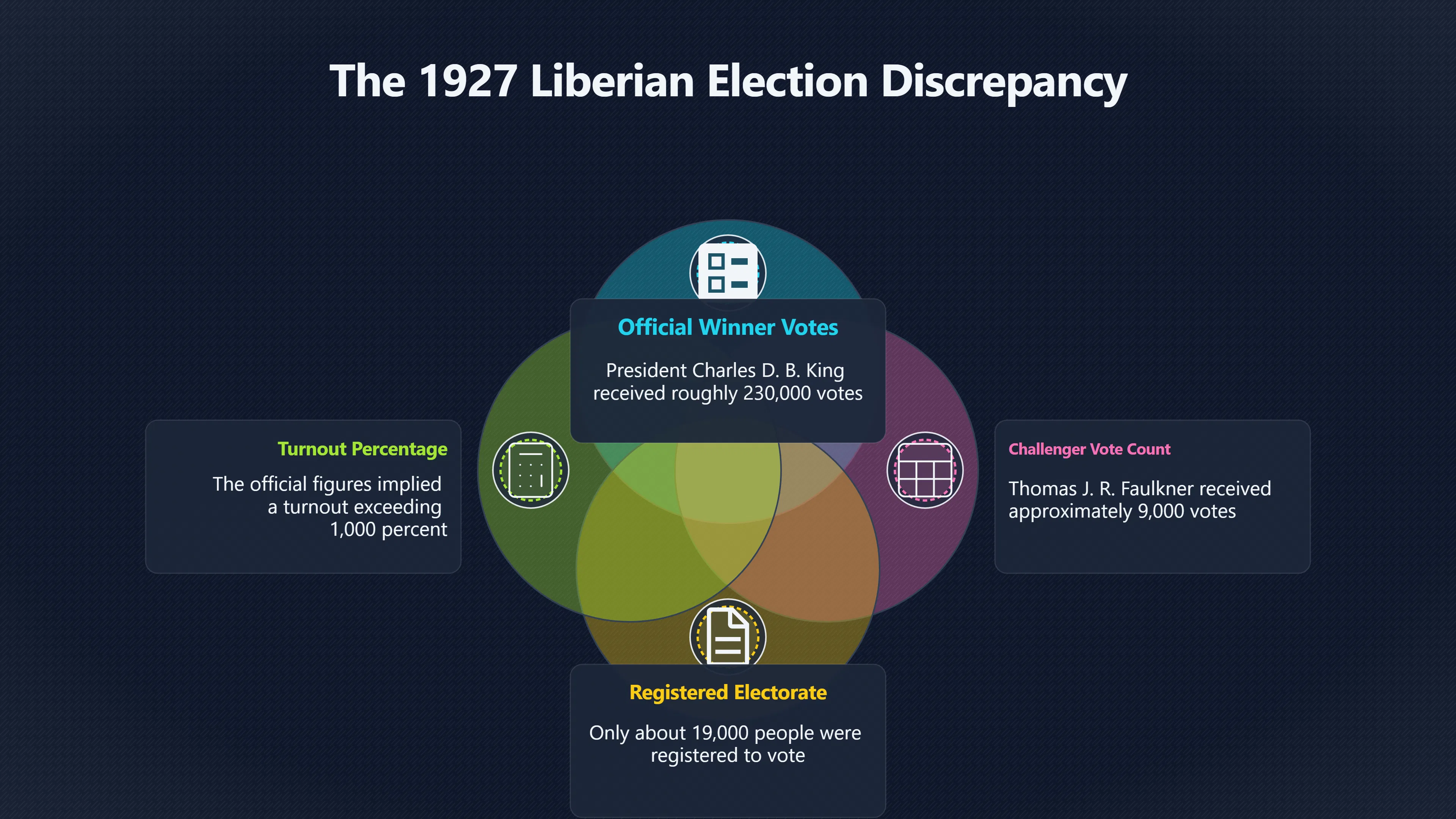
The 1927 Liberian presidential election occupies a unique place in the history of political fraud because the official results claimed far more votes than there were eligible voters. President Charles D. B. King of the ruling True Whig Party was declared the overwhelming winner, receiving roughly 230,000 votes against about 9,000 for challenger Thomas J. R. Faulkner, despite a registered electorate of only around 19,000 people and a much smaller body of citizens actually entitled to vote under Liberia’s restrictive political system. The discrepancy was so extreme that the election later entered popular memory as one of the most blatant examples of electoral manipulation ever recorded.[Wikipedia]Wikipedia1927 Liberian general election1927 Liberian general election
For a project examining famous deceptions in Liberia, this case matters because it was not merely a disputed election. The official arithmetic itself became evidence of fraud. The scandal exposed the realities of one-party domination, helped trigger international scrutiny of the Liberian government, and eventually contributed to the downfall of the president whose victory it was supposed to secure.[Wikipedia]Wikipedia1927 Liberian general election1927 Liberian general election
What the Official Results Claimed
Liberia held general elections on 3 May 1927. Charles D. B. King, already serving as president, sought another term against Thomas J. R. Faulkner of the People’s Party. According to the official results, King won by an extraordinary margin, receiving approximately 229,000 to 234,000 votes, while Faulkner received around 9,000. Yet the country had only about 19,000 registered voters, and some contemporary accounts placed the practical electorate even lower because voting rights were heavily restricted.[wikipedia.org]Wikipedia1927 Liberian general election1927 Liberian general election
The figures were not merely suspicious; they were mathematically impossible. Depending on which contemporary count is used, King was credited with more than ten times the number of voters who actually existed on the electoral rolls. The result implied a turnout that exceeded 1,000 per cent and, in some retellings, approached 1,700 per cent.[Wikipedia]Wikipedia1927 Liberian general election1927 Liberian general election
The absurdity of the numbers is one reason the story has endured. Many election scandals involve allegations that are difficult to prove. In Liberia’s 1927 contest, the official figures themselves became the evidence. Decades later, the election was widely cited by reference works and commentators as perhaps the most quantitatively fraudulent election ever recorded.[Wikipedia]Wikipedia1927 Liberian general election1927 Liberian general election
How One-Party Rule Enabled the Fraud
The election did not occur in a competitive democratic environment. By the 1920s, Liberia was effectively dominated by the True Whig Party, which had controlled national politics since the nineteenth century. Political power was concentrated in the hands of the Americo-Liberian elite, descendants of settlers from the United States and the Caribbean, while most Indigenous Liberians remained excluded from meaningful political participation.[Wikipedia]WikipediaCharles D. B. KingCharles D. B. King
This political structure created conditions in which official election returns could be manipulated with little immediate risk. Opposition candidates existed, but they operated within a system where state institutions, patronage networks and electoral administration were heavily influenced by the ruling party. King had already won previous elections, and the True Whig Party’s dominance was rarely challenged successfully.[Wikipedia]WikipediaCharles D. B. KingCharles D. B. King
The scale of the reported fraud suggests that the goal was not simply to ensure victory but to demonstrate overwhelming authority. In many authoritarian systems, exaggerated electoral margins are intended to project legitimacy and discourage opposition. The Liberian case became notorious because the exaggeration was so extreme that it undermined the credibility of the result itself.[Wikipedia]Wikipedia1927 Liberian general election1927 Liberian general election

Why People Accepted the Result at the Time
Modern readers often wonder how such figures could be published at all. Part of the answer lies in the political and communications environment of the 1920s.
Liberia did not possess the extensive independent media, election-monitoring organisations or international observation missions that later became common in many elections. Information moved slowly, and official declarations carried considerable authority. In a state dominated by one party, many citizens had little practical ability to challenge published figures.[Wikipedia]WikipediaCharles D. B. KingCharles D. B. King
Another factor is that the election’s notoriety grew over time. The result was controversial when announced, but it became internationally famous only later, after journalists, historians and political commentators repeatedly cited the impossible numbers as a symbol of electoral fraud. The election’s reputation today is therefore partly the product of later scrutiny and historical comparison.[Wikipedia]Wikipedia1927 Liberian general election1927 Liberian general election
From the Election Scandal to the Forced-Labour Inquiry
The most important consequence of the election was not the result itself but what happened afterwards.
After his defeat, Thomas J. R. Faulkner accused the Liberian government of involvement in forced labour practices and the recruitment of labourers for shipment to the Spanish-controlled island of Fernando Póo (now part of Equatorial Guinea). He alleged that senior officials benefited from a system that amounted to coercive labour trafficking.[Wikipedia]Wikipedia1927 Liberian general election1927 Liberian general election
Initially, the Liberian government rejected these accusations. However, the allegations attracted international attention and eventually prompted the League of Nations to establish an inquiry under British jurist Cuthbert Christy. The resulting investigation examined claims of slavery, forced labour and official abuses of power.[Wikipedia]Wikipedia1927 Liberian general election1927 Liberian general election
The commission’s findings did not validate every accusation exactly as originally presented, but they did conclude that senior government figures were implicated in systems of forced labour and coercion. The report damaged Liberia’s international reputation and implicated officials at the highest levels of government, including President King and Vice-President Allen Yancy.[Wikipedia]Wikipedia1927 Liberian general election1927 Liberian general election
Under growing pressure, King resigned in 1930. Ironically, the fraudulent election that appeared to cement his authority became one step in a chain of events that ended his presidency.[Wikipedia]Wikipedia1927 Liberian general election1927 Liberian general election
What 1927 Election reveals about belief and deception
Many political scandals fade from memory because the details are complex. The 1927 Liberian election survives because its central fact is easy to grasp. People remember the story as the election in which there were more votes than voters.
That memorable arithmetic has turned the episode into a shorthand example of state-sponsored electoral fraud. Historians often cite it when discussing authoritarian elections, manipulated vote counts and the dangers of unchecked political power. The case is frequently referenced in discussions of election integrity precisely because the discrepancy is so stark and so easily understood.[Wikipedia]Wikipedia1927 Liberian general election1927 Liberian general election
At the same time, reducing the episode to a humorous statistic risks missing its deeper significance. The inflated numbers were not merely an accounting error or a political joke. They reflected a system in which political competition was severely constrained, public accountability was weak and official institutions could be used to manufacture legitimacy. The subsequent forced-labour investigation revealed that the same structures enabling electoral manipulation were connected to broader abuses of power.[wikipedia.org]Wikipedia1927 Liberian general election1927 Liberian general election
Within Liberia’s wider history of contested truths and official narratives, the 1927 election stands out because the deception was visible in plain sight. Unlike a forged artefact, a fabricated legend or a hidden conspiracy, the evidence was printed in the official results themselves. That is why nearly a century later, the election remains one of the country’s most enduring symbols of political fraud.[wikipedia.org]Wikipedia1927 Liberian general election1927 Liberian general election
Amazon book picks
Further Reading
Books and field guides related to How Did Liberia Record More Votes Than Voters?. Use these as the next step if you want deeper reading beyond the article.
How Democracies Die
Provides broad context for extreme electoral fraud and one-party dominance.
Political Order and Political Decay
Offers comparative insight into institutional weakness and corruption.
Imagined Communities
Helps explain the creation of national legends and shared historical myths.
eBay marketplace picks
Marketplace Samples
Live-tested eBay searches with available results related to this page.


Endnotes
1.
Source: Wikipedia
Title: 1927 Liberian general election
Link:https://en.wikipedia.org/wiki/1927_Liberian_general_election
2.
Source: Wikipedia
Title: Charles D. B. King
Link:https://en.wikipedia.org/wiki/Charles_D._B._King
3.
Source: Wikipedia
Title: Elecciones generales de Liberia de 1927
Link:https://es.wikipedia.org/wiki/Elecciones_generales_de_Liberia_de_1927
4.
Source: Wikipedia
Link:https://en.wikipedia.org/wiki/Liberia
Source snippet
LiberiaLiberia is a country on the West African coast. It is bordered by Sierra Leone to its northwest, Guinea to its north, Ivory Coa...
5.
Source: Wikipedia
Link:https://en.wikipedia.org/wiki/1927
Source snippet
19271927 (MCMXXVII) was a common year starting on Saturday of the Gregorian calendar, the 1927th year of the Common Era (CE) and Anno...
6.
Source: liberiapastandpresent.org
Link:https://liberiapastandpresent.org/1927ElectionsMF.htm
Source snippet
election results some 240,000 votes were cast in favour of Charles D.B.King. The following year, the defeated Presidential candidate, Fau...
7.
Source: liberiapastandpresent.org
Title: Forced Labour Scandal
Link:https://liberiapastandpresent.org/ForcedLabourScandal.htm
Source snippet
Liberia Past and PresentThe 1930 Forced Labour ScandalAfter his defeat in the 1927 presidential elections, Thomas Faulkner accused the Pr...
Additional References
8.
Source: euronews.com
Title: elections history in africa s oldest democratic republic liberia
Link:https://www.euronews.com/2017/10/08/elections-history-in-africa-s-oldest-democratic-republic-liberia
Source snippet
Elections history in Africa's oldest democratic republicOct 8, 2017 — The first governor Thomas Buchanan was succeeded by the fir...
9.
Source: popsci.com
Title: weirdest thing election fraud facts
Link:https://www.popsci.com/story/science/weirdest-thing-election-fraud-facts/
Source snippet
1927 presidential elections in Liberia. Incumbent President Charles D.B. King won in a landslide of 234,000 to 9,000—despite there only...
10.
Source: youtube.com
Title: The most rigged election
Link:https://www.youtube.com/watch?v=T8zfW4duS_Y
Source snippet
1927 Liberian election fraud Charles King The Most Rigged Election Ever: Liberia’s 1927 Political Scandal Just Learned...
11.
Source: youtube.com
Link:https://www.youtube.com/watch?v=fj3CWXD1doI
Source snippet
Liberia 1927: The Most Rigged Election in World History...
12.
Source: techafricanews.com
Link:https://techafricanews.com/2026/06/11/liberia-secures-us125-million-world-bank-financing-for-infrastructure-energy-and-digital-projects/
13.
Source: facebook.com
Link:https://www.facebook.com/LiberianTVPage/posts/its-lunchtime-yall-lets-talk-history-small-what-do-you-know-about-the-1927-elect/1531544052315700/
14.
Source: reddit.com
Link:https://www.reddit.com/r/todayilearned/comments/6cn64x/til_former_president_of_liberia_charles_king/
15.
Source: medium.com
Link:https://medium.com/lessons-from-history/the-most-rigged-election-according-to-the-guinness-book-of-world-records-ffd3217f8b12
16.
Source: linkedin.com
Link:https://www.linkedin.com/posts/paul-lugona-748103388_the-most-fraudulent-election-ever-recorded-activity-7470718976822566913-IO6P
17.
Source: facebook.com
Link:https://www.facebook.com/100087891440237/posts/-a-flashback-to-one-of-the-most-controversial-elections-in-world-history-did-you/901169186156121/
Topic Tree