Within Jordan Hoaxes
How Fake Moabite Relics Fooled European Museums
The Moabitica scandal shows how biblical excitement, museum rivalry and undocumented dealers turned crude modern objects into prized antiquities.
On this page
- Demand after the Mesha Stele
- How the objects entered museum collections
- Clermont Ganneau and the exposure
Page outline Jump by section
Introduction
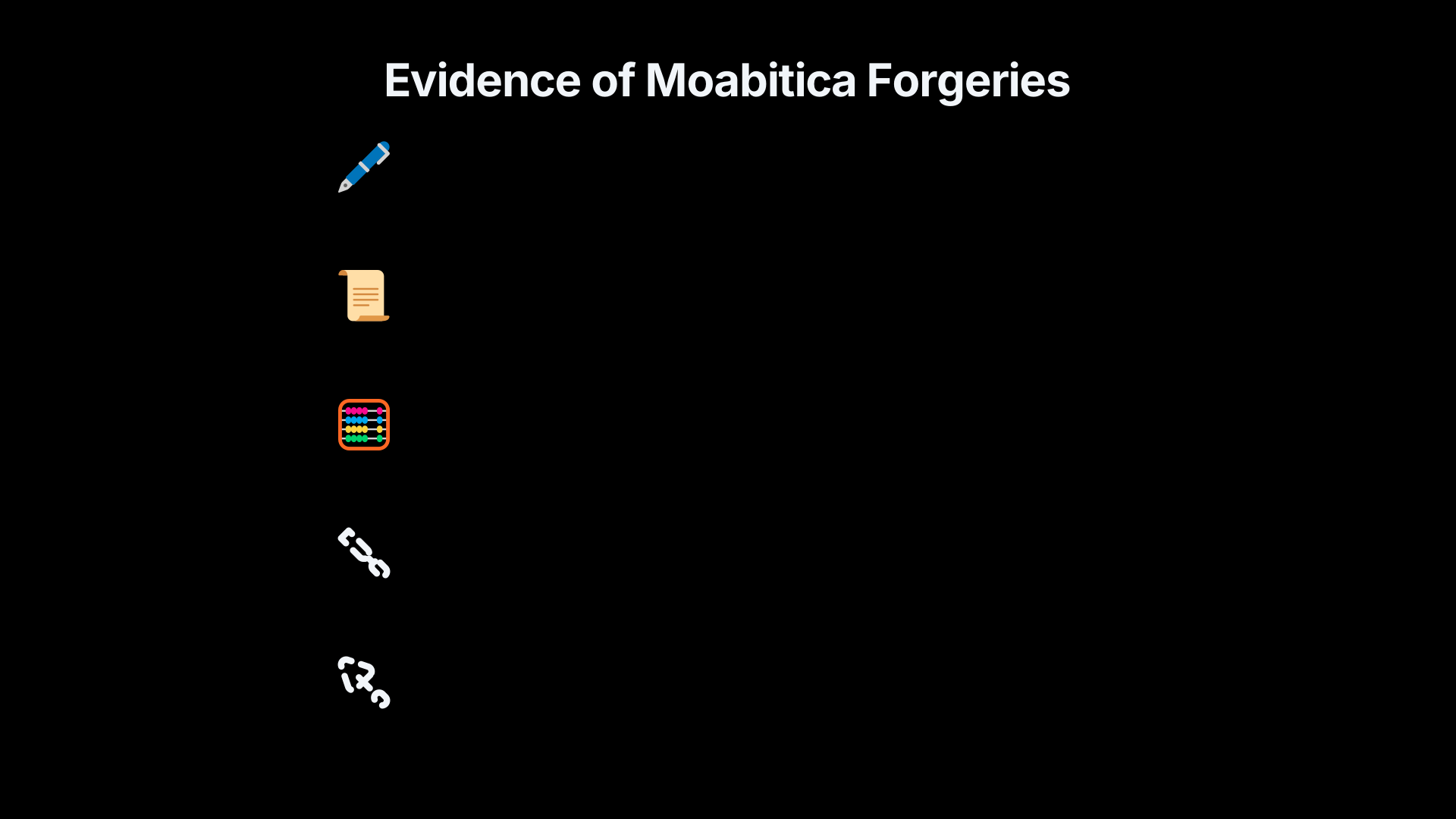
The nineteenth-century scandal known as the “Moabitica” is one of the most revealing antiquities forgery episodes connected to present-day Jordan. In the years after the discovery of the Mesha Stele in 1868, European museums and collectors became eager to acquire artefacts from the ancient kingdom of Moab. Into that demand flowed hundreds, and eventually thousands, of supposedly ancient objects: clay figurines, vessels, inscribed fragments and small sculptures said to have been found east of the Dead Sea. Many were purchased by respected institutions before investigators concluded that they were modern creations rather than genuine archaeological finds. The affair demonstrates how biblical enthusiasm, commercial incentives and weak standards of provenance combined to create a thriving market for fakes.[Taylor & Francis Online]tandfonline.comTaylor & Francis OnlineMoses Wilhelm Shapira, Hermann Weser and the Moab…by H Goren · 2025 — The 1870s case of the archaeological forg…
Demand After the Mesha Stele
The forgery boom did not emerge in a vacuum. The Mesha Stele, discovered in the territory of ancient Moab, was one of the most important Near Eastern inscriptions ever found. Its apparent connection to people and places known from the Hebrew Bible generated enormous scholarly and public interest. European powers, museums and learned societies suddenly wanted more material from the same region.[Biblical Archaeology Society]biblicalarchaeology.orgBiblical Archaeology SocietyBible Artifacts Found Outside the Trench: The Moabite StoneOctober 24, 2013 — The Mesha Stele, or Moabite Sto…
That demand created a classic forgery opportunity. Genuine Moabite artefacts were scarce, archaeological methods were still developing, and many objects reached scholars through dealers rather than controlled excavations. Collectors were often willing to trust stories about dramatic discoveries in remote areas because there was little comparative material available to challenge those claims.[Taylor & Francis Online]tandfonline.comTaylor & Francis OnlineMoses Wilhelm Shapira, Hermann Weser and the Moab…by H Goren · 2025 — The 1870s case of the archaeological forg…
The market rewarded anyone who could produce new “Moabite” finds. What made the Moabitica especially persuasive was not their quality by modern standards but the fact that scholars were attempting to reconstruct an ancient culture from very limited evidence. Strange inscriptions and unfamiliar artistic styles could be interpreted as signs of a poorly understood civilisation rather than as warnings of forgery.[Academia]academia.eduPDF) “The Moabitica and their AftermathHow to Handle a…The paper explores the historical context and implications of the Moabitica forgeries, particularly focusing on the ac…
How the Objects Entered Museum Collections
The central figure in the trade was the Jerusalem antiquities dealer Moses Wilhelm Shapira. Through local intermediaries and suppliers, his shop acquired large quantities of objects claimed to come from Moab. The artefacts included clay figurines, pottery vessels and pieces covered with inscriptions loosely modelled on the script of the Mesha Stele.[Wikipedia]WikipediaMoses Wilhelm ShapiraMoses Wilhelm Shapira
European buyers were eager customers. Berlin’s museums, disappointed that Germany had failed to secure the Mesha Stele itself, moved quickly to obtain this new material. Thousands of pieces were purchased, and additional examples found their way into private collections and scholarly institutions. The acquisition was substantial enough to become an international scholarly event rather than a minor collecting mistake.[Wikipedia]WikipediaMoses Wilhelm ShapiraMoses Wilhelm Shapira
Several factors helped the objects gain acceptance:
- They appeared soon after a genuine and famous Moabite discovery.
- Their supposed findspots were difficult for foreign scholars to verify.
- Museums feared losing important acquisitions to rivals.
- Knowledge of Moabite archaeology was limited.
- The objects arrived in large numbers, creating an impression of authenticity through sheer volume.[tandfonline.com]tandfonline.comTaylor & Francis OnlineMoses Wilhelm Shapira, Hermann Weser and the Moab…by H Goren · 2025 — The 1870s case of the archaeological forg…
Some purchasers even travelled to see locations where further examples were allegedly being found. Later accounts suggested that forged objects had been planted in advance to reinforce the story of their discovery.[Wikipedia]WikipediaMoses Wilhelm ShapiraMoses Wilhelm Shapira
How the Forgery Network Worked
Modern research suggests that the affair involved more than a single dishonest dealer. A network of craftsmen, suppliers and intermediaries appears to have participated in producing and distributing the artefacts. Investigations identified local artisans who worked with clay and stone and who had access to copies of the Mesha Stele’s lettering.[Wikipedia]WikipediaMoses Wilhelm ShapiraMoses Wilhelm Shapira
The forgers did not attempt perfect reproductions of known objects. Instead, they exploited the lack of knowledge about Moabite material culture by creating artefacts that looked exotic and ancient enough to satisfy collectors. Many inscriptions borrowed individual letter forms from the Mesha Stele but did not produce coherent texts. Decorative motifs, figurines and vessels were invented or heavily adapted from contemporary ideas about biblical antiquity.[Academia]academia.eduPDF) “The Moabitica and their AftermathHow to Handle a…The paper explores the historical context and implications of the Moabitica forgeries, particularly focusing on the ac…
This approach was effective because buyers were not comparing the pieces against a large corpus of excavated Moabite material. The market rewarded novelty. An object that looked unlike anything already known could be interpreted as a remarkable discovery rather than a suspicious anomaly.[Taylor & Francis Online]tandfonline.comTaylor & Francis OnlineMoses Wilhelm Shapira, Hermann Weser and the Moab…by H Goren · 2025 — The 1870s case of the archaeological forg…
Clermont-Ganneau and the Exposure
The most important critic of the Moabitica was the French scholar and diplomat Charles Clermont-Ganneau. Unlike many collectors, he treated the objects as a problem to investigate rather than treasures to celebrate. He became suspicious of both the artefacts and the circumstances surrounding their appearance.[Eco-Vector Journals Portal]journals.eco-vector.comBetween Apostate and Forger: Moses Wilhelm Shapira and the Moabite Pottery Affair (…Read more…
Clermont-Ganneau pursued the matter on several fronts. He examined the inscriptions, questioned individuals involved in the trade and traced connections between dealers, craftsmen and suppliers. According to later accounts, his inquiries uncovered people associated with producing the objects and obtaining the materials used to make them.[Wikipedia]WikipediaMoses Wilhelm ShapiraMoses Wilhelm Shapira
At the same time, philologists and epigraphers studied the inscriptions more closely. They found recurring problems:
- Letter forms appeared inconsistent and artificial.
- The texts failed to produce convincing ancient language.
- Statistical patterns in the writing differed markedly from genuine inscriptions.
- The script showed awkward combinations and unusual features difficult to explain as authentic Moabite usage.[Academia]academia.eduPDF) “The Moabitica and their AftermathHow to Handle a…The paper explores the historical context and implications of the Moabitica forgeries, particularly focusing on the ac…
These criticisms gradually undermined confidence in the collection. By the mid-1870s, major scholars concluded that the objects were forgeries. German authorities and institutions that had championed the acquisitions were eventually forced to acknowledge that they had been deceived.[Academia]academia.eduPDF) “The Moabitica and their AftermathHow to Handle a…The paper explores the historical context and implications of the Moabitica forgeries, particularly focusing on the ac…

Why So Many Experts Were Convinced
Looking back, some of the Moabitica appear crude. Yet judging them solely by modern archaeological standards misses why they succeeded.
The forgery trade exploited a moment when demand dramatically exceeded reliable evidence. Scholars wanted material from Moab, museums wanted prestige, and collectors wanted tangible links to biblical history. The objects arrived at precisely the moment when expectations were highest and verification methods were weakest.[Taylor & Francis Online]tandfonline.comTaylor & Francis OnlineMoses Wilhelm Shapira, Hermann Weser and the Moab…by H Goren · 2025 — The 1870s case of the archaeological forg…
The affair also illustrates a recurring problem in archaeology: provenance. An artefact recovered during a documented excavation can be studied in context. An artefact purchased through dealers arrives with a story rather than evidence. In the Moabitica case, the stories often proved more convincing than the objects themselves.[Biblical Archaeology Society]biblicalarchaeology.orgBiblical Archaeology SocietyBible Artifacts Found Outside the Trench: The Moabite StoneOctober 24, 2013 — The Mesha Stele, or Moabite Sto…
The Lasting Importance of the Moabitica Affair
The Moabitica scandal remains significant not because the forgeries were especially sophisticated, but because they exposed structural weaknesses in the antiquities market. The episode showed how commercial competition, scholarly ambition and public fascination with the biblical past could combine to elevate undocumented objects into museum treasures.[Taylor & Francis Online]tandfonline.comTaylor & Francis OnlineMoses Wilhelm Shapira, Hermann Weser and the Moab…by H Goren · 2025 — The 1870s case of the archaeological forg…
It also shaped later debates surrounding Moses Wilhelm Shapira, whose name became linked to additional controversial artefacts and manuscripts. Although historians continue to debate aspects of his role and responsibility, the consensus remains that the Moabitica represented one of the nineteenth century’s most influential archaeological forgery scandals.[bgu.ac.il]bgu.ac.ilOpen source on bgu.ac.il.
For Jordan’s history of deception and disputed discoveries, the case is a classic example of how a genuine archaeological sensation—the Mesha Stele—created the conditions for a lucrative trade in fabricated relics. The lesson remains relevant today: spectacular claims are far easier to believe when they appear to fill a gap people desperately want filled.[7iber.com]7iber.command the stele. 150 years have passed since the discovery of the…
Amazon book picks
Further Reading
Books and field guides related to How Fake Moabite Relics Fooled European Museums. Use these as the next step if you want deeper reading beyond the article.
Frauds, Myths, and Mysteries: Science and Pseudoscience in Ar...
Explains how fake artifacts enter accepted narratives.
The Bible Unearthed
Rating: 3.5/5 from 9 Google Books ratings
Covers the historical setting behind demand for Moabite material.
Archaeology : theories, methods, and practice
Emphasizes provenance and excavation context.
The Archaeology of the Holy Land
Provides background on the material culture collectors sought.
eBay marketplace picks
Marketplace Samples
Live-tested eBay searches with available results related to this page.



Endnotes
1.
Source: academia.edu
Title: (PDF) “The Moabitica and their Aftermath
Link:https://www.academia.edu/3454665/_The_Moabitica_and_their_Aftermath_How_to_Handle_a_Forgery_Affair_with_an_International_Impact_in_New_Inscriptions_and_Seals_Relating_to_the_Biblical_World_ed_by_E_and_M_Lubetski_Atlanta_SBL_2012_pp
Source snippet
How to Handle a...The paper explores the historical context and implications of the Moabitica forgeries, particularly focusing on the ac...
2.
Source: journals.eco-vector.com
Link:https://journals.eco-vector.com/0869-6063/article/view/655818
Source snippet
Between Apostate and Forger: Moses Wilhelm Shapira and the Moabite Pottery Affair (...Read more...
3.
Source: Wikipedia
Title: Moses Wilhelm Shapira
Link:https://en.wikipedia.org/wiki/Moses_Wilhelm_Shapira
4.
Source: academia.edu
Link:https://www.academia.edu/24911481/Between_Apostate_and_Forger_Moses_Wilhelm_Shapira_and_the_Moabite_Pottery_Affair
Source snippet
Moses Wilhelm Shapira and the Moabite Pottery Affair15 Mar 2022 — Moses Wilhelm Shapira sold 1,700 forged artifacts to the Berlin...
5.
Source: academia.edu
Title: (PDF) The Mesha Stele
Link:https://www.academia.edu/129589695/The_Mesha_Stele_An_Archaeological_Artefact_From_The_19th_Century
6.
Source: Wikipedia
Title: Mesha Stele
Link:https://en.wikipedia.org/wiki/Mesha_Stele
7.
Source: tandfonline.com
Link:https://www.tandfonline.com/doi/full/10.1080/00310328.2024.2435787
Source snippet
Taylor & Francis OnlineMoses Wilhelm Shapira, Hermann Weser and the Moab...by H Goren · 2025 — The 1870s case of the archaeological forg...
8.
Source: biblicalarchaeology.org
Link:https://www.biblicalarchaeology.org/daily/biblical-artifacts/artifacts-and-the-bible/moabite-stone-mesha-stele/
Source snippet
Biblical Archaeology SocietyBible Artifacts Found Outside the Trench: The Moabite StoneOctober 24, 2013 — The Mesha Stele, or Moabite Sto...
Published: October 24, 2013
9.
Source: 7iber.com
Link:https://www.7iber.com/the-mesha-stele-is-repatriation-possible/
Source snippet
mand the stele. 150 years have passed since the discovery of the...
10.
Source: bgu.ac.il
Link:https://www.bgu.ac.il/en/news-and-articles/where-were-the-moabite-antiquities-created/
Additional References
11.
Source: youtube.com
Title: The Lost Bible Scroll… Real or One of History’s Biggest Fakes? | Dr. Joel Baden
Link:https://www.youtube.com/watch?v=Iso7fS-dHrA
Source snippet
Was the Oldest and Most Significant Dead Sea Scroll Mistakenly Declared a Forgery in 1883?...
12.
Source: youtube.com
Title: How Scholars Identify Fake Dead Sea Scrolls
Link:https://www.youtube.com/watch?v=oMSjVpuCx0E
Source snippet
The Lost Bible Scroll… Real or One of History's Biggest Fakes? | Dr. Joel Baden...
13.
Source: researchgate.net
Title: Research Gate(PDF) The Mesha Stele
Link:https://www.researchgate.net/publication/392129550The_Mesha_Stele-_an_archaeological_artefact_from_the_19th_century
Source snippet
Walking one day with me through a street, le...Read more...
14.
Source: researchgate.net
Link:https://www.researchgate.net/publication/352292181_The_Mesha_Stele_a_Reappraisal_of_a_Forgery
15.
Source: instagram.com
Link:https://www.instagram.com/reel/C8tcHyOtkd1/?hl=en
16.
Source: rollstonepigraphy.com
Link:https://www.rollstonepigraphy.com/?p=896
17.
Source: jewishencyclopedia.com
Link:https://www.jewishencyclopedia.com/articles/13505-shapira-m-w
18.
Source: facebook.com
Link:https://www.facebook.com/LaboratoireCaraa/posts/revisiting-ancient-famous-and-less-famous-forgeries-i-the-biblical-moabites-fake/1153132441501257/
19.
Source: themosesscroll.com
Link:https://themosesscroll.com/clermont-ganneau-and-conder-come-out-against-mr-shapiras-manuscripts-21-august-1883/
Published: august 1883
20.
Source: youtube.com
Title: The Moabitica Scandal & Moses Wilhelm Shapira
Link:https://www.youtube.com/watch?v=ql4Yvs2K6Is
Source snippet
The Shapira Scroll: The First Dead Sea Scroll...
Topic Tree