Why Germany's Most Famous Hoaxes Worked
Germany’s history of famous hoaxes is not a story of one unusually gullible society. It is a series of episodes in which convincing objects, uniforms, documents or official-sounding narratives exploited the expectations of their time. Fake fossils persuaded an eighteenth-century professor because the origin of fossils was still scientifically disputed.
Page outline Jump by section
Introduction
The most revealing German cases also show why “hoax” is an imperfect catch-all. Some were deliberate commercial frauds; some were propaganda operations; some were impostures or practical jokes. Clever Hans, the supposedly calculating horse, was probably neither a fraud nor a miracle, but a lesson in unconscious signalling. Kaspar Hauser’s royal identity was a legend later undermined by genetics, although his full personal history remains unresolved. Together, these cases show how deception flourishes when evidence is secret, verification is rushed and a claim supplies something that its audience already wants.
When false objects filled gaps in history
Beringer’s lying stones
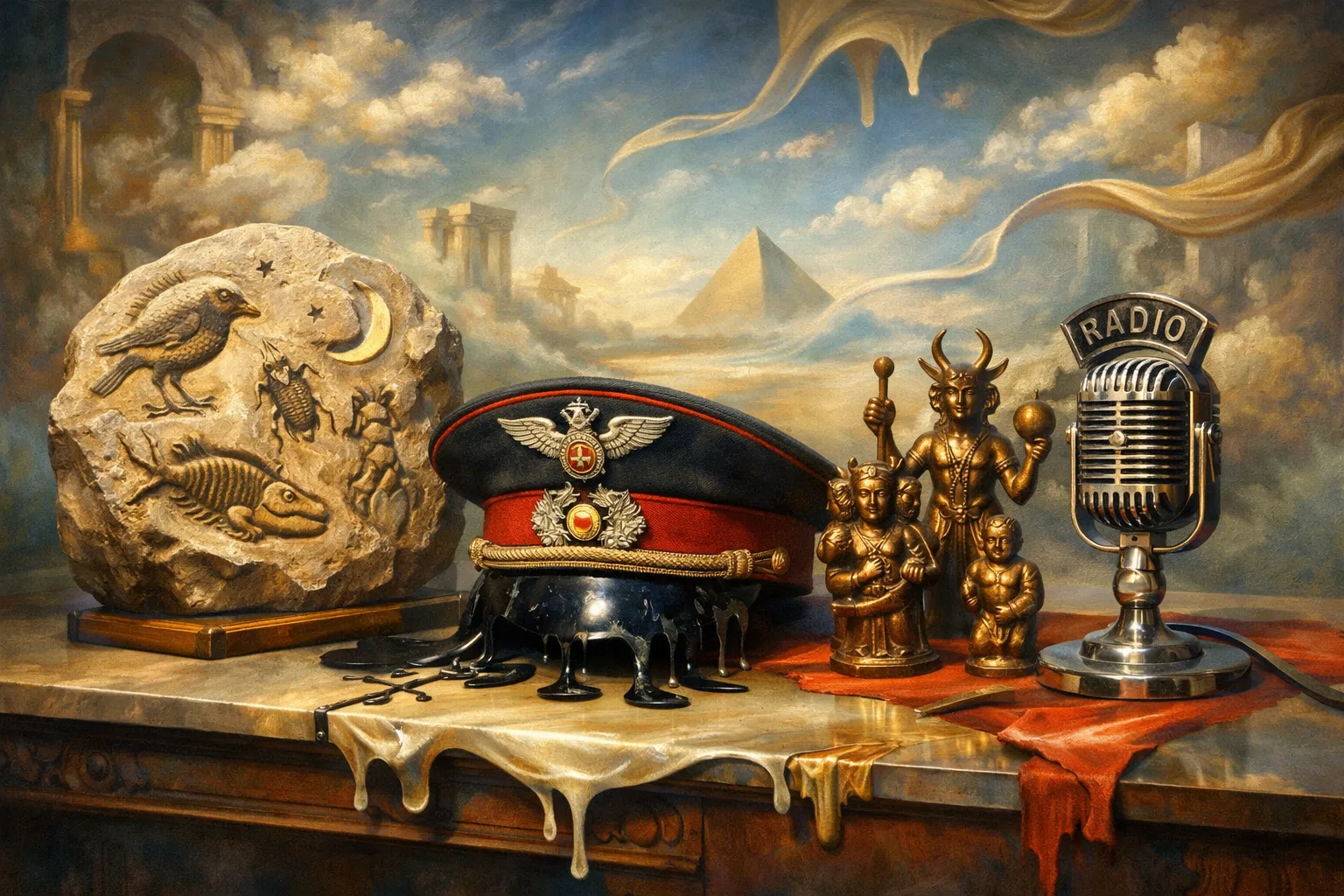
In 1725, Johann Bartholomäus Adam Beringer, a physician and professor at the University of Würzburg, began receiving extraordinary limestone specimens supposedly found near Eibelstadt. They carried sharply defined images of insects, birds, frogs, plants, heavenly bodies and writing. Beringer published engravings of the stones in an elaborate 1726 study, treating them as evidence relevant to contemporary arguments about how fossils were formed.[bibliothek.uni-wuerzburg.de]bibliothek.uni-wuerzburg.deWürzburg Lying StonesUniversity LibraryJuly 30, 2025 — 30 Jul 2025 — Beringer included copperplate engravings of various pieces of limestone in his publicatio…
The stones were carved. The traditional account identifies two of Beringer’s academic enemies, Johann Ignace Roderique and Johann Georg von Eckhart, as participants in a scheme to humiliate him. What made the trick effective was not simply Beringer’s vanity. Early eighteenth-century naturalists did not yet share a settled modern account of fossils as the remains or traces of ancient life. The strange carvings therefore entered a field where divine action, mineral growth and other theories were still being debated.[Wikipedia]WikipediaBeringer's Lying StonesBeringer's Lying Stones
Later retellings added an irresistible scene in which Beringer finally unearthed a stone bearing his own name. That detail is widely repeated but should not be treated as the secure foundation of the story. Recent scholarship has even reopened the question of who produced the stones, proposing—controversially—that Beringer himself may have been more involved than the conventional victim narrative allows. The surviving evidence still establishes that the specimens were fabricated, but the exact distribution of responsibility is less tidy than popular versions suggest.[geologie.nu]geologie.nuBeringer's Lügensteine reconsideredMay 25, 2025 — by JWF ReumeR · Cited by 1 — Beringer let himself be cheated by accepting the sun, the moon, stars, shells and even suppos…
The case matters because it demonstrates a recurring principle of scientific fraud: a fake need not resemble what later experts consider plausible. It needs to resemble what its first audience is prepared to regard as possible.
The Prillwitz idols
A different kind of historical appetite sustained the Prillwitz idols, a collection of bronze figures and plates that appeared in Mecklenburg in the eighteenth century. Their owners claimed that the objects had been dug up at Prillwitz and came from Rethra, the long-sought religious centre of the medieval Polabian Slavs. Many carried invented-looking inscriptions and represented supposed pagan gods. A lavishly illustrated book published in 1771 helped transform the collection from a local curiosity into evidence discussed by antiquarians and aristocrats across Europe.[Wikipedia]WikipediaPrillwitz idolsPrillwitz idols
The idols were persuasive because they appeared to solve two problems at once: they located a famous lost sanctuary and supplied a material pantheon for a culture whose religion was poorly documented. Their imagery then fed scholarship and cultural imagination beyond Germany, helping to populate later accounts of Slavic mythology with deities supposedly confirmed by physical artefacts.[Academia]academia.eduSlavic Antiquities and Forgeries as Means for the ShapingSlavic Antiquities and Forgeries as Means for the Shaping
By the mid-nineteenth century, research and legal investigation had established that most or all of the pieces were modern productions associated with the Sponholz goldsmith family of Neubrandenburg. Their mixture of unrelated artistic styles and dubious inscriptions reflected eighteenth-century ideas about the pagan past rather than medieval Slavic practice.[Wikipedia]WikipediaPrillwitzer IdolePrillwitzer Idole
Unlike a simple counterfeit coin, the Prillwitz collection generated facts that outlived belief in the objects themselves. Once names, illustrations and interpretations had entered books, they could be copied without the original artefacts being re-examined. The forgery therefore shows how a fake source can create an entire secondary tradition.
How authority became the disguise
The Captain of Köpenick
On 16 October 1906, the former convict Wilhelm Voigt put on a second-hand Prussian captain’s uniform, assumed command of a group of real soldiers and led them to the town hall at Köpenick, outside Berlin. There the soldiers occupied the building and detained municipal officials while Voigt took money from the treasury. He escaped, although he was arrested ten days later after an associate informed on him.[Deutschlandmuseum]deutschlandmuseum.deOpen source on deutschlandmuseum.de.
Voigt did not forge an elaborate military order or construct a convincing personal history. The uniform, confident commands and habits of military obedience did most of the work. Officials and soldiers accepted the visible signs of rank before establishing who the supposed captain was or whether his orders were genuine. The imposture quickly became a national joke about the prestige of the Prussian officer class and the readiness of institutions to obey it.[DIE WELT]welt.deOpen source on welt.de.
The public response also changed the meaning of the crime. Voigt was initially a thief using impersonation, but newspapers, theatrical adaptations and later Carl Zuckmayer’s play turned him into a folk figure exposing bureaucratic and military absurdity. Emperor Wilhelm II pardoned him in 1908, and Voigt subsequently earned money by appearing before audiences and retelling his exploit.[DIE WELT]welt.deOpen source on welt.de.
The episode survives because it was more than a successful disguise. It dramatised a structural weakness: people were not fooled by Voigt’s detailed performance of military expertise, but by their own belief that a uniform was sufficient proof of authority.
Clever Hans and the mistake that looked like fraud
Around the same period, Berlin crowds marvelled at Clever Hans, a horse owned and trained by Wilhelm von Osten. Hans appeared able to answer questions involving arithmetic, spelling, dates and music by tapping his hoof. The performances were investigated by a commission that found no conventional trick such as concealed signals or deliberate assistance.[Wikipedia]WikipediaClever HansClever Hans
Psychologist Oskar Pfungst then varied the conditions. Hans performed well when he could see a questioner who knew the answer, but his accuracy collapsed when the questioner was hidden or did not know the correct response. Pfungst concluded that the horse was reading tiny, involuntary changes in human posture and expression. As Hans approached the right number of taps, people unconsciously became tense; when he reached it, they relaxed.[Wikipedia]WikipediaClever HansClever Hans
This makes Clever Hans an important boundary case. Von Osten appears to have believed in the horse’s abilities, and there was no need for a secret accomplice. The impressive result emerged from an intelligent animal, unconscious human cues and inadequate experimental controls.
The “Clever Hans effect” now describes systems that produce correct-looking answers for the wrong reason. The term is used in psychology, animal research and artificial intelligence, where a model may exploit irrelevant patterns in training data rather than learn the intended task.[arXiv]arxiv.orgOpen source on arxiv.org.
When deception served war and power
The staged attack at Gleiwitz
On the evening of 31 August 1939, German operatives seized the radio station at Gleiwitz, then inside Germany and now Gliwice in Poland. Dressed to appear Polish, they broadcast an anti-German message. The operation was one of several fabricated border incidents intended to support Nazi claims that Poland had attacked German territory. Germany invaded Poland the following day.[Holocaust Encyclopedia]encyclopedia.ushmm.orgdeceiving the publicdeceiving the public
This was not a popular hoax that grew through gossip. It was a state-organised false-flag operation, created to manufacture evidence for a political narrative already being promoted through controlled media. Nazi authorities presented aggression as self-defence while directing the press to frame the opening of hostilities in approved terms.[Holocaust Encyclopedia]encyclopedia.ushmm.orgdeceiving the publicdeceiving the public
Much of the detailed reconstruction rests on post-war testimony, including the Nuremberg affidavit of SS officer Alfred Naujocks, who described organising the raid under orders from senior security officials. The operation reportedly included the murder of Franciszek Honiok, whose body was used to strengthen the appearance of a genuine Polish attack.[Wikipedia]WikipediaGleiwitz incidentGleiwitz incident
Gleiwitz belongs in a history of hoaxes because its central mechanism was fabricated proof. Yet calling it merely a hoax can sound too playful. It was lethal propaganda conducted by a dictatorship as part of the preparation for invasion.
Operation Bernhard’s counterfeit money
Nazi Germany also pursued deception on an industrial scale through Operation Bernhard, a programme to reproduce Bank of England notes. The initial strategic idea was to release enough false currency to destabilise sterling. The revived programme, directed from 1942 by SS officer Bernhard Krüger, used prisoners at Sachsenhausen concentration camp to manufacture extremely convincing notes.[Bank of England]bankofengland.co.ukoperation bernhardoperation bernhard
The counterfeiters had to reproduce specialised paper, watermarks, engraving and serial-number conventions. Although the plan to scatter enormous quantities over Britain was not carried out as first imagined, the money was used to finance intelligence operations and purchase supplies. The quality and volume of the notes created a serious problem for the Bank of England, which withdrew higher-denomination notes and later introduced redesigned currency.[Bank of England]bankofengland.co.ukoperation bernhardoperation bernhard
Operation Bernhard differs from an ordinary criminal forgery in three ways. It was sponsored by a state, intended as economic warfare and depended on coerced skilled labour. Its surviving notes are now collectable historical objects, but their technical achievement cannot be separated from the concentration-camp system that produced them.

The Hitler diaries and the price of wanting a scoop
In April 1983, the West German magazine Stern announced that it had obtained a large collection of Adolf Hitler’s private diaries, supposedly recovered after an aircraft crash in 1945 and secretly preserved in East Germany. The magazine had paid about 9.3 million Deutsche Marks for sixty volumes supplied through reporter Gerd Heidemann. Publication rights were sold abroad, and major newspapers prepared serialisations.[Reuters]reuters.comOpen source on reuters.com.
The diaries were the work of Konrad Kujau, a dealer and forger who had already been selling false Nazi memorabilia. He copied information from published reference works, added mundane inventions and imitated Hitler’s handwriting. He also created a dramatic provenance involving lost documents smuggled out of East Germany. That story made independent checking difficult while making the alleged discovery more exciting.[The New Yorker]newyorker.comThe New Yorker Diary of the Hitler Diary HoaxThe New Yorker Diary of the Hitler Diary Hoax
Stern’s authentication process failed partly because secrecy took priority over testing. Experts were shown limited material, while some comparison documents supplied as examples of genuine Hitler writing were themselves Kujau forgeries. The resulting handwriting opinions therefore compared one fake with another. Historians were also drawn towards the apparent opportunity to revise knowledge of the Nazi leadership.[Wikipedia]WikipediaHitler DiariesHitler Diaries
Once complete volumes reached forensic laboratories, the fraud collapsed rapidly. Investigators found modern materials in the paper and bindings, inks inconsistent with the claimed period and historical errors derived from post-war publications. The Federal Archives confirmed the diaries were modern forgeries in early May 1983, only days after the international launch.[Wikipedia]WikipediaHitler DiariesHitler Diaries
The scandal was not caused by a technically brilliant fake. It was caused by a persuasive commercial environment surrounding a weak one. Money had been committed, exclusivity was valuable, senior figures had publicly endorsed the discovery and each additional investment made retreat more embarrassing. The diaries remain one of the clearest examples of institutional confirmation bias: the desire for the documents to be real shaped how evidence was selected, shared and interpreted.
The art market’s forged histories
Wolfgang Beltracchi’s paintings deceived a different set of authorities. For years, he produced works in the styles of modern artists, including Heinrich Campendonk, Max Ernst and others, often creating paintings that had never existed rather than copying known originals. This avoided immediate comparison with museum works or catalogue photographs.[Vanity Fair]vanityfair.comVanity Fair The Greatest Fake-Art Scam in History?Vanity Fair The Greatest Fake-Art Scam in History?
The paintings were supported by invented ownership histories. Beltracchi and his wife Helene claimed that works had descended through a family collection assembled before the Second World War. Photographs, labels and stories connected the pictures to respected dealers and collectors. Provenance—the documented history of an artwork’s ownership—was therefore not merely missing; it was manufactured as part of the product.[Vanity Fair]vanityfair.comVanity Fair The Greatest Fake-Art Scam in History?OnVanity Fair The Greatest Fake-Art Scam in History?On
The scheme unravelled after scientific testing of a supposed 1914 Campendonk detected titanium white, a pigment inconsistent with the painting’s claimed date. The laboratory result did what connoisseurship and commercial confidence had failed to do: it identified a material that did not belong in the object’s alleged history.[Time]time.comNot Fine ArtNot Fine Art
Beltracchi’s success exposed a weakness shared with the Hitler diaries affair. Experts rarely judge an object in isolation. They assess the object together with its paperwork, owner, dealer, market reputation and apparent place in an accepted historical narrative. A skilful fraudster can therefore forge the context as carefully as the artefact.
Legends that evidence can narrow but not completely solve
Kaspar Hauser appeared in Nuremberg in 1828 as an adolescent with an extraordinary account of confinement. He claimed that he had spent most of his life isolated in a dark cell, with little human contact, before being released. His limited behaviour, uncertain origins and later injuries generated intense speculation. The most famous theory identified him as a hereditary prince of Baden who had been secretly removed from the succession.[Wikipedia]WikipediaKaspar HauserKaspar Hauser
Critics suspected imposture during Hauser’s lifetime, particularly because parts of his account were unverifiable and some apparent attacks on him may have been self-inflicted. His death from a stab wound in 1833 deepened rather than settled the mystery. The “lost prince” theory then survived through biographies, plays and speculative histories because it gave a dynastic explanation to an otherwise obscure and disturbing life.
Genetic evidence has now answered one major question. A 2024 study examined mitochondrial DNA from multiple samples attributed to Hauser and found a consistent genetic profile that did not match the maternal lineage of the House of Baden. This strongly excludes the claim that he was the missing Baden prince.[University of Leicester]le.ac.ukUniversity of Leicester New DNA analysis helps bust 200-year-old royalUniversity of Leicester New DNA analysis helps bust 200-year-old royal
It does not prove every accusation made against him. Hauser may have lied, suffered abuse, combined genuine trauma with invention or been manipulated by others. The responsible conclusion is narrower: the famous royal identity has been refuted, while the exact circumstances of his childhood and death remain uncertain.
Why these German hoaxes endured
The cases differ in scale and morality, but several mechanisms recur.
They supplied missing evidence. The Würzburg stones seemed to clarify the nature of fossils; the Prillwitz idols appeared to reveal a vanished religion; Kaspar Hauser’s royal theory converted an unknown boy into the victim of a dynastic plot.
They borrowed authority. Voigt used a uniform, Kujau used historians and publishers, Beltracchi used auction houses and provenance, while Nazi propaganda used the machinery of the state.
They restricted independent checking. Secret sources, inaccessible collections, smuggling stories and claims of commercial exclusivity prevented sceptics from seeing the complete evidence.
They mixed truth with fabrication. Effective deception usually contains authentic features: correct historical dates, convincing materials, recognisable handwriting, genuine institutional habits or established political fears.
They rewarded belief. Collectors obtained rare objects, journalists gained exclusives, scholars acquired apparently transformative evidence and governments gained political justification. The beneficiary was not always the person who created the falsehood; entire networks could become invested in maintaining it.
The decisive exposures were usually less romantic than the original stories. They came from controlled experiments, pigment analysis, paper fibres, ink chemistry, archival comparison, witness testimony or DNA. German hoax history therefore offers a practical lesson in scepticism: reputation and narrative can identify what deserves investigation, but they cannot substitute for tests that might prove an attractive claim wrong.

Amazon book picks
Further Reading
Books and field guides related to Why Germany's Most Famous Hoaxes Worked. Use these as the next step if you want deeper reading beyond the article.
Mistakes Were Made (but Not by Me)
Explains why people defend mistaken beliefs and deceptions.
Extraordinary Popular Delusions and the Madness of Crowds
Rating: 4.0/5 from 5 Google Books ratings
Historical survey of mass belief and deception.
Why People Believe Weird Things
Provides context for belief in hoaxes and extraordinary claims.
eBay marketplace picks
Marketplace Samples
Live-tested eBay searches with available results related to this page.

Endnotes
1.
Source: bibliothek.uni-wuerzburg.de
Title: Würzburg Lying Stones
Link:https://www.bibliothek.uni-wuerzburg.de/en/about-us/events/exhibition-fakt-fake/wuerzburg-lying-stones/
Source snippet
University LibraryJuly 30, 2025 — 30 Jul 2025 — Beringer included copperplate engravings of various pieces of limestone in his publicatio...
Published: July 30, 2025
2.
Source: Wikipedia
Title: Beringer’s Lying Stones
Link:https://en.wikipedia.org/wiki/Beringer%27s_Lying_Stones
3.
Source: geologie.nu
Title: Beringer’s Lügensteine reconsidered
Link:https://geologie.nu/wp-content/uploads/2025/05/148-2024-Reumer-Rev.Paleobiol.-on-Beringers-LugensteineVERKLEIND-BESTAND.pdf
Source snippet
May 25, 2025 — by JWF ReumeR · Cited by 1 — Beringer let himself be cheated by accepting the sun, the moon, stars, shells and even suppos...
Published: May 25, 2025
4.
Source: Wikipedia
Title: Prillwitz idols
Link:https://en.wikipedia.org/wiki/Prillwitz_idols
5.
Source: Wikipedia
Title: Prillwitzer Idole
Link:https://de.wikipedia.org/wiki/Prillwitzer_Idole
6.
Source: academia.edu
Title: Slavic Antiquities and Forgeries as Means for the Shaping
Link:https://www.academia.edu/109512847/Slavic_Antiquities_and_Forgeries_as_Means_for_the_Shaping_of_Canons
7.
Source: Wikipedia
Title: List of Slavic pseudo-deities
Link:https://en.wikipedia.org/wiki/List_of_Slavic_pseudo-deities
8.
Source: deutschlandmuseum.de
Link:https://www.deutschlandmuseum.de/en/history/calendar/1906-10-16-the-captain-of-koepenick/
9.
Source: welt.de
Link:https://www.welt.de/geschichte/article250050208/Hauptmann-von-Koepenick-Wie-Wilhelm-Voigt-sogar-den-Kaiser-zum-Schmunzeln-brachte.html
10.
Source: Wikipedia
Title: Clever Hans
Link:https://en.wikipedia.org/wiki/Clever_Hans
11.
Source: arxiv.org
Link:https://arxiv.org/abs/1912.11425
12.
Source: arxiv.org
Title: arXiv The Clever Hans Effect in Unsupervised Learning
Link:https://arxiv.org/abs/2408.08041
13.
Source: Wikipedia
Title: Gleiwitz incident
Link:https://en.wikipedia.org/wiki/Gleiwitz_incident
14.
Source: reuters.com
Link:https://www.reuters.com/world/europe/fake-hitler-diaries-one-worlds-biggest-hoaxes-head-german-archive-2023-04-24/
15.
Source: Wikipedia
Title: Hitler Diaries
Link:https://en.wikipedia.org/wiki/Hitler_Diaries
16.
Source: encyclopedia.com
Link:https://www.encyclopedia.com/science/encyclopedias-almanacs-transcripts-and-maps/hitler-diaries
17.
Source: time.com
Title: Not Fine Art
Link:https://time.com/4236989/not-fine-art/
18.
Source: Wikipedia
Title: Kaspar Hauser
Link:https://en.wikipedia.org/wiki/Kaspar_Hauser
19.
Source: Wikipedia
Title: Art forgery
Link:https://en.wikipedia.org/wiki/Art_forgery
20.
Source: Wikipedia
Title: Wilhelm Voigt
Link:https://en.wikipedia.org/wiki/Wilhelm_Voigt
21.
Source: Wikipedia
Title: Operation Bernhard
Link:https://en.wikipedia.org/wiki/Operation_Bernhard
22.
Source: Wikipedia
Title: Gleiwitz incident
Link:https://simple.wikipedia.org/wiki/Gleiwitz_incident
23.
Source: Wikipedia
Title: Wolfgang Beltracchi
Link:https://en.wikipedia.org/wiki/Wolfgang_Beltracchi
24.
Source: hoaxes.org
Title: the lying stones of dr. beringer
Link:https://hoaxes.org/archive/permalink/the_lying_stones_of_dr._beringer
25.
Source: history.com
Title: s most famous literary hoaxes
Link:https://www.history.com/articles/historys-most-famous-literary-hoaxes
26.
Source: encyclopedia.ushmm.org
Title: deceiving the public
Link:https://encyclopedia.ushmm.org/content/en/article/deceiving-the-public
27.
Source: bankofengland.co.uk
Title: operation bernhard
Link:https://www.bankofengland.co.uk/museum/online-collections/blog/operation-bernhard
28.
Source: bankofengland.co.uk
Title: Bank of England Counterfeit and imitation notes
Link:https://www.bankofengland.co.uk/museum/online-collections/banknotes/counterfeit-and-imitation-notes
29.
Source: newyorker.com
Title: The New Yorker Diary of the Hitler Diary Hoax
Link:https://www.newyorker.com/books/page-turner/diary-of-the-hitler-diary-hoax
30.
Source: vanityfair.com
Title: Vanity Fair The Greatest Fake-Art Scam in History?
Link:https://www.vanityfair.com/culture/2012/10/wolfgang-beltracchi-helene-art-scam?srsltid=AfmBOooSTCummcxRuyWjJzHfh4WiRDr4HCyqlmimj_m1X-m0E2_Hvpu3
31.
Source: vanityfair.com
Title: Vanity Fair The Greatest Fake-Art Scam in History?On
Link:https://www.vanityfair.com/culture/2012/10/wolfgang-beltracchi-helene-art-scam
32.
Source: le.ac.uk
Title: University of Leicester New DNA analysis helps bust 200-year-old royal
Link:https://le.ac.uk/news/2024/july/kaspar-hauser
33.
Source: tripadvisor.com
Title: The Captain of Köpenick
Link:https://www.tripadvisor.com/Attraction_Review-g187323-d13235577-Reviews-The_Captain_of_Kopenick-Berlin.html
34.
Source: berlin-info.info
Link:https://berlin-info.info/koepenick/
Additional References
35.
Source: researchgate.net
Title: Research Gate(PDF) The first case of paleontological fraud
Link:https://www.researchgate.net/publication/378971394_The_first_case_of_paleontological_fraud_Beringers_Lugensteine_reconsidered
Source snippet
Beringers...15 Mar 2024 — Beringer. Here, I hypothesize that these Lügensteine are instead an early case of scientific fraud and the fir...
36.
Source: blog.library.si.edu
Title: a heavy hoax the lying stones of johann beringer
Link:https://blog.library.si.edu/blog/2019/07/25/a-heavy-hoax-the-lying-stones-of-johann-beringer/
Source snippet
A Heavy Hoax: The “Lying Stones” of Johann Beringer25 Jul 2019 — This tale of stony deception began when the twenty-seven year old Bering...
37.
Source: youtube.com
Link:https://www.youtube.com/watch?v=-Lak2SLlJs8
Source snippet
Beringer lying stones BERINGER'S LYING STONES The Fossil HOAX That Shook Science Historic Mysteries...
38.
Source: blog.geolsoc.org.uk
Title: the lying stones of johann beringer
Link:https://blog.geolsoc.org.uk/2017/04/01/the-lying-stones-of-johann-beringer/
Source snippet
The Geological Society BlogThe Lying Stones of Johann Beringer1 Apr 2017 — The Geological Society Library's latest exhibition 'The Lying...
39.
Source: youtube.com
Title: The Most Mysterious Boy In History | Random Thursday
Link:https://www.youtube.com/watch?v=jiiCvdnoPGc
Source snippet
The Prussian Robber-Captain who Seized and Scammed an Entire Town: Hauptmann von Köpenick (1906)...
40.
Source: deutsches-spionagemuseum.de
Link:https://www.deutsches-spionagemuseum.de/sammlung/10-pfund-banknote-der-operation-bernhard
41.
Source: brittakadolsky.com
Link:https://brittakadolsky.com/der-skandal-um-den-kunstfaelscher-beltracchi/
42.
Source: archivaria.ca
Link:https://archivaria.ca/index.php/archivaria/article/download/11132/12069/12774
43.
Source: vdl.lu
Link:https://www.vdl.lu/en/friedrich-wilhelm-voigt
44.
Source: instagram.com
Link:https://www.instagram.com/p/C2sKtXzs0Bp/
Topic Tree
Follow this branch
Related pages 192
- Albanian Hoaxes
- Algerian Hoaxes
- Antigua Deceptions
- Argentina Hoaxes
- Armenian Hoaxes
- +187 more in sidebar