Within El Salvador Hoaxes
How the El Mozote Denial Unravelled
Official attempts to dismiss the El Mozote massacre collapsed as survivor testimony, exhumations and international investigations converged.
On this page
- What officials claimed after the massacre
- How survivors and journalists challenged the denial
- Why forensic and international findings changed the record
Page outline Jump by section
Introduction
The story of El Mozote is not only about a massacre. It is also about a long-running attempt to deny, minimise or discredit evidence of what happened. In December 1981, Salvadoran troops killed hundreds of civilians in and around the village of El Mozote during the civil war. When journalists reported the killings weeks later, government officials and their international allies insisted the reports were false, exaggerated or manipulated by guerrilla propaganda. For years, that denial shaped public debate. Yet the case became one of the clearest examples in modern Latin American history of how survivor testimony, forensic science and international investigations can converge to overturn an official narrative.[PBS]pbs.orgel mozote massacre journalism el salvadorThe High Price of Doing Journalism in El SalvadorNov 9, 2021 — A Salvadoran reporter reflects on teaming up with the American journali…
Within the history of deception and contested truth in El Salvador, El Mozote stands out because the falsehood did not involve an invented monster, forged object or media stunt. Instead, it involved efforts by powerful institutions to cast doubt on a documented atrocity. The eventual collapse of that denial shows how difficult it can be to suppress evidence when multiple independent sources point to the same conclusion.[Inter-American Court of Human Rights]corteidh.or.crseriec 252 ing1Inter-American Court of Human RightsInter-American Court of Human Rights Case of the Massacres…Oct 25, 2025 — Archeological report, Vi…
What Officials Claimed After the Massacre
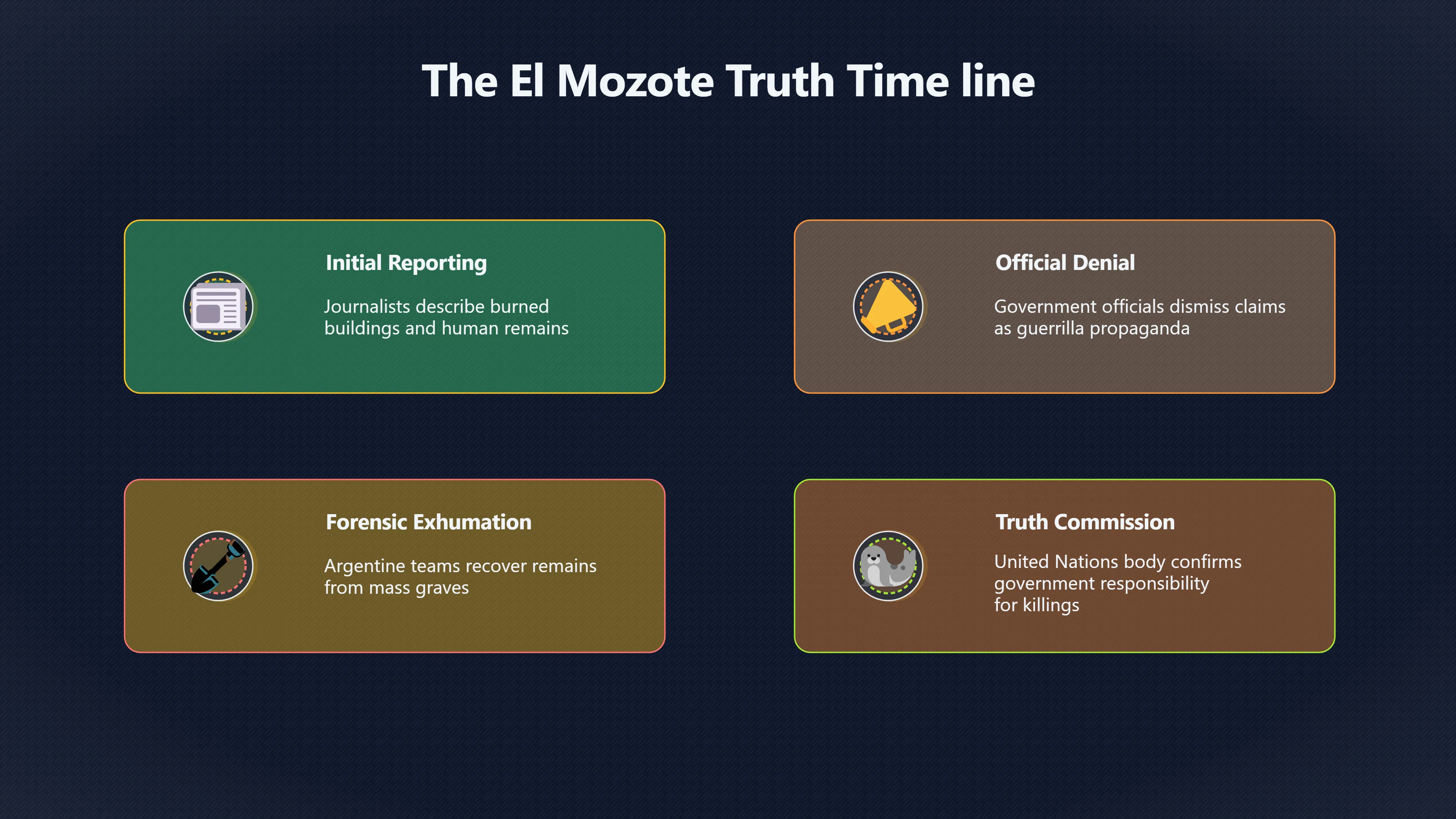
When reports of the killings first appeared internationally in January 1982, they were met with immediate resistance. Journalists Raymond Bonner of The New York Times and Alma Guillermoprieto of The Washington Post visited the area and described burned buildings, human remains and accounts from survivors. Their reporting suggested that hundreds of civilians had been killed.[Wikipedia]WikipediaEl Mozote massacreEl Mozote massacre
Salvadoran military and government officials denied that any large-scale massacre had occurred. The claims were dismissed as guerrilla propaganda, wartime exaggeration or deliberate misinformation. Some officials argued that the casualty figures were impossible, while others questioned whether the village population was large enough to support the reported death toll. U.S. officials, concerned about continued military aid to El Salvador during the Cold War, publicly challenged aspects of the reporting and suggested the allegations were unproven.[Wikipedia]WikipediaEl Mozote massacreEl Mozote massacre
The denial worked partly because the massacre occurred in a remote conflict zone. Independent access was difficult, the war generated competing propaganda from both sides, and many foreign observers were predisposed to view dramatic claims with scepticism. Critics attacked the journalists rather than directly confronting the physical evidence they had described.[Wikipedia]WikipediaEl Mozote massacreEl Mozote massacre
How Survivors and Journalists Challenged the Denial
The official narrative faced an immediate problem: eyewitnesses existed.
The most famous survivor was Rufina Amaya, who escaped and later described how soldiers separated villagers, executed civilians and killed members of her own family. Her testimony remained remarkably consistent over the years despite repeated efforts to dismiss it. At a time when authorities portrayed massacre reports as fabrication, her account preserved a detailed record of events.[Wikipedia]WikipediaEl Mozote massacreEl Mozote massacre
Journalists also provided evidence that was difficult to reconcile with official claims. Bonner and Guillermoprieto reported seeing human remains, destroyed buildings and other signs of mass killing shortly after the events. Their reports were published independently of one another, strengthening their credibility. Both journalists faced criticism and political pressure, yet neither account was later shown to contain the kind of errors that would justify the sweeping denials made at the time.[Wikipedia]WikipediaEl Mozote massacreEl Mozote massacre
The dispute gradually became larger than a disagreement about casualty numbers. It evolved into a test of whether eyewitness testimony from poor rural civilians could be trusted when it conflicted with statements from governments and military authorities.[markdanner.com]markdanner.comThe Truth of El MozoteMark DannerDec 6, 1993 — For most Americans, El Salvador had long since slipped back into obscurity. But El Mozote may well have been the…
Why Forensic and International Findings Changed the Record
The decisive turning point came after the civil war, when investigators were finally able to examine the site scientifically.
In 1992, exhumations supervised by the Argentine Forensic Anthropology Team (EAAF) began as part of investigations connected to the United Nations-backed Truth Commission. Archaeologists and forensic specialists recovered extensive human remains from El Mozote, including large numbers of children. The findings confirmed that a mass killing had occurred and that civilians had been deliberately executed.[wikipedia.org]WikipediaEl Mozote massacreEl Mozote massacre
One of the most important discoveries came from the church sacristy, where investigators recovered the remains of numerous victims. Forensic evidence demonstrated that many had died from gunshot wounds. The physical evidence matched key elements of survivor testimony that critics had long dismissed.[The New Yorker]newyorker.comThis move could affect the ongoing El Mozote massacre hearings, overseen by Judge Jorge Guzmán. The massacre occurred in 1981, resulting…
The significance of these excavations went beyond identifying victims. They transformed the debate from one centred on competing narratives into one grounded in physical evidence. Human remains, ballistic analysis and archaeological findings could not easily be portrayed as propaganda. As researchers studying human rights investigations later observed, the exhumations gave powerful confirmation to witness accounts that some observers had previously doubted.[HRDAG - Human Rights Data Analysis Group]hrdag.orgHuman Rights Data Analysis GroupWho Did What to Whom?: Chapter 3For example, only after the Argentine Forensic Anthropology Team'…
The Truth Commission and the Collapse of the Official Story
The United Nations-sponsored Truth Commission for El Salvador examined the evidence collected after the peace process and concluded that the massacre had occurred and that government forces were responsible. The commission rejected attempts to portray the killings as a fabrication or battlefield confusion.[Wikipedia]WikipediaEl Mozote massacreEl Mozote massacre
Its findings were especially important because they drew on multiple forms of evidence:
- Survivor testimony.
- Forensic exhumations.
- Documentary records.
- Military and governmental information available after the war.
- Independent investigative reporting.[Wikipedia]WikipediaEl Mozote massacreEl Mozote massacre
No single source carried the entire case. Instead, different forms of evidence reinforced one another. This convergence made continued denial increasingly untenable.
Subsequent human rights investigations, court proceedings and rulings by international bodies, including the Inter-American Court of Human Rights, further solidified the historical record. The massacre is now recognised internationally as one of the worst atrocities of the Salvadoran civil war.[Inter-American Court of Human Rights]corteidh.or.crseriec 252 ing1Inter-American Court of Human RightsInter-American Court of Human Rights Case of the Massacres…Oct 25, 2025 — Archeological report, Vi…

Why the El Mozote Case Still Matters
El Mozote remains a powerful example of how official denials can persist long after evidence first emerges. The initial reports were not disproved; instead, they were politically contested, attacked and delayed. Years passed before forensic investigations provided the level of proof that many institutions were willing to accept.[PBS]pbs.orgel mozote massacre journalism el salvadorThe High Price of Doing Journalism in El SalvadorNov 9, 2021 — A Salvadoran reporter reflects on teaming up with the American journali…
The case also illustrates a recurring pattern in the history of misinformation and contested truth. First come eyewitness accounts. Then come efforts to discredit those witnesses. Only later, when documentary or scientific evidence becomes available, does the broader public begin to accept what survivors had been saying all along.[HRDAG - Human Rights Data Analysis Group]hrdag.orgHuman Rights Data Analysis GroupWho Did What to Whom?: Chapter 3For example, only after the Argentine Forensic Anthropology Team'…
For El Salvador, the unraveling of the El Mozote denial stands as a reminder that false narratives do not always take the form of invented stories. Sometimes they arise from attempts to suppress uncomfortable facts. What ultimately exposed the deception was not a single revelation but the accumulation of testimony, journalism, forensic science and international investigation, all pointing to the same conclusion.[or.cr]corteidh.or.crseriec 252 ing1Inter-American Court of Human RightsInter-American Court of Human Rights Case of the Massacres…Oct 25, 2025 — Archeological report, Vi…
Amazon book picks
Further Reading
Books and field guides related to How the El Mozote Denial Unravelled. Use these as the next step if you want deeper reading beyond the article.
Truth Commissions and Procedural Fairness
Explains mechanisms used to investigate disputed atrocities.
eBay marketplace picks
Marketplace Samples
Live-tested eBay searches with available results related to this page.
Endnotes
1.
Source: pbs.org
Title: el mozote massacre journalism el salvador
Link:https://www.pbs.org/wgbh/frontline/article/el-mozote-massacre-journalism-el-salvador/
Source snippet
The High Price of Doing Journalism in El SalvadorNov 9, 2021 — A Salvadoran reporter reflects on teaming up with the American journali...
2.
Source: Wikipedia
Title: El Mozote massacre
Link:https://en.wikipedia.org/wiki/El_Mozote_massacre
3.
Source: hrdag.org
Link:https://hrdag.org/whodidwhattowhom/ch_323.html
Source snippet
Human Rights Data Analysis GroupWho Did What to Whom?: Chapter 3For example, only after the Argentine Forensic Anthropology Team'...
4.
Source: markdanner.com
Title: The Truth of El Mozote
Link:https://markdanner.com/1993/12/06/the-truth-of-el-mozote/
Source snippet
Mark DannerDec 6, 1993 — For most Americans, El Salvador had long since slipped back into obscurity. But El Mozote may well have been the...
5.
Source: markdanner.com
Title: Cutting Through the Fabric of Lies: On El Mozote
Link:https://markdanner.com/1994/05/06/cutting-through-the-fabric-of-lies-on-el-mozote/
6.
Source: eaaf.org
Title: el salvador
Link:https://eaaf.org/wp-content/uploads/2018/08/elsalvador_ar_1992.pdf
7.
Source: jsis.washington.edu
Title: mozote 36 years
Link:https://jsis.washington.edu/humanrights/2018/01/03/mozote-36-years/
8.
Source: eaaf.org
Link:https://eaaf.org/wp-content/uploads/2018/08/elsalvador1999.pdf
9.
Source: pbs.org
Title: massacre in el salvador
Link:https://www.pbs.org/wgbh/frontline/documentary/massacre-in-el-salvador/
10.
Source: pbs.org
Title: el equipo the team 0efses
Link:https://www.pbs.org/video/el-equipo-the-team-0efses/
11.
Source: Wikipedia
Title: Truth Commission for El Salvador
Link:https://en.wikipedia.org/wiki/Truth_Commission_for_El_Salvador
12.
Source: corteidh.or.cr
Title: seriec 252 ing1
Link:https://www.corteidh.or.cr/docs/casos/articulos/seriec_252_ing1.pdf
Source snippet
Inter-American Court of Human RightsInter-American Court of Human Rights Case of the Massacres...Oct 25, 2025 — Archeological report, Vi...
13.
Source: newyorker.com
Link:https://www.newyorker.com/news/daily-comment/is-el-salvadors-president-trying-to-shut-down-a-hearing-on-the-infamous-el-mozote-massacre
Source snippet
This move could affect the ongoing El Mozote massacre hearings, overseen by Judge Jorge Guzmán. The massacre occurred in 1981, resulting...
15.
Source: newyorker.com
Title: the truth of el mozote
Link:https://www.newyorker.com/magazine/1993/12/06/the-truth-of-el-mozote
Additional References
16.
Source: columbia.edu
Link:https://www.columbia.edu/itc/journalism/j6075/edit/readings/mozote.html
Source snippet
Columbia UniversityEl Mozote Case StudyReports of a massacre by the Salvadoran Army were spreading before Bonner and Guillermoprieto ente...
17.
Source: youtube.com
Link:https://www.youtube.com/watch?v=03XyXFHCMQM
Source snippet
What's Left of Our Lives: The Survivors of the El Mozote Massacre...
18.
Source: youtube.com
Link:https://www.youtube.com/watch?v=kqBkGvJ-rRk
Source snippet
President marks Salvadoran civil war with apology...
19.
Source: youtube.com
Title: Ugly History: The El Mozote murders
Link:https://www.youtube.com/watch?v=bObfR_uJ4oQ
Source snippet
ICE arrests Salvadoran man wanted for war crimes in relation to gruesome El Mozote massacre...
20.
Source: scholarcommons.scu.edu
Title: Scholar Commons A War Against the Facts and the Press
Link:https://scholarcommons.scu.edu/context/historical-perspectives/article/1024/viewcontent/3_A_war_against_the_facts_and_the_press.pdf
Source snippet
El Mozote Massacre (in conjunction with Alma.Read more...
21.
Source: youtube.com
Title: What’s Left of Our Lives: The Survivors of the El Mozote Massacre
Link:https://www.youtube.com/watch?v=lEGQ88xUq_k
Source snippet
Ugly History: The El Mozote murders - Diana Sierra Becerra...
22.
Source: researchgate.net
Link:https://www.researchgate.net/publication/229051334_The_contribution_by_forensic_archaeologists_to_human_rights_investigations_of_mass_graves
23.
Source: dplf.org
Link:https://dplf.org/en/wp-content/uploads/2024/12/2024-DPLF-El-Salvador-El-Mozote-Massacre-43-years-later-why-we-mustnt-give-up-the-fight-for-accountability.pdf
24.
Source: susanmeiselas.com
Link:https://www.susanmeiselas.com/el-salvador-investigation
25.
Source: audaciousproject.org
Link:https://www.audaciousproject.org/grantees/equipo-argentino-de-antropologia-forense
Topic Tree