Within Romanian Hoaxes
Why Millions Trusted Romania's Caritas Scheme
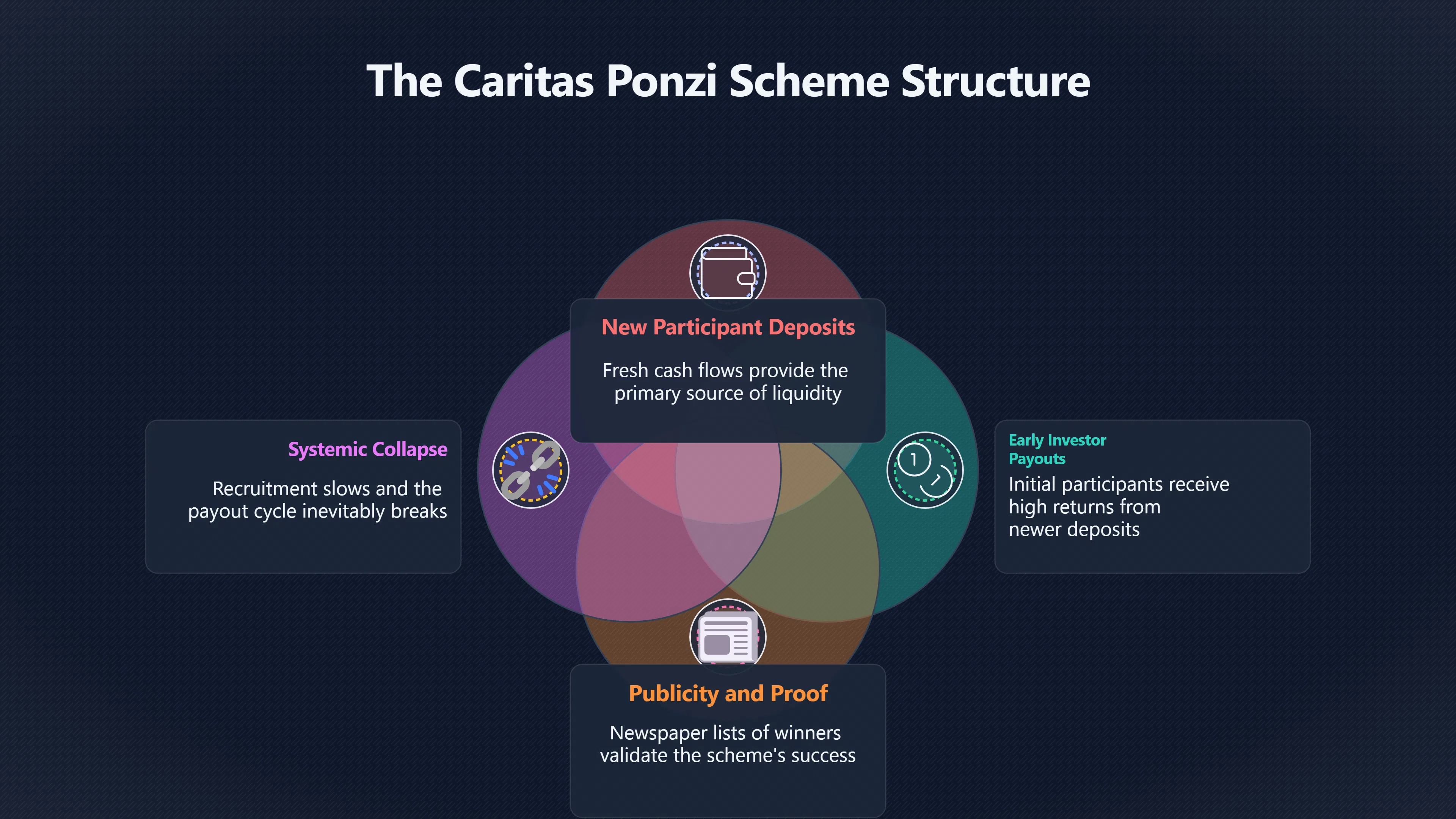
Caritas converted inflation, public endorsements and visible early payouts into mass confidence in an economically impossible promise.
On this page
- The promise of multiplying deposits within months
- How inflation and early payouts made the scheme believable
- Political respectability, collapse and public losses
Page outline Jump by section
Introduction
Few frauds in modern Romanian history were as vast, visible or socially consequential as Caritas. Launched in 1992 by businessman Ioan Stoica, the scheme promised something that should have been impossible: deposit money and receive eight times the amount back within a few months. Yet millions of Romanians participated, queues stretched through city streets, newspapers published long lists of successful recipients, and local political figures publicly associated themselves with the operation. By the time Caritas collapsed in 1994, it had become a defining symbol of Romania’s turbulent transition from communism to a market economy.[Wikipedia]WikipediaCaritas (Ponzi schemeCaritas (Ponzi scheme
Caritas matters in the history of deception because it did not rely on forged documents, fake science or hidden manipulation. Its central claim was made openly. What made it persuasive was a combination of economic hardship, inflation, visible early payouts and political respectability. The scheme became a national lesson in how an obviously unsustainable promise can appear credible when enough people seem to be getting rich from it.[wikipedia.org]WikipediaCaritas (Ponzi schemeCaritas (Ponzi scheme
The Promise of Multiplying Deposits Within Months
Caritas presented itself as a form of mutual aid rather than a conventional investment company. Participants deposited cash and were promised a return worth eight times their original contribution after a waiting period. The operation began in Brașov in 1992 before moving to Cluj-Napoca, where it expanded dramatically.[Wikipedia]WikipediaCaritas (Ponzi schemeCaritas (Ponzi scheme
The mathematics were impossible. No legitimate business could consistently multiply deposits by such a factor without generating extraordinary profits from real economic activity. Like classic pyramid and Ponzi schemes elsewhere, Caritas depended on a constant flow of new participants whose deposits funded payouts to earlier entrants. As long as enough new money arrived, the illusion of success could continue. Once recruitment slowed, the structure would inevitably fail.[SPIA România]spiaromania.comeverything you need to know about the ponzi schemeSPIA RomâniaAbout Ponzi Schemes | SPIA Romania Blog30 Dec 2020 — A Ponzi scheme is a type of fraud that involves attracting a large numbe…
What distinguished Caritas from many smaller frauds was its scale. Contemporary estimates vary, but sources commonly place participation in the millions, with some estimates suggesting that between 35 and 50 per cent of Romanian households became involved. At its peak, observers believed the scheme controlled an astonishing share of the cash circulating in the country.[Wikipedia]WikipediaCaritas (Ponzi schemeCaritas (Ponzi scheme
How Inflation and Early Payouts Made the Scheme Believable
To understand why so many people trusted Caritas, it is necessary to remember the economic conditions of early post-communist Romania. The collapse of the old system brought inflation, uncertainty, falling living standards and confusion about how a market economy worked. Savings often lost value rapidly, while many people felt excluded from the opportunities promised by economic reform.[romania-insider.com]romania-insider.comRomania Insider RomaniaRomania InsiderRomania - 30 years of democracy: 19942 Jun 2022 — And in a difficult economic and political context, a Ponzi scheme that p…
In that environment, Caritas offered something more powerful than a financial product: hope. Depositors did not need to understand complex investments. They could see neighbours, relatives and work colleagues apparently receiving huge returns. Early participants really did get paid, because their profits came from money supplied by later participants. Those visible successes became the scheme’s most effective advertising.[Wikipedia]WikipediaCaritas (Ponzi schemeCaritas (Ponzi scheme
Inflation also helped blur economic reality. When prices were changing rapidly and ordinary people were struggling to judge what money would be worth in a few months, extraordinary financial claims could seem less absurd than they would in a stable economy. Anthropologist Katherine Verdery, who studied the phenomenon closely, argued that Caritas reflected deeper uncertainties about money itself during Romania’s transition from socialism to capitalism. The scheme flourished in a period when many people were trying to understand entirely new economic rules.[JSTOR]jstor.orgOpen source on jstor.org.
Another factor was publicity. Newspapers printed lengthy lists of those scheduled to receive payouts, creating a public record of apparent winners. The visibility of these payments encouraged the belief that Caritas was not merely surviving but thriving. To many participants, the evidence seemed to be right in front of them.[Wikipedia]WikipediaCaritas (Ponzi schemeCaritas (Ponzi scheme
Why So Many Ignored the Warning Signs
The warning signs were obvious to economists and financial specialists. A scheme that promised eightfold returns without a productive source of income could not continue indefinitely. Officials within Romania’s central banking and intelligence institutions reportedly expressed concern well before the collapse.[Wikipedia]WikipediaCaritas (Ponzi schemeCaritas (Ponzi scheme
Yet warnings struggled to compete with personal experience. People who knew someone who had received a payout often trusted that evidence more than abstract economic arguments. This is a common feature of large financial frauds: direct testimony from apparent beneficiaries can be more persuasive than expert criticism.
There was also a psychological feedback loop. The larger Caritas became, the safer it appeared. Huge queues, packed offices and constant discussion in the media created the impression that participation itself was proof of legitimacy. If millions were joining, many reasoned, surely the authorities would stop it if it were illegal or fraudulent.[The Washington Post]washingtonpost.comThe Washington PostROMANIANS GRASP A STRAW17 Oct 1993 — CLUJ, ROMANIA – In the realm of pyramids, there is none bigger than the one bein…
Political Respectability and Public Trust
One of the most controversial aspects of Caritas was the degree of political legitimacy it appeared to enjoy. The scheme developed close associations with local political figures in Cluj-Napoca, particularly mayor Gheorghe Funar and the nationalist Romanian National Unity Party. Funar publicly defended Caritas, appeared alongside its founder and helped reinforce the perception that the operation was respectable. At one stage the company even operated from premises linked to the city administration.[Wikipedia]WikipediaCaritas (Ponzi schemeCaritas (Ponzi scheme
This political visibility mattered. Many citizens interpreted official tolerance and public endorsements as signs that the scheme had been examined and found acceptable. Whether politicians genuinely believed in Caritas or simply benefited from its popularity, the effect was to reduce public scepticism.[Wikipedia]WikipediaCaritas (Ponzi schemeCaritas (Ponzi scheme
The relationship between politics and the scheme later became part of the broader debate about responsibility. Critics argued that stronger intervention might have limited losses. Others pointed out that shutting down a programme involving millions of participants risked public unrest and political backlash. Contemporary accounts suggest that fear of social consequences contributed to official reluctance to act decisively.[Wikipedia]WikipediaCaritas (Ponzi schemeCaritas (Ponzi scheme
Collapse and Public Losses
The first serious cracks appeared during late 1993, when critical reporting increased and questions about sustainability became harder to ignore. As confidence weakened, Caritas struggled to attract enough new deposits to maintain promised payouts. Since the entire mechanism depended on continuous growth, even a modest slowdown threatened its survival.[Wikipedia]WikipediaCaritas (Ponzi schemeCaritas (Ponzi scheme
By 1994 the scheme was effectively collapsing. Payments were delayed, operations were repeatedly suspended and organisers blamed technical problems or outside interference. Eventually Caritas ceased functioning, leaving enormous unpaid obligations. Estimates of the money involved vary, but contemporary reporting and later analyses place the total between roughly one and five billion US dollars, making it one of the largest pyramid schemes of the twentieth century.[wikipedia.org]WikipediaCaritas (Ponzi schemeCaritas (Ponzi scheme
As with most pyramid schemes, the timing of entry determined outcomes. Early participants who received payouts could profit handsomely. Those who joined later, often influenced by stories of earlier success, bore the greatest losses. The very evidence that persuaded many people to participate—the existence of genuine winners—was produced by the mechanism that guaranteed most participants would eventually lose.[Wikipedia]WikipediaCaritas (Ponzi schemeCaritas (Ponzi scheme
Ioan Stoica was prosecuted and convicted, although his prison sentence was reduced on appeal. Legal disputes over losses and compensation continued for years after the collapse.[Wikipedia]WikipediaCaritas (Ponzi schemeCaritas (Ponzi scheme
Why Caritas Still Matters
Caritas remains one of the defining frauds of post-communist Romania because it exposed vulnerabilities created by rapid economic change. The scheme succeeded not because its promise was convincing on paper, but because social proof, visible payouts, inflation and official tolerance made the impossible appear real.[Cambridge University Press & Assessment]cambridge.orgThe hypothesis gains credence from Stoica's failure to put an upper limit on the size of withdrawals—a chief cause…
The episode also illustrates a broader lesson about large-scale deception. People rarely join such schemes because they believe mathematics has been suspended. They join because they see others apparently benefiting, because trusted figures seem to approve, and because difficult circumstances make extraordinary opportunities feel worth the risk. Caritas transformed those familiar human impulses into one of Europe’s largest pyramid booms, leaving a lasting mark on Romania’s memory of the chaotic years that followed the end of communist rule.[wikipedia.org]WikipediaCaritas (Ponzi schemeCaritas (Ponzi scheme
Amazon book picks
Further Reading
Books and field guides related to Why Millions Trusted Romania's Caritas Scheme. Use these as the next step if you want deeper reading beyond the article.
Extraordinary Popular Delusions and the Madness of Crowds
Rating: 4.0/5 from 5 Google Books ratings
Explains crowd behavior behind financial bubbles.
Thinking, Fast and Slow
Explains biases that make unrealistic promises seem believable.
eBay marketplace picks
Marketplace Samples
Live-tested eBay searches with available results related to this page.



Endnotes
1.
Source: Wikipedia
Title: Caritas (Ponzi scheme)
Link:https://en.wikipedia.org/wiki/Caritas_%28Ponzi_scheme%29
2.
Source: cambridge.org
Link:https://www.cambridge.org/core/journals/comparative-studies-in-society-and-history/article/faith-hope-and-caritas-in-the-land-of-the-pyramids-romania-1990-to-1994/D5C3CA9EBC09554EE76B04BCBAC3893D
Source snippet
The hypothesis gains credence from Stoica's failure to put an upper limit on the size of withdrawals—a chief cause...
3.
Source: romania-insider.com
Title: Romania Insider Romania
Link:https://www.romania-insider.com/romania-30-years-democracy-1994
Source snippet
Romania InsiderRomania - 30 years of democracy: 19942 Jun 2022 — And in a difficult economic and political context, a Ponzi scheme that p...
4.
Source: Wikipedia
Title: Caritas (schema Ponzi)
Link:https://it.wikipedia.org/wiki/Caritas_%28schema_Ponzi%29
5.
Source: sciencedirect.com
Link:https://www.sciencedirect.com/science/article/pii/S2214845025002157
Source snippet
Financial literacy and financial well-being: Empirical...by MS Anghel · 2025 · Cited by 3 — Under communism, financial educ...
6.
Source: jstor.org
Link:https://www.jstor.org/stable/2783317
7.
Source: Wikipedia
Title: List of Ponzi schemes
Link:https://en.wikipedia.org/wiki/List_of_Ponzi_schemes
8.
Source: caritas.eu
Link:https://www.caritas.eu/wp-content/uploads/2023/06/Romania_CountryReport_Digital_single.pdf
9.
Source: caritas.eu
Link:https://www.caritas.eu/caritas-romania/
10.
Source: jstor.org
Link:https://www.jstor.org/stable/179204
11.
Source: youtube.com
Link:https://www.youtube.com/watch?v=C4DUISkpGIE
Source snippet
4 Anii '90 în România: Țepe, bișniță și băieți deștepți...
12.
Source: washingtonpost.com
Link:https://www.washingtonpost.com/archive/politics/1993/10/17/romanians-grasp-a-straw/77705c69-f374-4fc8-bc2b-268160b4cc8e/
Source snippet
The Washington PostROMANIANS GRASP A STRAW17 Oct 1993 — CLUJ, ROMANIA -- In the realm of pyramids, there is none bigger than the one bein...
13.
Source: spiaromania.com
Title: everything you need to know about the ponzi scheme
Link:https://spiaromania.com/en/blog/everything-you-need-to-know-about-the-ponzi-scheme/
Source snippet
SPIA RomâniaAbout Ponzi Schemes | SPIA Romania Blog30 Dec 2020 — A Ponzi scheme is a type of fraud that involves attracting a large numbe...
14.
Source: visualcapitalist.com
Title: biggest ponzi schemes in modern history
Link:https://www.visualcapitalist.com/biggest-ponzi-schemes-in-modern-history/
15.
Source: washingtonpost.com
Link:https://www.washingtonpost.com/archive/opinions/1993/11/21/transylvanias-s-l/3364fb79-d085-42c2-a4ea-17d2348679b9/
Additional References
16.
Source: reddit.com
Link:https://www.reddit.com/r/europe/comments/1954cz7/people_queuing_to_deposit_their_money_with/
Source snippet
People queuing to deposit their money with Caritas, one of...35-50% of Romanian households were involved in the scheme. At its pea...
17.
Source: tontinecoffeehouse.com
Title: The Tontine Coffee-House Romania’s ‘Caritas’ Scheme
Link:https://tontinecoffeehouse.com/2024/02/12/romanias-caritas-scheme/
Source snippet
Offering a bit of hope to many was a local 'mutual-aid' financial scheme called Caritas.Read more...
18.
Source: solidaritate.eu
Link:https://www.solidaritate.eu/index.php/english/activities/research-and-publications/
19.
Source: trendspider.com
Link:https://trendspider.com/learning-center/the-caritas/
20.
Source: youtube.com
Title: Caritas: jocul care a ruinat România
Link:https://www.youtube.com/watch?v=mm_xfX1Xp4Q
Source snippet
3 CARITAS - Cea mai mare ȚEAPĂ Națională din istorie...
21.
Source: utgjiu.ro
Title: 31 Amelia Georgiana BONCEA THE PREPETUAL CRISIS OF THE ROMANIAN ECONOMY.pdf;
Link:https://www.utgjiu.ro/rev_mec/mecanica/pdf/2020-01/31_Amelia%20Georgiana%20BONCEA%20-%20THE%20PREPETUAL%20CRISIS%20OF%20THE%20ROMANIAN%20ECONOMY.pdf%3B
22.
Source: youtube.com
Title: Anii ‘90 în România: Țepe, bișniță și băieți deștepți
Link:https://www.youtube.com/watch?v=TEeOu2dC1uM
Source snippet
5 Cum era prostită Romania în anii 1990...
23.
Source: youtube.com
Title: Caritas: cea mai mare țeapă dată românilor (anii ‘90)
Link:https://www.youtube.com/watch?v=F2swizzJr0c
Source snippet
2 Caritas: jocul care a ruinat România...
24.
Source: ziare.com
Title: caritas ponzi inselaciune cluj ioan stoica 1839376
Link:https://ziare.com/caritas-schema-ponzi/caritas-ponzi-inselaciune-cluj-ioan-stoica-1839376
25.
Source: independent.co.uk
Title: romania s getrichquick pyramid fails 1437267
Link:https://www.independent.co.uk/news/world/romania-s-getrichquick-pyramid-fails-1437267.html
Topic Tree