Which South African Hoaxes Refused to Die?
South Africa’s best-known hoax stories range from buried Boer gold and a “lost city” in the Kalahari to apartheid disinformation, AIDS pseudoscience and a newspaper report about ten newborn babies who apparently never existed. They did not all begin as deliberate frauds.
Page outline Jump by section
Introduction
South Africa’s best-known hoax stories range from buried Boer gold and a “lost city” in the Kalahari to apartheid disinformation, AIDS pseudoscience and a newspaper report about ten newborn babies who apparently never existed. They did not all begin as deliberate frauds. Some were political operations designed to deceive; others were sincere errors enlarged by newspapers, commercial interests or public fear. A few survive mainly as folklore because the evidence is incomplete rather than because a culprit confessed.
What connects them is a persuasive mixture of authority and desire. Readers trusted an explorer, an editor, a police specialist, a government or an apparently authentic photograph. The claims also offered something people already wanted or feared: hidden treasure, archaeological wonder, monstrous creatures, secret enemies or miraculous medical answers. Their history shows that exposure rarely depends on one dramatic revelation. More often, stories collapse when investigators ask ordinary questions about records, witnesses, physical evidence and who benefits from belief.
The treasure that was never found
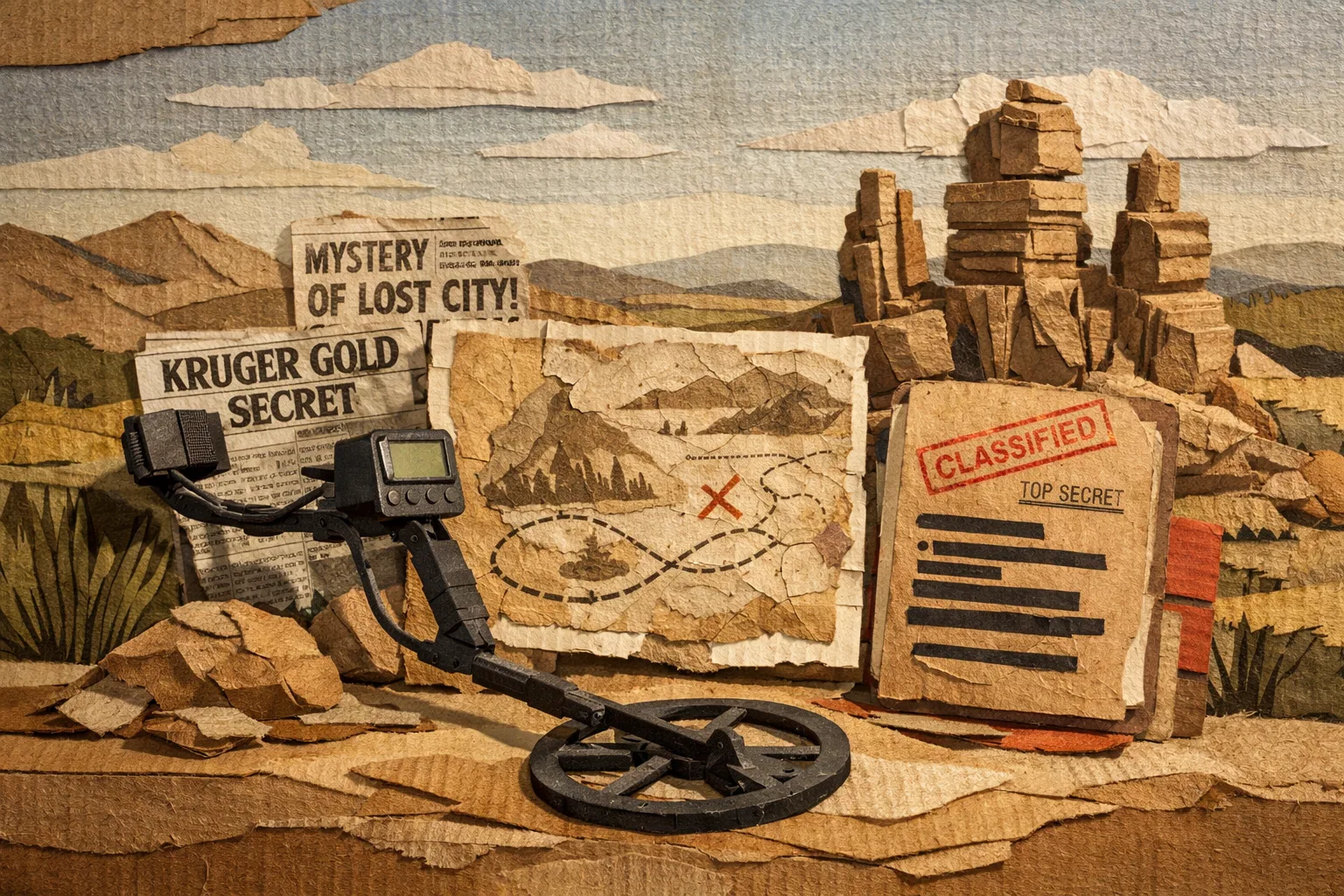
The “Kruger Millions” are supposedly a fortune in gold removed from Pretoria as British forces advanced during the South African War and then buried somewhere in the eastern Transvaal. There is a firm historical core beneath the legend: the government of the South African Republic did evacuate gold and coin from Pretoria in 1900. What remains unproved is the popular version in which a vast treasure was secretly placed underground and never recovered.
The legend became powerful because several different mysteries were folded together. Contemporary accounts disagreed over the amount of gold involved, while British officials suspected that republican funds had been transferred abroad. Later storytellers converted disputed wartime accounting into a treasure map. A prisoner claimed in 1905 that millions in gold and diamonds had been buried near the Blyde River; journalists and treasure hunters subsequently repeated and embellished the story. In 1929 Denys Reitz publicly argued that little money remained after the war, partly in an effort to stop enthusiasts damaging graves and historic sites while digging for treasure.[Wikipedia]WikipediaKruger MillionsKruger Millions
The story therefore sits on the boundary between unsolved financial history and invented tradition. Gold was moved, spent and possibly transferred overseas, but no reliable documentation establishes a giant buried hoard. Discoveries of old South African Republic coins are regularly presented as fragments of the treasure, although a coin cache does not prove the existence of the legendary veld burial. The South African Mint’s acquisition of a hoard of hundreds of republican coins found in a Swiss vault illustrates the problem: the coins were real, but their survival in Europe arguably supports overseas removal more readily than the familiar tale of chests hidden in Mpumalanga.[Wikipedia]WikipediaKruger MillionsKruger Millions
The Kruger Millions continue to circulate because they turn complicated wartime finance into a simple, participatory mystery. Anyone with a metal detector, an inherited map or a family story can imagine being one clue away from solving it. The people who benefit are not necessarily fraudsters: publishers, television producers, tourist businesses and collectors can all profit from an unresolved treasure without claiming to possess definitive proof.
Did an explorer find a lost Kalahari city?
In the 1880s, the Canadian-born showman and traveller William Leonard Hunt, better known as the Great Farini, described what appeared to be extensive ruins in the Kalahari. His published account evoked walls, masonry and the remains of a vanished settlement. Photographs associated with his journey and a paper presented to the Royal Geographical Society gave the claim an air of scientific respectability.[Wikipedia]WikipediaLost City of the KalahariLost City of the Kalahari
The claim was persuasive for reasons larger than Farini himself. Nineteenth-century European audiences were fascinated by unexplored interiors and “lost civilisations”. The idea also fitted a colonial habit of interpreting striking African landscapes as remnants of forgotten outsiders rather than first considering natural geology or the histories of living communities. Farini’s reputation as a performer did not necessarily weaken the tale; his skill at self-promotion helped place it before an international audience.
Repeated searches failed to locate a city. The most influential attempted solution came from A. J. Clement, who reconstructed Farini’s probable route and examined formations near Rietfontein. Clement argued that the apparent walls were weathered dolerite: igneous rock fractured into blocks and lines that can look remarkably architectural from a distance. He published his proposed solution in 1965.[Journals.co.za]journals.co.zaAJA00382353 1297Farini's 'Lost City' of the Kalahari: The probable solutionby AJ Clement · 1965 · Cited by 1 — Farini's 'Lost City' of the Kalahari: The…
This is not a cleanly solved hoax in the manner of a forged photograph. Farini may have exaggerated for literary effect, genuinely mistaken natural formations for ruins, or done both. No archaeological evidence has verified his city, however, and the geological explanation fits the physical features later investigators found. The case matters because it shows how visual resemblance becomes “evidence” when an observer already expects a discovery. Once the phrase “lost city” entered circulation, every regular line of stone became a possible wall.
The white sea monster of Margate
A similarly uncertain transformation occurred at Margate in 1924. Newspaper reports described a huge pale creature fighting whales offshore before its carcass washed onto the beach. Later versions gave it white fur, a tail and an elephant-like trunk. Decades afterwards, the creature acquired the memorable nickname “Trunko”.[Wikipedia]WikipediaOpen source on wikipedia.org.
The most dramatic elements came through press retellings rather than a scientific examination. The carcass reportedly remained on the shore for days, yet no preserved specimen, measurement set or contemporary zoological report survives. That evidential gap allowed each retelling to become more definite. What may originally have been an indistinct mass seen at sea became a complete unknown animal with a recognisable anatomy.
Photographs rediscovered and publicised many decades later weakened the monster interpretation. They appear to show a large fibrous mass rather than a coherent, fur-covered animal. Decomposing whale tissue can separate into pale, hair-like strands, producing the “globster” appearance that has generated sea-monster reports elsewhere. The supposed trunk could have been torn connective tissue or another distorted part of a carcass.[Wikipedia]WikipediaOpen source on wikipedia.org.
Trunko is best treated as a likely misidentification magnified by newspaper storytelling, not as a demonstrated conspiracy. There is no strong evidence that witnesses deliberately fabricated a model or planted a carcass. Its survival illustrates a basic rule of monster legends: a poor record can be more durable than a good one. Missing samples and vague photographs do not settle the identity, but they leave enough uncertainty for later writers to reconstruct the animal in increasingly spectacular forms.
Apartheid’s organised machinery of falsehood
Some South African deceptions were neither playful nor accidental. During apartheid, state security structures used propaganda, forged material, covert media activity and personal smears against political opponents. These operations were commonly grouped under “Stratcom”, short for strategic communications, although the term is often used more broadly in later public discussion than it was in official structures.
Truth and Reconciliation Commission material records applications from former security personnel for operations classified as disinformation, propaganda and “dirty tricks”. The Commission linked numerous intimidation and disinformation incidents to Strategic Communications activities within the Witwatersrand Security Branch.[Government of South Africa]gov.zaApartheid politics turned traditional leaders into politicians re p… disinformation. 46. The majority of the ninety-one incidents in t…
One documented campaign, Operation Romulus, sought to damage Winnie Madikizela-Mandela and, through her, the African National Congress. Former operatives described feeding hostile stories into the media and exploiting genuine controversies alongside manipulated information. This combination was effective because a disinformation campaign does not require every element to be invented. A real dispute can be surrounded by planted claims, selective leaks and anonymous allegations until readers can no longer distinguish verification from repetition.[Justice]justice.gov.zaJustice28 Nov 97Justice28 Nov 97
The beneficiaries were clear: the security state hoped to weaken opposition organisations, divide communities and make repression appear justified. Journalists and editors did not always know when they were being used, but the system depended on media outlets carrying material whose hidden source could not be assessed by readers.
Stratcom remains politically potent because the word is now sometimes applied to almost any hostile reporting. That usage can obscure the historical specificity of documented covert operations. Calling criticism “Stratcom” is not proof that a modern report was planted by state agents. The archival lesson is more demanding: identify the operation, chain of instruction, intermediary, document or testimony that demonstrates organised deception.
When a moral panic became police business
During the late apartheid period and into the democratic era, South African newspapers, religious campaigners and some police specialists repeatedly warned of organised Satanic networks behind murders, youth rebellion, heavy-metal music and other social anxieties. Real crimes were sometimes described as ritual or Satanic before investigators had established a motive.
The concern was institutionalised through an Occult Related Crimes Unit established in 1992. Its approach drew criticism because Christian theological assumptions were sometimes treated as investigative expertise. Lists of supposed warning signs associated occult involvement with such broad behaviour as interest in horror films, fantasy games, computers, unconventional clothing or hostility towards Christianity. Scholars have connected the panic to conservative religious politics, social instability and the uncertainties surrounding apartheid’s end.[Wikipedia]WikipediaSatanic panic (South AfricaSatanic panic (South Africa
The central falsehood was not that no crime ever involved occult language or ritual symbolism. Some offenders did invoke demons, sacrifice or supernatural commands. The misleading leap was from isolated behaviour to a hidden, coordinated national conspiracy. In several prominent cases, “Satanism” supplied an immediate media explanation even when later evidence pointed towards bullying, personal conflict, psychological disturbance, coercion or the offender’s desire for notoriety.
Such stories spread because they simplified disturbing violence. A secret cult seemed easier to understand than domestic abuse, social breakdown or an individual’s mixed motives. The label could also shift attention away from mundane failures by families, schools, police and communities. Recent scholarship continues to examine how supernatural explanations can be hijacked by opportunists or used to frame crimes that are better investigated through conventional evidence.[OpenUCT]open.uct.ac.zaOpen source on uct.ac.za.
This case requires particular care. Religious belief, African spiritual traditions, minority faiths and criminal conduct are not interchangeable. The historical problem lies in unsupported conspiracy claims and prejudicial policing, not in treating an entire category of belief as fraudulent.
AIDS denialism and the cost of official credibility
South Africa’s most consequential episode of pseudoscience arose during the HIV/AIDS epidemic. President Thabo Mbeki questioned the established causal link between HIV and AIDS and gave attention to denialist figures who disputed mainstream virology. His government was also slow to provide antiretroviral treatment through the public health system. Health Minister Manto Tshabalala-Msimang promoted nutritional approaches while frequently casting doubt on antiretroviral drugs.[PMC]pmc.ncbi.nlm.nih.govOpen source on nih.gov.
This was not a conventional hoax with a single inventor. It combined sincere political suspicion, misinformation, ideological resistance and commercial pseudoscience. South Africa had valid reasons to distrust pharmaceutical pricing and unequal global health systems. Denialists exploited that context by presenting the scientific consensus as a foreign or corporate plot. Vitamin entrepreneur Matthias Rath, for example, marketed supplements while attacking antiretroviral medicine, turning political uncertainty into a commercial opportunity.[The New Yorker]newyorker.comOpen source on newyorker.com.
The evidence against denialism did not depend on authority alone. Researchers had identified HIV, measured its effects on immune cells and repeatedly shown that combinations of antiretroviral drugs suppressed the virus and reduced illness and transmission. South African activists, particularly the Treatment Action Campaign, used scientific evidence and constitutional litigation to press for access to treatment.
Researchers later attempted to estimate the human cost of delayed provision. A Harvard-led analysis calculated that more than 330,000 premature deaths between 2000 and 2005 could have been avoided and that roughly 35,000 infants acquired HIV who might otherwise have been protected. Such figures are modelled estimates rather than a count of named individual cases, but they demonstrate the scale of the policy consequences.[Harvard Chan School of Public Health]hsph.harvard.eduChan School of Public Health The cost of South Africa's misguided AIDS policiesChan School of Public Health The cost of South Africa's misguided AIDS policies
The episode shows why pseudoscientific claims become especially dangerous when backed by office, celebrity or commerce. Ordinary people were not simply choosing between equal scientific theories. They were hearing doubt amplified by national leaders during an emergency, while sellers of unproved remedies benefited from confusion.

How ten babies became international news
On 8 June 2021, the Pretoria News reported that Gosiame Sithole of Tembisa had given birth to ten babies, supposedly setting a world record. The claim raced through South African and international media. It had every ingredient of an irresistible online story: an astonishing medical event, identifiable parents, emotional photographs and apparent confirmation from a recognised newspaper.
Basic verification was missing. No hospital was named in the original account, no doctors were produced, and health authorities could find no record of the births. As doubts grew, the publisher’s response shifted from defending an exclusive to alleging that officials were concealing the babies and covering up medical wrongdoing. The absence of evidence was thus repackaged as evidence of a conspiracy.[Wits University]wits.ac.zathe 10 babies hoaxthe 10 babies hoax
Independent Media’s own ombudsman reportedly concluded that the story was a hoax and had failed elementary journalistic standards. An external inquiry described the publication as reckless. In December 2022 the Public Protector found the birth claim unsubstantiated after examining health records and the actions of public bodies. No medical documentation or reliable eyewitness evidence established that decuplets had been delivered.[dailymaverick.co.za]dailymaverick.co.zaOpen source on dailymaverick.co.za.
The story nevertheless acquired a second life. Its promoters continued to allege trafficking and official concealment, while critics pointed to the publisher’s refusal to retract the central narrative. The dispute demonstrates how a failed exclusive can become a conspiracy story: every correction is described as suppression, and every missing record becomes proof that records were destroyed.
The “Tembisa 10” also exposed the weakness of copied journalism. Many outlets repeated the extraordinary claim because another established publication had apparently done the reporting. The speed and emotional appeal of the story displaced the most important questions: Which hospital? Which clinicians? Where were the birth registrations? Had any independent reporter seen the children?
Why these stories keep returning
South Africa’s hoax history is not a catalogue of national gullibility. Each story emerged from a particular system of incentives.
Authority shortened the path to belief. Farini appeared before geographical institutions; apartheid operatives exploited the press; AIDS denialism had presidential backing; and the decuplet claim came from a newspaper rather than an anonymous social-media account.
Emotion made verification feel secondary. Treasure promised wealth, the lost city promised wonder, Trunko promised a surviving monster, Satanic conspiracies offered a simple enemy, and the Tembisa story offered a celebratory record.
Uncertainty was converted into proof. Missing gold encouraged treasure stories. The absence of a Trunko specimen preserved the monster. Missing hospital records were interpreted by decuplet believers as signs of a cover-up. Yet missing evidence normally weakens a claim; it does not automatically support the most dramatic explanation.
Repetition blurred the source. Later accounts often cite earlier retellings rather than the original document, witness or photograph. Details accumulate while provenance disappears. This is how a natural rock formation becomes masonry, an indistinct carcass grows a trunk, and disputed wartime accounts become a precise treasure legend.
The most reliable way to approach these cases is therefore to identify what kind of claim is being made. A confessed forgery, a covert propaganda operation, a commercial medical falsehood, a newspaper failure and a folk legend require different standards of judgement. The useful question is not merely “Was it a hoax?” but “What evidence would distinguish deliberate deception from error, exaggeration, belief or tradition?”
That distinction preserves both scepticism and fairness. It allows the Kruger Millions and Trunko to remain entertaining mysteries without treating speculation as fact. It recognises that apartheid disinformation and harmful medical misinformation involved far greater power and consequences. Above all, it explains why exposure is rarely the end of a story: once a claim provides identity, profit, excitement or political protection, disproving it may only produce a new tale about why the truth has supposedly been hidden.
Amazon book picks
Further Reading
Books and field guides related to Which South African Hoaxes Refused to Die?. Use these as the next step if you want deeper reading beyond the article.
Extraordinary Popular Delusions and the Madness of Crowds
Rating: 4.0/5 from 5 Google Books ratings
Examines how collective belief sustains doubtful stories.
The Demon-Haunted World
Rating: 4.5/5 from 43 Google Books ratings
Focuses on skepticism, evidence and extraordinary claims.
The Misinformation Age
Explains the social dynamics behind enduring hoaxes and misinformation.
A Field Guide to Lies
Shows how readers can evaluate evidence behind extraordinary claims.
eBay marketplace picks
Marketplace Samples
Live-tested eBay searches with available results related to this page.




Endnotes
1.
Source: Wikipedia
Title: Kruger Millions
Link:https://en.wikipedia.org/wiki/Kruger_Millions
2.
Source: Wikipedia
Title: Lost City of the Kalahari
Link:https://en.wikipedia.org/wiki/Lost_City_of_the_Kalahari
3.
Source: journals.co.za
Title: AJA00382353 1297
Link:https://journals.co.za/doi/10.10520/AJA00382353_1297
Source snippet
Farini's 'Lost City' of the Kalahari: The probable solutionby AJ Clement · 1965 · Cited by 1 — Farini's 'Lost City' of the Kalahari: The...
4.
Source: Wikipedia
Link:https://en.wikipedia.org/wiki/Trunko
5.
Source: Wikipedia
Title: Satanic panic (South Africa)
Link:https://en.wikipedia.org/wiki/Satanic_panic_%28South_Africa%29
6.
Source: pmc.ncbi.nlm.nih.gov
Link:https://pmc.ncbi.nlm.nih.gov/articles/PMC1125376/
7.
Source: hsph.harvard.edu
Title: Chan School of Public Health The cost of South Africa’s misguided AIDS policies
Link:https://hsph.harvard.edu/news/spr09aids/
8.
Source: Wikipedia
Title: Piet Rampedi
Link:https://en.wikipedia.org/wiki/Piet_Rampedi
9.
Source: news24.com
Link:https://www.news24.com/southafrica/news/tembisa-10-public-protector-finds-claims-mom-gave-birth-to-decuplets-unsubstantiated-20221231
10.
Source: Wikipedia
Title: Cottingley Fairies
Link:https://en.wikipedia.org/wiki/Cottingley_Fairies
11.
Source: Wikipedia
Title: Piltdown Man
Link:https://en.wikipedia.org/wiki/Piltdown_Man
12.
Source: Wikipedia
Title: Tembisa 10
Link:https://en.wikipedia.org/wiki/Tembisa_10
13.
Source: Wikipedia
Title: AIDS denialism in South Africa
Link:https://en.wikipedia.org/wiki/HIV/AIDS_denialism_in_South_Africa
14.
Source: news24.com
Link:https://www.news24.com/southafrica/news/tembisa-10-independent-media-internal-ombud-brands-story-as-hoax-wants-titles-to-publish-apology-20211029
15.
Source: journals.co.za
Title: AJA00382353 1297
Link:https://journals.co.za/doi/pdf/10.10520/AJA00382353_1297
16.
Source: gov.za
Link:https://www.gov.za/sites/default/files/gcis_document/201409/trc0.pdf
Source snippet
Apartheid politics turned traditional leaders into politicians re p... disinformation. 46. The majority of the ninety-one incidents in t...
17.
Source: justice.gov.za
Title: Justice28 Nov 97
Link:https://www.justice.gov.za/trc/media/1997/9711/s971128n.htm
18.
Source: open.uct.ac.za
Link:https://open.uct.ac.za/handle/11427/38158
19.
Source: wits.ac.za
Title: satanic panic 5 occult crimes that gripped sa
Link:https://www.wits.ac.za/news/latest-news/opinion/2025/2025-09/satanic-panic-5-occult-crimes-that-gripped-sa.html
20.
Source: newyorker.com
Link:https://www.newyorker.com/magazine/2007/03/12/the-denialists
21.
Source: wits.ac.za
Title: the 10 babies hoax
Link:https://www.wits.ac.za/news/latest-news/opinion/2021/2021-11/the-10-babies-hoax-.html
22.
Source: dailymaverick.co.za
Link:https://www.dailymaverick.co.za/article/2021-10-29-revealed-independent-medias-internal-report-on-piet-rampedis-decuplets-story-found-it-was-a-hoax-and-demanded-an-apology/
23.
Source: gov.za
Title: gauteng government takes legal action against independent media and pretoria
Link:https://www.gov.za/news/media-statements/gauteng-government-takes-legal-action-against-independent-media-and-pretoria
24.
Source: dailymaverick.co.za
Link:https://www.dailymaverick.co.za/article/2023-01-01-acting-pp-agrees-tembisa-decuplets-never-existed-but-still-no-scrutiny-for-piet-rampedi-and-iqbal-surves-role/
25.
Source: dailymaverick.co.za
Link:https://www.dailymaverick.co.za/article/2021-11-13-atrocious-crimes-apartheid-hitmans-brutal-confessions-serve-as-a-warning-for-south-africans/
26.
Source: dailymaverick.co.za
Link:https://www.dailymaverick.co.za/article/2022-04-06-independent-medias-tembisa-10-series-an-inma-global-media-awards-finalist-and-sanef-is-appalled/
27.
Source: cryptidz.fandom.com
Link:https://cryptidz.fandom.com/wiki/Trunko
28.
Source: thecreaturecodex.tumblr.com
Link:https://thecreaturecodex.tumblr.com/post/703214607538536448/trunko
29.
Source: open.uct.ac.za
Link:https://open.uct.ac.za/bitstreams/7c8bc3b2-0567-489a-9b0b-fd0373263336/download
30.
Source: justice.gov.za
Link:https://www.justice.gov.za/trc/report/finalreport/volume%203.pdf
31.
Source: justiceinfo.net
Title: 157061 justice suspended in south africa
Link:https://www.justiceinfo.net/en/157061-justice-suspended-in-south-africa.html
Additional References
32.
Source: wired.com
Link:https://www.wired.com/story/the-man-who-sold-out-medicine
Source snippet
Research indicates that if ARV treatments were widely adopted, approximately 343,000 deaths and 171,000 new HIV infections could have bee...
33.
Source: explorersweb.com
Title: exploration mysteries lost city of the kalahari
Link:https://explorersweb.com/exploration-mysteries-lost-city-of-the-kalahari/
Source snippet
Clement claimed to have debunked Farini's lost city as a disappointing case of dolerite rock. He...Read more...
34.
Source: sabctrc.saha.org.za
Link:https://sabctrc.saha.org.za/reports/volume6/section3/chapter1/subsection20.htm
Source snippet
Truth CommissionTRC Final Report - Truth CommissionAll three applicants applied for a range of unlawful operations, broadly classified as...
35.
Source: karlshuker.blogspot.com
Title: behold trunko
Link:https://karlshuker.blogspot.com/2010/09/behold-trunko.html
Source snippet
BEHOLD, TRUNKO!!6 Sept 2010 — The huge white-furred trunked sea monster that was allegedly observed from the shores of Margate, South Afr...
36.
Source: youtube.com
Title: Al-Shabaab exploits Kenya’s divisions to wage war
Link:https://www.youtube.com/watch?v=j13wvZND5zk
Source snippet
Election info changes quickly. Verify responses with official sources...
37.
Source: youtube.com
Title: Inside Al Shabaab: The extremist group trying to seize Somalia
Link:https://www.youtube.com/watch?v=KVSw0E9Y1RI
Source snippet
How Al-Shabab is recruiting young men from Kenya...
38.
Source: youtube.com
Title: Somalia: Govt bans Al Shabaab ‘propaganda’ contents
Link:https://www.youtube.com/watch?v=Vean7jaorHc
Source snippet
Inside Al Shabaab: The extremist group trying to seize Somalia...
39.
Source: youtube.com
Link:https://www.youtube.com/watch?v=5hKAyQIc5rk
Source snippet
Al-Shabaab exploits Kenya's divisions to wage war...
40.
Source: youtube.com
Title: How Al-Shabab is recruiting young men from Kenya
Link:https://www.youtube.com/watch?v=xc6wfF9sV90
Source snippet
Inside Al Shabaab (2017): Terror group tackles drought...
41.
Source: academia.edu
Link:https://www.academia.edu/38342835/RETHINKING_OCCULTISM_AND_CRIME_SATANISM_THE_OCCULT_AND_YOUTH_GANG_SUBCULTURES_IN_THE_GLOBAL_AND_SOUTH_AFRICAN_CONTEXT
Topic Tree
Follow this branch
Related pages 192
- Albanian Hoaxes
- Algerian Hoaxes
- Antigua Deceptions
- Argentina Hoaxes
- Armenian Hoaxes
- +187 more in sidebar