Which Papua New Guinea Stories Were Really Hoaxes?
Papua New Guinea has no single, universally recognised “great hoax” comparable with Piltdown Man or the Cottingley Fairies.
Page outline Jump by section
Introduction
These episodes should not be treated as evidence that Papua New Guineans are unusually credulous. They arose from familiar pressures found worldwide: commercial incentives, unequal access to information, trust in authority, religious hope, tourism, political instability and the media’s appetite for remote “mysteries”. They also require careful labels. The Asaro Mudmen are an evolving cultural tradition, not simply a fake. The so-called ropen is better understood as cryptozoology and misidentification than as a proven conspiracy. U-Vistract, by contrast, was a documented financial deception. Sorcery identifications occupy the gravest category: unsupported claims promoted as special knowledge, sometimes for payment, with real victims.
The Asaro Mudmen: invented does not mean fraudulent
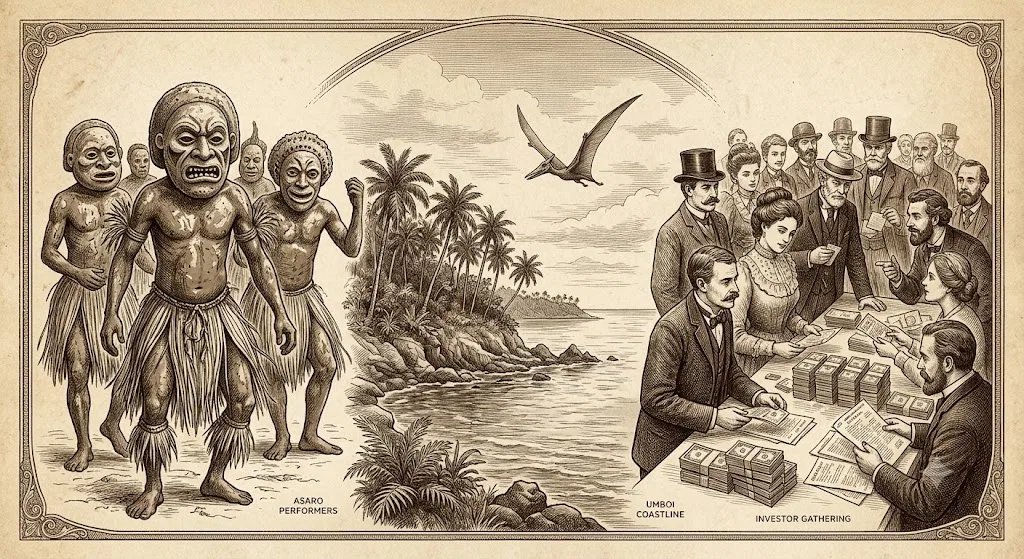
Photographs of pale, clay-masked figures emerging from vegetation have become among the most recognisable images associated with Papua New Guinea. Tourist accounts commonly repeat a dramatic origin story: defeated warriors supposedly hid in the Asaro River, emerged coated in mud, and frightened their enemies into believing that the dead had returned.
Research by anthropologists Ton Otto and Robert Verloop found a more recent and complicated history. The familiar performance developed at an agricultural show in the Eastern Highlands in the 1950s. It drew upon earlier local practices involving disguise, body covering and warfare, but its elaborate masks, choreography and explanatory legends grew through cultural competitions, photography and tourism. The researchers also recorded competing accounts of who originated it and who had the right to perform it or receive income from it.[ScholarSpace]scholarspace.manoa.hawaii.eduand R. J. Verloop. 1996. The Asaro Mudmen: Local Property, Public Culture? The Contemporary Pacific 8 (2): 349-86.Read more…
That makes the Mudmen a classic example of an invented tradition, but not necessarily a hoax. Many customs regarded as ancient were formalised, standardised or reshaped surprisingly recently. Once created, they can acquire genuine communal meaning. The Mudmen performance became associated with a particular community, generated tourism income and eventually served as a wider symbol of the Eastern Highlands and Papua New Guinea. Its modern origin does not make the performers or their identity counterfeit.
The misleading element enters when outsiders present one picturesque legend as settled historical fact. Tourism rewards simple stories with clear beginnings, while oral histories often contain several versions serving different families or communities. National Geographic’s discussion of staged cultural encounters in Papua New Guinea likewise cautioned against assuming that a performance is either wholly authentic or wholly artificial; people may knowingly adapt what they present while still regarding it as their own culture.[National Geographic]nationalgeographic.comNational GeographicAuthentic, Staged, or Somewhere in Between?29 Oct 2013 — Papua New Guinea isn't exactly a wildly popular destination f…
The useful question is therefore not “Are the Mudmen fake?” but “Which parts are old practices, which were developed for public performance, and who controls the story now?” Calling the entire tradition fraudulent erases the agency of the people who created and sustained it. Calling its popular origin legend literal history ignores the evidence of twentieth-century innovation.
The ropen: how a local mystery became a living-pterosaur claim
The ropen is usually described online as a large nocturnal flying creature seen around Papua New Guinea, particularly on or near Umboi Island. In its most dramatic form, the claim says that a pterosaur survived the mass extinction at the end of the Cretaceous period and remains alive in the region.
The modern story was promoted strongly by cryptozoological investigators, including advocates of young-Earth creationism. Witness descriptions, local vocabulary, distant lights, indistinct video and silhouettes were assembled into a case for a supposedly prehistoric animal. The remoteness of the locations helped the story: readers unfamiliar with Papua New Guinea could easily imagine that an enormous species might persist unseen in its forests or coastal caves.
Yet the claimed evidence has never produced the essentials required to establish a living pterosaur: a body, bone, tissue sample, clear diagnostic photograph or repeatable observation by zoologists. One widely circulated video was assessed as showing a frigatebird rather than an extinct reptile. Large fruit bats, birds seen under difficult conditions, and lights whose source cannot be determined offer less extraordinary explanations for at least some reports.[Smithsonian Magazine]smithsonianmag.comSmithsonian Magazine Don't Get Strung Along by the "Ropen" MythSmithsonian MagazineDon't Get Strung Along by the "Ropen" MythAugust 16, 2010 — 16 Aug 2010 — Naturally, some might be disappointed that…
The ropen case is not proven to be a single organised hoax. Local stories may refer to several phenomena, and witnesses can report what they sincerely believe they saw. The distortion occurs when uncertain testimony is translated into a precise zoological conclusion. Questions asked through an interpreter may encourage witnesses to choose between pictures supplied by investigators. Accounts gathered years after an event can also change as people encounter books, television programmes and visitors already searching for a pterosaur.
The story remains persuasive because its weakest feature—lack of access—can be presented as its strongest. Every unsuccessful expedition becomes evidence that the animal is elusive; every blurred shape remains open to interpretation. Papua New Guinea’s real biological richness then lends plausibility to a claim that has not met the ordinary standards of species identification.
The ropen illustrates an important distinction in hoax history. It is possible for a claim to be false without every participant lying. A legend, ambiguous sighting, mistaken identification and ideological campaign can combine into a durable pseudo-mystery without a single mastermind fabricating the entire affair.
U-Vistract: the promise of impossible wealth
The clearest large-scale fraud in this history is U-Vistract, the investment operation founded by Noah Musingku in the late 1990s. It promised returns so extreme that ordinary investment activity could not plausibly sustain them. ABC reporting described offers of interest as high as 100 per cent a month and said that the scheme collected hundreds of millions of kina from families, businesses, churches and other investors.[ABC News]abc.net.auABC News MP calls for Bougainville authorities to deal with infamousABC NewsMP calls for Bougainville authorities to deal with infamous…November 8, 2020 — 8 Nov 2020 — In the late 1990s Musingku founded…
Like many Ponzi-style operations, U-Vistract benefited from early displays of apparent success. Payments to some participants could be presented as proof that the system worked, encouraging further deposits and word-of-mouth recruitment. Such payments need not come from profitable business activity; they can be funded with money supplied by later investors.
The scheme’s appeal cannot be explained simply as greed. Papua New Guinea’s formal banking system was inaccessible to many people, while churches and community networks carried high levels of trust. The country was also emerging from severe political and social upheaval, particularly in Bougainville. U-Vistract offered not only personal profit but a story of economic liberation: wealth supposedly available outside institutions associated with distant governments, foreign companies and established banks.
A Papua New Guinea court declared the operation insolvent, and Musingku became a fugitive. He later established himself in Bougainville, adopted royal titles and linked his financial claims to an asserted political order. Research from the Australian National University described the operation as an elaborate Ponzi scheme whose money, political symbolism and promises of sovereignty became intertwined.[Coral Bell School]bellschool.anu.edu.auU-Vistract, Noah Musingku, U-Vistract was declared bankrupt in 2000 and a warrant for Musingku's arrest…
The collapse did not eliminate belief. Some followers continued to regard Musingku as a leader who would eventually release enormous payments. Later reporting found that his self-styled kingdom and bank retained supporters long after the original insolvency proceedings.[thediplomat.com]thediplomat.comMusingku: Bougainville's 'Royal' Pyramid Scheme ProblemJanuary 27, 2021 — 27 Jan 2021 — He is the CEO of a pyramid scheme called U-Vistract, a ruse that has defrauded millions of dollars from…
That persistence follows a pattern seen in many enduring frauds:
- The promised reward becomes too important to abandon. Accepting the fraud may mean admitting that savings, status and years of loyalty are gone.
- Delay is converted into proof of persecution. Courts, governments and banks can be blamed for preventing payment.
- Financial belief merges with identity. Leaving the scheme may feel like betraying a church, political cause, family network or community.
- The promoter remains visible. Continued authority creates the impression that final vindication is still possible.
U-Vistract therefore became more than a failed investment. It was a financial deception protected by a wider narrative in which wealth, faith, sovereignty and resistance to outside authority reinforced one another.

Sorcery accusations and the manufacture of certainty
Papua New Guinea’s most harmful false claims are not colourful tourist legends or monster tales. They are accusations that a named person has caused illness, death or misfortune through sorcery. Such beliefs have varied histories and meanings, and it would be misleading to treat every spiritual belief as deliberate fraud. The critical issue is the act of identifying an individual as guilty without reliable evidence.
Some accusations are encouraged by people described in English-language reporting as diviners or “prayer warriors”, who claim an ability to reveal the supposed sorcerer. Papua New Guinea’s National Research Institute has found that the involvement of such figures is a recurring trigger in cases of sorcery accusation-related violence.[pngnri.org]pngnri.orgOpen source on pngnri.org.
The mechanism resembles a confidence trick, but with consequences far beyond financial loss. A family faces an unexplained death. A self-proclaimed specialist offers certainty, perhaps for payment. Existing grudges, jealousy, land disputes or prejudice help determine the suspect. Once an authoritative accusation is made publicly, the absence of evidence may no longer protect the victim. Denial itself can be interpreted as deceit.
These accusations are often presented as ancient custom, yet researchers warn that contemporary violence cannot be understood as a timeless or uniform Papua New Guinean tradition. Weak health services, economic insecurity, rapid social change, evangelical influences and poor access to policing can all intensify the search for a human culprit. The practice of professional identification has also spread into places without the same local history of divination.[pngnri.org]pngnri.orgOpen source on pngnri.org.
The law has increasingly recognised accusation itself as a dangerous act. Legislation adopted in 2022 created penalties for making sorcery allegations, and a later court case produced a conviction after an accusation preceded the killing of a woman in Morobe Province. The ruling was important because it targeted the person who manufactured the claim, not only those who carried out the eventual violence.[The Australian]theaustralian.com.auThe Australian PNG bid to stamp out sorcery killingsThe Australian PNG bid to stamp out sorcery killings
This is a sobering reminder that a hoax need not be playful, technically elaborate or nationally famous. A false claim can operate through social authority rather than forged documents. Its “evidence” may consist of dreams, ritual performance or assertion. Those promoting it may gain money, status, revenge or protection from blame, while the accused bears the entire risk.
The myths outsiders brought with them
Some of the most persistent deceptions concerning Papua New Guinea were created or amplified outside the country. Colonial officials, missionaries, collectors, travel writers and later television producers repeatedly framed its people as inhabitants of a timeless “Stone Age”. Practices from particular places and periods were generalised to an exceptionally diverse population. Ceremonial performances were photographed without explanation, while stories of cannibalism, headhunting and supernatural belief were favoured because they confirmed an existing image of primitive danger.
This does not mean that every report of warfare, ritual killing or historical cannibalism was invented. The deception lay in selection, exaggeration and the removal of context. An unusual practice could be treated as the defining condition of the whole country; a staged or revived performance could be captioned as everyday life; contemporary towns, schools, churches, elections and businesses disappeared from view.
The same process shaped the popular idea of the “cargo cult”. The term was coined in the colonial Pacific and applied to a wide range of religious, political and anti-colonial movements. Anthropologist Lamont Lindstrom notes that it bundled together very different organisations and encouraged the stereotype that Melanesians irrationally copied European actions to obtain manufactured goods. In reality, movements labelled this way could express demands for moral equality, political autonomy, religious renewal or a fair share of wealth controlled by colonial systems.[Open Encyclopedia of Anthropology]anthroencyclopedia.comOpen Encyclopedia of AnthropologyOpen Encyclopedia of Anthropology
These outsider myths mattered because they benefited institutions. Missionaries could use images of danger or superstition to demonstrate the need for conversion. Colonial administrations could portray political resistance as irrational excitement rather than a response to inequality. Collectors and tourism businesses gained from objects and performances marketed as survivals from an untouched past. Foreign media received a dramatic setting for stories about monsters, cannibals and lost tribes.
The result was not one discrete hoax but a self-reinforcing picture. Once Papua New Guinea had been established in the foreign imagination as remote and unknowable, almost any extraordinary claim seemed more credible there than it would elsewhere.

How to judge a Papua New Guinea hoax story
The most reliable approach is to separate the underlying event from the version packaged for outsiders. A cultural performance may be real even when its advertised origin is embellished. A witness may be sincere even when the creature described does not exist. A financial promoter may borrow genuine political grievances to support a fraudulent promise.
Several questions help expose the difference:
- What exactly is being claimed? “People reported an unusual light” is not equivalent to “a living pterosaur was observed”.
- Is the story contemporary with the event? A written record made at the time normally carries more weight than a polished legend collected decades later.
- Who supplied the categories? Investigators can distort testimony by asking witnesses whether they saw a dinosaur, witch or spirit rather than allowing an account in the witness’s own terms.
- Who gains from certainty? Tourist operators, investment promoters, diviners, collectors and media producers may all benefit when an ambiguous story becomes definite.
- What evidence could disprove it? A claim that treats every failure as further confirmation is protected from meaningful testing.
- Are local voices treated as evidence or decoration? Papua New Guineans should not appear merely as anonymous believers in stories interpreted entirely by foreign visitors.
The central lesson is that deception in Papua New Guinea has rarely been a simple contest between clever tricksters and foolish victims. The strongest stories succeeded because they connected with real needs or expectations: a community’s wish to control and profit from its cultural image, religious hopes for justice, public fascination with undiscovered species, anger at economic exclusion, or the desperate need to explain an unexpected death.
What changed these stories was not ridicule but investigation: reconstructing when a tradition took its present form, identifying ordinary animals in ambiguous footage, tracing the flow of investors’ money, challenging the supposed authority of paid accusers, and questioning colonial labels that had long passed as neutral description.
Amazon book picks
Further Reading
Books and field guides related to Which Papua New Guinea Stories Were Really Hoaxes?. Use these as the next step if you want deeper reading beyond the article.
Extraordinary Popular Delusions and the Madness of Crowds
Rating: 4.0/5 from 5 Google Books ratings
Provides comparative examples of how doubtful claims gain followers.
The Art of Not Being Governed
Helps readers understand how narratives, identities and contested histories emerge in remote regions.
Imagined Communities
Explains how shared stories and identities become accepted as truth.
The Asaro Mudmen
Directly covers the best-known contested tradition discussed on the page.
eBay marketplace picks
Marketplace Samples
Example marketplace items related to this page. Use the search link to explore similar finds on eBay.




Endnotes
1.
Source: thediplomat.com
Title: Musingku: Bougainville’s ‘Royal’ Pyramid Scheme Problem
Link:https://thediplomat.com/2021/01/musingku-bougainvilles-royal-pyramid-scheme-problem/
Source snippet
January 27, 2021 — 27 Jan 2021 — He is the CEO of a pyramid scheme called U-Vistract, a ruse that has defrauded millions of dollars from...
Published: January 27, 2021
2.
Source: pngnri.org
Link:https://pngnri.org/index.php/news-events/news/270-involvement-of-glasman-glasmeri-in-sorcery-accusation-cases-triggers-violence
3.
Source: anthroencyclopedia.com
Title: Open Encyclopedia of Anthropology
Link:https://www.anthroencyclopedia.com/printpdf/302
4.
Source: scholarspace.manoa.hawaii.edu
Link:https://scholarspace.manoa.hawaii.edu/items/f29bacee-f0f5-4295-9d2b-60a19d1f743d
Source snippet
and R. J. Verloop. 1996. The Asaro Mudmen: Local Property, Public Culture? The Contemporary Pacific 8 (2): 349-86.Read more...
5.
Source: scholarspace.manoa.hawaii.edu
Link:https://scholarspace.manoa.hawaii.edu/bitstreams/079e1082-4a61-4634-a2de-8efe19e41f8a/download
Source snippet
Eastern Highlands. Asaro Mudmen as a local cultural practice and as a widely circulating cultural symbol...
6.
Source: nationalgeographic.com
Link:https://www.nationalgeographic.com/travel/article/authentic-staged-or-somewhere-in-between
Source snippet
National GeographicAuthentic, Staged, or Somewhere in Between?29 Oct 2013 — Papua New Guinea isn't exactly a wildly popular destination f...
7.
Source: smithsonianmag.com
Title: Smithsonian Magazine Don’t Get Strung Along by the “Ropen” Myth
Link:https://www.smithsonianmag.com/science-nature/dont-get-strung-along-by-the-ropen-myth-78644354/
Source snippet
Smithsonian MagazineDon't Get Strung Along by the "Ropen" MythAugust 16, 2010 — 16 Aug 2010 — Naturally, some might be disappointed that...
Published: August 16, 2010
8.
Source: abc.net.au
Title: ABC News MP calls for Bougainville authorities to deal with infamous
Link:https://www.abc.net.au/pacific/programs/pacificbeat/mp-calls-on-authorities-to-deal-with-bougainville-conman/12862570
Source snippet
ABC NewsMP calls for Bougainville authorities to deal with infamous...November 8, 2020 — 8 Nov 2020 — In the late 1990s Musingku founded...
Published: November 8, 2020
9.
Source: bellschool.anu.edu.au
Link:https://bellschool.anu.edu.au/sites/default/files/publications/attachments/2015-12/IB-2014-7-Cox-ONLINE_0.pdf
Source snippet
U-Vistract, Noah Musingku, U-Vistract was declared bankrupt in 2000 and a warrant for Musingku's arrest...
10.
Source: theaustralian.com.au
Title: The Australian PNG bid to stamp out sorcery killings
Link:https://www.theaustralian.com.au/world/sorcery-accuser-jailed-in-landmark-png-case-after-victim-hacked-to-death/news-story/8dee0c41e46c4aaa4354066561133cd0
11.
Source: manifold.uhpress.hawaii.edu
Link:https://manifold.uhpress.hawaii.edu/read/cargo-cult-strange-stories-of-desire-from-melanesia-and-beyond/section/037d221e-d204-429f-b162-33219a1adb6e
12.
Source: openresearch-repository.anu.edu.au
Link:https://openresearch-repository.anu.edu.au/items/7678635c-9faf-469d-b23a-8283777d13a0
13.
Source: press.anu.edu.au
Title: anu.edu.au From ‘Stone-Age’ to ‘Real-Time’
Link:https://press.anu.edu.au/publications/series/monographs-anthropology/stone-age-real-time
14.
Source: anthroencyclopedia.com
Link:https://www.anthroencyclopedia.com/printpdf/1401
15.
Source: scholarspace.manoa.hawaii.edu
Link:https://scholarspace.manoa.hawaii.edu/bitstreams/ba633164-8e57-432f-9766-d6f741e2df6d/download
16.
Source: scholarspace.manoa.hawaii.edu
Link:https://scholarspace.manoa.hawaii.edu/bitstreams/c8a37b85-005d-4502-919d-65a6aebf06b4/download
17.
Source: scholarspace.manoa.hawaii.edu
Link:https://scholarspace.manoa.hawaii.edu/bitstreams/4eae6c78-f718-455c-ab09-8ef03d00520f/download
18.
Source: scholarspace.manoa.hawaii.edu
Link:https://scholarspace.manoa.hawaii.edu/bitstreams/1398775b-4a03-4c99-ae62-08e9abd7b123/download
19.
Source: scholarspace.manoa.hawaii.edu
Link:https://scholarspace.manoa.hawaii.edu/bitstreams/e2e765f3-1f1d-4776-a90c-db1e50d3254f/download
20.
Source: smithsonianmag.com
Link:https://www.smithsonianmag.com/arts-culture/striking-photos-past-present-papua-new-guinea-180968083/
21.
Source: smithsonianmag.com
Title: nothing art museum real 180964918
Link:https://www.smithsonianmag.com/travel/nothing-art-museum-real-180964918/
22.
Source: Wikipedia
Title: Noah Musingku
Link:https://en.wikipedia.org/wiki/Noah_Musingku
23.
Source: Wikipedia
Title: Asaro Mudmen
Link:https://en.wikipedia.org/wiki/Asaro_Mudmen
24.
Source: Wikipedia
Title: Cargo cult
Link:https://en.wikipedia.org/wiki/Cargo_cult
25.
Source: books.openedition.org
Link:https://books.openedition.org/pacific/170?lang=en
26.
Source: villains.fandom.com
Link:https://villains.fandom.com/wiki/Ropen
27.
Source: cryptidz.fandom.com
Link:https://cryptidz.fandom.com/wiki/Ropen
28.
Source: magicalgains.blogspot.com
Title: The Ropen
Link:https://magicalgains.blogspot.com/2018/03/the-ropen-its-not-what-you-might-think.html
29.
Source: abc.net.au
Title: bougainville president scam
Link:https://www.abc.net.au/pacific/programs/pacificbeat/bougainville-president-scam/13774128
30.
Source: homepage.ntu.edu.tw
Link:https://homepage.ntu.edu.tw/~anthro/syllabus/851_105%2024110.pdf
31.
Source: lighthouse.mq.edu.au
Title: Unearthing museum fakes critical for setting the historical record straight
Link:https://lighthouse.mq.edu.au/article/october/Unearthing-museum-fakes-critical-for-setting-the-historical-record-straight
Additional References
32.
Source: youtube.com
Link:https://www.youtube.com/watch?v=QtzsqIGJgnA
Source snippet
The Ponzi King: The Cult of Noah Musingku & The Universal Payout Tech Takedown...
33.
Source: youtube.com
Title: The Ponzi King: The Cult of Noah Musingku & The Universal Payout Tech Takedown
Link:https://www.youtube.com/watch?v=64im0lx6vzA
Source snippet
Cryptid Profile - The Ropen or "The Living Pterosaur"...
34.
Source: youtube.com
Title: Cryptid Profile
Link:https://www.youtube.com/watch?v=kHvBjCyb-Qg
Source snippet
'Noken Kilim Meri: A Documentary on Sorcery Accusation Related Violence' - Complete Film...
35.
Source: youtube.com
Title: ‘Noken Kilim Meri: A Documentary on Sorcery Accusation Related Violence’
Link:https://www.youtube.com/watch?v=3CIbqfv0-4A
Source snippet
Papua New Guinea's Most Famous Tribe...
36.
Source: facebook.com
Link:https://www.facebook.com/groups/275114380263865/posts/344423776666258/
37.
Source: researchgate.net
Link:https://www.researchgate.net/publication/262863695_Back_to_the_Village_Return_Migrants_and_the_Changing_Discourse_of_Tradition_in_Manus_Papua_New_Guinea
38.
Source: researchgate.net
Link:https://www.researchgate.net/publication/273632282The_Hidden_Treasure_of_Historic_Photographs_from_Papua_New_Guinea-_in_a_repatriation_perspective
39.
Source: researchgate.net
Link:https://www.researchgate.net/publication/332749668_Ten_Preliminary_Findings_Concerning_Sorcery_Accusation-Related_Violence_in_Papua_New_Guinea
40.
Source: facebook.com
Link:https://www.facebook.com/groups/754126754686589/posts/9120957488003432/
41.
Source: facebook.com
Link:https://www.facebook.com/groups/721734017963433/posts/3966784553458347/
Topic Tree
Follow this branch
Related pages 192
- Albanian Hoaxes
- Algerian Hoaxes
- Antigua Deceptions
- Argentina Hoaxes
- Armenian Hoaxes
- +187 more in sidebar